Suzanne Ciani + Li Yilei
Kings Place, London, UK
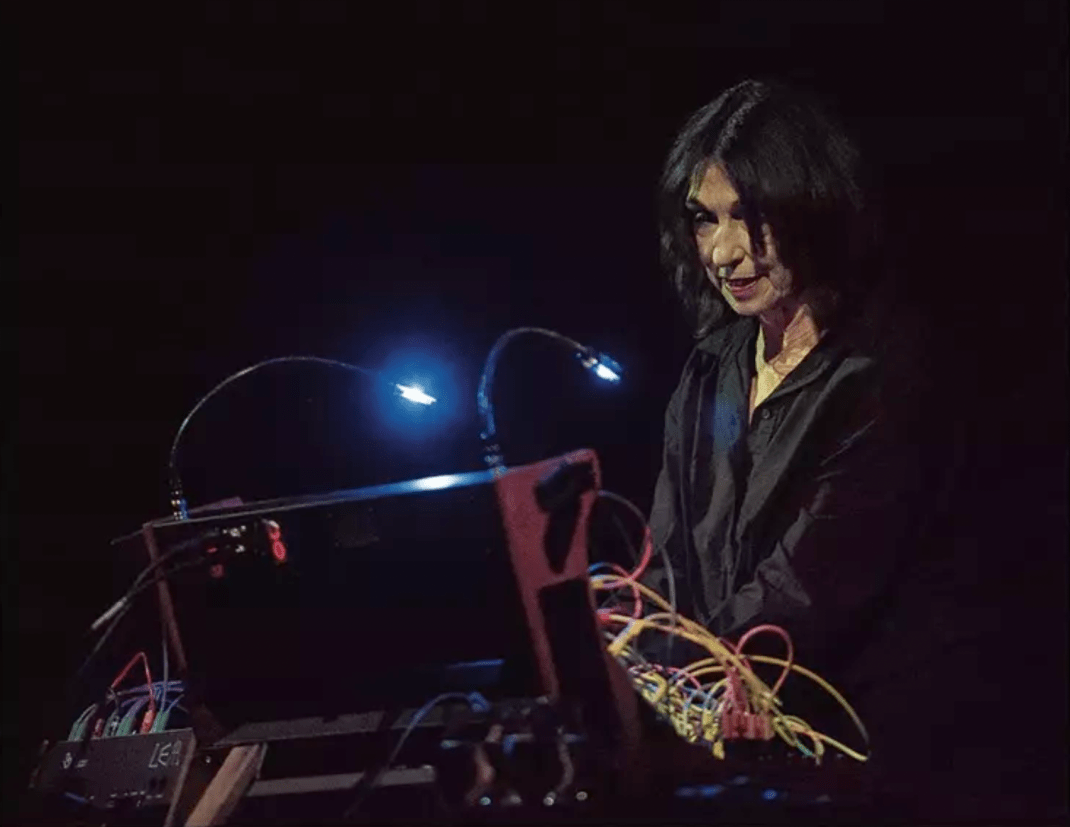
Taking refuge in Kings Place from the sweltering summer heat, I’m met by Li Yilei’s solitary song. The London based artist begins with an avian melody performed on a whistle. The phrase fills the hall, looping and creasing, inviting other sounds to follow. Electric rushes bring to mind soft fabric blowing in the breeze of an open window and the dancing tree leaves beyond. Li takes to her Moog Claravox to duet with the bird calls. The theremin is somewhat harsh at first, but Li later fades in gentle drones and sounds of rain.
Perhaps it’s the disconcerting weather coupled with the incessant hype around AI in the media, but the discordant frequencies emanating from Li’s theremin and the way they swell into broken and distorted voices evokes a sense of loss for me. Li is influenced by Eastern ideologies of emptiness and their music laments the fading resilience of nature. Soon our planet will be nothing more than plastic trash and scorched earth. We’ll be gone, but the lauded AI we are so desperate to perfect will remain, reminding our lifeless desert that it was once thriving and beautiful with a litany of simulated rainforest sounds.
The start of Suzanne Ciani’s performance echoes the closing minutes of Li’s set with crashing waves and electric birdsong that rise out of the silence to challenge my pessimism. Her workstation consists of the Buchla 200e, a few touch screens and a bird-like tactile controller. The composer’s movements are captured by a live visual feed. The projection shows her intimate interaction with the modular synth, going some way to deconstruct the instrument’s monolithic impassibility.
Suddenly, bubbling acid bass and metallic textures catapult us into the cosmos. The tempo increases. It’s pulsating, almost industrial, begging you to move without ever really breaking out into dance beats. There is a moment when the camera loses focus and only the synth’s blinking LEDs remain visible. The impression is that of a ship sighting the lights of a coastal city at night, in dense fog. You’re not sure whether to feel relief or trepidation, because you’re still many miles from shore.
Despite its illuminating projection, Ciani’s quadraphonic set is better experienced with your eyes closed. Subaquatic sounds and crashing waves cascade around the the cavernous concert hall, as if striving to flood it. At one point the sequenced beeps are filtered and transformed into humanoid voices that recall the sampled throat singing in Shpongle’s psytrance epic “Divine Moments Of Truth”. In light of Ciani’s former flirtation with new age, this performance is psychedelic but in a way that doesn’t rely on kitsch or cliche. Instead the composer foregrounds technology to make the listener look inward.
At the end of the show, Ciani invites the audience onstage to say hello to her Buchla. She also expresses admiration for the quadraphonic format, explaining that “electronic sound is meant to move”. The Buchla was designed with this in mind and therefore creates “valid content for the medium”. Ciani’s remarkable career as a commercial composer, concert pianist and electronic music pioneer are documented in the 2017 film A Life In Waves. In it, she talks about being drawn to nature’s spiritual influence and the romanticism of life itself. Perhaps, if we appreciated what Ciani calls the “theatre of the ocean”, with the same conviction that she does, our future wouldn’t be so bleak after all.
Ilia Rogatchevski
Originally published by The Wire, July 2023
 Ilia Rogatchevski