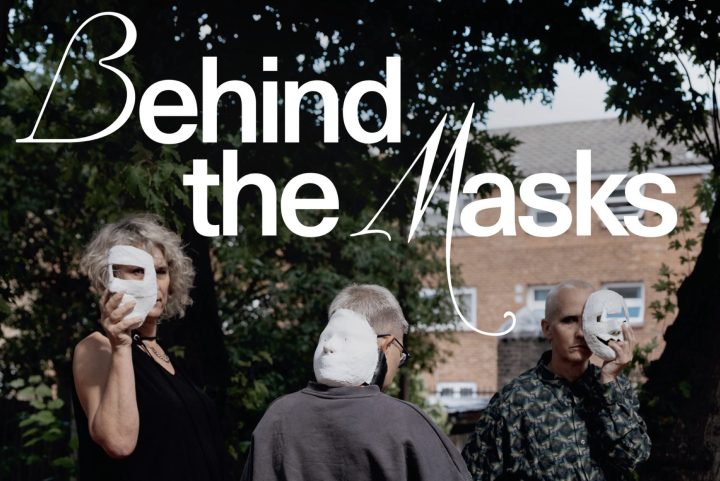
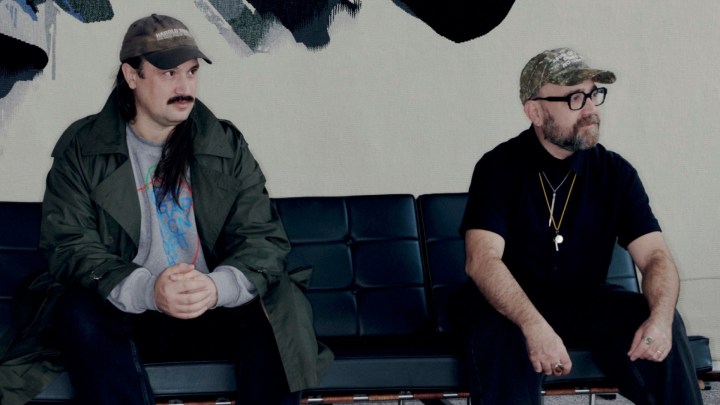
In a new work referencing 9/11, London’s performance art trio mix Burroughsian cut-ups with absurdist clowning to find the truth. Photography by Amy D’Agorne.
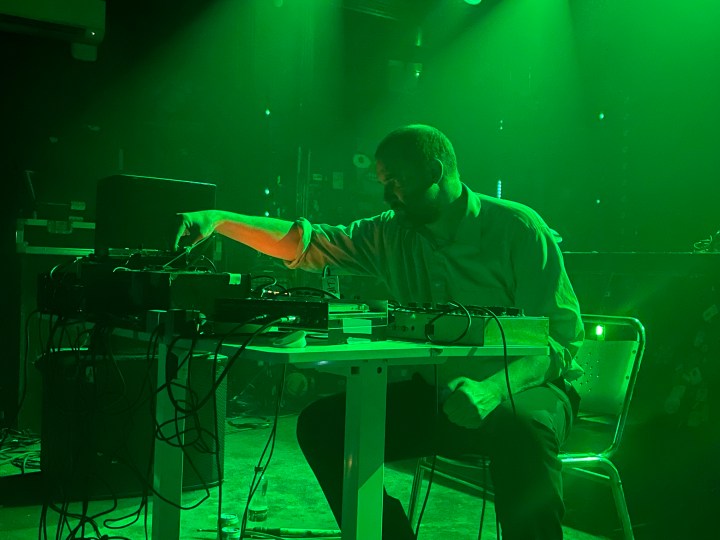
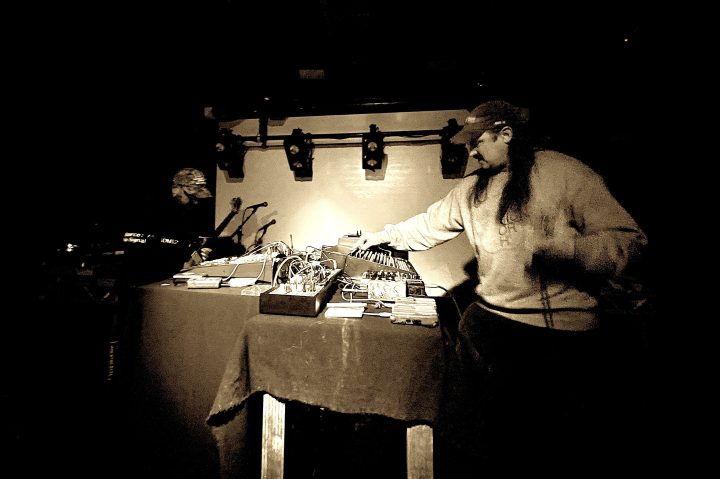
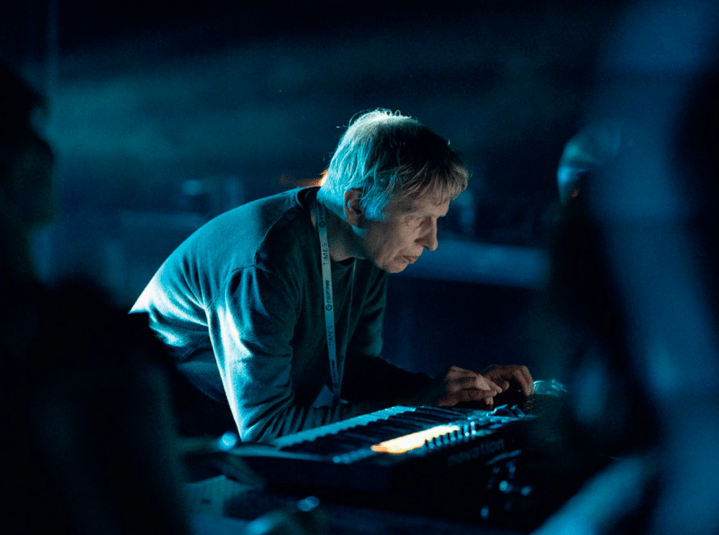
Inside the concrete confines of South London performance space Iklectik stand two vertical screens displaying the colossal carnage of the 2001 9/11 attacks in New York. In front of them, on a riser marked 4WTC (a reference to the Southeast Plaza Building of the World Trade Center complex), sits one third of the surrealist trio Tears|Ov. Terces Wale wears an oversized cardboard head. Its grotesque smile is cast downward, beady eyes scanning the room. Evil gabber kicks, elastic drones and sinister toplines escape from a fleet of samplers and black boxes commandeered by accomplices Lori E Allen and Lottie Lou Poulet.
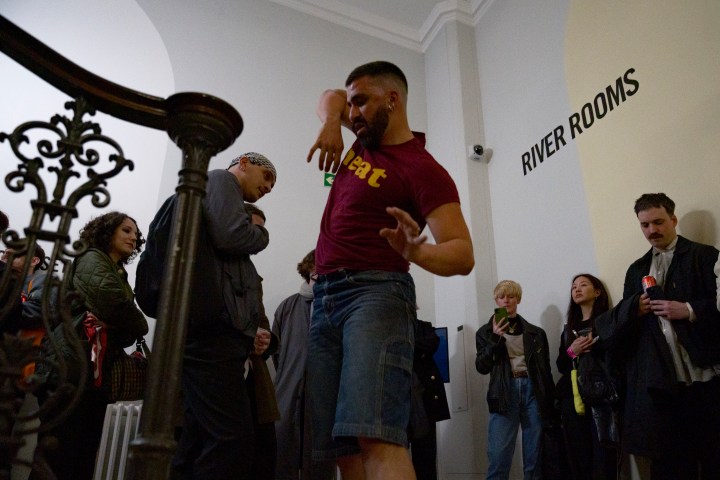
Casting off the mask, Wale paces between the crowd monologuing about “the bully who was bullied by their bully”, thrashing on the floor with a bass guitar and throwing stacks of Monopoly money into the air. While the banal poetics of appropriated material inform the group’s sonic playbook, and the clandestine gifts of the Burroughs-Gysin cut-up process lend themselves to the text, dada underpins their performance. Wearing a suit and a shaved hairstyle, Wale comes across as a metamodern Claude Cahun. “I have an alter ego called Boobies the Clown,” Wale says on a group video call. “In my performances, you’re seeing a different iteration of that character. There are lots of themes that oscillate around the performance. I wanted to reflect on Ol’ Dirty Bastard’s vibes and the French highwire artist [Philippe Petit] who walked between the [WTC’s] Twin Towers [in 1974].”
Tears|Ov launched their latest record A Life On Hold on the 25th anniversary of 9/11. Tracks such as “Probably, I”, with its battery acid beats shuffling along like Dead Cities-era Future Sound Of London, or the synthetic standing bells detuning throughout “Simple Things/Formation For Now”, evoke millennial dread. The group have personal connections to the terrorist attacks, too. “I lived in New York and Terces lived in London,” says Allen, who was working nearby and saw both towers collapse. “I was worried about voyeurising it, about it being passé, but 9/11 made way for Palantir, ICE, the surveillance state in the US. It’s still really relevant. Working with Wrench [Gooding] on the visuals, we had a tête-à-tête about including the jumpers and impact images. I felt we had to honour the terrible beauty of it. I didn’t want to say it outright but wanted the needlessness of it to come through.”
On the day the towers fell, Allen managed to phone Wale to reassure them she was safe. “It helped me commit to Lori in a way that I hadn’t done in other relationships,” Wale admits. “I really could have lost someone I loved. It had a huge extrasensual effect on me. And here we are, still together.”
Reuniting in London in 2002, Wale and Allen cycled through various collaborations before settling on Tears|Ov. There was FØL, a “masturbatory” psych band also featuring Terminal Cheesecake’s Gordon Watson. Then came the shortlived folk project Serious Hardened Swingers, in which, Wale says, they were “noodling with poetry”. Arguably, meeting Tapeworm/ Wormhole label founder Philip Marshall over a decade ago sent Tears|Ov on their current trajectory. “I first met Lori and Terces at a party for Wolfgang Tillmans, at a Berlin bar,” Marshall reveals via email. “I liked their humour a dry sass – and that truly queer otherness, and playful horror, that’s unlike any other.”
Their first tape, 2016’s Tears Of The Material Vulture, is credited to Lori E Allen despite contributions from Wale and the cellist Katie Spafford, who continued collaborating with the band until 2021’s Pluto’s Return. “There was a bit of a drama around that [first] one,” Allen recalls. “I was commissioned to do it. We then played at the Tate Modern [as part of Tillmans’s 2017 South Tank installation] and they wanted it to just be Lori E Allen. We thought it was an art world thing.”
Conceptually, Tears Of The Material Vulture straddles similar themes to what Tears|Ov are currently exploring. Much like the endless labyrinths of Kane Parsons’s Backrooms, the 80 minute running time suggests you’re stuck in an eternal loop. The title plays on the phrase material culture, pointing towards Allen’s former career as an archaeologist and her obsession with examining what she calls “bodiless artefacts” exhumed from the dustiest corners of YouTube. The album’s foundations derive from samples of Madame Chaos, a NYC public access cable TV show that Allen worked on in the mid-90s. Informed by hiphop sample culture, the way the programme took the offal from an oversaturated media hellscape (spiralling edits of cartoons, B movies and commercials soundtracked by clipping breakbeats), foreshadowed the hyperactive visuals of the TikTok-era internet.
By contrast, the group’s debut proper A Hopeless Place (2019) comes over like a lucid dream marinated in mild panic, even as it overflows with non sequiturs from cringeworthy family gameshows. “That album was about unrequited love,” says Allen. “That’s where we started styling ourselves as ‘experimental pathos’. There are some good numbers on there, though.”
Indeed, among the album’s many good numbers, “Trapdoor Ant” and “I Stand On The Cable” are infused with a paranoid energy. In the former, a wet house beat and jerking metal percussion frame Wale’s evocation of a “trapdoor wiped clean with bodily juices” and, in the murky atmosphere of the latter, Spafford’s cello pirouettes around an Alan Watts lecture, recalling the jazz noir of Angelo Badalamenti’s “Silencio”.
Evolving from the Tate performance, the record reveals itself like a time capsule of half-forgotten mementos, or the “Pandora’s box” referenced in the closing title track that spills horrors into the world and leaves hope sealed firmly inside. The follow-up, Pluto’s Return, was a response to the uncertain chaos of the Covid-19 pandemic. Framed through an astrological reading of the dwarf planet’s influence on terrestrial events, it provided, according to Allen, “all the evidence we needed that capitalism doesn’t have a pause button”. The record echoes newer material, too, namely an unreleased Sound UK commission, and “AWOL”, which appears on A Life On Hold. Wale, who works as an addiction therapist in the prison system, elaborates: “I read this book called We’re All Doing Time [by Bo Lozoff of the Prison-Ashram Project], which is about how we’re all doing time in the prisons of our minds. It’s a wonderful role reversal of what it is to be human.”
Although initially inspired by the circular bureaucracy of customer service (see the frenetically edited automated replies on “P/R/o/t/L” or the snide “We’re Sorry”), A Life On Hold surreptitiously mirrors momentous life events: Wale and Allen cementing their love in the wake of 9/11, for example. Poulet, whose credits include engineering live sets for Liars, Throbbing Gristle and 808 State, as well as producing Test Dept’s Disturbance (2019), joined Tears|Ov when mixing A Life On Hold three years ago. “We finished mixing the album at Wysing Arts Centre,” recalls Poulet. “When I drove them back to the station, because I did some vocals [on “Narrow Valley”], they asked me if I wanted to be in the band. I kind of went: I don’t know. I don’t normally do bands!”
Despite misgivings, the collaboration proved fruitful. “Meeting these two,” says Poulet, “reopened me to poetry. I fell in love with the text and it still inspires ideas. The archeology we were talking about earlier makes me want to work for the future.”
For Allen, this approach goes back to childhood, hearing her parents’ voices overlapping with the TV next door and the storybook tapes, recorded by her mother, worn down by continuous playback. On the other hand, Wale’s eyes are fixed on the stars: “I’ve been really getting into Philip K Dick and feel that poetry, especially when you use chaos magick or cut-up processes, comes from aliens or a spiritual entity. It’s a collaborative process with the universe.”
Tears/Ov’s A Life On Hold is released by The Wormhole Originally published by The Wire, October 2026
Raven Row, London, UK Image: Deborah-Joyce Holman – Thicc and Slippery, 2020. Courtesy of Raven Row.
Curated by writer Imani Mason Jordan, Nomenclature For The Time Being is a group show centred on sculpture that teases out notions of identity from the Black feminist diaspora. In the words of the curator, Dionne Brand’s longform poem, from which the exhibition title is borrowed, informs the exhibition in “both invocation and method”. Written in the aftermath of the pandemic, the poem reflects on the “the Anglo-American prison of thought” and seeks avenues for escape from “the scrim of their philosophies”.
The accompanying exhibition text, designed to resemble a political pamphlet and containing prose that might be found in such, states that the show is “about the absent body – its hypersensitivity and disappearance”. This is certainly exemplified in many of the pieces here.
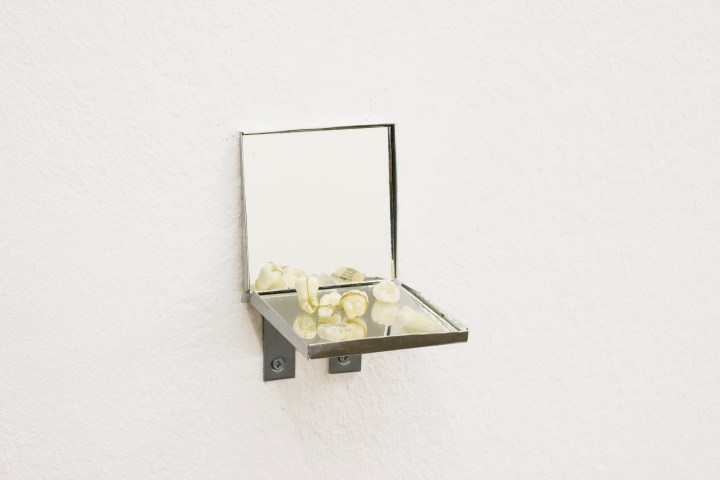
Atiéna R Kilfa’s photo series Espresso Adagio No 1 & No 2 (2025) depicts black coffee poured into a disposable cup. A white sugar cube is swallowed by the liquid, symbolising a reversal of Eurocentric cultural domination. Upstairs, Deborah-Joyce Holman’s Thicc And Slippery (2020) is a miniature display of human teeth on a mirrored shelf. Bound in wire and marked with ink, the teeth represent an individual’s final remnants after death and question whether we ever have total ownership of our bodies.
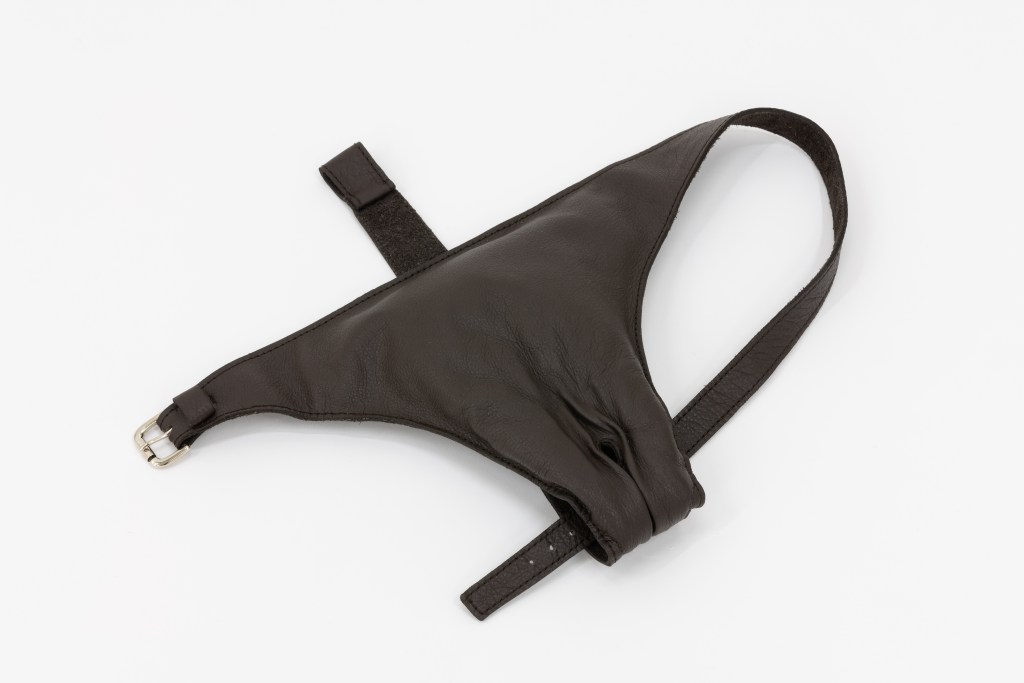
Ebun Sodipo – Prosthesis for freedom – Mary Jones’ ‘piece of cow [leather?] pierced and opened like a woman’s womb’ (2022)
Ebun Sodipo’s work assembles archival objects that foreground “Black trans presence where the record has erased it”. Amulets and carved nude figurines, assembled in a glass case, variously suggest their owners’ attitudes to gender and recall Katie Paterson’s Afterlife (2025), a grand Folkestone Triennial installation of fictional artefacts. Meanwhile Sodipo’s Prosthesis for freedom – Mary Jones’ ‘piece of cow [leather? pierced and opened like a woman’s womb (2022) is inspired by a 19th century trans woman who wore leather underwear with a vulva-like opening in an act of self-definition.
The exhibition is further activated by a series of performances. On the evening I visit, Jordan is joined by Alpha Maid, Jay Bernard, Remi Graves and Elaine Mitchener in an extended reading of Brand’s poem. Bernard is the anchor for the majority of the performance, reading the text straight. Mitchener scrapes a water bottle across the floor, etching a magick circle around the group. The others interject with phrases such as “Why am I on Earth with these people?” that cycle in a crescendo of crosstalk as Alpha Maid draws angular drones and loops from her guitar.
The purpose-built performance space, with its timber platform and corrugated metal sheets mounted on the walls, references Brand’s film Long Time Comin’ (1993) which features the building of a community centre by queer activists in Canada. These materials also serve as percussive instruments. Graves strikes the metal in between readings, while Bernard taps contact mics attached to the platform with heartbeat regularity. The resulting beats punctuate Jordan’s voice as they muse on “unforgivable narrations” causing suppressed explosions that “detonate nevertheless” inside the author.
Alpha Maid’s dangerous textures are like sand slipping inside an hourglass. As the quilt of syllables unravels and pages of the text are thrown into the air, the anger of the reader becomes palpable. The words die down but the dust is whipped up a final time by Mitchener’s thunderous solo, her handheld fan beating the metal. It lasts for longer than feels comfortable and the intensity reverberates in the mind long after the audience vacates the space.
Ilia Rogatchevski Originally published by The Wire, September 2026
Bluecoat, Liverpool, UK Photo: Lucy Enderby by Benjamin Nuttal
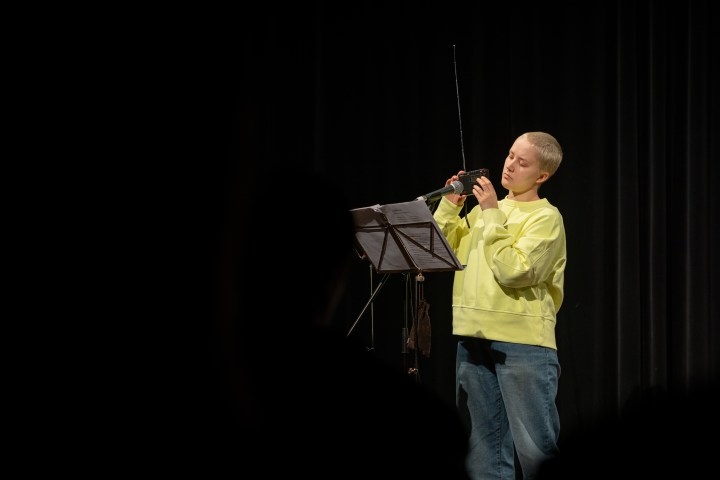
Commissioned by the disability charity We Are Unlimited and the Liverpool Biennial, Roy Claire Potter’s COMMS FAIL is a multifaceted work that foregrounds radio not only as a medium for transmission but as a metaphor for communication breakdown. The hybrid piece is designed to evolve over time but in this iteration it’s a radio play performed in front of an audience and simultaneously broadcast on Resonance FM.
Bluecoat’s utilitarian performance space is a blank slate for Potter’s minimalist staging. Joining Potter are the actors Lucy Enderby and Alex Symington. Standing in a triangular formation, the three figures echo corners of a quad antenna used by amateur radio enthusiasts. As the audience enters, ushers guide attendees to their seats and hand out miniature bells attached to biros, which are later activated in unison to simulate radio interference.
Inclusivity is central to the piece, with a British Sign Language interpreter, televised captions and an audio describer present for the benefit of remote listeners and disabled audience members. Typically cast to the periphery of media – if considered at all – these inclusive elements are deliberately brought to the forefront here. In addition to providing paratextual weight to Potter’s script they are also, to reclaim the social media pejorative, performative in the sense that they underscore how often people with neurodivergence and disabilities are underserved in such contexts.
The actors and audience mill under the red wash of the stage lights while a repeating chord sequence, peppered with trepidatious hi-hats, plays over the speakers. Composed by Carmel Smickersgill, the music is based on prompts given by people with lived experience of autism. The composition later leans into bass frequencies that imitate electromagnetic waves and searing synths that scan across the spectrum: from Red (overstimulation) and Blue (miscommunication), to Purple, where the previous two modes combine and build in anticipation of reciprocal information exchange.
The script underpinning the narrative is fractured, dancing around an obfuscated problem. The “botanical shapes” of solar flares, alluded to in Potter’s opening monologue, precipitate technological collapse. The flares disable “satellites, doorbells, fridge-freezers” and, as the energy of the sun diminishes, humans hear the “final signals” of their failing phones “transmit in the dark”. Ham radio, however, survives and offers an alternative peer to peer transmission network.
The three actors display contrasting motivations. Enderby appears ambivalent about the unfolding changes, while Symington is enthusiastic. Potter’s delivery is typically anxious with overtones of distress lingering between the syllables – phrases repeated; words disassembled.
Certain moments in the text are punctuated by the actors playing transistor radios (extending the aerials, cycling between stations and experimenting with mic proximity) and the ushers holding up plastic sheets illustrated with curvilinear abstractions. While the faint rustling of the latter props mimic sferics bouncing off the Earth’s magnetosphere, the transistor static conveys a sense of emptiness that supersedes the vacated radio bands.
After the cardinal climax of surging percussion and crosstalk, listeners are implored to “make an alliance” to “shape a silence” and embrace “holy moments of perfect clarity”. With McLuhan-like zeal, Potter argues for inventing “the message at the same time as the language”, reducing the distance between people and returning to more corporeal forms of communication. More than moralistic technophobia, COMMS FAIL asks us to reflect on the media we use to communicate and the impact on what is being said.
Ilia Rogatchevski Originally published by The Wire, June 2026
An international gathering of dadaists, noise freaks, DIY artists and weirdos in Brighton makes for a great weekend at the seaside
Various venues, Brighton, UK Photo: Aaron Dilloway by Ilia Rogatchevski
Colour Out Of Space is a magnet for noiseniks and dadaists who refuse to take themselves too seriously. The festival returns after a six or seven year absence – depending on whether you count 2020’s Plague Time Television YouTube series – and for a few wonderful days the Sussex city descends into a bacchanalia for the weird.
Jo Morrison wanders through the crowd at The Old Market, costumed in a reclaimed graduation gown and foam mask. Her set is a collage of toys and spiritual signifiers performed over a tense backing track. The ending is a music box melody that mirrors Brighton’s hallucinatory seafront carousel.
Melbourne’s Absurd Cosmos Late Nite deliver a sardonic dialogue between two frenemies, one of whom derides the aesthetic merits of noise in favour of a reunited Oasis, much to the ironic delight of the audience. Marc Matter dives into his sampler to sequence spoken word fragments. He gets physical with the button pushing, dissolving Gregory Whitehead’s voice into Black Lodge techno.
However, there’s nothing quite like the junkyard hiphop of Hexakaidecagon, whose trash (metal files, saws, slinky) are a sound person’s treasure. These objects are clanged out of time to an errant piano loop and the duo’s set permanently teeters on collapse.
Closing Friday night – and opening Saturday morning at The Rose Hill – is Chicago’s Hali Palombo, whose background in ham radio informs her approach to visuals. Postcards of kitsch US architecture are modulated into terrestrial TV signals and decoded by custom software. Her soundwork is, she says, a “patchwork quilt” of granular synthesis, hydrophones and quotidian field recordings. There’s an emotional ambivalence to her compositions, which are peppered with eerie number patterns, spectral atmospherics and waves of bass that haunt the spirit.
The One Church hosts an afternoon of rotating improvisation from the 4046 Group, an anti-performance by Lonny Hoffmann and Zhao Ziyi – in which the duo move their chairs painfully slowly across the stage – and violin torture from Marija Kovačević. Back in the depths of The Old Market, drummer Shakeeb Abu Hamdan employs transducers, beaters and ample intervals to deliver a set that sounds like panicked wings inside a battery cage.
Running with the avian metaphor are Michael Barthel and Anna Schimkat, whose bird song mimicry and animated Germanic sound poetry elicit great pleasure from the crowd. Chik White does a convincing Tom Waits impression while choking on a broken jaw harp and serenading us with tall tales on a detuned guitar. A major highlight is Augusté Vickunaité who attacks her tape spools like a turntablist, cutting the reels to create rhythmic and disconcerting loops out of obscure voice recordings.
Sunday largely takes place at Concorde 2, where noise artists of various stripes confound resident sound engineers familiar with less divisive creative choices. Ypsmael, Chop Shop and Suppwiyah all walk the plank between tinnitus-inducing jet engine ambient and self-immolation. Meanwhile, Zheng Hao and Shit Creek’s respective electro scrapes and scattergun drops are the festival’s most club friendly performances.
Former Wolf Eye Aaron Dilloway, though, is the bluesman trading souls at the devil’s crossroads. By swallowing contact mics, smashing metal plates against his leg and stacking bricks of hiss inside the PA he ensures that everyone in attendance has a great weekend by the seaside, surrendering to the emerald stage lights and static.
Ilia Rogatchevski Originally published by The Wire, June 2026
The residents of central London’s sprawling creative hub subvert its institutional history with dance, performance and archival stories
Somerset House, London, UK Photo: Samir Kennedy at Assembly by Anne Tetzlaff
Returning to the palatial interiors of Somerset House for the fifth time, Assembly is a festival of contemporary music that showcases the studio residents of the central London complex and arts space. This year themes of diasporic experiences and cultural identity are present in many of the performances. Onyeka Igwe’s No archive can restore this chorus of (diasporic) shame uses archival footage and a 13 strong choir to explore the legacy of Nigeria’s protest movement. Songs from the Abeokuta Women’s Revolt, sourced from the archive of activist and educator Funmilayo Ransome-Kuti – mother of Fela – are reworked by Tanya Auclair. Sung a cappella, but punctuated on occasion with traditional percussion, the songs are designed to cement solidarity, filling the room with mantras like “Lagos women do not pay any tax”.
One staircase is given a makeover with blue lighting and indigo fabrics hanging from the balustrades. The audience snakes down the steps, at the bottom of which is a paddling pool, home to a “wellkeeper” pounding a water drum. Seyi Adelekun’s (un)drowned uses Black feminist theory to examine colonial attitudes to black bodies. Spoken word testimonies emanate from loudspeakers, interacting with singers on different floors. The vocal group harmonises individual syllables, the cycles extending and spiralling into the phrase “I dive deeper”. The piece comes to an optimistic conclusion with blue ribbons falling through the air as the choir descends to join the drummer in a symbolic baptism.
Hanne Lippard and Renato Grieco’s minimalist performance centres on a fictitious email exchange between a scammer ‘donating’ a piano and a naive school board representative. Lippard and Grieco exchange absurd observations about “hands acting out of hand”, count in different languages, and spin an unthreaded tape spool for the rhythm track. The performance is austere but humorous, in the vein of Andy Kaufman or Bastard Assignments, concluding with the punchline “there’s no such thing as a free piano”.
In an adjacent corridor, Samir Kennedy pushes through the waiting crowd, dancing vigorously and body slamming the walls. Most pretend he isn’t there, but it’s surely the frontispiece for Relay, his collaboration with Hannan Jones. Once inside the concert hall, tape loop hiss envelops the auditorium. Jones teases out half-remembered fragments of melody from an archive of Algerian cassettes. Kennedy joins her, intoning on the mic over fluttering echo, while swooping synths draw knives.
Polish artist felicita’s czysta forma (pure form) follows Jones and Kennedy’s meditation on body and memory with a ballet score inspired by Polish folk and the experimental playwright SI Witkiewicz aka Witkacy. The dancers are replaced with a cyberpunk string quartet that moves between avian modulations, deep note glissandos and clapping games. Chiptune breakbeats deliver an 8-bit rendering of the classical form while Xiaoqiao drifts in to deliver serene wordless vocals across organ playback and a bowed saw. Mark Fell and Mohammad Reza Mortazavi also turn tradition on its head with refracted beats that bounce around the room like beads in a marble run. Fell’s granular pulses are in dialogue with Mortazavi’s drumming on the tombak and daf. The irregularity of the rhythm and timbre suggest an infinite number of plains shifting in size and dimension. It’s percussion without edges, softly focused, like living inside a perpetually glitching startup screen. Despite this collaboration being more exciting for the mind than the eyes, it’s among the more alluring pieces at the festival.
Ilia Rogatchevski Originally published by The Wire, May 2026
There are two halves to Mihály Víg, the Hungarian composer known for his collaborations with the late film director Béla Tarr. The first is the minimalist whose scores submit themselves to Tarr’s austere monochrome palette, extended takes and character studies. The second is the rock musician who fronts Balaton, a band with origins in the 1980s Hungarian underground. The way these two halves cross over and complement each other is on display at tonight’s packed show. It’s hard to believe, but this is Víg’s UK debut “because”, promoter Stanley Schtinter tells me, “no one had thought to invite him until now”.
The first set features songs written by Balaton and Trabant, Víg’s shortlived project with the actor Marietta Méhes and numerous musicians from the Hungarian alternative scene. Alongside Víg tonight are János Bujdosó, György Rósz, Balázs Székely and Gábor Horváth. They launch into “Kínai Kormány”, an energetic college rock track with call and response guitar solos exchanged between Bujdosó and Rósz. Víg’s vocals are submerged in the mix but the band are aware and tweak their amp settings. “Ragaszthatatlan Szív” has a despondent reggae groove, engineered by Székely’s articulated percussion and Horváth’s inquisitive basslines, with cheesewire guitars cutting through the centre. “Kígyó”, meanwhile, deviates from the searching origins of the recorded version and resembles something akin to Bruce Springsteen’s bravado live.
Balaton throw in blues, psychedelic and hard rock references that get some people dancing and singing along. “Fáraó Népe” echoes REM’s “Everybody Hurts” in its arpeggiated chords but Bujdosó’s volume swells and the progressive tendencies of the rhythm section edge the track closer to the art rock stylings of Talk Talk. Rósz and Bujdosó’s twinned guitars lock together creating a human chorus pedal, as Víg pivots around his mic like a white crow on a weather vane. The band cap off the first set of the evening with “Mániákus Depresszió”, a midtempo melancholy number that presages what is yet to come.
After an intermission, Víg sits behind the piano to perform soundtracks with which the audience appear more familiar. “Oreg”, a pained waltz from Werckmeister Harmonies, opens this set with additional accents from the band. Víg looks content behind the keys and follows up with the main score from Sátántangó and two dance numbers from Damnation. A scene that reappears in Tarr’s later films features barflies dancing drunkenly in a tavern, usually with an accordion accompaniment. It speaks to alienation and loneliness endemic to a disintegrating society. In Balaton’s reworking of these themes, the tracks are injected with a revised optimism while maintaining a link to their innate sadness. “Valuska”, the kind of song you can’t help but play on repeat when your heart is aching, captures this sentiment best with its tearful melody. It gets a rapturous ovation from the audience.
Balaton loosen up completely towards the end, concluding the evening with “Elmúlik”, a song with a Velvet Underground swagger – an aloof bass, stomping drums and spidery guitar. When reflecting on his career in a 2020 interview for Arbelos Films, Víg self-effacingly conceded: “I’m just a rock musician who entertains his friends so that they can enjoy themselves.” Indeed, in spite of the horrors going on in the world right now, spirits are high as the audience spill out into the night.
Ilia Rogatchevski Originally published by The Wire, April 2026
Yellow Swans are a psychedelic noise duo comprising Pete Swanson and Gabriel Saloman Mindel. Originally formed in 2001 in Portland, Oregon, the group drew their influences from hardcore punk and DIY ethics of anarchist communities of the Pacific North West. During their initial seven year run, Yellow Swans released four studio albums and countless CD-Rs or cassettes, often produced in small numbers and distributed via mail order through their Collective Jyrk label. Swanson and Mindel toured extensively, building a reputation as a relentlessly hardworking unit who nurtured and connected networks of likeminded artists.
Their live shows evolved from many hours spent improving together, with Mindel’s processed guitar locking into Swanson’s tape loops and tabletop electronics. Their final studio album Going Places (2010), released after the duo disbanded, was edited from recordings that pivoted away from catharsis to explore more ambient textures. Yellow Swans reformed in 2023, releasing their archive on Bandcamp and playing a handful of shows. Their recent tape series Out Of Practice I-IV documents this era of the band and showcases tentative steps towards new material.
The jukebox was conducted remotely with Yellow Swans dialling in from Paris, where they were working on a multichannel commission for the Présences électronique festival.
The Third Bardo “I’m Five Years Ahead Of My Time” From Lose Your Mind (Sundazed) 2000, rec 1967
GSM Is it [Arthur Lee’s] Love?
IR No, it’s not, but it was recorded in the same year as Forever Changes.
PS It sounds like The 13th Floor Elevators.
IR It’s The Third Bardo, who released one single and split up. It featured on a Pebbles compilation along with other obscure garage rock bands. How much kinship do you feel with early American psychedelic rock?
GSM It’s not our roots in terms of how we began playing music, but we’re an extension of that practice in some ways.
PS Yes, but more in ethics and philosophy than aesthetics. I definitely feel like the countercultural element and the notion of mind expansion resonate with our project.
GSM Yellow Swans is a resource for a psychedelic experience we produce an altered state of consciousness. I was born in Oakland, raised in San Francisco. That counterculture was all around. One of my earliest influences was Jimi Hendrix, specifically his “Star Spangled Banner” performance at Woodstock. He was pulling noise out of the cosmos, expressing anguish and a political sentiment through that guitar. Early on, because I was such a miserable guitar player, I focused on imitating his physical body rather than worrying about scales.
PS People will respond differently to our set. There have been instances of people dancing next to people weeping. It’s interesting to see these divergent experiences at a noise show.
IR It’s funny that noise music has that polarity. I wanted to touch on The 13th Floor Elevators because fragments of “Slip Inside This House” feature on Out Of Practice II.
PS When we started playing again, we had to map our set. The first two shows were in Austin and New York, so we referenced their underground histories. With Austin, it’s like, are we going to choose The 13th Floor Elevators or Butthole Surfers? It’s about having something legible for the crowd so they understand what’s happening. I’m obsessed with Devil’s Music by Nicolas Collins and early plunderphonic records by John Oswald. I’ve been collecting his Mystery Tapes so I wanted to tap into that thread as well.
GSM The comedian Andy Kaufman was also an influence, particularly his “Mighty Mouse” routine. We take what we do seriously, but we try not to take ourselves too seriously. Kaufman takes a form we know and upends expectations, changing the meaning of what’s happening. It’s a magic trick disguised as entertainment like Antonin Artaud’s Theatre Of Cruelty, but done from a place of deep kindness and compassion.
Masonna “Chapter 1-7” From Ejaculation Generater (Alchemy) 1996
GSM John Wiese?
IR No, this is Masonna. A series of short untitled tracks from Ejaculation Generater. Was he an early influence for you? GMS When I was in high school, I got interested in prepared guitar because I really wanted to do what Nirvana did at the end of their set destroying instruments. Then I saw 120 Minutes [on MTV].
PS Yeah, I saw the same thing.
GSM Thurston Moore was hosting. He had clips of Japanese noise music including Masonna. What stood out, more than anything, was the sheer physicality of that performance. I immediately thought I had to go to Japan because, I assumed, it’s where that music happens. It never occurred to me that there was an American noise scene. Masonna and Merzbow played in Oakland, when I was at university. Masonna was very good but I could see he was a human doing this thing. Merzbow was different. I thought, I don’t know what this is, but I could spend the rest of my life trying to figure it out.
PS Growing up, I lived in this small town in Oregon, and for a while I was obsessed with this grindcore and powerviolence scene in California. I saw Masonna as an extension of extreme hardcore punk because it has the same sort of energy, but I was more inspired by bands like The Dead C, Harry Pussy and The Shadow Ring. Music that was on the fringes but not because of extremity. They were entirely unique and on their own plane.
IR It feels like Yellow Swans combined the guitar noise of bands like The Dead C and a tabletop of electronics. Is that accurate?
GSM What’s accurate about that is that we’ve never, except in a few collaborations, resorted to purely harsh noise. We’ve always included elements of rhythm or the guitar as a tonal instrument.
Milan Knizák “Composition N3” From Broken Music (Multhipla) 1979
GSM This is great. This feels like Nurse With Wound.
PS [Laughs] I mean it sounds like Nic Collins. It also reminds me of Reese Williams’s Whirlpool.
IR This is the Czech artist Milan Knížák.
PSBroken Music!
IR Yes, exactly. So, you’re aware of it?
PS Yes. It sounds very contemporary with all those 80s plunderphonics folks.
IR Knížák predates plunderphonics by several years. He made new compositions from damaged and defective LPs. What attracts you to appropriated sound?
PS For me, it goes back to my solo work where I was playing with dance music tropes. I became obsessed with using material that elicited an emotional response from the listener that I could flip into something alien. I always liked this mischievous play between the understood and the absolutely confusing, like hearing fragments of sound that are familiar but just out of reach.
GSM I don’t think we belong to the same family tree as plunderphonics. Yellow Swans is connected to industrial music and 90s sample culture that’s not for the dancefloor but is unavoidably attached to it. We’ve always felt indifferent to copyright and the idea that a sound belongs to any one person. Needless to say, we’re happy to get paid for people buying our records, but at the same time we’re ambivalent. Once the music’s out there it belongs to somebody else, and as long as it’s not a corporation, I’m more or less OK with it.
IR Knížák is also associated with Fluxus. Yellow Swans produced many small runs of CD-Rs and cassettes, which recall artist’s multiples. You also share an affinity with the conceptual side of music. Is that something you consciously aligned yourselves with?
GSM It was never a formal concern, but it’s what I liked about the anarcho punk ethic, making your own music, posters and objects. You make things for the community, not for commerce. In the US there’s a huge separation between the identity of experimental musicians and them being considered artists. In Europe people make those connections much more immediately. When we performed in Belgium for the first time, we were hanging out with these older Fluxus artists. They understood what we were doing collectively not just Pete and I but that mid-2000s noise scene as an extension of the Fluxus project.
PS We wanted to be able to work on a few different scales. Official albums versus releases that are more like us thinking out loud. GSM If you make only a hundred, print the covers and sell them on tour you might actually meet everyone who buys your record. So I think there was this immediacy that is impossible now but, at the time, felt like an alternative to participating in the mainstream music industry.
Prince “1999″ From 1999 (Warner Bros) 1982
GSM [Immediately] Prince! Are you a fan, ’cause you’re dressed all in purple? It’s OK, you can admit it.
IR A happy accident, I think! Are you fans?
GSM I’ve become a greater fan than I was when I was younger. At a certain point, I decided to write a book about “1999” and the end of the world. The song was inspired by a documentary, narrated by Orson Welles, about Nostradamus and his ‘prediction’ of a nuclear war in 1999. That was the kind of world people were living in in the 80s, but the song also captures this American apocalypticism that is still with us. When I moved to Portland [in 2001], I went to all these house parties and, at every single one, they played this song. The entire room was dancing with a kind of militancy. Someone told me it was because an anarchist house was raided by the police and, as the anarchists fought the cops, “1999” was playing. So it became an anthem of solidarity with the anarchist communities in Portland. It didn’t occur to me until later that it’s also a coincidence with the 1999 anti-World Trade Organisation protests in Seattle, which were hugely formative for our generation. I needed to solve the puzzle: is this a political anthem and, if it is, what are its politics?
IR Is that how you got interested in writing, as an academic, about noise in protest music?
GSM No. I was engaging in protests as a young person and listening to the world differently. I began asking if noise can be a mode of resistance? The conclusion I came to is that there’s nothing inherent to noise that is political. Police use noise all the time as a method of violence, but noise does do something. In Minneapolis right now, where I’m living, it’s one of the only tools people have to defend their neighbours [against ICE raids]. It’s blowing whistles, honking horns, yelling at the fascists. It works! That’s the insane thing. Noise is a repellent. I’m sceptical of music’s ability to change society organising politically will do that but I do think music and art play huge roles in creating conditions in which people are willing to take risks.
Wolf Eyes “With Spykes 5” From Wolf Eyes w/ Spykes (Hanson) 2000
GSM [After listening intensely for several minutes] Wolf Eyes?
IR Yes. This has Nate Young, Aaron Dilloway and John Olson on it.
PS Right. That’s actually the first recording with John Olson, if remember correctly.
IR They’re your contemporaries. I wanted to get your thoughts on what the noise scene was like back then across the US.
PS We would book a tour and, almost always, at the same time, Wolf Eyes or Black Dice would be on tour. We’d be a few weeks off schedule and somewhere, at some point, we’d all play a show together. There were all these serious noise bands and every scene was so accessible. The stuff in Detroit was very exciting, not just Wolf Eyes but also VIKI, Mammal, Max Cloud and Hive Mind. In LA there was John Wiese, Cherry Point, Moth Drakula and Rainbow Blanket.
GSM This was before most music was on the internet. On the one hand local scenes could form because you were playing for each other. The bar for entry was relatively low because you were playing for the same 20 people in each one of these cities. The only other way you could hear this music was through DIY labels that were putting out tons of releases but in incredibly small numbers like Hanson, Collective Jyrk [the label Yellow Swans ran alongside Pat Maherr and Eric Mast] and American Tapes.
PS You would stuff 40 dollars in an envelope and just be like, send me whatever’s new.
GSM Because anything that you heard about from someone else was probably already gone. A good way to think about this is Another State Of Mind [directed by Adam Small and Peter Stuart, 1984], that documentary with Social Distortion. You know there are scenes. You know there’s at least one band you’ve traded music with through the mail. So you figure, well if we could get enough gas to get to the next town we could probably pull this off. There were a handful of us who were more willing, or able, to tour, but every town we’d go to was so deep with artists. You could talk about Wolf Eyes, but there were all these other musicians doing mind-blowing stuff.
PS It was a great time to be on the road but there were also a lot of problems with it. We would play these clubs with tiny mono PAs. So we had to build our own sound system. Kites or Hair Police would come through on tour and everybody would share different bits of knowledge about making records, tapes and artwork.
Christina Carter “School Song/Desire To Play And Play” From Bastard Wing (Eclipse Records) 2003
PS [After a while] I don’t know.
IR It’s somebody you’ve collaborated with.
PS Oh, is this Christina? Is that from Bastard Wing? Such a beautiful record. She was at our show in Austin [in 2023] when we played The 13th Floor Elevators and she was so excited about that moment. Both her and Tom Carter [from Charalambides] are people I’ve spent a lot of time with over the years. Christina sang on our album Psychic Secession. She has this incredible presence when she performs. It’s very restrained but done with such precision, confidence and beauty.
When we were establishing ourselves in Portland, we started playing with improvisors like Bryan Eubanks, who were aligned with electroacoustic music. When we moved to the Bay Area, Tom and Christina were the perfect people to work with even though they were coming from a different place aesthetically. It led us to produce music aligned with psychedelia, improvisation and listening. I don’t know if I could call what we do Deep Listening, but we play better when we are patient and really paying attention to what each other is doing.
IR You often had collaborators on your studio albums. Is that because you wanted to hone your craft through other people?
PS We didn’t always do that for our studio records. For Bring The Neon War Home, it was about solving problems. We had people who helped because we didn’t know what we were doing. For Psychic Secession, we had been listening to things like Forever Changes and Pet Sounds. We were thinking what an orchestral noise record would sound like with different voices in unison. On our first few tours we collaborated at every single show we played. When you see all those CD-Rs we made then, those collaborations happened live. Maybe we played an hour in the evening after the show or in the morning the next day. We were just engaging with the larger community. When coming back to the studio [to record Psychic Secession], we embraced this ethic and created a community project that emulated these ambitious [1960s] albums.
Raven Chacon “This Is Where We Went/Were” From Overheard Songs (Innova) 2006
GSM [Screeching feedback plays] I’m utterly stumped, but I could listen to that all day.
IR It’s Raven Chacon.
PS Oh, of course. It sounds so good. We have such high regard for Raven.
GSM We met Raven at this underground venue called Il Corral in West Hollywood. He was the door guy. It’s incredible seeing him now because he’s definitely developed his craft. He’s matured in a way that we can only be envious of. I’d lost track of him and, years later, I was putting together a show Landscape & Life about settler colonialism at Indexical in Santa Cruz. I came across, I think on your recommendation, Pete, these early sound pieces Raven had done called Field Recordings (1999). They were photos he appropriated of landmarks within the Navajo Nation that are thought of as quiet, but he affected these recordings into the harshest noise.
PS They’re flexi postcards with an image of the site and the recordings cut into the plastic. Such elegant art objects. I was sending them to anybody that I thought would be interested because it’s such a simple articulation of noise as art.
GSM There’s a discourse around field recording and landscape in the UK that doesn’t translate in the North American context. In the UK, there’s such a big interest in attempts to reconnect to a landscape that is ancestral. In the US, Canada, Australia, New Zealand and Palestine there are lots of countries where that kind of listening is not as straightforward. For someone like Raven doing work around the act of listening to the land has an incredibly different connotation than someone like myself, who is a child of refugees but is also a guest here. It’s a conversation that is still working itself out between these anglophone worlds.
Devendra Banhart “Support Our Troops” From Remixed & Covered (Kill Rock Stars) 2007
GSM I get the reference. It’s very layered. We met Devendra through [Xiu Xiu founder and co-writer of this song] Jamie Stewart when they were on tour together.
PS They stayed at our house. We all bonded listening to The Real Bahamas, the Nonesuch Explorer record that Joseph Spence song “Won’t That Be A Happy Time”.
GSM We listen widely and are interested in people who are committed to whatever art form they’re doing, even if it’s objectively nothing like us. What people often miss, when they approach an artist from a very specific entry point, is the breadth of relationships that exist behind the scenes. We named our album Live During War Crimes because we were in opposition to the wars in Iraq and Afghanistan. Jamie’s song is unapologetic in its positionality vis-à-vis people participating in those wars. Devendra covered it and we asked him to make art for Live During War Crimes. There are these shared values that don’t always manifest themselves in the music or in the presentation.
PS This goes back to a time when the noise scene was less codified. Xiu Xiu and the 5 Rue Christine [label] scene, like Deerhoof, Hella and Get Hustle we saw them as our peers. We’ve always had this broader sense of where we fit in within music culture. Having Jamie from Xiu Xiu and John Wiese supporting us early on was transformative.
GSM Xiu Xiu taking us on tour as their opener was a huge deal and exposed us to a wider audience. A lot of other noise artists wouldn’t have understood that connection between the bands and wouldn’t have pursued it. I think we were more interested in taking risks and not deciding in advance that the audience shouldn’t experience us.
PS Not only are we broad listeners, we played broadly. But also we didn’t know any better.
Metalux & John Wiese “Exoteric/1” From Exoteric (Load) 2004
GSM [Within seconds] John Wiese.
IR Yes! It’s his collaboration with Metalux. How important is he to Yellow Swans?
PS I think it was our third show ever. We played in a basement with John and immediately he asked us to do a split 7″.
GSM I can’t say what would have happened to Yellow Swans if we hadn’t met John. He was partly the reason why LA became a second home for us.
PS He was no nonsense, like, ‘Let’s make a ton of records. Let’s do this.’ I loved his work ethic. He designs his own typefaces and also comes from the same hardcore scene as us. I knew about [Wiese’s band] Sissy Spacek before I met John because this cut-up grindcore music sat with that extreme end of hardcore that I liked when I was in high school.
IR You played in the UK with Wiese and Metalux, in 2007, along with Evan Parker, John Edwards, Paul Hession, Culver and C Spencer Yeh on the Contemporary Music Network’s Free Noise tour. Do you recall how the noise and jazz artists worked together?
GSM I was terrified because these were real musicians. It was intimidating. Everyone was nervous and unsure like, who are these other people? There was no explanation for how it would work, but then we started playing and realised that it’s just listening and making sound in response; experimenting and not being obligated to know in advance what it’s going to be. Everyone was very generous. I give credit to Evan for leading the way, being the senior artist and the best known in the room. We turned it into a game, creating different pairings and trios every night to create an unknown set of possibilities.
PS There were some incredible moments. One of my favourites was a duet with MV Carbon from Metalux using microphone and tape and Evan Parker soloing. Carbon was reading an unintelligible monologue, recording Evan and playing him backwards over himself. Evan looked so tickled because it was a moment of true improvisation that I don’t think he had experienced before.
Evicshen “Bolete” From Hair Birth (American Dreams) 2020
IR [After long pause] No idea? This is Victoria Shen, who works under the name Evicshen.
GSM Oh yeah. I’m definitely aware of her. I didn’t even know she had a recording.
IR She creates her own instruments and foregrounds the body as part of her performance. In terms of stage presence, John Wiese might play a tabletop set, but you guys are somewhere in between.
GSM Daniel Menche, who is a sound artist, friend and mentor, understood that performance is inextricable from physicality. The music came from the body even though it was not immediately apparent. What I’m trying to do is make the audience aware that my body is the origin point of what they’re hearing. The intensity of what I’m feeling is transducing through our instruments.
PS It’s about movement and engagement. While we’re not people who put our bodies on the line, we’re averse to visuals. We play in the tradition of a hardcore band. We want the sound to be the most compelling thing and our bodies are working in service of the sound. In those 15 years when we weren’t a band, a lot of people started thinking of us as an ambient project because of Going Places and I’m like, OK, but you have to understand that this was all executed at incredibly high volumes and live! We got back into this because our creative partnership was extremely fruitful. We could push it in new directions, differentiated from what it was earlier, while also tapping into our history. Where do we fit into the contemporary landscape, now that we’re approaching 50? We’re a band out of time.
Originally active from 2001-08, Yellow Swans have acquired mythic status among lovers of dirty transcendental drone. If some of tonight’s audience have seen them before, many would have been too young the first time around. To warm things up, aya’s twin DJ sets swing between menacing loops and glitchy screamo. Dhangsha’s dub, meanwhile, pertains to a militant political edge that’s summoned almost exclusively from a drum machine.
Yellow Swans Pete Swanson and Gabriel Saloman Mindel have been working on separate projects for the better part of two decades but recently reconvened to digitise their archive and play a sporadic string of shows. Mindel wears a cap with the legend “abuse of power comes as no surprise”. As is customary for Yellow Swans gigs, he introduces their set with a contextualising monologue on the tide of fascism in the US, the UK and “wherever there’s complacency”, as well as his recent lung cancer diagnosis, and reflects that their music is in service of struggles against oppression.
Commissioned by Groupe de Recherches Musicales, “Air Material” speaks to these themes of resistance and “what lives on beyond” them. It begins with two voices English and French, male and female reciting a poem in a language tape-style delivery. The speakers muse on breath, mortality and authoritarianism, their voices overlapping.
Repeated several times, the line “I saw a banner that says ‘Fuck ICE” is succeeded by instructions on how to avoid detainment. The text is followed by what sounds like a distorted bird chorus and mutating ocean waves but are possibly just phantoms. Synthetic bass creeps in like continents dividing and the room, which was until now very still, starts swaying.
Each of the duo controls a minimal set-up consisting of cassette players, mixers and effects pedals. Swanson also has a small modular rig and reel-to-reel machine that provide accents of meat and grit respectively. “Peace Eternity” is built around three chords that loop, modulate and sway. The sequence evolves gradually, picking up dusty artefacts along the way as it fixes into a steady rhythm. Mindel’s body convulses as he punches notes into his guitar. This movement is echoed in the duo’s shaking of cabled joysticks that add to the wall of fuzz. And yet melody lurks in the mirth, suggesting the track is about survival rather than ruin. Swelling like an anxiety attack, it’s all over before you can catch your breath.
Knowing this might be one of the last opportunities to hitch a ride onto their maelstrom of tape static and electric hiss makes the moment all the more urgent. Mindel concedes that it’s unlikely these pieces will be played live again. He has to sit down before leaving the stage but still talks to fans after the show. It’s almost exactly 20 years since Yellow Swans last played Corsica Studios. With the venue soon closing its doors, this gig feels like a swan song in more ways than one.
Ilia Rogatchevski Originally published by The Wire, March 2026
Various Venues, Tromsø, Norway Image: Ismistik at Insomnia Festival by Celine Richard
Inspired by the sleepless nights imposed by the midnight sun, Insomnia takes place in Tromsø, which lies beyond the Arctic Circle. Since 2002, the festival has fostered a culture of inclusive and forward thinking electronica that builds on the city’s foundations as Norway’s techno stronghold. The programme opens with a screening and lectures at Tromsø’s historic Verdensteatret cinema. Harun Farocki’s video installation series Serious Games, alongside presentations by Holger Pötzsch and Noura Tafeche, interrogate the double standards of Western thinking in relation to conflicts in the Middle East, particularly when refracted through media. Although not explicitly related to the curated musical acts, the forum points to the cultural critique inherent to some of the artists appearing this year.
The Palestinian artist Bint Mbareh presents an open air performance at Strandtorget. Facing a harbour and the snowcapped mountains beyond, this square is the weekly meeting place for Palestinian solidarity marches. Mbareh’s work uses the parallels between sound and water waves as a metaphor for dissolutions between states of being, blending her voice and looping buzuq into swelling tides of fractured drones that recall 1990s Seefeel. The Lofoten based sound artist Lasse Marhaug follows up with a delightfully disorientating laptop set in which digital blips, fireworks and foghorns blast off in six directions at once. It sounds like the world grinding on its axis, and turns some bemused heads from the flocks of tourists trying to escape the rain.
Back in Verdensteatret, the Tuvan throat singer Sainkho Namtchylak improvises around Θ (theta)’s bleak temporal basslines. Alternating between Russian and English phrases, primal screams and glossolalic overtone singing, Namtchylak activates the entire range of her vocal ability. Arms beating like a crow’s wings, she calls on the audience to join her in the “dangerous asylum”. Some heed the invitation and sign up for a two day throat singing workshop at the Nordnorsk Kunstmuseum.
Most of the action happens at Bryggeriet, a club with three stages on Storgata, Tromsø’s main shopping strip. Valentina Magaletti and YPY aka Koshiro Hino of goat (jp) don -fluorescent vests as they deliver a jackhammer thunderstorm. Hino’s percussive samples fuse with Magaletti’s kit like pneumatic tools on a well-oiled construction site. Getting the most out of their trip to Norway, the artists reappear elsewhere: Magaletti with the motorik dub trio Holy Tongue (locked grooves impossible to break away from) and Hino in KAKUHAN, his duo with the cellist Yuki Nakagawa.
With custom turntables, an orphaned air pump and disembodied bass strings, Evicshen delivers an onslaught of theatrical noise that is possibly the most polarising set of the festival. A lot of people are here to dance and for them there’s local legend Ismistik and eclectic selections from DJ Marcelle, not to mention the Iranian duo Temp-Illusion who distill techno to its darkest essence and propel the dancefloor into complete abandon. Hailing from the Nyege Nyege scene, the Afrofuturist collective HHY & The Kampala Unit do much the same, albeit with jouissance channelled through blazing brass arrangements and the dancer Exocé Kasongo, whose tireless energy hypes the crowd into a single mass. The Bug & Warrior Queen close the festival, obliterating the senses with blinding lights and dub cuts exploding out of totemic bass cabs positioned on the edge of the stage. It’s so intense that I have to leave early and I’m not sure if I’ll ever recover completely.
Ilia Rogatchevski Originally published by The Wire, December 2025
For the last few months I’ve been working away behind the scenes, with a team of great US-based physicians, on a podcast about American healthcare.
It’s called Doctor Friends and foregrounds candid conversations about what it means to be a healthcare provider in a system that is often difficult to navigate for patients and doctors alike.
My comfort zone is usually art and music so researching the ins and outs of the American healthcare system has been a fun challenge.
The first few episodes are out now and I would be grateful if you gave it a listen and a follow. It’s available on all major platforms.