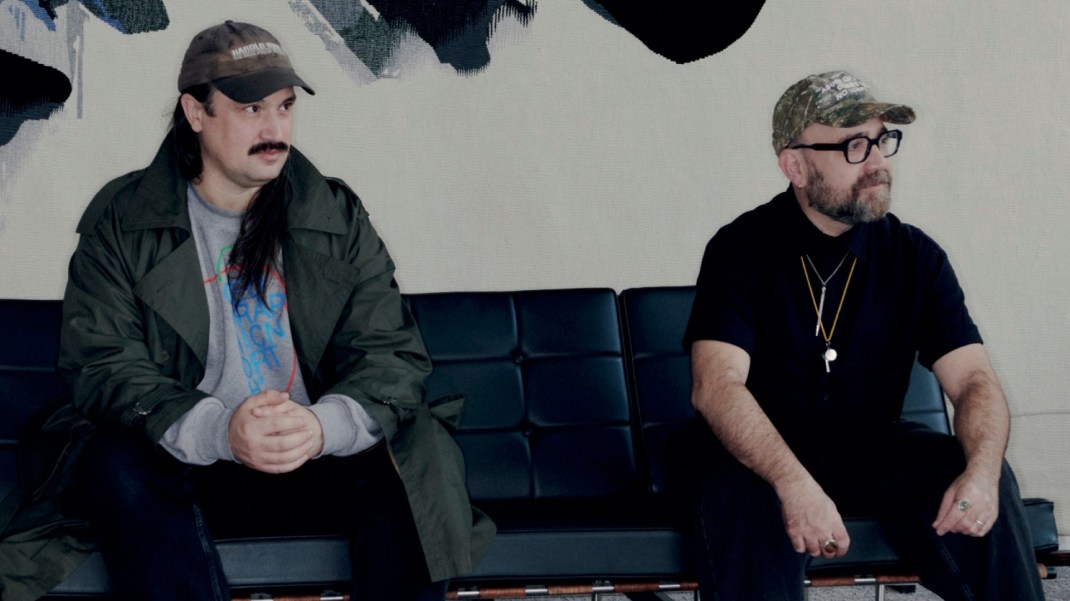
Each month we play an artist or group a series of records which they are asked to comment on with no prior knowledge of what they are about to hear
Tested by Ilia Rogatchevski
Photography by Daniel Antropik
Yellow Swans are a psychedelic noise duo comprising Pete Swanson and Gabriel Saloman Mindel. Originally formed in 2001 in Portland, Oregon, the group drew their influences from hardcore punk and DIY ethics of anarchist communities of the Pacific North West. During their initial seven year run, Yellow Swans released four studio albums and countless CD-Rs or cassettes, often produced in small numbers and distributed via mail order through their Collective Jyrk label. Swanson and Mindel toured extensively, building a reputation as a relentlessly hardworking unit who nurtured and connected networks of likeminded artists.
Their live shows evolved from many hours spent improving together, with Mindel’s processed guitar locking into Swanson’s tape loops and tabletop electronics. Their final studio album Going Places (2010), released after the duo disbanded, was edited from recordings that pivoted away from catharsis to explore more ambient textures. Yellow Swans reformed in 2023, releasing their archive on Bandcamp and playing a handful of shows. Their recent tape series Out Of Practice I-IV documents this era of the band and showcases tentative steps towards new material.
The jukebox was conducted remotely with Yellow Swans dialling in from Paris, where they were working on a multichannel commission for the Présences électronique festival.
The Third Bardo “I’m Five Years Ahead Of My Time”
From Lose Your Mind (Sundazed) 2000, rec 1967
GSM Is it [Arthur Lee’s] Love?
IR No, it’s not, but it was recorded in the same year as Forever Changes.
PS It sounds like The 13th Floor Elevators.
IR It’s The Third Bardo, who released one single and split up. It featured on a Pebbles compilation along with other obscure garage rock bands. How much kinship do you feel with early American psychedelic rock?
GSM It’s not our roots in terms of how we began playing music, but we’re an extension of that practice in some ways.
PS Yes, but more in ethics and philosophy than aesthetics. I definitely feel like the countercultural element and the notion of mind expansion resonate with our project.
GSM Yellow Swans is a resource for a psychedelic experience we produce an altered state of consciousness. I was born in Oakland, raised in San Francisco. That counterculture was all around. One of my earliest influences was Jimi Hendrix, specifically his “Star Spangled Banner” performance at Woodstock. He was pulling noise out of the cosmos, expressing anguish and a political sentiment through that guitar. Early on, because I was such a miserable guitar player, I focused on imitating his physical body rather than worrying about scales.
PS People will respond differently to our set. There have been instances of people dancing next to people weeping. It’s interesting to see these divergent experiences at a noise show.
IR It’s funny that noise music has that polarity. I wanted to touch on The 13th Floor Elevators because fragments of “Slip Inside This House” feature on Out Of Practice II.
PS When we started playing again, we had to map our set. The first two shows were in Austin and New York, so we referenced their underground histories. With Austin, it’s like, are we going to choose The 13th Floor Elevators or Butthole Surfers? It’s about having something legible for the crowd so they understand what’s happening. I’m obsessed with Devil’s Music by Nicolas Collins and early plunderphonic records by John Oswald. I’ve been collecting his Mystery Tapes so I wanted to tap into that thread as well.
GSM The comedian Andy Kaufman was also an influence, particularly his “Mighty Mouse” routine. We take what we do seriously, but we try not to take ourselves too seriously. Kaufman takes a form we know and upends expectations, changing the meaning of what’s happening. It’s a magic trick disguised as entertainment like Antonin Artaud’s Theatre Of Cruelty, but done from a place of deep kindness and compassion.
Masonna “Chapter 1-7”
From Ejaculation Generater (Alchemy) 1996
GSM John Wiese?
IR No, this is Masonna. A series of short untitled tracks from Ejaculation Generater. Was he an early influence for you? GMS When I was in high school, I got interested in prepared guitar because I really wanted to do what Nirvana did at the end of their set destroying instruments. Then I saw 120 Minutes [on MTV].
PS Yeah, I saw the same thing.
GSM Thurston Moore was hosting. He had clips of Japanese noise music including Masonna. What stood out, more than anything, was the sheer physicality of that performance. I immediately thought I had to go to Japan because, I assumed, it’s where that music happens. It never occurred to me that there was an American noise scene. Masonna and Merzbow played in Oakland, when I was at university. Masonna was very good but I could see he was a human doing this thing. Merzbow was different. I thought, I don’t know what this is, but I could spend the rest of my life trying to figure it out.
PS Growing up, I lived in this small town in Oregon, and for a while I was obsessed with this grindcore and powerviolence scene in California. I saw Masonna as an extension of extreme hardcore punk because it has the same sort of energy, but I was more inspired by bands like The Dead C, Harry Pussy and The Shadow Ring. Music that was on the fringes but not because of extremity. They were entirely unique and on their own plane.
IR It feels like Yellow Swans combined the guitar noise of bands like The Dead C and a tabletop of electronics. Is that accurate?
GSM What’s accurate about that is that we’ve never, except in a few collaborations, resorted to purely harsh noise. We’ve always included elements of rhythm or the guitar as a tonal instrument.
Milan Knizák “Composition N3”
From Broken Music (Multhipla) 1979
GSM This is great. This feels like Nurse With Wound.
PS [Laughs] I mean it sounds like Nic Collins. It also reminds me of Reese Williams’s Whirlpool.
IR This is the Czech artist Milan Knížák.
PS Broken Music!
IR Yes, exactly. So, you’re aware of it?
PS Yes. It sounds very contemporary with all those 80s plunderphonics folks.
IR Knížák predates plunderphonics by several years. He made new compositions from damaged and defective LPs. What attracts you to appropriated sound?
PS For me, it goes back to my solo work where I was playing with dance music tropes. I became obsessed with using material that elicited an emotional response from the listener that I could flip into something alien. I always liked this mischievous play between the understood and the absolutely confusing, like hearing fragments of sound that are familiar but just out of reach.
GSM I don’t think we belong to the same family tree as plunderphonics. Yellow Swans is connected to industrial music and 90s sample culture that’s not for the dancefloor but is unavoidably attached to it. We’ve always felt indifferent to copyright and the idea that a sound belongs to any one person. Needless to say, we’re happy to get paid for people buying our records, but at the same time we’re ambivalent. Once the music’s out there it belongs to somebody else, and as long as it’s not a corporation, I’m more or less OK with it.
IR Knížák is also associated with Fluxus. Yellow Swans produced many small runs of CD-Rs and cassettes, which recall artist’s multiples. You also share an affinity with the conceptual side of music. Is that something you consciously aligned yourselves with?
GSM It was never a formal concern, but it’s what I liked about the anarcho punk ethic, making your own music, posters and objects. You make things for the community, not for commerce. In the US there’s a huge separation between the identity of experimental musicians and them being considered artists. In Europe people make those connections much more immediately. When we performed in Belgium for the first time, we were hanging out with these older Fluxus artists. They understood what we were doing collectively not just Pete and I but that mid-2000s noise scene as an extension of the Fluxus project.
PS We wanted to be able to work on a few different scales. Official albums versus releases that are more like us thinking out loud. GSM If you make only a hundred, print the covers and sell them on tour you might actually meet everyone who buys your record. So I think there was this immediacy that is impossible now but, at the time, felt like an alternative to participating in the mainstream music industry.
Prince “1999″
From 1999 (Warner Bros) 1982
GSM [Immediately] Prince! Are you a fan, ’cause you’re dressed all in purple? It’s OK, you can admit it.
IR A happy accident, I think! Are you fans?
GSM I’ve become a greater fan than I was when I was younger. At a certain point, I decided to write a book about “1999” and the end of the world. The song was inspired by a documentary, narrated by Orson Welles, about Nostradamus and his ‘prediction’ of a nuclear war in 1999. That was the kind of world people were living in in the 80s, but the song also captures this American apocalypticism that is still with us. When I moved to Portland [in 2001], I went to all these house parties and, at every single one, they played this song. The entire room was dancing with a kind of militancy. Someone told me it was because an anarchist house was raided by the police and, as the anarchists fought the cops, “1999” was playing. So it became an anthem of solidarity with the anarchist communities in Portland. It didn’t occur to me until later that it’s also a coincidence with the 1999 anti-World Trade Organisation protests in Seattle, which were hugely formative for our generation. I needed to solve the puzzle: is this a political anthem and, if it is, what are its politics?
IR Is that how you got interested in writing, as an academic, about noise in protest music?
GSM No. I was engaging in protests as a young person and listening to the world differently. I began asking if noise can be a mode of resistance? The conclusion I came to is that there’s nothing inherent to noise that is political. Police use noise all the time as a method of violence, but noise does do something. In Minneapolis right now, where I’m living, it’s one of the only tools people have to defend their neighbours [against ICE raids]. It’s blowing whistles, honking horns, yelling at the fascists. It works! That’s the insane thing. Noise is a repellent. I’m sceptical of music’s ability to change society organising politically will do that but I do think music and art play huge roles in creating conditions in which people are willing to take risks.
Wolf Eyes “With Spykes 5”
From Wolf Eyes w/ Spykes (Hanson) 2000
GSM [After listening intensely for several minutes] Wolf Eyes?
IR Yes. This has Nate Young, Aaron Dilloway and John Olson on it.
PS Right. That’s actually the first recording with John Olson, if remember correctly.
IR They’re your contemporaries. I wanted to get your thoughts on what the noise scene was like back then across the US.
PS We would book a tour and, almost always, at the same time, Wolf Eyes or Black Dice would be on tour. We’d be a few weeks off schedule and somewhere, at some point, we’d all play a show together. There were all these serious noise bands and every scene was so accessible. The stuff in Detroit was very exciting, not just Wolf Eyes but also VIKI, Mammal, Max Cloud and Hive Mind. In LA there was John Wiese, Cherry Point, Moth Drakula and Rainbow Blanket.
GSM This was before most music was on the internet. On the one hand local scenes could form because you were playing for each other. The bar for entry was relatively low because you were playing for the same 20 people in each one of these cities. The only other way you could hear this music was through DIY labels that were putting out tons of releases but in incredibly small numbers like Hanson, Collective Jyrk [the label Yellow Swans ran alongside Pat Maherr and Eric Mast] and American Tapes.
PS You would stuff 40 dollars in an envelope and just be like, send me whatever’s new.
GSM Because anything that you heard about from someone else was probably already gone. A good way to think about this is Another State Of Mind [directed by Adam Small and Peter Stuart, 1984], that documentary with Social Distortion. You know there are scenes. You know there’s at least one band you’ve traded music with through the mail. So you figure, well if we could get enough gas to get to the next town we could probably pull this off. There were a handful of us who were more willing, or able, to tour, but every town we’d go to was so deep with artists. You could talk about Wolf Eyes, but there were all these other musicians doing mind-blowing stuff.
PS It was a great time to be on the road but there were also a lot of problems with it. We would play these clubs with tiny mono PAs. So we had to build our own sound system. Kites or Hair Police would come through on tour and everybody would share different bits of knowledge about making records, tapes and artwork.
Christina Carter “School Song/Desire To Play And Play”
From Bastard Wing (Eclipse Records) 2003
PS [After a while] I don’t know.
IR It’s somebody you’ve collaborated with.
PS Oh, is this Christina? Is that from Bastard Wing? Such a beautiful record. She was at our show in Austin [in 2023] when we played The 13th Floor Elevators and she was so excited about that moment. Both her and Tom Carter [from Charalambides] are people I’ve spent a lot of time with over the years. Christina sang on our album Psychic Secession. She has this incredible presence when she performs. It’s very restrained but done with such precision, confidence and beauty.
When we were establishing ourselves in Portland, we started playing with improvisors like Bryan Eubanks, who were aligned with electroacoustic music. When we moved to the Bay Area, Tom and Christina were the perfect people to work with even though they were coming from a different place aesthetically. It led us to produce music aligned with psychedelia, improvisation and listening. I don’t know if I could call what we do Deep Listening, but we play better when we are patient and really paying attention to what each other is doing.
IR You often had collaborators on your studio albums. Is that because you wanted to hone your craft through other people?
PS We didn’t always do that for our studio records. For Bring The Neon War Home, it was about solving problems. We had people who helped because we didn’t know what we were doing. For Psychic Secession, we had been listening to things like Forever Changes and Pet Sounds. We were thinking what an orchestral noise record would sound like with different voices in unison. On our first few tours we collaborated at every single show we played. When you see all those CD-Rs we made then, those collaborations happened live. Maybe we played an hour in the evening after the show or in the morning the next day. We were just engaging with the larger community. When coming back to the studio [to record Psychic Secession], we embraced this ethic and created a community project that emulated these ambitious [1960s] albums.
Raven Chacon “This Is Where We Went/Were”
From Overheard Songs (Innova) 2006
GSM [Screeching feedback plays] I’m utterly stumped, but I could listen to that all day.
IR It’s Raven Chacon.
PS Oh, of course. It sounds so good. We have such high regard for Raven.
GSM We met Raven at this underground venue called Il Corral in West Hollywood. He was the door guy. It’s incredible seeing him now because he’s definitely developed his craft. He’s matured in a way that we can only be envious of. I’d lost track of him and, years later, I was putting together a show Landscape & Life about settler colonialism at Indexical in Santa Cruz. I came across, I think on your recommendation, Pete, these early sound pieces Raven had done called Field Recordings (1999). They were photos he appropriated of landmarks within the Navajo Nation that are thought of as quiet, but he affected these recordings into the harshest noise.
PS They’re flexi postcards with an image of the site and the recordings cut into the plastic. Such elegant art objects. I was sending them to anybody that I thought would be interested because it’s such a simple articulation of noise as art.
GSM There’s a discourse around field recording and landscape in the UK that doesn’t translate in the North American context. In the UK, there’s such a big interest in attempts to reconnect to a landscape that is ancestral. In the US, Canada, Australia, New Zealand and Palestine there are lots of countries where that kind of listening is not as straightforward. For someone like Raven doing work around the act of listening to the land has an incredibly different connotation than someone like myself, who is a child of refugees but is also a guest here. It’s a conversation that is still working itself out between these anglophone worlds.
Devendra Banhart “Support Our Troops”
From Remixed & Covered (Kill Rock Stars) 2007
GSM I get the reference. It’s very layered. We met Devendra through [Xiu Xiu founder and co-writer of this song] Jamie Stewart when they were on tour together.
PS They stayed at our house. We all bonded listening to The Real Bahamas, the Nonesuch Explorer record that Joseph Spence song “Won’t That Be A Happy Time”.
GSM We listen widely and are interested in people who are committed to whatever art form they’re doing, even if it’s objectively nothing like us. What people often miss, when they approach an artist from a very specific entry point, is the breadth of relationships that exist behind the scenes. We named our album Live During War Crimes because we were in opposition to the wars in Iraq and Afghanistan. Jamie’s song is unapologetic in its positionality vis-à-vis people participating in those wars. Devendra covered it and we asked him to make art for Live During War Crimes. There are these shared values that don’t always manifest themselves in the music or in the presentation.
PS This goes back to a time when the noise scene was less codified. Xiu Xiu and the 5 Rue Christine [label] scene, like Deerhoof, Hella and Get Hustle we saw them as our peers. We’ve always had this broader sense of where we fit in within music culture. Having Jamie from Xiu Xiu and John Wiese supporting us early on was transformative.
GSM Xiu Xiu taking us on tour as their opener was a huge deal and exposed us to a wider audience. A lot of other noise artists wouldn’t have understood that connection between the bands and wouldn’t have pursued it. I think we were more interested in taking risks and not deciding in advance that the audience shouldn’t experience us.
PS Not only are we broad listeners, we played broadly. But also we didn’t know any better.
Metalux & John Wiese “Exoteric/1”
From Exoteric (Load) 2004
GSM [Within seconds] John Wiese.
IR Yes! It’s his collaboration with Metalux. How important is he to Yellow Swans?
PS I think it was our third show ever. We played in a basement with John and immediately he asked us to do a split 7″.
GSM I can’t say what would have happened to Yellow Swans if we hadn’t met John. He was partly the reason why LA became a second home for us.
PS He was no nonsense, like, ‘Let’s make a ton of records. Let’s do this.’ I loved his work ethic. He designs his own typefaces and also comes from the same hardcore scene as us. I knew about [Wiese’s band] Sissy Spacek before I met John because this cut-up grindcore music sat with that extreme end of hardcore that I liked when I was in high school.
IR You played in the UK with Wiese and Metalux, in 2007, along with Evan Parker, John Edwards, Paul Hession, Culver and C Spencer Yeh on the Contemporary Music Network’s Free Noise tour. Do you recall how the noise and jazz artists worked together?
GSM I was terrified because these were real musicians. It was intimidating. Everyone was nervous and unsure like, who are these other people? There was no explanation for how it would work, but then we started playing and realised that it’s just listening and making sound in response; experimenting and not being obligated to know in advance what it’s going to be. Everyone was very generous. I give credit to Evan for leading the way, being the senior artist and the best known in the room. We turned it into a game, creating different pairings and trios every night to create an unknown set of possibilities.
PS There were some incredible moments. One of my favourites was a duet with MV Carbon from Metalux using microphone and tape and Evan Parker soloing. Carbon was reading an unintelligible monologue, recording Evan and playing him backwards over himself. Evan looked so tickled because it was a moment of true improvisation that I don’t think he had experienced before.
Evicshen “Bolete”
From Hair Birth (American Dreams) 2020
IR [After long pause] No idea? This is Victoria Shen, who works under the name Evicshen.
GSM Oh yeah. I’m definitely aware of her. I didn’t even know she had a recording.
IR She creates her own instruments and foregrounds the body as part of her performance. In terms of stage presence, John Wiese might play a tabletop set, but you guys are somewhere in between.
GSM Daniel Menche, who is a sound artist, friend and mentor, understood that performance is inextricable from physicality. The music came from the body even though it was not immediately apparent. What I’m trying to do is make the audience aware that my body is the origin point of what they’re hearing. The intensity of what I’m feeling is transducing through our instruments.
PS It’s about movement and engagement. While we’re not people who put our bodies on the line, we’re averse to visuals. We play in the tradition of a hardcore band. We want the sound to be the most compelling thing and our bodies are working in service of the sound. In those 15 years when we weren’t a band, a lot of people started thinking of us as an ambient project because of Going Places and I’m like, OK, but you have to understand that this was all executed at incredibly high volumes and live! We got back into this because our creative partnership was extremely fruitful. We could push it in new directions, differentiated from what it was earlier, while also tapping into our history. Where do we fit into the contemporary landscape, now that we’re approaching 50? We’re a band out of time.
Originally published by The Wire, March 2026

