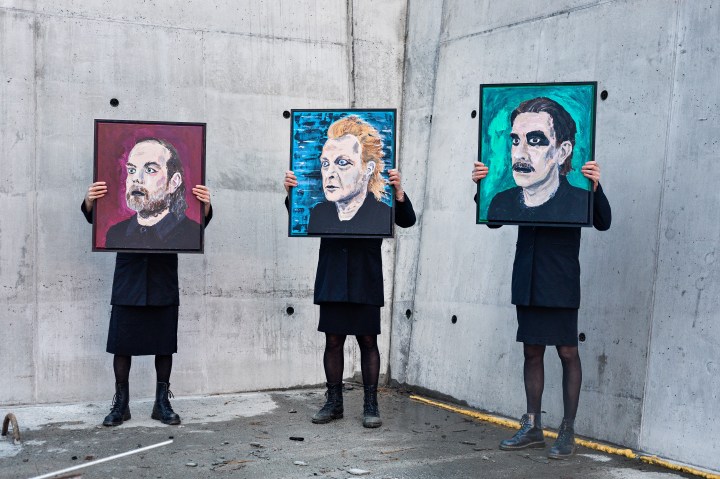
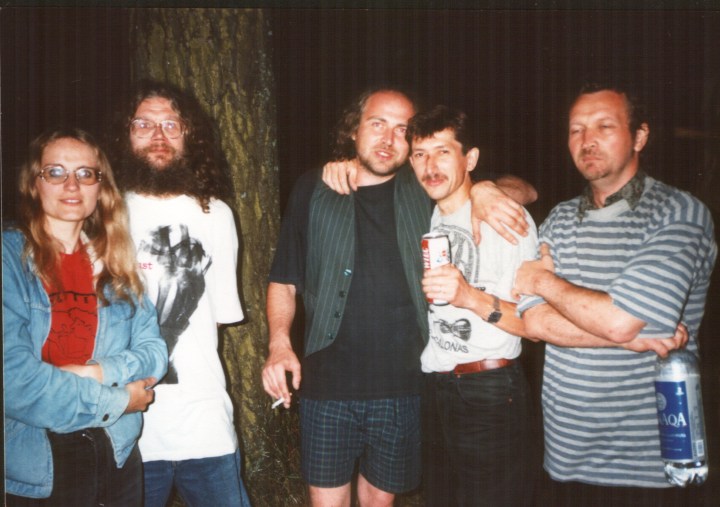
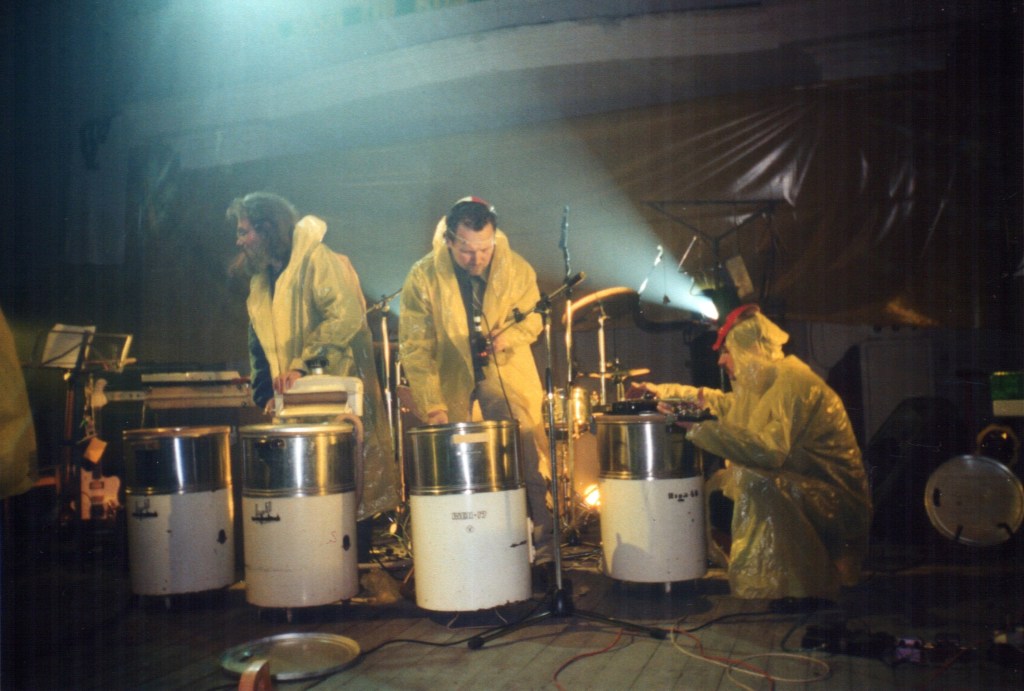
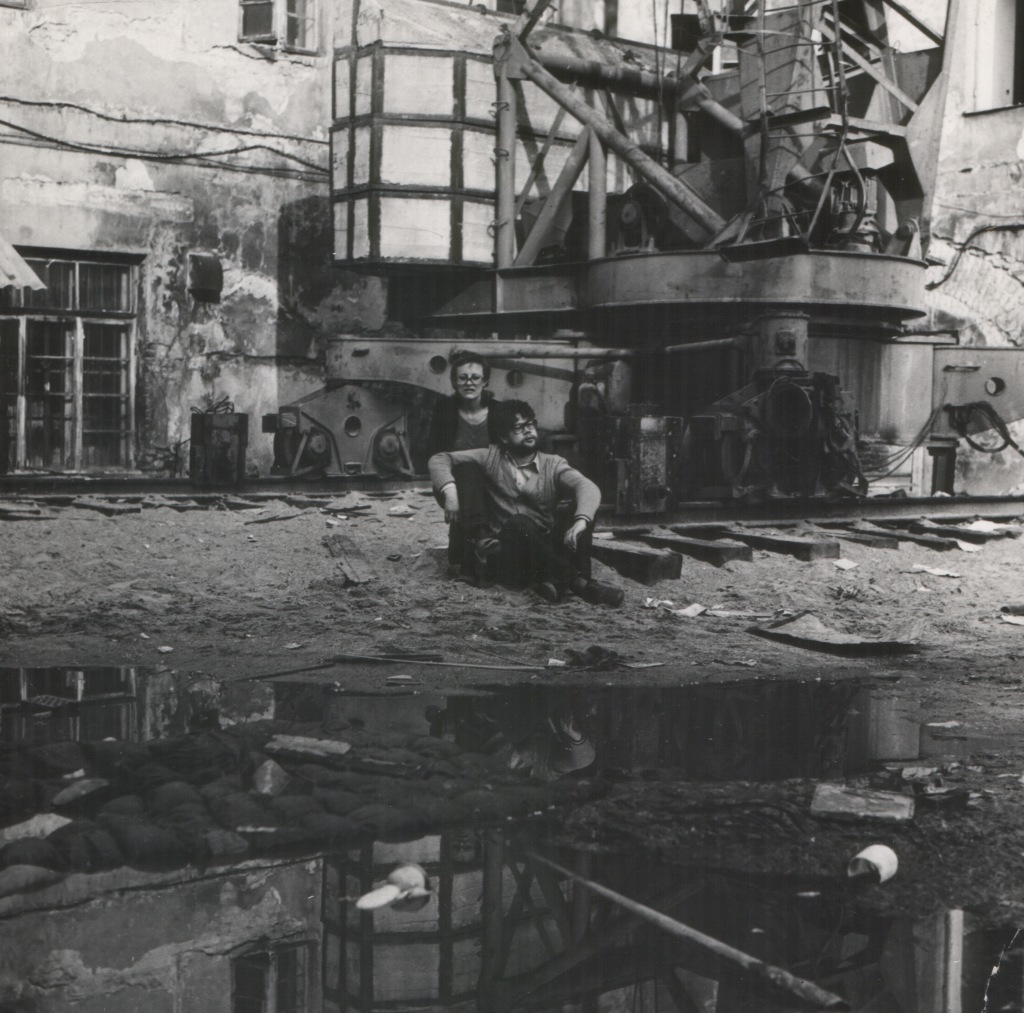
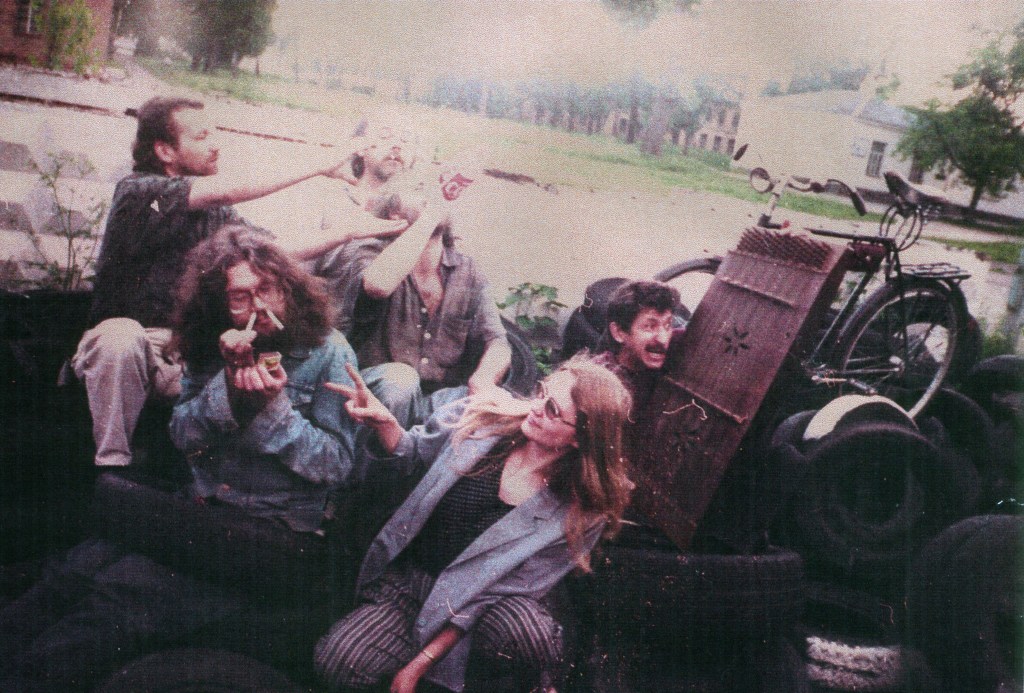
The Finnish trio’s cleaning robot alter egos make industrial music from the contents of a linen cupboard around sci-fi themes that are anything but domestic. From left: CW04 (Tero Vänttinen), CW01 (Risto Puurunen), CW03 (Timo Kinnunen) – Photo by Jussi Karjalainen.
In the music video for “Ricewestern” the cosmic track opening Cleaning Women’s 2001 debut Pulsator the Finnish trio teleport themselves across the Russian border to Saint Petersburg to perform on their modified clothes horses before bemused bystanders. The grainy 8 mm footage documents this absurd happening like it was captured by an amateur film maker. “In the early 2000s, we played there many times and had a following,” reveals Tero Vänttinen aka CW04. “The atmosphere was free. The Soviet Union collapsed less than ten years before and there was a big need for influences from outside. We had strange instruments and costumes. They didn’t know what to think of us.”
Reissued on vinyl in February, Pulsator remains Cleaning Women’s mission statement: three androgynous cleaning robots (CW01, CW03 and CW04), from the planet Clinus, adapt salvaged household materials into DIY instruments and compose what they describe as a “combination of cinematic sci-fi western and sparkling trash can disco”. Brusque Beefheartian delivery echoes through their lyrics, while their rhythmic instrumentals and image recall early Kraftwerk.
Cleaning Women were formed in 1996 by Risto Puurunen aka CW01 and Anu Keränen aka CW02, who left a few years later. Dialling in from Vacuum Sound Space, their airless rehearsal studio, Puurunen explains their origins: “When I arrived in Helsinki, I bought a laundry rack. CW03 [Timo Kinnunen] and I had been experimenting with contact mics [for another project when both living in Kuopio]. I put a microphone on the rack and sent it through some effects. The sounds became interesting, almost musical. CW02 programmed parties at our art school and said we should make something. That’s how we started. It was more like an experimental sound performance. Much different from what we are now.”
After finding the ‘natural’ sound of the clothes horses too limiting, they began adding other materials to create variations in pitch and timbre. “We like dogmas,” explains Puurunen, “we have rules like all the instruments have to be built by ourselves.” Kinnunen adds: “We mostly find everything in the recycling centre. You just take some metallic stuff in your hand and start thinking about what it could be.”
This method of explorative tinkering has evolved over the last 30 years, and their arsenal of instruments has expanded to include a coffee can bouzouki, closet hanger bass, melodic kling klang and hammered dulcimer among other self-made constructions all held together with twists of tape and wire. “We are really old school,” declares Vänttinen. “We play everything live no backing tracks, no samples, no click tracks. Everything comes from the instruments and from us on stage. We’ve been really strict with that.”
Aside from being an accessible live act whose music revolves around the interplay of hypnotic rhythms, Cleaning Women are also composers of nuanced film scores. They have performed bespoke music for silent classics like Sergei Eisenstein’s Battleship Potemkin (1925) and Fritz Lang’s Metropolis (1927), and composed soundtracks for contemporary films including Alice Rohrwacher’s Oscar-nominated short Le Pupille (2022). “[Dziga Vertov’s 1930 film] Enthusiasm was the first one [we did],” remembers Vänttinen, “and it was an accident. There was a guy who ran a film festival [in Russia]. He said we should make music for that film and come to his festival to perform it. We rehearsed, made the score and went to Saint Petersburg to play but they had forgotten the whole idea! That was the first screening it never happened!” Instead they unveiled the score at Helsinki’s Riemu festival in 2003. It was soon followed by more commissions.
When Cleaning Women released their soundtrack to the 1924 Soviet sci-fi film Aelita as their second album in 2004, it included additional material that didn’t make the final score. Directed by Yakov Protazanov and based on Aleksey Tolstoy’s novel, Aelita follows the story of an engineer who overthrows the Martian ruling class with help from the titular alien queen. Cleaning Women’s Aelita score goes into darker territories than its predecessor. “Secret Passenger”, for example, mirrors the terse industrial sounds of Einstürzende Neubauten. Longtime Neubauten member Alexander Hacke mixed Cleaning Women’s 2019 Intersubjectivity album, and hackedepicciotto toured with them in Finland.
“Our first album was made without us knowing what we were doing, because no one had recorded a laundry rack before,” says Vänttinen. “After that we have been figuring out how this band should be recorded. For Intersubjectivity, we found a method of recording where we use a PA system in the studio to get some air to the sound.”
Cleaning Women used the same method on their new album Washer. Although not as conceptually tight as some of their previous work, singles like “1984” and “City Of Confusion” are saturated with dystopic tension, reflecting the trio’s desire to evolve. “Timo getting bored with playing the drums was an offset for the new album,” Vänttinen admits. “The overall feeling was that everything sounds the same. There are only three of us so if Timo doesn’t play the beat, and the other two need to play string instruments, then we have to figure out how to make things sound new. Now we share the beats with Timo. They come from both of us. It’s like a monster that has three arms.”
Cleaning Women’s Pulsator and Aelita reissues are out now, Washer is released this month, all via Svart
Ilia Rogatchevski Originally published by The Wire, October 2025
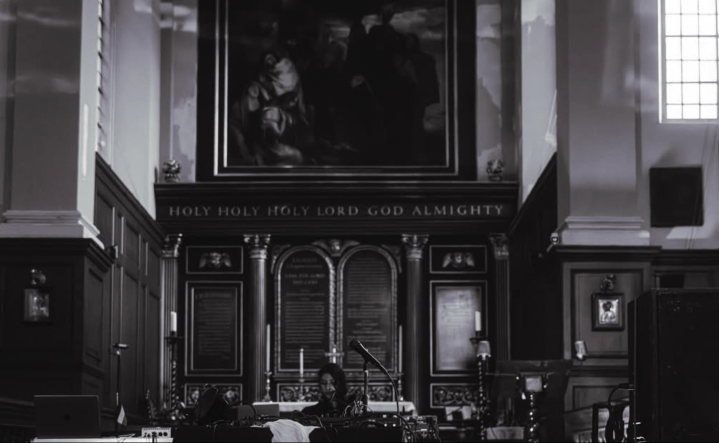
Tonight’s edition of Boundary Condition, an event series curated by the Egyptian artist Alaa Yousry aka Cerpintxt, centres around the launch of her new album Refugees Of The Symbolic Network. The record’s identity is rooted in an impulse response (a process that allows you to replicate the reverb of a given space) gathered at the King’s Chamber in the Pyramid of Giza. Its sonic footprint was then applied to compositions based around texts by Izz al-Din Manasirah and Sargon Boulus, poets who worked with mythology and surrealist imagery to explore Middle Eastern identity. Their deconstructed verses are transposed onto a spectral netherworld populated by, as Yousry notes in The Wire 499, a “collective of individuals who have been systemically oppressed and exiled out of existence”.
This transposition happens in the physical space too. Reconstructed by Sir Christopher Wren after the original medieval building was destroyed in the Great Fire of London, St James Garlickhythe boasts an opulent decor, large rounded windows and an impossibly tall ceiling. As the sun sets and the theatrical lighting intensifies, the impression that you’re lying entombed at the foot of a great monument becomes more pervasive. It’s an appropriate setting for contemplating with a soundtrack to match. mortality –
Heavy drones flow out of the PA and grow perceptibly louder as the audience file into the pews. Recordings of rainfall indicate the start of the opening set by BEORHTA, who walks through the nave holding a wind instrument shaped like three terracotta papayas fused at the stems. The ceramic innato flute emits haunting tones that counterpoint the masonry rattling bass at the climax of the ritualistic performance. The focal point is BEORHTA’s voice, which fills every crevice of the church with sorrow and is informed by caoineadh, the Gaelic Celtic tradition of vocal lament for the dead.
Plasma-like projections are cast on the walls behind Daniela Huerta, who co-created the artwork for Refugees Of The Symbolic Network, and performs pieces from her recent Soplo album. Created in part from soundtracks for films by the Colombian artist Iván Argote, Huerta combines ambiguous pulses and disembodied voice into a soundscape that is embedded with unease. She uses the SOMA Pipe, a voice-activated synthesizer, to augment her vocals into a multitude of blazing fractals while shifting drones contribute to the overall sense of disquiet.
Cerpintxt is billed between the above performers. Yousry is joined by pianist Ruben Sonnoli and cellist Nina Hitz (formerly of The Kilimanjaro Darkjazz Ensemble), both of whom appear prominently on her album. The start is unamplified and unannounced. Sonnoli tinkers away at piano keys at the back of the church, while Hitz is hidden somewhere near the pulpit, holding steady a disconcerting drone. Yousry, meanwhile, layers whispered intonations like a stream of sinful confessions.
The sounds connect in a diagonal spatial formation, making good use of the building’s acoustics, but the unamplified instruments soon give in to Yousry’s dominating electronic set-up. Hitz makes her way to the chancel, bowing on a piece of aluminium foil to mirror shimmering feedback. Sonnoli soon joins her on keyboards as Yousry’s voice slithers around stretched and distorted samples, and the trio continue fully amplified. While there is an element of stasis to their sound, like the remnants of dreams that stalk your waking life, the atmosphere is designed to evoke the an ushering into a dark eternal subterranean realm.
Ilia Rogatchevski Originally published by The Wire, October 2025
The composer and field recordist draws on a painterly sensibility to layer loops and samples into documentary narratives that are startling, funny and human. Photography by Ashley Markle
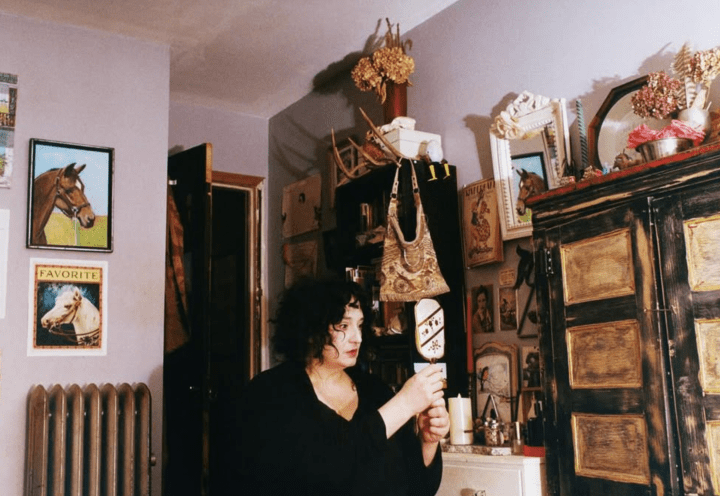
Poised over a laptop at a recent Cafe Oto show in London, Vanessa Rossetto pulls up spliced recordings of disparate voices, looping ephemera and snatches of incidental melody. She gestures and lipsyncs to the samples, layering clips on the fly and improvising new transient spaces from unremarkable fragments of time. Prior to her 2025 European tour, Rossetto had only played a handful of shows, even though she’s been producing music since the late 2000s. “I haven’t played live very much and I’m still working that out,” she confides over a video call from her Staten Island home. “Some elements are more constructed, some are not. In Lithuania, [April’s] Jauna Muzika festival had the theme of the amateur and so I sourced recordings of people singing their favourite songs. I made a backing track and set mics up so that people in the audience could come up and sing. I was ready to sing the whole 30 minutes myself if I had to, but every time I looked up there were different people doing it.” The recordings created on this tour will most likely see publication next year as The Professional, a double album on the Erstwhile Records imprint ErstSolo, which will “explore the idea of being put into that sort of situation, as an untrained and inexperienced practitioner, and the humorous situations that would undoubtedly ensue”.
The original meaning of amateur is a lover of something, and Rossetto’s journey in composition reflects this. Initially trained as a painter, she began working with sound almost 20 years ago by habitually recording her surroundings and constructing epic compositions from hundreds of layers. Her latest release Pictures Of The Warm South spans 142 minutes across two CDs. It’s her longest work to date, but the soundworlds present on the recordings are far from random, focusing on Rossetto’s relationship with her mother Toni. “She was liquidating her possessions and selling the house so that she could move into an apartment complex for older people. For almost four months I was helping her do this and recording the whole time. She moved to Alabama and then passed away. I went there and recorded her funeral at the apartments.”
Toni’s monologues are woven into an impressionistic documentary featuring street musicians, traffic, commercials and domestic minutiae that together underpin the traces that our lives leave behind. Listening to Pictures Of The Warm South is like being a guest in a strange house. You surreptitiously wander into different rooms and examine the objects there, which together form a portrait of the host, their tastes and personality. Familial complexities inevitably come into play, as in the piece “pool water, salt water, and the water in your head” in which Rossetto is heard crying and her mother berates her for it. Towards the end, “the chapel” captures the ritual of mourning at Toni’s funeral. Rossetto’s eulogy encourages those in attendance to dance rather than grieve. Even though the ones we love leave us, life carries on.
Rossetto’s mother is also the central voice on the 2019 album You & I Are Earth, in which she recalls memories of being a young girl during the London Blitz. The Actress, from 2022, is also dedicated to her. “She was so influential to me in ways that she will now never realise,” Rossetto explains. “I don’t know if she understood what I was doing, if it made sense to her as an artform. She found it confusing that I recorded things and put them together, but the whole reason I went on the European tour was because when I was at her house helping her pack, people from the Archipel festival in Geneva contacted me. I wasn’t sure if I should go. She was like, ‘You have to do this.’ She made me promise that I would go.” Rossetto grew up in New Orleans and considers the city to be pivotal to her development as an artist, not only because of its rich musical heritage but its outdoor culture. Toni sold paintings on Jackson Square and Vanessa spent a lot of time in the French Quarter, which is the centre for tourism, Mardi Gras, bar culture and street life. “As a kid I was down there all the time with her. She hung her paintings on a fence and sold them like that. I remember waiting for her to pack up and listening to all these sounds overlapping. When I got older, I would go walking and listening, seeing all this crazy behaviour – people go wild there. That really influenced me and I don’t know if I appreciated it as much at the time as I do now in retrospect.”
Her mother would set up an assembly line in their kitchen, and Vanessa helped by colouring the paintings. Seeing that it was possible to make a living from art drove Rossetto to study it herself, first at the University of Texas at Austin and later at Tulane University in New Orleans. Despite being immersed in Austin’s slacker scene and being into “ridiculous out there stuff” like Butthole Surfers and Scratch Acid, Rossetto’s transition towards working with sound wasn’t immediate. “At the time, I was really just trying to paint well but I was interested in performance art too. I had this microcassette recorder and was trying to record my entire inner monologue. I wish I still had the tapes.”
Rossetto had some gallery shows, but became increasingly frustrated with the limitations of painting as a medium. She began producing autobiographical comics and briefly considered making films. “I wanted to deal with narrative and time. Those were two things that I didn’t know how to approach. Film making seemed too complicated and intimidating. Narrowing it down to sound was like taking a slice of that and isolating it, which seemed more approachable to me as someone with no musical background.” Having friends in “quote unquote weird bands” gave Rossetto access to instruments and recording equipment, but she didn’t start making music in earnest until her late thirties. “I was drifting around and trying different things. It took me a long time to attempt anything with sound. I had friends with mixers and started recording whatever was happening in my house – just leaving it running and recording my activity or lack of activity – and making things out of that. I was aware of field recording but not its possibilities, other than documentary capture of an instance.” Rossetto’s first musical project was Catrider, a duo with the Australian musician Michael Donnelly. Their self-titled album was recorded in 2006 in a few days while Donnelly was staying in Austin. “From Mirrors Are Oceans”, which appears on the Music Your Mind Will Love You label’s 2008 Hand-Rolled Oblivion compilation, is awash with a claustrophobic combination of scratched objects, pawed strings and reverb. The same CD-R album also features “Arnold School 1” by The Mighty Acts Of God. This early solo project of Rossetto’s saw her experimenting with her housemate’s instruments, layering and processing them into anxious soundscapes, a method that led her to embrace chamber instrumentation more widely across her work.
Around this time, she was also turned on to the I Hate Music (IHM) forum by the composer Steven Flato, whom she met on MySpace and collaborated with as part of the improvisation duo Hwaet. “I was finding out about all these things [on IHM] and the floodgates opened to all the possibilities of what could be done. I started just making things, fulfilling something that painting had not for me. Something clicked at that point.” A wide spectrum of experimental music was discussed on the forum including noise, classical and musique concrète. It proved to be an invaluable resource and a pathway to collaborations with likeminded artists in different corners of the world. Over the years these have included Lee Patterson, Lionel Marchetti and Moniek Darge.
Imperial Brick, Misafridal and Whoreson In The WIlderness, a trilogy of albums released on her own Music Appreciation label in 2008, largely discarded effects and documented Rossetto’s raw droning improvisations on viola. Each album bore a minimalist black cover that suggested the sparse sounds within. It wasn’t until Dogs In English Porcelain, released the following year, that Rossetto hit her stride with measured and intentional composition. Constructed over the course of ten months, the 41 minute piece combined countless field recordings of domestic activities and aural snapshots from daily life. “Dogs In English Porcelain was the first one where I feel like I was using the actual form that I’m still using now: edited and augmented field recordings. When I first started learning how to operate a recorder and software, I would begin with a substrate layer – the length of whatever I wanted the track to be – look at where things were happening and build around those. I was trying to figure out a process of how to make things coalesce.” Dogs In English Porcelain caught the attention of Graham Lambkin, whose Salmon Run album influenced Rossetto’s early work. Lambkin asked her to produce a 7″ for his Kye label, a project that evolved into 2010’s Mineral Orange album. Feeling uncertain about what shape the tracks should take, she sent unfinished compositions to Lambkin for feedback. “He had a lot of input on that, because, at the time, I was very unsure about what I was doing. I was probably a pain in the ass sending him partially done things. I would never do that now!”
Two more Kye releases followed, 2012’s Exotic Exit and 2014’s Whole Stories, both of which intensified Rossetto’s method of splicing hundreds of recordings and carefully layering them to construct new narratives from the resulting juxtapositions. “That’s why it takes me a long time to make them,” she says. “I actually work often and for long periods of time, but some of the files are ridiculously huge. I use Audacity too and that’s maybe part of it. It’s actually analogous to the way I used to paint, because I mixed a lot of medium with my paint. The layers were translucent so you could see down into the paintings. I feel there is some relation there.”
Exotic Exit saw her expand the sonic palette to include violin, cello, dulcetina and glockenspiel on top of recordings from quotidian settings, language tapes and incidental conversations. The material developed from a live collaboration with Lambkin for the 2011 edition of the AMPLIFY festival in New York, which was organised by Erstwhile founder and IHM alumnus Jon Abbey. Rossetto used the live performances leading up to AMPLIFY as an opportunity to mould the material into what Matthew Revert referred to in a 2013 article for Surround as “a canvas where fragments of life are assembled into fictions”. Revert, a writer and multidisciplinary artist based in Melbourne, is Vanessa’s most frequent collaborator and life partner, even though they live on different continents. Revert was also a contributor to IHM, but their paths crossed properly during the making of Exotic Exit when Rossetto commissioned him to create the album cover, after being impressed by his book jacket designs.
“We met online,” she recalls. “We started working on things together and he came to visit me when I was performing at the Kye showcase at ISSUE Project Room [New York, 2014]. He was the secret guest and we did a duo set together. While he was here we were recording the whole time, quickly assembling an album. I would say my biggest influence is probably Matthew because he’s such a brave performer. He is creatively free and knowledgeable about a wide variety of artforms.”
Earnest Rubbish, the result of these sessions, came out on Erstwhile in 2016. Commissioned by Abbey, most Erst duos bring together musicians who would not have played together before and perhaps don’t even know each other. By this point he had already put out Severe Liberties, her collaboration with Kevin Parks, and liked what Rossetto and Revert sent in, pairing their release with Christian Wolff and Michael Pisaro’s Looking Around.
Earnest Rubbish, released in 2016, and its 2018 follow-up Everyone Needs A Plan, are looser in the way they combine ephemeral sounds when compared with Rossetto’s other work. The latter album in particular drifts from hissing drones and swollen strings to fractious synthesizer tones. Across 75 minutes, Rossetto and Revert’s late night voice notes drop in and out of the liminal soundscape. They suggest a scripted but elusive narrative that filters through as you slip into semi-consciousness while falling asleep to the radio. Rossetto thrives on longform pieces and when I mention that her work is perfect for the medium of experimental broadcasts she lights up. “I’ve actually been thinking a lot about radio plays and things of that nature,” she enthuses. “That’s one of the things that influenced the concept of mine and Matt’s next one. I have a lot of ideas but I don’t want to give them away. It will have ‘vignettes within a framework’ and follow the trajectory of the other two.” Rossetto is fastidious about planning which elements appear where in a given composition, sitting with a notebook and mapping them out. “Sometimes I draw, not a graphic score, but the shape of where I want things to be. I have really particular ideas about that, which has pissed off some collaborators before. There have been people who said, ‘Oh, you just put stuff wherever!’ as if I’m just throwing a bunch of things in together, but it’s all very intentional. Every single bit of it is individually placed to a microscopic degree.”
An example of her attention to detail can be heard on The Way You Make Me Feel and Erased De Kooning, both created in 2014 but released a few years apart. These works are composed from what Rossetto refers to as interstices or “the silences between deliberate acts”. Inspired by the Robert Rauschenberg artwork, the latter album sourced its sounds from the Experimental Music Year Book, which between 2009–19 published an online repository of works by composers working in experimental music. But The Way You Make Me Feel came from a more personal place. “I suffer from lifelong depression and anxiety and I was going through a very bad period around that time. I was also paradoxically going through really wonderful things but I was not allowing myself to experience them. I was removing myself from the possibility of being happy because I was so ill. In trying to remove most of the intentionality and leaving only the interstices in those recordings, I was trying to express that.”
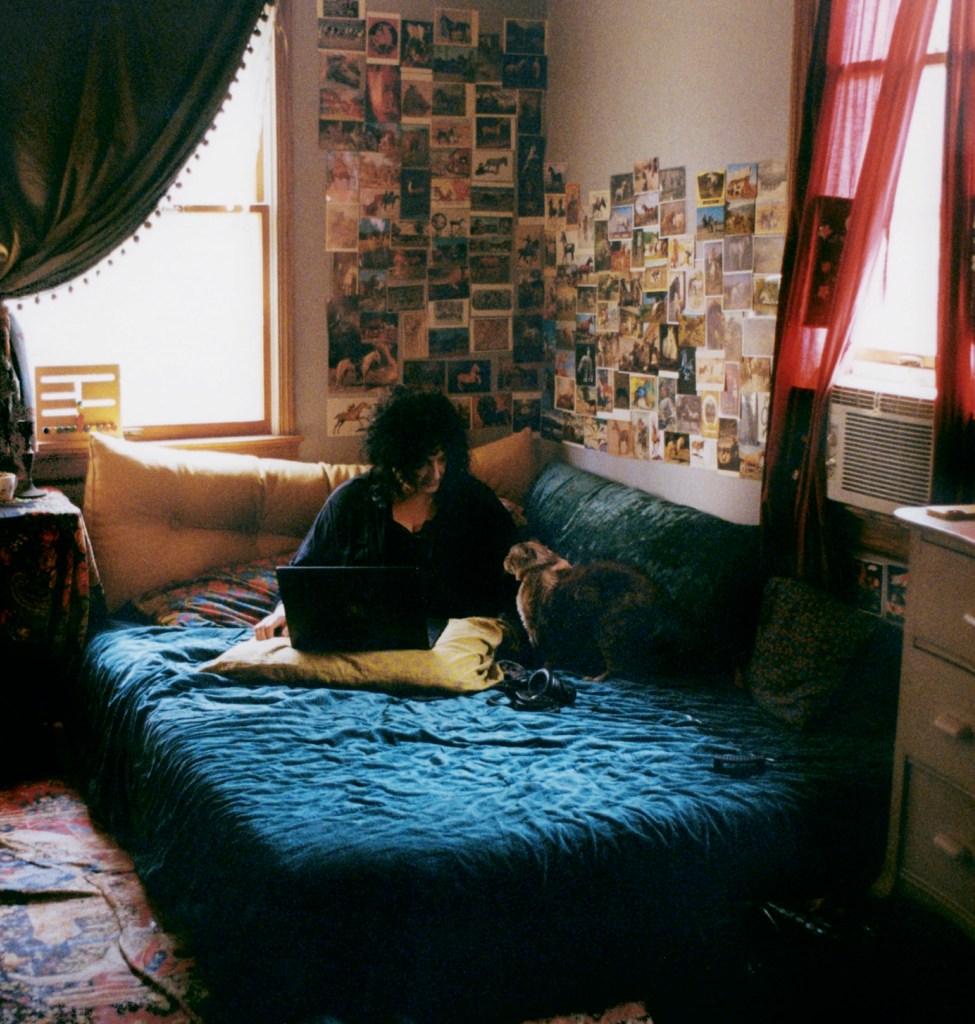
These sentiments are evident in pictorial form, too. Rossetto’s Bandcamp bio jokingly claims that she is a horse. This has flowered into a meme among her fans and resulted in many horse-related gifts over the years, some of which decorate the walls of her apartment. Revert’s cover design for 2022’s The Actress depicts an erased horse. With its ghostly outline lingering in a field, this image can also be interpreted as the subconscious removal of self – although Rossetto maintains that she simply preferred the background to the horse. Over time Rossetto has become more present in her pieces. Her voice appears regularly, from Exotic Exit through to her sonic collaborations with Revert and beyond, and anchors the ear at critical points in the narrative. “This Is A Recorder”, which takes up the first side of Whole Stories, is a good example of her authorial presence. “I was in New Orleans during Mardi Gras. People were all drunk and uninhibited and I had my recorder with a big fluffy windscreen on it. This guy came up to me and asked what it was and I was like, I record things, cut them up and reassemble them so that they have some narrative structure. This is the point where I felt like I was making my intentionality clear. I was trying to make sense of the world and that’s still what I’m trying to do.”
Rossetto continues that she would like to go further by forcing interactions and being more active in public to see what happens. When I bring up that the recordist’s presence can often be seen as taboo, particularly in wildlife recording, due to the perception that it undermines the purity of the natural environment, she responds: “I have a lot of respect for nature recordists but if there are no people, I’m not interested. That element is important to me. I want to go where there is interaction and human life. What’s interesting about most artforms is seeing the hand of the creator in them. Otherwise it’s sterile to me. I love street performers, cars passing by, getting in and out of Ubers with different songs on the radio, doors closing and delineating one space from another. I like the mistakes and bumped recorders in your bag. The unintentional is sometimes the most interesting.” ● Vanessa Rossetto’s Pictures Of The Warm South is released by ErstSolo
Ilia Rogatchevski Originally published by The Wire, July 2025
Dave Welder, a prolific Brighton project led by the film maker Ben Wheatley and music producer Simon Byrt, have amassed over a dozen eclectic lo-fi releases on Bandcamp since August 2024. Seated behind synths, laptops and MIDI controllers, the duo push out warp engine basslines laced with a lamentful sci-fi soliloquy that borrows the template of The Orb’s Adventures Beyond The Ultraworld. In a further nod to their ambient house forebears, the projection behind the group shows mirrored images of fluffy clouds. Looped piano sequences and sampled soul vocals later lift us out of the deep space odyssey, segueing nicely into warmly discordant industrial spaces.
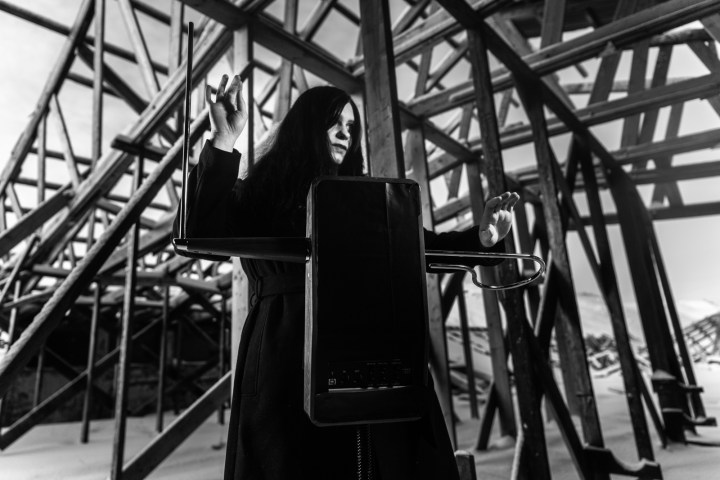
This sets the scene for the richly gothic timbres of the headliner. Iceland’s Hekla Magnúsdóttir is a theremin player who embraces the instrument’s associations with the supernatural, leaning into horror movie tropes evoked by its sinuous tones, while conversely steering the sounds to somewhere new. Her merch, for example, includes a pin badge showing disembodied hands hovering in the dark – spectral warnings of the devastation to come.
She begins with an improvised piece, its rattling subs and metallic sirens quickly engulfing the room. Bathed in vampiric light, Hekla teases clandestine melodies out of the air that murmur and disappear as the viscous low end spreads across the venue like swamp fog. Hekla’s right hand controls the pitch – poised as if pulling invisible threads – while her left hand droops inside a curved antenna responsible for the amplitude. Her equipment consists of little more than a Moog Claravox and a modest collection of pedals that loop and augment the sounds created by the instrument, yet this minimal set-up is more than enough to create vast sonic environments.
Hekla comes from a classical background, initially learning cello, and “bought the theremin on a whim”. She joined Bárujárn in the late 2000s, adding atmospheric textures to the band’s brooding surf rock. After going solo, Hekla began exploring the theremin’s unnerving potential, feeling drawn to darker themes prevalent in doom metal and drone. “It can be quite a dramatic instrument,” she tells me, “with the high notes, bass and vibrato. It’s often compared to a human voice – you get this fragility. Even though it’s a simple wave, the pedals allow you to pitch-shift and distort the signal to get these different colours. It opens a whole new dimension of sound.”
This dimension is fully explored in the remainder of the set, which is dominated by compositions from her last two albums Xiuxiuejar and Turnar. The melancholy topline on “Silfurofinn” recalls the human voice, wordlessly beckoning the listener into the depths, while Hekla’s own vocals on “The Whole” makes this invitation explicit: “Come to the hole… let it cover you up and blind your senses”.
Hekla later explains that it’s necessary to have an awareness of your whole body when playing the theremin because minor movements affect the pitch: “You’re playing in the air – drawing the music.” Turnar was partially recorded in a French castle and tracks like “Var” and “Gráminn” replicate the physicality of the tower’s medieval structure, evoking the candlelit uncertainties of the Old World. These emotions are then brought forward and combined with the theremin’s neoteric language, creating music that is at once ancient, futuristic and imbued with phantasmagorical apprehension.
Ilia Rogatchevski Originally published by The Wire, April 2025
In Focus: Michael Snow ICA, London, UK | Image: still from *Corpus Callosum (2002)
Michael Snow’s films are largely about film itself: its structure, texture, purpose and aesthetics. Presented by Dream Of Light, this weekend of screenings celebrates the late Canadian artist’s cinematic works, which are here being shown together in the UK for the first time in 16 years.
Wavelength (1967) takes place in a spartan New York loft. The story ostensibly revolves around a mystery death but the principal focus is the room itself. Over 45 minutes, the camera zooms incrementally to the opposing wall. We hear traffic and a sine tone that starts at 50 hertz and gradually ascends in pitch to 12kHz. As the lighting conditions and colour filters vary, you begin thinking about rooms and their depictions in art: Van Gogh’s Bedroom In Arles, David Lynch’s neglected TV series Hotel Room, Richard McGuire’s graphic novel Here. These works reflect on the apparent stillness in the experience of linear time with the room acting as the anchor around which events unfold.
Snow’s path to the screen led through fine art, and it’s useful to analyse the bare formality of Wavelength in relation to painting. When writing about the film in 2023, Jonathan Rosenbaum noted that “its primary obstacle is in fact the intimidating richness of what it has to offer”. Snow’s films are all obstacles in the sense that they challenge the notion of cinema as entertainment.
La Région Centrale (1971) takes this idea to the extreme. Once described by Jean-Luc Godard as “pure cinema”, the 190 minute feature is essentially an epic landscape painting devoid of narrative or human presence. Snow, his partner Joyce Wieland and their colleagues mounted a camera to a robotic arm in a remote location in northern Quebec. The camera pans, tilts and rotates, moving continuously in every conceivable direction. The mountainous landscape and the sky beyond it appear alien, particularly as the only sound present is the whirring robotic mechanism. The act of watching becomes a meditation of sorts. As the camera picks up speed, the film climaxes in abstraction with terrestrial colours swimming past the eye.
Sometimes Snow uses humour to deconstruct our conception of film. So Is This (1982) explicitly asks the audience to consider the author’s intentions in its playful use of language. Words flash on the screen one at a time with sentences taking left turns. There is no sound – only the dynamic shifts in the rhythm of the words and the changing tone of the ‘narrator’. Blurring the lines between communal reading and cinema, it’s a strangely novel experience that signposts to preceding text based works by Richard Serra, Su Friedrich and others.
Sshtoorrty (2005) and *Corpus Callosum (2002) both see Snow return to the study of human subjects. The former repeatedly superimposes two strands of the same story, the room again holding the centre, while the latter experiments with early digital techniques to subvert notions of identity and social structures. Office workers and a family of rotating characters experience a constantly shifting reality. Objects disappear, bodies are distorted and time stretches to comical ends. Named after the nerve fibres connecting the two cerebral hemispheres, *Corpus Callosum prophetically encapsulates the hallucinatory chaos of social media saturation that we find ourselves immersed in today. Many of Snow’s films are available online but meeting their demand of prolonged unreserved engagement can only happen at the cinema.
Ilia Rogatchevski Originally published by The Wire, March 2025.
Various venues, Sheffield & Rotherham, UK Photo: Lord Spikeheart by James Ward
After taking a year out in 2023, No Bounds returns with a sprawling programme for its seventh edition. Things begin in a low key fashion with a lecture at Sheffield University’s Firth Hall. The American composer John Chowning, now in his nineties, explains how he accidentally discovered FM synthesis in 1967. His early compositions, which consist of various synthetic timbres, ping across the room through a quadraphonic set-up. The evening closes with Voices, where his partner and soprano Maureen Chowning controls a Max/MSP patch with her voice.
Sheffield’s Emergence Collective kick things off in earnest the following night at the cathedral. Ten improvisors circle around repeating modes, constructing seemingly archaic compositions that slot beautifully into the grand architectural setting. Oram Award winner Lola de la Mata follows with a minimal set that employs the inherent acoustics of the building. Backed with dramatic red lighting, the choreography and growling theremin elicits near universal awe from the audience. Over at the Hallamshire Hotel, local electronica legends The Black Dog take over with two AV sets. As the music shifts from murky ambient to dark minimal house, distorted monochrome images of brutalist buildings dissolve into impossible ruins and Gaudí-like towers dreamt up by AI. What initially looks like a paean to postwar architecture reveals itself to be a critique of utopian thinking.
Safety concerns mean that Mark Fell’s multi-channel installation Cole’s Hidden Corners is cancelled outright. Instead I head to the basement of Exchange Place Studios for Flow State. Co-created by Aaron Spall, Daniel Bacchus and Dr Joan Ramon Rodriguez-Amat, the installation features various mutating forms projected onto walls while squelchy sounds pour down from speakers hidden in the overhead pipework. The piece utilises data gathered from the Don and Sheaf rivers that bring into focus the history and ecology of these vital ecosystems. Nearby at SADACCA – Sheffield and District African Caribbean Community Association – several rooms are given over to a group exhibition. White Teeth explore the impact of Sheffield’s pirate radio scene in a film multicast on multiple portable TV sets, while What Your Sound Can Do by Ashley Holmes dives into the cultural legacy of dub production techniques with a visual poem featuring grainy footage of a nighttime cityscape.
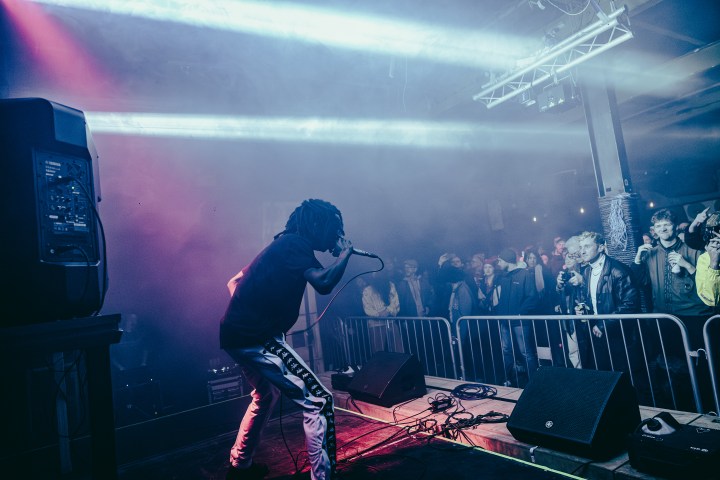
The late night programme takes place at Hope Works, a repurposed industrial estate outside the city centre. This is the festival’s spiritual home, and there’s an overwhelming number of acts scheduled into the early hours. Kenya’s Lord Spikeheart fuses extreme vocal delivery with furious industrial beats that polarise some attendees, while Batu’s set unites the crowd into a heaving sweaty organism. Back at SADACCA, tech difficulties mean Tom Payne’s immersive performance Storm Cloud is delayed. After waiting for 40 minutes in the cold, the intimate DIY space Delicious Clam provides a welcoming alternative with Micromoon’s shifting time signatures and hiphop-infused shoegaze.
On Sunday, focus shifts to neighbouring Rotherham. Chapel Of Our Lady is a tiny church sitting atop a bridge. Inside, Akhmad Kharoub – a Syrian refugee whose journey to the UK is scarred with traumatic experiences – performs what he calls a “mix of flamenco and war music”. Improvising alone on an acoustic guitar, Kharoub draws out serene melodies that are loaded with tension and despair. Despite the festival’s evident desire to max out the programme, the more understated performances make the most impact.
Ilia Rogatchevski Originally published by The Wire, November 2024
Ilia Rogatchevski speaks to Polish multi-instrumentalist Wacław Zimpel and master ghatam player Giridhar Udupa about their parallel journeys through music, and their combination as “interstellar folk” project Saagara. Photo by Rakesh Maiya.
In the first few seconds of ‘God Of Bangalore’, the track that opens Saagara’s latest album 3, eccentric rhythms fuse with bulging basslines and sequenced percussion. Synth pads are stalked by a serpentine violin as the steady thud of the ghatam builds up anticipation. Before the first minute has elapsed, we’re thrown into a world that combines musical languages from across the globe.
“It might have been 2016,” remembers Wacław Zimpel, the Polish multi-instrumentalist who, along with the master ghatam player Giridhar Udupa, is one of the main drivers behind Saagara, as he looks back to the song’s origin. “I was in India, walking around Giridhar’s neighbourhood with my field recorder. There was this amazing procession with drummers and folk musicians. I was recording the intensity of the rhythms and it became the inspiration for the track. The rhythm has changed [since then] – everything has changed – but the original vibe comes from the streets of Bangalore.”
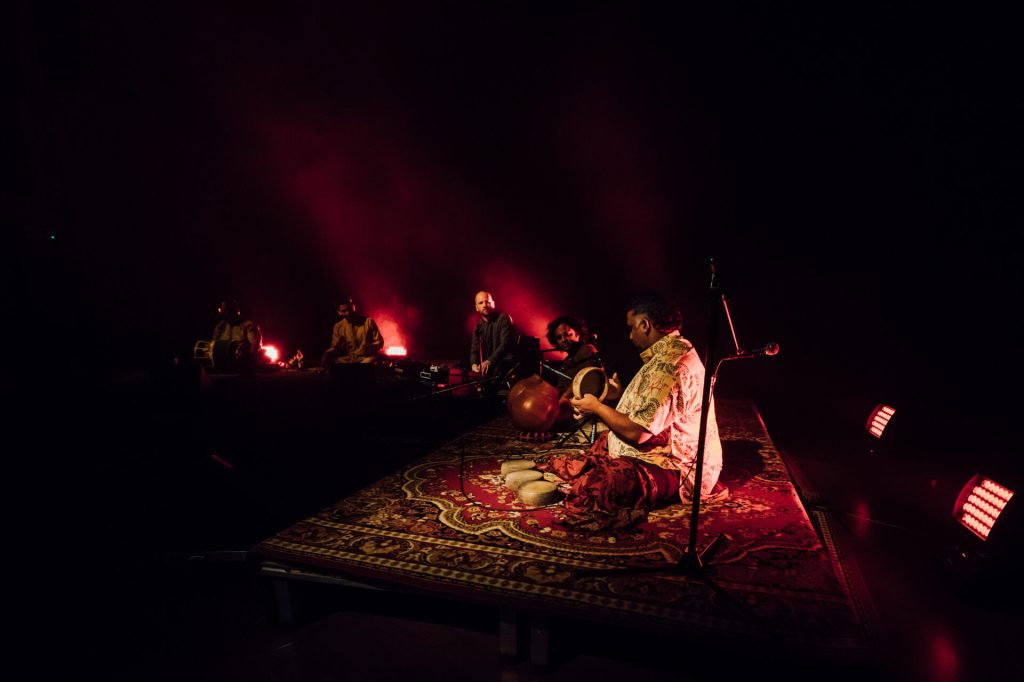
tQ speaks with Zimpel and Udupa via video call, each of us dialling in from different parts of the world. We discuss their parallel journeys through music and the roads that led them to develop a style that Zimpel has christened “interstellar folk”. Both musicians are classically trained and began playing at a young age. Udupa was first taught the mridangam – a double headed drum that typically leads in Carnatic ensembles – by his father Ullur Nagendra Udupa, before switching to the ghatam, a tuned earthenware pot. “When I was 9 years old, my father organised a concert and asked me to be part of it,” Udupa the younger says. ”Since there was already a mridangam player, he said I should play ghatam. They belong to the same family. The language is the same but the technique is different. Since then, when I perform classical music in India, I play only ghatam.”
Zimpel also changed instrument early on, from violin to clarinet, absorbing influences from Western classical, jazz and improvised music. He continues to master new sounds and, in recent years, has been incorporating electronics into his work. Last year’s solo album Train Spotter, for example, used field recordings from Warsaw in combination with an arsenal of synthesisers, keyboards and plugins to construct a pulsating portrait of the Polish capital. Saagara’s story, however, goes all the way back to 2012 when Zimpel and Udupa performed together for the first time. “I was very lucky that Giridhar was in Poland that summer,” Zimpel explains. “Our mutual friend Jacek Mazurkiewicz invited us to collaborate – that’s how we met. Before that, I had a big interest in Indian music. Mostly Hindustani music, which is from north India.”
Photo by Maciej Kaczyński
Zimpel was listening to a lot of Ravi Shankar, Ali Akbar Khan and Bismillah Khan along with minimalists like Terry Riley and La Monte Young who studied with Pandit Pran Nath. A desire to understand their compositional approach led Zimpel to Bangalore. “Giridhar introduced me to the flute maestro Ravichandra Kulur who has experience in both Carnatic and Hindustani music. Because I was in south India, and because Ravichandra is mostly a Carnatic musician, he taught me the fundamentals of Carnatic music.” Initially, Zimpel found it difficult to integrate his playing with Carnatic rhythms because he couldn’t follow what the other musicians were doing. However, studying konnakol (a vocal technique through which complex patterns are mapped out using percussive syllables) allowed him to better understand these rhythm cycles, freely improvise within that system, and thereby engage in a dialogue with the other musicians.
Saagara’s eponymous debut, released in 2015, was partially inspired by John McLaughlin’s acoustic fusion group Shakti. “It was a very important band for me, Giridhar and the other guys from Saagara,” Zimpel admits. “They’re legendary and a huge inspiration for us to make a real connection between West and East. Not just being on stage together, but really discovering our own language. My goal was to improvise with Giridhar, Aggu Baba [who plays khanjira], K Raja [thavil] and Mysore N. Karthik [violin] – who joined the band later – on a high level of understanding.” Even though it isn’t unusual to hear synths replacing tambura drones in Carnatic music, there were no electronics employed at that stage. “I told Wacław that it’s nice to have some pads, just a couple,” says Udupa. “And he was so particular: ‘No, let’s make everything acoustic’. So he brought two shruti boxes – manual things. We did two tours like this. From that to Saagara 3 is a drastic change. A complete evolution.”
The band’s 2017 album 2 articulates this careful transformation from an ensemble examining the roots of Carnatic music to one that embraces the studio as a separate instrument. “I wanted us to be as original as possible,” Zimpel says. “But when I started working more in the studio, I started feeling that I needed more control. We used to work with the producer Mooryc and he brought a lot of electronic sounds to our second album. Shortly after, I met James Holden and Sam Shackleton, and playing with those guys was like university for me.” The first song to be recorded for 3 predates the pandemic. ‘The Rite Of Rain’ maps out a new direction with looping synth and organ notes, backed by incisive rhythms, interlocking with Karthik’s violin. Holden mixed the track but also showed Zimpel how to connect the natural timing of Indian drums with sequencers using the Humanizer plugin. “It’s the heart of this whole production,” Zimpel says. “It allows you to translate the natural timing of the drummer to the sequencer, and those sequences start sounding more organic”. Zimpel produced the track in 2018, but it took him several years, and many albums in between, to master the skills required to complete the album.
Photo by Rakesh Maiya
This journey resulted in a record that has as much in common with its Carnatic roots as it does with a basement jazz club, or indeed a sweat lodge dancefloor. ‘Sunbeam Spirits’ is a delightful track that bridges these spaces. Strings are chopped into a flickering stereo attack before the ghatam breakdown leads you into a joyous clarinet solo that commands attention like a street corner preacher. Considering how Indian classical performances can stretch to three hours in duration, as well as psychedelic heights that their own work can reach, I ask if framing Saagara as trance music is valid. “The spiritual aspect of Indian music was something which brought me into it,” Zimpel says. “It’s about emptying your mind and experiencing the sound, rhythm, raga and harmony going through your body and being open to processes beyond your intellectual capacity.” The best part is that it’s enjoyable, Udupa hastens to add. “Starting from the first note, when we look at each other, we have fun. That’s what connects us to the audience.”
Saagara will be touring Europe in November in support of the new album. Meanwhile, their music has also been received well in India, not only because the group is disciplined and honest about how they experiment with traditional forms, but also because of the energy they bring to the stage. Zimpel concludes: “It is amazing how musicians in India are very particular about the energy in the room, what kind of thoughts or conversation we have in the tour bus, what kind of attitude we have towards one another. We try to bring the best from ourselves. It’s much less the theory about sequencers, Carnatic rhythms and ragas. What’s most important is when we’re all experiencing something extraordinary, something bigger than us. That is what Saagara is about – bringing this energy and spreading it to the world. That’s our mission.”
Saagara’s 3 is released by Tak:til on 18 October.
Ilia Rogatchevski Originally published by The Quietus, October 2024
The interweaving stories of avant rock band Ir Visa Tai Kas Yra Gražu Yra Gražu, jazz improvisors Haruspic and radical film maker Artūras Barysas provide a window into Lithuania’s underground from the Soviet era to the present day. Lead image: Juozas Milašius, Artūras Barysas in 2000. All photos courtesy of the IVTKYGYG Archive.
On the bank of the Vilnia River, in the northern part of Vilnius Old Town, stands the Lithuanian National Culture Centre. This unassuming building is home to the Plokštelinė recording studio. The avant rock band Ir Visa Tai Kas Yra Gražu Yra Gražu (And Everything That Is Beautiful Is Beautiful, often shortened to Gražuoliai – The Handsome Ones – or abbreviated to IVTKYGYG) invited me here to witness the recording of Catastropicum, their first studio album in six years.
IVTKYGYG’s leader Artūras Šlipavičius aka Šlipas greets me warmly and immediately offers a glass of whisky, which, he tells me, helps to warm up the vocal cords and stave off the cold in the cavernous studio. The ceiling of the live room is adorned with triangular diffusers, hanging upside down like stalactites, which were installed during the Soviet era. The studio was formerly run by the state-owned record label Melodiya and is famed for having recorded acts such as the ska-infused post-punk band BIX.
Although IVTKYGYG formed in 1987, they had never recorded in this legendary space before, until a grant from the Ministry of Culture of Lithuania financed their new project. The sessions took place in early February 2022 amid rising geopolitical tensions in the region. When I arrive, the band are in the midst of recording a semi-improvised track called “Spletni” (“Gossip”). “There is so much gossip in Lithuania right now about the Russian tanks standing on Ukraine’s border,” Šlipas tells me afterwards. “There are so many emotions. We are recording this at a period when war could start next week.” Russia’s full-scale invasion of Ukraine commenced two weeks after my trip.
Unlike their contemporaries Antis, who took an active part in the Singing Revolution of the late 1980s – a series of peaceful protests, which paved the way for independence of all three Baltic republics from the Soviet Union – IVTKYGYG claim never to have been overtly political. “It’s totally different with these guys,” says Radvilė Buivydienė, director of the Music Information Centre Lithuania. “Antis, they were mainstream. Everybody was talking about them. IVTKYGYG are the real underground. I think that IVTKYGYG is a gem for real diggers, because the context is very rich.” The Baltic republics had a relatively relaxed attitude to rock in the late 1960s and early 70s. The popularity of The Beatles spawned many bands who imitated their sound. Countercultural youth movements such as the khippi (hippies) were initially tolerated by the state, because the authorities knew that many Western hippies were ideologically opposed to capitalism. Estonians had access to Finnish TV and radio broadcasts and, in many parts of Lithuania, you could tune in to Radio Luxembourg. In the southwest of the country Polish TV and FM radio were also available. Rock flourished as a result and khippi youth would regularly congregate in the Baltic states during the summer, often travelling from all corners of the USSR.
This all changed in 1972, when 19 year old student Romas Kalanta burned himself to death in front of the Kaunas State Musical Theatre in protest against the Soviet regime in Lithuania. The police attempted to suppress his funeral, which angered the khippi community of Kaunas and the city fell into rioting. After order was restored, the authorities cracked down on anything seen to be countercultural. Men with long hair would be arrested on the streets and forcibly shorn. Rock was banned and many musicians gave up playing altogether.
Kaunas had been the temporary capital of independent Lithuania during the interwar period and was the country’s cultural centre before Kalanta’s self-immolation. After 1972, Vilnius became the bedrock of the nation’s culture. Until the early 80s, performing in a band meant playing state-approved compulsory repertoire in restaurants. Clubs only started reopening in the late 70s, as disco became popular. Slowly, amateur bands formed, but instruments and sound equipment were extremely hard to come by. The guitar body could be fashioned out of wood, but the strings, pickups and amplifiers had to be sourced from elsewhere.
From left: Ara Šlipavičienė, Artūras Barysas, Artūras Šlipavičius, Gedas Simniškis, Vaclovas Nevčesauskas in Poland, 1998
IVTKYGYG’s bassist Gediminas Simniškis aka Gedas tells me how they obtained bass strings during this time: “In our music school there stood an unused piano under the stairs. My brother and his friend decided to cut a few strings from it. I stood guard. Later, I asked my brother how they chose the strings – did they pick them out by their notes? He replied that they chose them by eye, judging by their thickness.” Payphones would be similarly vandalised, with the handset microphones appropriated and refashioned into DIY guitar pickups. Amplifiers were made from stolen loudspeakers. Everything was handmade. “We had essentially been playing punk rock on homemade instruments before they played punk rock in the UK,” Gedas recollects.
Gedas is a prolific bass player who also worked with Antis and the new wave group Foje, both of which achieved significant success in Lithuania in the late 80s. Around this time, he was listening to Billy Cobham and Frank Zappa (who has a monument dedicated to him in Vilnius despite having no connection to the city) as well as prog bands Emerson, Lake & Palmer and Yes. Šlipas also mentions Zappa as a principal influence along with Gong, Faust and Fred Frith.
This music came into their possession due to Lithuania’s large expat population. Relatives and acquaintances living in the West would often send LPs back home. These albums would then be sold, copied, and traded underground.
The most esteemed record collector in Vilnius was a jobless man called Artūras Barysas aka Baras. Bearded, shaggy-haired and bespectacled, he was well known in alternative circles. His apartment was stacked with rare books, vinyl and antique paraphernalia. It was a criminal offence to be unemployed in the Soviet Union, but due to Baras’s myopia he was able to claim disability. He sustained himself by selling rare books to collectors in the West and LPs to curious youth at home. He also made absurd experimental films, in the Fluxus style, that bring to mind the work of Lithuanian expat avant garde film maker Jonas Mekas. For example, the short 16mm film Tie Kurie Nežino Paklauskite Tų Kurie Žino (Those Who Don’t Know Should Ask Those Who Know), from 1975, has Baras playing a messianic figure who incites his disciples to fight among themselves before walking away from the carnage to the sound of Kraftwerk’s “Kometenmelodie 2”.
By the late 80s, the combined fallout from perestroika and glasnost shifted the cultural mood in Lithuania, not to mention the rest of the USSR. Bands began performing openly and organising festivals without fear of reprisal from the authorities. One such festival, Roko Maršas (Rock March), was initiated by Antis leader Algirdas Kaušpėdas. The festival toured various cities in Lithuania in the summers of 1987–89 and soon became a vehicle for the Sąjūdis independence movement, as documented in Giedrė Žickytė’s 2012 film Kaip Mes Žaidėme Revoliuciją (How We Played the Revolution). It was within this social context that IVTKYGYG began their journey. The morning after IVTKYGYG’s recording session at Plokštelinė, Šlipas picks me up in his green 4×4 outside the Aušros Vartai (Gates of Dawn), the historic entrance to Vilnius Old Town, to take me to his dacha, the countryside studio where he spends half of his working week. The vehicle is decorated with photos of IVTKYGYG’s members and logo. He wants to show me his paintings and, on the way, he reveals how he started making music. “I was a bard,” he explains, referring to the Soviet singer-songwriter genre. “Lots of complicated guitar parts. I had some fans, but not many.”
This was 1985, the era of the Soviet-Afghan War. Teachers were not required to serve in the army, so to avoid conscription, Šlipas took up a post teaching art at a school in Rudamina, a village just outside Vilnius. There he met jazz saxophonist Vytautas Labutis, who had performed alongside Vladimir Chekasin, Sergey Kuryokhin and many other influential Soviet jazz players. Labutis was also dodging the draft by teaching music. The two got together and improvised around Šlipas’s paintings, christening their project Haruspic (the name refers to an ancient divination practice that utilised animal entrails to make predictions).
Inspired by the Lithuanian symbolist Mikalojus Konstantinas Čiurlionis, Šlipas’s paintings depict surreal netherworlds inhabited by tortured figures. Posed in the Orthodox icon style, and often based on his own family members, these figures may be seen dining on eyeballs or, in a curious recurring motif, pickled cucumbers. The facial expressions of the sitters are distant, as if mourning a lifetime of mistakes and missed opportunities. Haruspic’s music reflects these themes on tracks like “The Flood”, in which two flutes, played by Šlipas and his wife Ara Šlipavičienė, intertwine with Labutis’s violin in a pseudo-medieval danse macabre. “Music like that you can only listen to once a year,” Šlipas says. “It’s very conceptual. You can’t drive, dance or drink wine to it. You have to look at the paintings and think.”
Running in parallel to Haruspic, but not directly connected to visual art, was IVTKYGYG. Despite having no musical ability, Baras was encouraged to start playing with Šlipas by pioneering punk musician Nėrius Pečiūra, who also drummed with IVTKYGYG for a short time. The band’s early work mixed energetic post-punk with accents of sonic eccentricity reminiscent of Pere Ubu or The Residents. Rehearsals took place twice a week, in the small basement of a residential house, with reel-to-reel recorders left running. These lo-fi recordings document a band on a vector separate from their contemporaries. Gedas tethered the band with his Peter Hook-like bass riffs as Šlipas’s raw guitar seared across the sonic spectrum. Baras, meanwhile, yowled lyrics appropriated from newspapers or other found materials. On “Eiti Eiti Eiti”, for example, Baras repeats, “Eiti eiti, dirbti dirbti, dar susitvarkyti” (“Go go, work work, sort it out afterwards”) – an ironic mantra ridiculing the Soviet obsession with labour as a symbol of economic citizenship.
Their self-titled debut, affectionately known as The Yellow Album on account of its cover art, was an underground hit when released on cassette in the early 90s (first under the patronage of Berlin’s Radio Marabu and later reissued by Lithuania’s Bomba Records). Recorded between 1989–91, the album reflects IVTKYGYG’s energetic early stage shows. The band would perform no more than a few live takes onto primitive equipment, before committing to a recording everyone could agree on. This resulted in an uncompromising sound that referenced the group’s appreciation of experimental music, while infusing the songs with a punk-like urgency. The album standout “Šunparkis” (“Dogpark”) references a rundown yard situated behind the Presidential Palace in Vilnius. The place was popular with punks and street drinkers, and was frequented by Baras himself. The song became a hit, particularly with students, and still elicits a jubilant response from the audience when performed today, due to the infectious riff Šlipas plays on his modified rubab.
Baras was a charismatic frontman, but the gigs were unpredictable. Gedas remembers one concert where the small stage had been extended by placing tables end to end. “For some reason, there was one table missing, which created a gap,” he says. “Baras was walking backwards [on the stage] and didn’t notice there was a table missing. He fell right into that hole.”
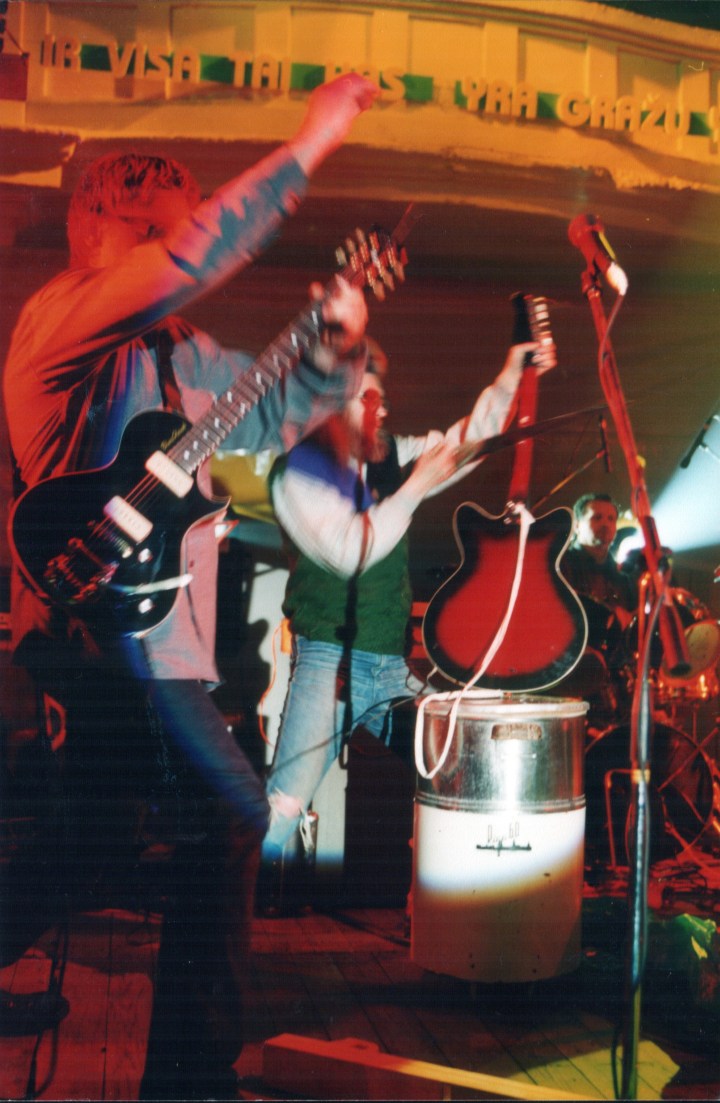
Another story recounts one of IVTKYGYG’s notorious washing machine concerts. Inspired by Fred Frith’s experimental guitar playing, Šlipas realised that everything had a sound potential, and all you needed was a microphone to amplify the signal. The band set up four Riga brand washing machines and put various objects, such as tennis balls, inside their upright cylindrical drums, creating a disorientating rhythmical din. One year, at the Muzyka W Krajobrazie (Music In The Landscape) festival in Poland, IVTKYGYG were performing one of these experimental sets. Baras’s machine refused to switch on. Eventually, the frontman realised it wasn’t plugged in, but instead of finding a spare socket, he unplugged an extension cable connected to other equipment and cut power to the PA. Perhaps echoing an anti-hero from one of his own films, Baras revelled in the ensuing chaos.
Baras drank heavily, before shows and in everyday life. His addiction eventually led to him being incarcerated in a “therapeutic labour dispensary” (a state-mandated rehab centre for problem drinkers) and inevitably caused tensions within the band. Ara Šlipavičienė, who played various instruments in IVTKYGYG before largely leaving the band to concentrate on her family and career in insurance, recalls that towards the end of his life, the frontman’s drinking became increasingly problematic.
“He was, at that time, very ill,” she recalls. “We had a really important gig and we guarded Baras for three days so that he wouldn’t drink. Still he demanded it. We gave him water, but told him it was vodka. He couldn’t tell the difference. We all thought it was funny at the time but, of course, it isn’t funny at all.”
In one of his last films, Suvokimas (Perception), Baras plays a man possessed by a woollen blanket – a metaphor for the perception-altering qualities of alcohol – who murders an artist in his studio. He is later arrested but released without charge. The short film is at once a delirious allegory of alcoholism and a self-reflective look into how addiction can destroy creativity. “Half the film was shot in my studio,” remembers Šlipas. “[Baras] wanted to show how seriously ill he was. How hard [alcohol addiction] is.”
From left: Artūras Barysas, Vaclovas Nevčesauskas and Gediminas Simniškis at Mėnuo Juodaragis Festival, 2001
Baras died in 2005, the night before IVTKYGYG were due to record their washing machine project. The band paid their respects with an art action near the Neris River. They lit a fire inside of Baras’s washing machine, burned the scarf in which he died, and threw the washing machine over a bridge. Says Šlipas: “Baras once said that he wanted his ashes to reach the White Sea. We felt that in this way, it will happen.” During one of Baras’s extended spells in state-enforced rehab in the mid-90s, Šlipas decided to change the band’s direction. By this time, they had already begun experimenting with different forms, amassing a rich archive of so-called Birthday Tapes.
These recordings ranged from standard rehearsal recordings to quirky birthday songs composed for each of the band members. A horn section was added, a singular concept developed and the arrangements began displaying elements of progressive rock, jazz and esoteric folk music.
Released in 1996 by Bomba Records, IVTKYGYG’s second album Linkėjimai Falkenhanui (Greetings To Falkenhann) is considered by Šlipas and Ara to be the band’s finest work. The album is informed by the horrors of the First World War and its title references the Prussian general Erich von Falkenhayn, the commander responsible for deploying poison gas on the Western Front. The album is composed of nine tracks, most of which are instrumental. The saxophones (played by Artūras Martinaitis, Darius Kodikas and Vytautas Labutis) often lead the way, cutting through percussive undergrowth or repetitively raging against IVTKYGYG’s rhythm section. With the lead vocalist largely absent, the interplay of melody and texture became principal concerns for the group.
The credits list 11 personnel playing a wide range of instruments that include some unusual sounding objects: kitchen kerbs, kaziukas, haruspik. In the studio, Gedas shows me a surviving haruspik, one that the band still perform with today. It is fashioned out of a long metal cylinder that eerily resembles an amputated tank gun. Categorically, the instrument sits somewhere between an electrified tube zither and a percussive outsider art sculpture. The haruspik was built by the band themselves and they consider it to be their signature instrument.
“For music lovers in Lithuania, this project passed with a bang,” Šlipas says of the album. “It’s completely different, because I was different. The band needed to evolve. It’s my masterpiece.” On his return from rehab, Baras was angered to find that Šlipas had recorded the album without him. What was he going to do on stage, if there weren’t any songs to sing? The two fell out, but eventually reached a compromise by having Baras viscerally shout “Falken-hann” over and again on the title track. Arranged in 3/4 time, the sinister song closes the album, and is described by Šlipas as “the final waltz – the waltz of death”. Surprised by its power, Šlipas was moved to tears listening back to the finished work for the first time.
Live, the band’s theatrics are reminiscent of Peter Gabrielera Genesis. In contrast to the British prog rock band, however, IVTKYGYG’s staging is laced with irony. Footage from their 25th anniversary concert in 2012 shows Rimas, Šlipas’s brother – a stained glass artist and collaborator who designed the band’s logo and wrote “Šunparkis” – wearing a yellow hazmat suit and gas mask. The costume evokes the spectre of Erich von Falkenhayn and the spirits of those who fell in conflict as a result of chemical weapons. Rimas mimes sawing off his own forearm with a bow-like object, while Ara and Arvydas Makauskas aka Makys (the band’s post-Baras vocalist) exchange rhythmic scat lines.
Artūras Barysas with unknown companion, circa 1980s
The band’s work is steeped in ambiguity and it can be difficult to unpack the messages behind their songs. IVTKYGYG’s percussionist and archivist Robertas Kancius sent over some translated lyrics. “Aš Aš” (“That’s Me, That’s Me”), from the 2016 album Paradas (Parade), is a bossa nova-like ska fusion that derives its lyrics from tabloid newspapers and celebrity magazines. “It’s a collage of the actual headings from the yellow press,” explains Kancius. “X did this and that, Y had dinner from plates made of chocolate, Z opened a bottle of champagne with a sword. We just skipped the names and left the actions only.” The result is a critique of the celebrity-driven personality cult. “Saldus Saldainis” (“Sweet Candy”), which appears on the 2002 album Lavonai (Corpses), treads similar ground. The only lyrics you hear are “saldus saldainis įstrigo mano gerklėje ir gargaliuoja” (“the sweet candy got stuck into my throat and gargles”). Kancius says: “[It] looks like nonsense, but that sweet candy can be anything from pop culture (in the worst sense of this word) or politicians’ promises, to anything the masses are fed to be stupid, happy and obedient.”
Their most problematic song is “Pigūs Norai” (“Cheap Desires”), the recording of which I witnessed at the studio. Although it was written in response to China’s blockade of Lithuanian goods (a measure intended to overturn the Baltic state’s ties with Taiwan), and is clearly engaged with a postmodern play on meaning and meaninglessness, the track’s execution comes across as a reactionary cultural appropriation. Ara sings lyrics mediated by an online translator in a faux-Chinese accent, while Šlipas’s melodic motifs imitate Chinese folk music.
Despite the track title’s apparent critique of globalisation, I ask Šlipas to clarify his intentions. He collects his thoughts before replying: “I lived for three months in the USA, in New York and Chicago. I exhibited my multimedia works, drank wine with [Jonas] Mekas. I wanted to buy some tableware for my dacha, but everything for sale was ‘made in China’. You begin to understand that maybe your brains are made in China, perhaps your ears are too. Do you hear what you’re supposed to? All the trains have been blocked by China, because a de facto Taiwanese embassy was opened in Vilnius. Everything is really bad in Lithuania currently. All the products, everything is stuck [at customs].”
In 2002, a few years before his death, Baras was invited to screen his films and read poetry at The Horse Hospital in London. He was received well by the Lithuanian expat community who attended the event, and was introduced to John Balance and Stephen Thrower of Coil, whose work he greatly admired. The event’s organiser David Ellis later played a significant role in bringing Baras’s work, as well as the music of IVTKYGYG, to a wider audience. Strut Records is releasing a compilation chronicling Ir Visa Tai Kas Yra Gražu Yra Gražu’s idiosyncratic compositions. The album, co-curated by Ellis and Strut founder Quinton Scott, taps into the band’s archive, shining light on long out of print recordings, recontextualising their better-known works, and making some of their rehearsal tapes public for the first time.
Baras’s films have also been restored and made public. Dovydas Bluvšteinas (founder of Zona Records, the first independent label in the Eastern Bloc) and Robertas Kundrotas (co-founder and former editor of the experimental music magazine Tango) undertook the project, for which Ellis was a creative advisor. With the help of Baras’s son, video editor Vytis Barysas, they began digitising the prints. The soundtracks to the original films contained unlicensed music collaged together. To get around the issue of copyright, several contemporary Lithuanian artists were asked to contribute new compositions.
How were the participants selected? “At the very least, they had to know who Baras was,” says Kundrotas. “Better still, if they knew him. They’re all serious artists: underground musicians, noiseniks, experimentalists.”
From left: Vaclovas Nevčesauskas, Artūras Barysas, Artūras Šlipavičius, Rimas Šlipavičius, Ara Šlipavičienė and Gedas Simniškis, circa 1990s
Baras: Contemporary Lithuanian Composers Scores To Artūras Barysas Short Films 1972–1982 was released on Zona Records in April 2022, and features 15 tracks from contributors such as Gintas K, McKaras and Arturas Bumšteinas. Many of the compositions feature ambient soundscapes, drones and field recordings. For example, Bumšteinas, who soundtracked Romas, Renata, Rimas (1977), blended the sounds of cicadas with organ drones and shortwave radio broadcasts. Coupled with saturated visuals of three friends swimming in a river and picking flowers in the nude, the result is a carefree impression of summer. Haruspic also contributed music for Tas Saldus Žodis (That Sweet Word, 1977) and Intelektuali Popietė (An Intellectual Afternoon, 1982), which can be viewed, along with the other restored films, on the website of the Lithuanian public broadcaster LRT. Towards the end of my visit, I’m invited to preview Balti Sparnai/ White Wings, Haruspic’s first album in two decades. Labutis’s studio is located on an industrial estate in the Žirmūnai district, on the north bank of the Neris. Erected in the Soviet era, the buildings in this complex all contain underground bomb shelters, later converted for alternative use. Labutis’s basement bunker, which he has occupied for 16 years, is filled with various instruments, electronic equipment, cables and computer monitors. The walls and ceilings are covered with carpet tiles to dampen the sound. Šlipas drives me here, and after shutting off the outside world with a steel blast door we listen to some key tracks together.
This record is very different from their earlier albums Haruspicija and Lethe. Whereas before Haruspic leaned heavily on free jazz and folk, this time musique concrète, samples and electronics all make an appearance. On “Menui Menas/Art For Art’s Sake”, Bluvšteinas recites a tautological manifesto inspired by the Italian Futurists. His voice is transformed with a vocoder, perhaps a nod to David Lynch’s “Strange And Unproductive Thinking”, before being chopped, repitched and pelted with disorientating dubstep bass drops.
Elsewhere more traditional rock structures emerge, as on “Manjana/Mañana”, but Haruspic subvert old tropes with nonsensical ironic humour. Labutis cites Russian musician Sergey Kuryokhin as an influence, recalling one concert in which a horse was brought onstage. It defecated next to the string quartet and was led off again. Kuryokhin’s infamous televised hoax Ленин — гриб (Lenin Was A Mushroom, 1991) also impacted this project. In the 60 minute interview, the po-faced composer reasoned, with reference to ‘evidence’, that the Bolshevik revolutionary and founder of the Soviet Union was in fact a mushroom. I ask about the change in direction. “It’s radical and we’re conscious that it’s different,” admits Labutis. “It’s not that it wasn’t working before, it’s just that a lot of time has passed since our early recordings.”
The worlds of Haruspic and Ir Visa Tai Kas Yra Gražu Yra Gražu have cross-pollinated over the years, the projects imbuing each other with avant garde ideas or more straightforward rock freakouts. In many ways, Šlipas is a modernist, but uses postmodernist techniques to achieve his aims. “It’s no coincidence we are named Haruspic,” concludes Labutis. “Because divination is what we do. We never give an answer, only provide associations. We know nothing ourselves.” ● The self-titled compilation Ir Visa Tai Kas Yra Gražu Yra Gražu will be released by Strut Records in May 2025
Ilia Rogatchevski Originally published by The Wire, October 2024
Working from exile in Poland, the Belarusian musician, poet and broadcaster keeps his home country’s avant garde flame alive. Photo by Jury Siemianuk.
Pramzona #7, the latest release in Viktar Siamaška’s arsenal of archival recordings, opens with a percussive conversation between found objects. The low rumble of what sounds like a plastic pipe flutters loosely as wooden sticks brush across metal railings and glass debris sweeps the floor. Prefiguring Siamaška’s brooding clarinet, a distant cuckoo contributes to the industrial clamour. Recorded in 2018 at the cultural complex Dalina Aniołaŭ (the Valley of Angels) in Mazyr, Belarus, it investigates the inert acoustics of abandoned spaces by activating them through improvised performance – just like the other albums in the Pramzona series.
“I’ve always wanted to go beyond the domestic recording process to environments with vast natural acoustics such as hills and forests,” reveals Siamaška. “Deserted industrial buildings became the best places for creative encounters. In light of recent events [the 2020-21 Belarusian anti-government protests], it became a bitter metaphor for my homeland. These buildings are scattered across the country, and the word pramzona (industrial zone) is used to refer to places where thousands of Belarusian political prisoners are currently being made to work.”
Born in Minsk in 1980, one of his earliest memories is Soviet leader Leonid Brezhnev’s state funeral on TV. “The music had to conform to the moment,” he recalls. “My artist father was worried that after the General Secretary’s death something bad would follow. He was right. The USSR, of which Belarus was then part, began the ‘tightening of the screws’ [political and cultural repression] which lasted until Perestroika.”
Within this context Siamaška first began improvising at home on the family piano. “It came naturally to me. I liked making sounds, observing them and proposing what should come next. In that sense, my childhood experiments haven’t changed: improvisation, for me, is music in its totality.”
In the 1990s, Siamaška’s attention turned to early Pink Floyd, Russian composer Alfred Schnittke and the “self-analytical” free jazz of The Ganelin Trio. Late-Soviet avant garde innovators like trumpeter Vyacheslav Guyvoronsky, cellist Vlad Makarov and composer Sergey Kuryokhin were also influential, along with concerts by Knyaz Myshkin. “They were a Minsk based improv group that played with a new line-up every time and had an open mic in case anyone from the audience wanted to join in,” Siamaška remembers. “I often played in a duo with the band leader Leonid Narushevich, which was a colossal experience. The gigs varied qualitatively and some ended with women asking for autographs. Others with bandits threatening violence.”
After cutting his teeth with Knyaz Myshkin, music-poetry duo Kuzniec & Siamania and psychedelic folk outfit Nagual, Siamaška formed Fantastyčnyja Płyŭcy (Fantastic Swimmers) in the mid-2000s. Initially, their idea was to anchor the music around the piano. As members joined and fell away, the project pitched horns against reeds (Chronograph, 2010), reshaped the blues (Duplet, 2011) and deconstructed Pink Floyd’s “Interstellar Overdrive” (2015). “It was important to have different musicians for different sessions,” says Siamaška. “This expanded our network of like-minded people, formulating a separate section of pianists, the Kum-Kuma choir, as well as musicians based in Minsk and Warsaw, who have now consolidated after the mass emigration from Belarus.”
Their early recordings often documented performances at various art centres around Belarus, but in recent years Fantastic Swimmers have increasingly spent more time in the studio. Bonaventura (2022), for example, was recorded at Warsaw’s Quality Studio. Gosia Zagajewska’s haunting vocals ride atop a life raft hurriedly constructed by Alaksiej Varsoba’s accordion and Vital Appow’s bassoon. Piotr Dąbrowski’s cascading snares lap at the sides, while Siamaška’s frenetic piano threatens to puncture the hull.
Also a poet, Siamaška published five books of verse between 2010–23. His project Viktar Siamaška Dy Kumpanija developed from solo concerts that incorporated psychedelic effects into his poetry readings, although recordings such as Duxo (2023) prioritise sonics over semantics. “In my opinion, there are two forms of art – musical and graphic,” Siamaška reflects. “The former is realised in time, the latter in space. Poetry and music are both time-based media, it’s just that music operates with abstract sounds while poetry is affirmed by linguistic meaning.”
His parallel career as a broadcast journalist provided Siamaška with an opportunity to research music stemming from Belarus. Local scenes blossomed before many people were forced into exile in 2020 (Siamaška himself is now based in Poland). His first show Terra Nova showcased new emerging sounds while his current programme Krakatuk – broadcasting on Białystok based Radio Racyja – dives into the archives exploring Belarusian jazz and avant garde music from the 20th century, among other eras and genres.
Siamaška has produced over 500 episodes and considers the programme his contribution to restoring Belarusians’ cultural DNA. “Right now, inside Belarus, everyone is risking their freedom while the diaspora comes to terms with integration. But all this will lead to the second stage of the revolution when the exiles return and there will be extensive synergy. I estimate this will happen within the decade.” ● Viktar Siamaška’s Pramzona #7 is released via Bandcamp. His Krakatuk archive and links to his other projects can be found at mixcloud.com/vvsiamashka
Ilia Rogatchevski Originally published by The Wire, September 2024
Ilia Rogatchevski speaks to the child star turned artist, musician and composer about his excellent new album Instability Of The Signal and his many collaborations with Derek Jarman. Portraits by Marta Ruly
On a torrid June morning, I’m invited to speak with Simon Fisher Turner at the Mute offices in South East London. The interview takes place in a converted loft that was once Daniel Miller’s residence but is now home to his label. Framed commemorative discs of Moby’s Play lean against the corridor walls, their former glory partially obstructed by a row of hanging coats. Turner is already here, setting up his red Edirol recorder on the balcony to capture trains screeching on the railway bridge below. “I collect sounds,” Turner tells me as we sit down in a large room filled with records, books and synthesisers. “But I don’t think of myself as a sound library. It’s a discipline where I must do something. That’s why I’ve stuck the microphone out the back there.”
Instability Of The Signal, his latest album for Mute, is a multifaceted record that incorporates many such field recordings alongside synthetic “slivers”, surreptitious strings, snatches of piano, the occasional detuned guitar and the composer’s own voice. The seeds germinated during Covid, when Turner came across some brooding noise experiments by David Padbury, who records as Salford Electronics. “I heard a piece by David and really liked it,” Turner recalls. “I sent him an email and suggested this idea of slivers of sounds. It’s something I’ve been after for ages. The older I got the less I played instruments, working with either my recordings or other people’s recordings. I asked David for these slivers, tiny bits of stuff, and started to make a piece out of the bits he sent me.”
Working at night, due to the compressed lifestyle that the pandemic impressed upon his household, Turner shaped Padbury’s foraged sounds and samples into blueprints for new compositions. Over thirty recordings, each one clocking in at around a minute in length, were manipulated into new structures, but only five made the cut. The lead single ‘Barefeet’ is a good example of this process. A looping phrase, something akin to a repitched elevator ping, holds court to deep pulses, sparse guitar and intrusions of electronic noise. You can also hear unmanipulated sounds of buzzing insects and dice thrown across the floor. In the music video, which is largely composed from still photographs taken by the filmmaker Sebastian Sharples, we see snapshots from everyday life: a desolate Soho street during lockdown, barren tree branches in winter, a car boot filled with trainers. These images document fleeting quotidian moments and echo Turner’s own enthusiasm for collecting “life recordings”, as he calls them.
Tying all these sounds together is Turner himself who sings spontaneously constructed poems. “At the end of Covid, I called up Daniel and told him about the slivers and that I’d love to sing. He said that the Mute studio is closing down but Francine Perry is finishing up there and we could record with them for a few days.” Perry is an award-winning producer who is one half of the minimal techno duo ORKA and also releases experimental electronica as La Leif. “Francine works really fast and I work really fast,” says Turner. “We were just naturally riffing. The vocals were made up on the spot, William Burroughs cut-up stylee. Just using this book [Taking On A Name: Videotapes 1986-94] about Breda Beban and Hrvoje Horvatic, and two poems by Harold Pinter, ‘Democracy’ and ‘The Special Relationship’. They’re war poems. I think they were just one take and that’s it.” Both texts reference the 2003 invasion of Iraq but the latter poem (“The bombs go off / The legs go off / The heads go off”) feels especially chilling when framed by Turner’s unsettling drones. The curt macabre imagery resonates with the interminable horrors unfolding in present day Gaza and Ukraine.
Beban and Horvatic were experimental filmmakers from war-torn Yugoslavia who settled in Britain in the 1990s. Using the aforementioned monograph (printed for the occasion of their 1994 retrospective at the Whitechapel Gallery) as source material for his lyrics was Turner’s way of paying homage to them. “They were video artists, filmmakers and friends of ours who both died [Horvatic in 1997, Beban in 2012]. It was just tragic. They were very, very influential and sort of a continuation of, for me, artists like Derek Jarman, who were just doing their own thing, and were really kind and generous.” Flipping through the book, Turner would arrive at a phrase or sentence that possessed some kind of magnetism and truncate it, divorcing it from its original context. For example, in the song ‘She Lowers Her Arms’ the original sentence reads “She lowers her arms and turns to walk slowly out of the frame”. Turner elaborates: “I was seeing that as a line. We’d track it and then go to the next line. I’m a big fan of William Burroughs’s cut-ups, through liking David Bowie, you know, from 40 or 50 years ago, whenever it was. It just made sense.”
Memories from this time surface on the track ‘Toast’, a song that evokes Turner’s childhood growing up in London. “I’ll get my own toast and read a comic / I like the war ones / I love my comics”, Turner reminisces in the song’s opening seconds. He sings about the joy of riding an old Routemaster bus, discovering the city by bicycle and living on his own as “a little thief”. The final refrain “my time in my time / my time in my mind”, which bounces up against a steady bass loop and scrawny guitars, is evidence of his nostalgia. Turner was a child actor before embarking on a career as a “non-popstar”, starring in Tom Brown’s Schooldays and The Intruder, among other TV series. Income from acting afforded the freedom to see bands regularly. “I saw The Spiders From Mars at Slough Technical College – that was life changing. All the universities used to put on gigs. There was the Marquee, the Lyceum, the Roundhouse. I saw everybody in the 70s. Once I discovered gigs, I was in heaven, really.”
While still a teenager, Turner signed to Jonathan King’s UK Records, releasing Simon Turner in 1973. His debut album is full of tepid covers but included a version of Bowie’s ‘The Prettiest Star’ which pulled Turner into the orbit around David and his then wife Angie. Turner spent time with the couple in Switzerland and looked after their apartment in New York. “I was friends with Angie and she was brilliant. She was a super strong woman and not given enough credit for supporting Mr. Jones. We had a great time and I ended up in very strange situations because of that. It was all part of MainMan, Tony Defries’s management company, who looked after Iggy Pop and Lou Reed. It was all very mad, but I learned that you have to fight for what you want.” Despite having rubbed shoulders with rock giants as a young adult, Turner’s time in the spotlight was brief. “I was in lots of magazines, but I wasn’t a popstar. And thank goodness. If I had been wildly successful, I wouldn’t be alive. I would have succumbed to everything. I had no control.”
In the early 1980s, when working for Cherry Red Records, Turner joined Matt Johnson and Colin Lloyd-Tucker in an early lineup of The The. Over the course of a single summer, the three-piece played swathes of support gigs on the London club circuit. “We all got our skinhead cuts, wore sweaters and jeans and carried our guitars in black plastic bags,” Turner remembers. “Just three of us playing Matt’s songs, one of Colin’s, one of mine. We didn’t have any drums so we were a good support band because we could just turn up and play.” Becoming increasingly more interested in “music [that] seemed light and touched our feminine side”, Turner and Lloyd-Tucker later splintered off to form the fictional French female duo Deux Filles, which blended ambient soundscapes with a post punk sensibility.
His other musical exploits included gallantly masquerading as The King of Luxembourg, performing baroque revisions of pop songs alongside his own opulent originals. “The first record [Royal Bastard, 1987] was a covers record. Mike Alway from Él chose all the songs. Then on the second record [“Sir”, 1988], I decided to write my own. As soon as you start to put words to music, then it has to be heartfelt and proper. If it’s insincere, lyrically, then it doesn’t make any sense to me. I can’t sing ‘Hey, baby, I love you’ unless I really mean it.” Turner also branched out into film scores around this time, working closely with Derek Jarman on projects including Caravaggio (1986), Edward II (1991) and Blue (1993). This led to more commercial work, such as the David Lynch-produced vampire flick Nadja (1994), and soundtracks for restored versions of The Great White Silence and The Epic of Everest (for which Turner received an Ivor Novello Award). Both films were originally completed in 1924 and depict two respectively tragic expeditions to the far corners of the planet: Captain Scott’s attempt to reach the south pole, and George Mallory and Andrew Irvine’s fatal effort to scale the summit of Mount Everest.
Over the years, Turner has been increasingly interested in experimenting with variations on texture, sound collage and noise. Soundescapes, his 2011 collaboration with the Norwegian filmmaker Espen J. Jörgensen foregrounds the fragmentation of samples in a similar vein to David Padbury’s slivers, while A Quiet Corner In Time from 2020 positions recordings of Edmund de Waal’s spinning ceramics as “sound solos” against alkaline washes of ambient drone. Meanwhile, his two albums for Editions Mego, Giraffe and Care (the latter being made in collaboration with Klara Lewis), released in 2017 and 2018 respectively, both experimented with harder edged industrial structures.
Despite his impressive résumé, Turner insists that his career was entirely accidental. “I went to ballet school. They had an agent so I started doing radio work and TV. I became an actor by accident, a bit like becoming a musician by accident. It was a period of time where you seemed to have accidents, which would lead to something else. It sums up my approach, without really even thinking about it.” One such accident was a chance encounter with the producer Guy Ford that led to Turner working with Jarman. “I was sitting on the street and Ford, who worked on Sebastiane (1976) and Jubilee (1978), came up and said: ‘I interviewed you when you were 16 years old. You were really obnoxious! Do you want a job?’ And suddenly I was working on The Tempest (1979). I drove the catering van and helped Heathcote Williams and Toyah Willcox test their lines. We were filming outside London and I just got involved.”
Because the shoot took place over several months at a remote location, Turner brought with him a keyboard and a Revox reel to reel recorder, contributing to concerts and happenings on the set during his downtime. This caught Jarman’s attention. He hired Turner to compose soundtracks for a string of Super 8 films and the historical feature Caravaggio. Their working partnership continued into the 90s, culminating in Jarman’s final film Blue. The famously emotive work chronicles the director’s experience of AIDS, and the partial blindness it inflicted on him, along with diaristic impressions of everyday life contrasted with dreamlike sequences. Consisting of a single shot of International Klein Blue, the work is held together by the strength of the narration and sound design. “Derek’s role in my life was like a teacher without teaching,” Turner says. “He’s constantly on my mind. He was wise and curious, instilling in me a sort of bravery. He used to talk about things I’d never heard of: Yves Klein, Caravaggio. I had no idea who these people were. He was capable of so much and made incredible images. He could do a narrative film like Edward II and then do The Last of England (1987) or The Garden (1990), which don’t have a normal structure. And then you have Blue, which is not so much a story, but observations about life and death and love in this frame, this void, of Yves Klein Blue: nothing and everything.”
After completing the voiceovers, Jarman tasked Turner with filling in the silences. Brian Eno lent them his house to record in and the producer Markus Dravs engineered the sessions. “The whole experience was mind blowing. The fact that it ended up as a film, this crazy idea, and all these people involved like Vini Reilly [The Durutti Column], is incredible. We had to structure it around the dialogue, so we were making it up as we went along.” Since its premiere in 1993, and Jarman’s death from an AIDS-related illness several months later, Blue has continued to evolve. Turner admits that the film is impossible to recreate live, which is why performances of the score tend to stretch Jarman’s original framing by experimenting with the setting, language, narrators, and duration. Last year’s Blue Now – directed by Neil Bartlett – restaged the project in venues like the Tate Modern and featured Russell Tovey, Travis Alabanza, Jay Bernard and Joelle Taylor as the narrators, consciously contrasting with, in Turner’s words, the “very English, white middle class actors” from the original film.
Turner considers Blue to be a seminal work, “as important as ‘Mona Lisa’”, and is visibly enlivened when talking about it. “Doing Blue live is great because it’s a different kettle of fish, much more fluent. For instance, I did it a few weeks ago in Italy, with only two performers, all in Italian. I had a piano and a computer. It was very focused. The concerts now illustrate the words far better than they do in the film. It’s just a fantastic opportunity [to experiment and improvise] because the words are there, the blue is there, and all we have to do is start. It’s really sexy and dangerous, a great palette to work against.” He explains that the project will resurface in the winter with more performances, this time featuring the cellist Lucy Railton and a looser sonic framework. Turner wants the music to avoid the trappings of illustrative sound effects, preferring it instead to be “like a mattress” that the actors can “jump on top of”.
Jarman’s legacy can be felt on Instability Of The Signal, too. Some of the sounds that made it to the album, albeit in different mixes, were first recorded for a documentary produced by The Derek Jarman Lab, a research media hub based at Birkbeck, University Of London. Directed by Tilda Swinton and Bartek Dziadosz, The Hexagonal Hive and a Mouse In A Maze (2024) is an essay film about how education is experienced across the world. “It’s a story of life – how every culture thinks about learning in different ways. For instance, there’s no point being in a village in Nigeria and learning about computer sciences if you haven’t got electricity. The more we looked into making a film about learning the more complicated it became, because it’s a big world and everybody has different ideas.” On the album, Turner’s textures, cut-ups and slivers are bridged with instrumentals performed by the contemporary classical Elysium Collective. These sessions were initially recorded for an exhibition of Jarman’s Super 8 portraits held at the LUMA Arles, France (2021-22). Later finding their way to the record, tracks like ‘Turning Slowly’ and ‘Purr’ inject a sense of drama to the proceedings. The strings cut across Turner’s drones like sirens through fog, while the prepared piano and closely miked whispers on ‘I Can’t Hear Anything’ fill the air with paranoid trepidation.
Never straying too far from moving image, Turner continues to collaborate with filmmakers. The deceptive simplicity of Chris Newby’s juxtapositions seamlessly complement the cold tranquillity of ‘Bless Your Hands (Part 1 And 2)’. Waves lap against the walls of a church, while children walk along its snow capped roof, recalling the frozen stillness in The Hunters In The Snow (1565) by Pieter Bruegel the Elder. The Japanese filmmaker Isao Yamada also contributed a Super 8 video for ‘Turning Slowly’. Edited from a much longer film inspired by Instability Of The Signal, it features shaky street scenes exposed onto expired film stock. The images are awash with a fading blue tint reminiscent of indeterminate memories left out in the sun.
Yamada features on the album’s cover, listening to the record for the first time, seemingly enraptured by the experience. At one point, another photo was considered for the cover, taken by Andy Warhol, of a young Turner partying with Fran Lebowitz on top of the World Trade Center. Why was that photo not used? “The Warhol thing would have been great. It was 48 years ago – a party for Dolly Parton – the contact sheets are all online. I went with Danny Fields, who managed the Stooges, Iggy, and the Ramones. I called Danny, who hadn’t spoken to me for years, and we went down this chain of trying to get permission, but they [The Andy Warhol Foundation] asked for a lot of money, £5,000 pounds or whatever. It was ridiculous.”
As we wrap up, Turner wonders if the SD card in his recorder maxed out. I take the opportunity to ask him about the ethics of collecting sound. Has he ever felt like he’s eavesdropping or using something he shouldn’t? “There was a Mute concert at the Roundhouse [in 2011] and I had been recording stuff from YouTube of the war in Syria. I saw this terrifying footage of a young couple who were on the roof of their house with tanks in the square below them. All you heard were these engines, the most horrific sounds. I played it with Mira Calix and Laura Moody and it was really, really disturbing because nobody would have known what it was but they would have felt that it was heavy. It was as political as I’ve ever been. I’m actually not interested in that kind of intensity but with this [points to a copy of the new album], with ‘Democracy’, I can say it with Pinter’s words. That’s as far as I can go.”