comment 0

KMRU: Different Every Time

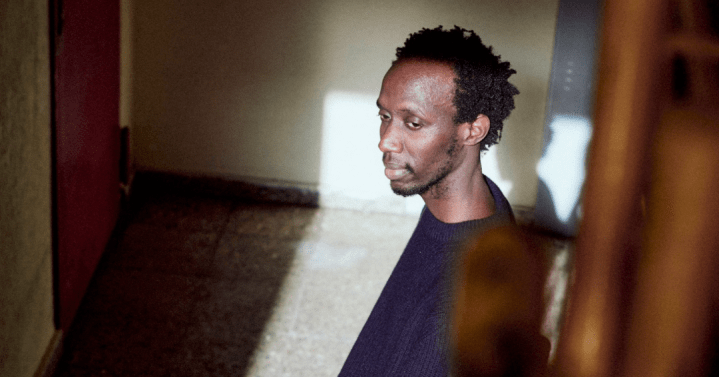
The Kenyan born producer and artist finds a sense of place via field recordings, music and installations, giving voice to ethnographic sounds and archived objects By Ilia Rogatchevski Photography by Laura Schaeffer

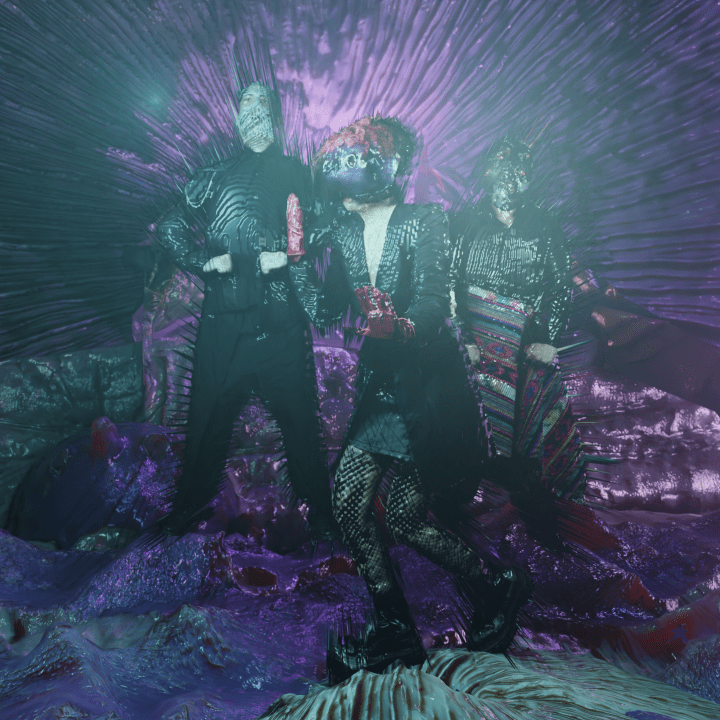
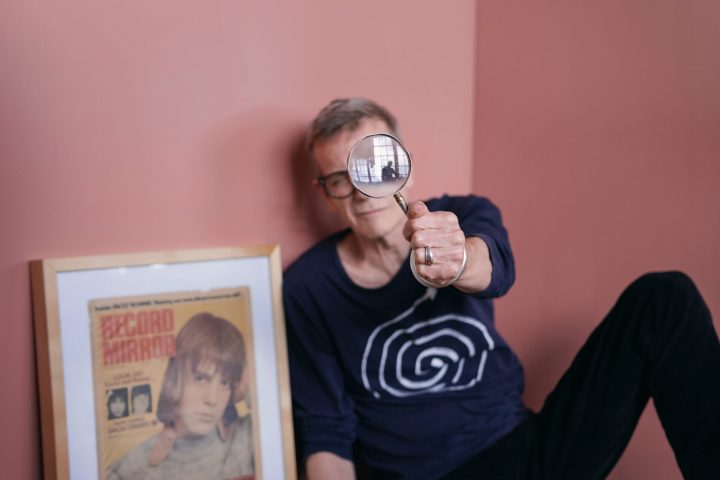
Listening to Disconnect, KMRU’s collaborative album with Kevin Martin, fills your gut with contradictory feelings of dread and elation. “Lately, I’ve been thinking about sound on a very physical level,” Joseph Kamaru, the Berlin based producer who releases under the KMRU alias, explains over video call. “I know most of The Bug stuff, and really enjoyed his Pressure album. With Kevin’s work, it’s interesting how he can push style and alter bass frequencies to extremes. I think that’s how we connected.”

The whispering drones on “Differences” evolve gradually out of silence, swirling around Kamaru’s wordless intonations, as steady percussive pulses carry the composition forward. Intense trepidation swells like the oncoming wave of an ecstasy high while his voice, softly spoken but authoritative, recites a monologue about “understanding the Other”. The text in “Arkives” discusses African traditions and artefacts within the context of colonial violence. The words are set against monochromatic chords and despondent chanting that suggest an imminent dystopian collapse.

“Differences” and “Arkives” are the core of the record and, in true dub fashion, the tracks that follow strip away certain elements while contributing new ones: the subtle bass drum and shuffling snare brush on “Difference”, for example, or the repeating minimal synths on “Differ”. Even the track titles resemble fading echoes by truncating the original text as you progress through the album.

Kamaru’s alliance with KRM is far from the only collaboration he has undertaken. Limen, his 2022 release with the French sound artist Niamké Désiré aka Aho Ssan, was described by Vanessa Ague in The Wire 460 as “a means to harness destruction and build something anew”. The album’s key track “Resurgence” was a Berlin Atonal commission. Paired with visuals of volcanic activity, its layers of digital noise and ceaseless crescendos share the density of a neutron star. The rest of the album is no less extreme. Despite the apocalyptic mood of the music, the collaboration itself came easy. “Limen was very spontaneous,” Kamaru says. “We had this one track and were like, let’s explore something together. Similar to Kevin’s collaboration, it was also online, but with Désiré it was so seamless, cohesive.” The two albums share a curiosity for the darker sides of the human condition – Limen is partly inspired by Katsuhiro Otomo’s cyberpunk manga Akira as well as the mythical phoenix bird – but whereas Disconnect concerns itself with solitude and soul searching, Limen is focused solely on cathartic intensity.

Martin – credited here under his initials KRM – first became aware of his collaborator’s work after watching Coco Em’s short documentary Under The Bridge (2020). The film opens with Kamaru collecting stones and throwing them against the concrete walls of a roadbridge, with recorder in hand. He uses their skittering as the starting point of a new track. The recordings are looped or augmented; drones are layered on top of each other with a tone generator. The process is broken down as if in a YouTube tutorial. He speaks directly to camera and shares screen recordings of his Ableton session, demystifying his methods.

So KRM contacted KMRU on social media, and at first the musicians shared music with each other, leading to a collaboration in 2021. “He reached out about making an album together based on my voice,” says Kamaru. “We shared sketches, although both of us were busy touring, and it wasn’t until late last year when we decided to finish the tracks. The timing was sort of interesting, because I was writing this paper in school [Universität der Künste, Berlin]. It was presented as an audio paper and I was like, maybe I can explore this voice in conjunction with the theme of the project, this idea of being removed or distant.”

Kamaru’s paper looked at Audre Lorde’s ideas about differences and how they should be harnessed to spark creativity within culture rather than be perceived as a threat to it. “She was writing about otherness and disagreement,” he says. “Like this friction happening; being in a place and trying to orient yourself in a world that’s dissolving, but still trying to push forward. The tracks evolved to carry the weight of how we were thinking about being in this dystopian situation alone. It’s dark, in a very beautiful way, with the simple, heavy, repetitive motifs led by the voice. There’s this hope”.

Kamaru’s A|||oy project with the Welsh vocalist and producer Freya Edmondes aka Elvin Brandhi explores similar themes but from an improv angle. “Most of [my collaborations] have been online, but this one with Freya is very different because it’s live improvisation. We performed at Atonal last year and she was the only one that I could do a big show with, only having three weeks to prepare.” In what way is improvising different from producing in the studio? “For improvising, it’s like this headspace that I have. So bringing instruments that I know are very reactional; field recordings; extreme processing with pedals. The last improv show with Freya was the first one I used my voice live.”

Elvin Brandhi performs with a microphone and a Roland SP-404 sampler. Kamaru was impressed by how extreme and layered her music could be from such a minimal set-up. It inspired him to lean away from established ways of working to a more spontaneous, non-linear approach. In his solo work, Kamaru is best known for the explorative ambient compositions that have roots in his home city of Nairobi. He grew up in Kariokor, a bustling neighbourhood with high levels of traffic and street noise. “I became more aware of sound growing up with public transport in Kenya. I liked the boomier, fancier sound systems in the matatus [public buses]. The louder the sound, the more I enjoyed it. As kids we used to watch for the boomiest one to come. Thinking back now it’s like, wow, I enjoyed loud music. It was mostly hiphop and rap.”

A young Kamaru played Lil Wayne bangers on the home theatre system while his parents were out. “I was cranking it super loud, seeing how it encompassed the space. Having that knowledge about the force of sound and what you can do with it was amazing – that you can push sound to its extreme.” As a teenager, he moved with his family to the suburbs in Rongai which attuned his ear to a different soundscape. Suddenly he was surrounded by nature and birdsong, a novel quietude that contrasted with the familiar sounds of Nairobi.

He was named after his maternal grandfather Joseph Kamaru, a popular benga musician and political activist whose presence and hits such as “Celina” and “Thina Wa Kamaru” were everywhere. “My connection with him was becoming more apparent in school when I introduced myself as Kamaru,” he recalls. “My teachers would ask if I could sing too. Studying his legacy at university drew me closer to his music and activism, and we became closer when he realised I’ll carry the music torch.” The two had aspirations of working together, before the elder Kamaru passed away in 2018. “I felt a need to keep his music alive and started reissuing his work online. His spontaneity and realness is something I got from his music and him as a person. Being honest with oneself creatively is the advice I got from him, I must say.”

Music was part of the younger Kamaru’s daily encounters, from daily commutes on matatus to mangling tapes and dubbing radio onto cassettes. “I remember being involved in a choir, but it wasn’t until high school that I pursued this fully.” He undertook a music technology degree at Kenyatta University and his early work, like the psychedelic single “Laibon”, leaned towards progressive house. “That’s where I got myself into DAWs. I was initially producing a lot on FL Studio. The intention was to make beats and share them with friends. I got into Ableton later but had to learn it the hard way as I didn’t know anyone using the software. It prompted me to start hosting the Nairobi Ableton User Group – workshops for music makers.”

It was around this time that Kamaru began to critically engage with his surroundings. An extended train journey across Kenya for the East Africa Soul Train artist residency resulted in the EAST EP. Produced together with Manch!ld – whom Kamaru met on the train – the music fuses sun-soaked electric piano and delicate four to the floor beats with snatches of passengers’ conversations. “This was my first experience with so many creatives together from all disciplines working on stuff. The concept was great and afforded a collaborative atmosphere, meeting artists with whom I still work like Kampire and Hibotep.”

Incidental sounds from this journey, such as the mechanical rhythms on “African”, were captured on his MP3 player which had a sound recording function. “I was finding myself travelling a lot and having to listen in a specific way. You’re constantly listening, but you sort of bring it to the foreground, like this attunement or awareness. Through field recording you realise the different nuances of a particular sound and how you’re supposed to listen to them, or how you’re supposed to record them.” This experience opened up new possibilities of incorporating environmental sound and Kamaru began using field recordings as the baseline for his compositions. Chris Watson’s album El Tren Fantasma – a radiophonic journey across Mexico’s railways – served as a blueprint for this method, showing that field recordings can possess their own drama and musicality.

Purchasing a Zoom recorder changed Kamaru’s approach to listening. Its onboard microphones enhanced the details of his surroundings, but this wasn’t the only way he recorded sounds in the field. “I was trying to extend this idea of not only listening with the ear. Sketching was something I was trying to do. Not replicating the environment with an image but trying to frame it like the sketch is the ‘recording’ of the environment.” Photography also plays a vital role in his practice. Documents of daily life often end up as album artwork. Deadpan shots of street furniture and ordinary objects, such as the solitary climbing frame on the cover of Dissolution Grip, give his releases an uncanny edge. Studying at Universität der Künste inevitably changed Kamaru’s relationship to composition, listening and performance, not least because his tutors found it difficult to separate KMRU the artist from Kamaru the scholar. On a practical level, sound synthesis has become more prevalent in his recent output, namely on Limen and Dissolution Grip, where he’s actively pushing new boundaries. “I was thinking about field recordings as the basis of sound but using the waveforms as raw recordings, the extreme ends – just sine and saw waves – and trying to replicate field recordings on a synthetic level.” The technique of blurring waveforms to create a tapestry of sounds stemmed from experiences with improvisation and live performance as well as from collaborator Aho Ssan. “Désiré is an influence because he starts making music with just pure tones and then it becomes so abstracted. I’m sure he played a role in this when we were working on Limen ”.

The theoretical side of academia contributed to expanding the contextual dimension of Kamaru’s projects. While Limen presents a widescreen depiction of planetary devastation, his multifaceted project Temporary Stored, which won an honorary mention at the 2023 Prix Ars Electronica, explores archives and the Western representation of the Other. Presented as an album, installation and radiophonic piece, Temporary Stored compiles sounds from the Royal Museum for Central Africa in Tervuren, Belgium. Ambient drones spiral around ethnographic recordings of indigenous African voices from across the continent (songs, dances, mourning rituals), recorded between the 1950s and 80s, reconfiguring the way we think about recordings from the past.

“Temporary Stored took lots of back and forth with the museum to get the archive,” he explains. “There wasn’t much negotiation, but more institutional protocols of working with an archive: going through digital catalogues with little or no information of the recordings; not being able to hear the recordings until I compiled a list of metadata. The project took almost a year to realise and [for me to] decide to engage with the work.”

Reflecting on the extraction of cultural property in an article published by Urgent Pedagogies in March 2023, Kamaru notes that the representation of African artefacts, when viewed from a Eurocentric perspective, strips away their original purpose. In Africa, many of these “objects” are not considered to be objects at all, but rather historical carriers and spiritual beings that are passed down through generations. Their inaccessibility perpetuates the colonial pattern of discourse, and Temporary Stored is Kamaru’s attempt to repatriate these artefacts.

I ask if his approach is any different when working for installation, given his recent contribution to the immersive piece Oceanic Refractions. Presented by CTM and transmediale at Berlin’s Silent Green earlier this year, the piece features testimonies of Fijian, i-Kiribati and Papua New Guinean elders on kinship, self-determination and care in the context of climate change. “The aesthetic of my work always changes based on the project that I’m doing with other people. Oceanic Refractions was one of the only installations that I’ve done on a large scale. So many people were involved and I wasn’t just the sound guy making the sound piece but involved in the project from the ground.”

At the same time, Kamaru recognises the limitations of gallery based installations, particularly when it comes to accessibility. The work is presented in a single location and only for a specific amount of time. This is why a stereo mix for a multichannel piece, or a radiophonic version of Temporary Stored, for example, gives more people the opportunity to engage with the work. However, he also acknowledges the benefits of leaving things unsaid. “The last works I’ve been exploring are engaging with things happening outside of music. I still battle with contextualising things. Sometimes it doesn’t have to be knowable or tangible. I like leaving room for opaqueness and not having to explain everything”.

Even before moving to Berlin, Kamaru regularly performed at various events across the world such as Uganda’s Nyege Nyege Festival, an annual showcase of contemporary African music,

and Gamma Festival in St Petersburg. After largely self-releasing his work, like the plaintive piano-led Erased EP from 2019, the breakthrough came the following year. The global pandemic didn’t stop him putting out three albums in 2020: Opaquer on Dagoretti, Jar on Seil Records and Peel with Editions Mego. Out of the three, Peel is especially good at highlighting a talent for combining melodic passages and drawn out textural electronics with field recordings of activated objects. Comparisons have been drawn with Tim Hecker, who treads similar waters, but the compositions have a subtle eeriness that is largely absent from the work of the Canadian producer.

He planned to release the record himself, but pitched it to Mego after Aho Ssan passed on the late Peter Rehberg’s email address “I was excited but also had three other records [coming out] and was thinking maybe Peter would just want Peel to be on its own. He was easy going, like: ‘I don’t care. We can release this and you can release another album [with someone else]. It’s fine.’ Having that confidence and trust from him is something that I appreciated. Most of the labels I release with have a community of listeners. Sharing music doesn’t have to have all this external pressure that changes how you relate to the record.”

Continuing in the spirit of independence, he launched his own OFNOT imprint in 2023, with Dissolution Grip as its debut. “I’m still a huge fan of self-releasing,” he says. “This stems from when I was sharing music with my friends in Nairobi on SoundCloud. I appreciate this idea of autonomy, of just being free to experiment. Lately, I’ve been thinking that my grandfather was so prolific, putting out so many albums. I’m creating so much. The decision to start OFNOT was based on all the music that I had made at university – just so much material. Some of them are long [compositions] and others are experiments I’ve done, but I’ll also possibly release music by friends or other people”.

Moving to Berlin made Kamaru reassess his listening once more. Compared to Nairobi, the German capital is sonically calmer, the odd police siren excepted. Kamaru’s approach to field recording is broad. Rarely does he look for something specific but makes room for chance, play and experimentation. “When I’m in the field, I carry different microphones. I’ll bury a hydrophone in the ground to see what happens. Other times, it’s mostly playing things that make sounds and recording that. As a listener, it’s the idea of taking time to be with the sound until a point where the self and the thing being listened to become porous. It’s a bit abstract, but I’m finding myself in these thresholds.”

In July, he will be releasing Natur on Touch, his first record with the label. Natur consists of a single piece derived from Kamaru’s experiments with electromagnetic frequencies. Evoking the work of Christina Kubisch, the piece reflects on the voices hidden inside our urban infrastructure and electronic devices. Static noise gives way to unexpected harmonies, rattling bass and birdsong. “The whole album is based on this recording I did with an electromagnetic microphone. It’s an interesting project because I performed it live for two years,” he says. Kamaru met Touch’s Mike Harding when on tour with Fennesz in the US, back in 2022, but the process to get the composition ready for release took its time. I ask how it feels to arrive here, considering that pivotal train journey in Kenya and the influence of Chris Watson, as well as all the other artists who have contributed to the label’s legacy. “Touch is a ‘listening’ label….They took a whole year just listening to the record and I appreciate that. I feel like it’s the perfect place for this kind of work”.

● KRM & KMRU’s Disconnect is released by Phantom Limb; KMRU’s Natur is released by Touch

Ilia Rogatchevski
Originally published by The Wire, June 2024

comment 0

Unofficial Channels: A Moon Age Daydream

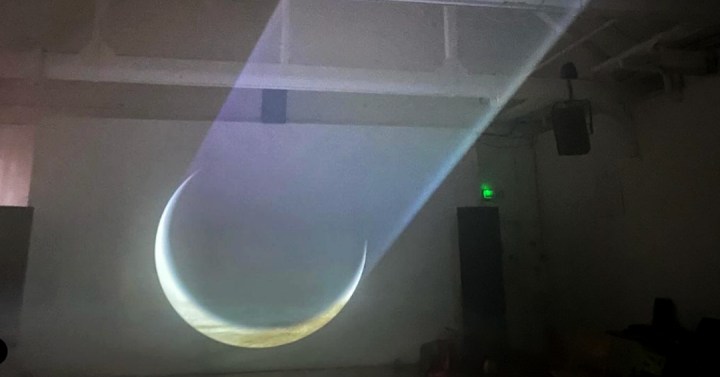
Image: ‘Darkside of the Cone‘ screened at IKLECTIK by Jason Brooks

As YouTube wormholes go, A Moon Age Daydream is possibly one of the more refined playlists on the platform. Curated by London artist and researcher Jason Brooks, the list charts the cultural connections between transportation, time and music from 1850 to the present. Scroll down its 500 plus tracks and you’ll find yourself stumbling across Captain Beefheart’s “Yellow Brick Road”, hitching a ride on John Coltrane’s “Blue Train” and flying high with Bridget St John. Less obvious examples include The Fall’s “Totally Wired”. Rather than physical transportation, the track explores the hyperactive change in perception experienced by someone on caffeine and uppers.

The project was inspired by David Bowie’s Ziggy-era, which mirrored the cultural obsession with propulsion and space travel prevalent at the time. The playlist formed in 2019 when Brooks was working for the UK’s Department of Transport. When it was marking the centenary of its formation, Brooks decided to investigate how much music had been influenced by various modes of transportation during its timespan. Soon after, the playlist expanded its scope, going further back to the beginnings of recorded sound and the development of combustion engines, before arriving at the cut off point of 1850 – the nascent days of the petroleum industry.

One surprise he came across in his research was the very first recording of Harry Dacre’s 1892 song “Daisy Bell”, about the then new bicycle craze. “The interesting aspect of this song was its reappearance as the first song made by a computer in the 1950s,” Brooks explains. “It was then famously used in 2001: A Space Odyssey as Hal the computer slowly dies.” The playlist’s sister Instagram account adds further context to tracks. For example, Tomorrow’s “My White Bicycle” is matched with the story of Amsterdam’s Witte Fietsenplan, Luud Schimmelpennink’s 1960s initiative concerning bike sharing.

The playlist took five years to complete and echoes the notion of evolutionary voyage suggested in Stanley Kubrick’s intergalactic odyssey by concluding with “The Big Ship” by Brian Eno. We are, after all, riding an enormous living vessel hurtling through time and space. “Rarely is the music about the mode itself,” Brooks reflects. “It’s a medium for a destination towards or away from the self, someplace, or someone.” ● youtube.com/@a.moonagedaydream

Ilia Rogatchevski
Originally published by The Wire, June 2024

comment 0

The breath is the body: an interview with Keeley Forsyth

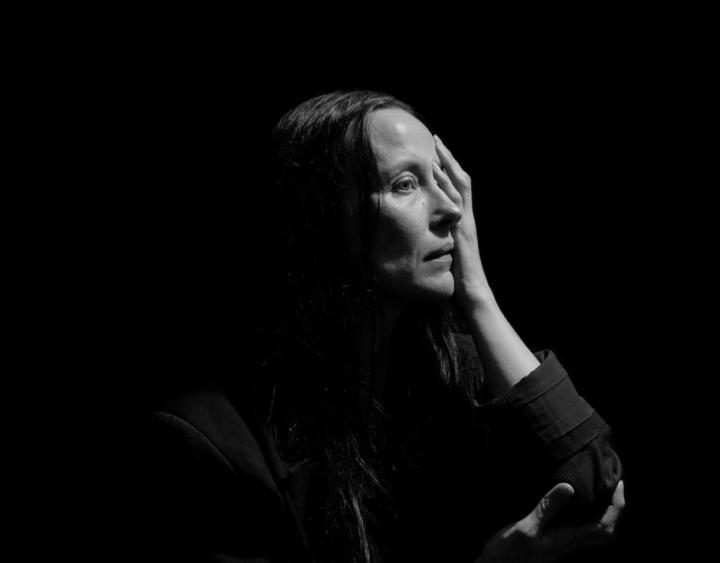
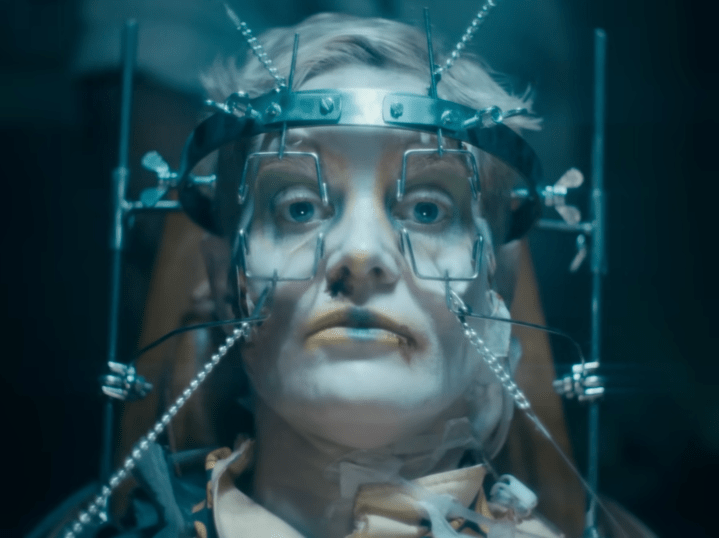
Ahead of a full performance of her new album The Hollow at London ICA, actor and artist Keeley Forsyth talks to Ilia Rogatchevski about Pina Bausch, Béla Tarr, genderless vocals, and perceiving the world as light and shade

Keeley Forsyth’s third album The Hollow explores the essence of solitude through a stark minimal framework. Composed with producer Ross Downes, the album takes its inspiration from an abandoned mineshaft in the North Yorkshire countryside near to where Forsyth is based. The small excavated room became a metaphor for how Forsyth saw her own voice – a resonating chamber channelling complex emotions – which is often compared to the likes of Scott Walker and Anohni.

Like its predecessor, Limbs (2022), the visual aesthetic of The Hollow is largely rooted in the landscape and mediated through monochromatic storytelling that echoes the work of the Hungarian film maker Béla Tarr. The album’s first single “Horse” reimagines Mihály Víg’s soundtrack for Tarr’s final film The Turin Horse (2011) with the music video picking up on the film’s themes of domestic duty, poverty and love.

Forsyth’s background in acting and dance informs her performative stage presence as well as the characters that inhabit her desolate musical world. Ahead of her concert at the ICA in London on 23 May, which will see The Hollow performed in full, we discuss her love for Pina Bausch, collaboration with Colin Stetson and the political dimensions of the voice.

Ilia Rogatchevski: The Hollow feels like an extension of your previous record Limbs, both aesthetically – the gestures, electronics, monochromatic palette – and in terms of the symbolism. What were the concepts and emotions that you were exploring for this album?

Keeley Forsyth: I definitely haven’t ventured out of that space. I don’t know whether it’s possible. I think the only way I travel emotionally, when I’m making work, is the reverse. I travel into that sweet spot of feeling where you’re so connected, but at the same time evoking something singular. The sense of what you know; the sense of daily life.

I like to take myself to that pinpoint, which made sense when coming across the mineshaft that The Hollow is based around. Walking into that reminded me of the psychology of where I go when I’m making work. You’re leaving something, but entering a space that feels truthful. It feels like this is where everything has come from. It’s telling the everyday stories of people’s lives.

Can you tell me about this mineshaft? You came across it on a walk in the moors?

Ross and I were in the middle of writing the record and just went for a bit of air. We were going on walks on the moors and found this abandoned place. When we came back, we realised that there was a part of us that was still in the mineshaft. It made sense, because, vocally, I’m always interested in the mouth area: the throat, the carcass of what we are. When I’m singing, I try to become this hollow space. So having that visual in my head with a mineshaft really helped.

I’m from the north [of England] and never thought that I would be making work around this kind of landscape. Every time I’m offered a chance to connect [with it] I have to throw myself into it. This is what the mineshaft became and the fact that it was partly dangerous and abandoned made sense. It became the set for the visuals of the music.

The landscape comes up again and again in your work. You have a performance piece called Bog Body and, in other music videos such as “Bring Me Water” and “Debris”, you examine the landscape, earth and soil. Why do you keep returning to the landscape as material?

It’s not the actual textures of what that feeling gives us, it’s about light and shade. There’s a reason why the visual work is black and white, because I feel that there’s a light and shade to the stuff that I want to make. When I’m going underneath and inside, it doesn’t mean that it’s in a lower or higher resonance of one’s being. Sometimes there’s the ability to come out of it, which is when the greys happen, but it’s a very black and white world that I’m in.

With Béla Tarr, you can put all of his work together. Sátántangó is like 430 minutes long. Not that I’m comparing my work to Béla Tarr, but it’s the same sense of being able to put this whole montage together of sounds and visuals. It’s one piece. I’m only doing little snippets, but it all makes sense. I decided a long time ago that I would plant myself out in the moors and it will stay that way for the duration of my music career.

When did you come across the work of Béla Tarr?

I can’t even remember. More so since working with Ross. He is a massive film fanatic. Our conversations are definitely film based when we’re talking about music. He’s encouraged that to come to the surface. Obviously, you don’t want to recreate someone else’s work, but it’s a feeling that you get which you then run with yourself. Ross and I have that same feeling with Béla Tarr and a few other artists. It’s really difficult to make work in such simple ways.

What was it about The Turin Horse that moved you to reimagine the soundtrack?

It was the character of the woman in it [Erika Bók]. I don’t know whether this kind of exercise is from being an actor, but you watch something and you slowly become it. I was watching The Turin Horse and I was going through the gestures with her. From that character started the muttering. If she could speak, what would she be saying? Even the house reminded me of that Beckett play [Quad, 1982] where it’s just four figures and they’re moving around. There are no words, just movement.

How does the composition process work for you? This time you’re mostly collaborating with Ross Downes, but [English composer] Matthew Bourne was somebody you worked with on Debris (2020). What is it that you’re striving for when working together?

The core team is myself, Ross Downes and Matthew Bourne. All three of us work together on the performance side of things. In the studio, it’s usually a direct conversation with one or the other, because my background is as a dancer, actor and a singer. I’m not a musician so I work with these guys to help me build a sound world.

That sound world might start with a tone on the pedal harmonium and then I can come in singing. I also work with an amazing guy called Adrian Shaw who sends me these stream of consciousness rants and poems. It’s a very visceral way of writing that he has. I’ll take these words like pieces of flesh.

I wouldn’t say I’m a collaborator. I find it hard to work with people. This core team will always remain, because without them, I wouldn’t have any records. Matthew is the most talented person you could ever meet, very generous. Ross is the same. I’ve somehow managed to attach myself to them. They have the energy to really take it where it needs to be.

The track “Turning” features Colin Stetson. How did that collaboration come about and what does he bring to the saxophone that other players do not?

There’s a similarity in how Colin and I approach what we do. The breath is the body. When I’m singing, I don’t actually think of the voice coming from here [points to the mouth], I think of another element coming in and making the voice, like you would push an instrument.

I’ve not had a conversation with him about this. This is only my interpretation of how he works, but that seems to be a thing that he embodies. I’ve worked with Evelyn Glennie before and she has the same thing with her instrument. It just becomes part of the whole thing that you are, not just the skill that someone has.

I didn’t think Colin would say yes. He seems to have such a work ethic. I’m not personally into artists drenched in suffering. I’m more attracted to the kind of person who is clear with their boundaries, like they’re clocking in and out of work. I had to raise my game working with someone like him.

Keeley Forsyth featuring Colin Stetson “Turning”

You sometimes get compared to Scott Walker, Nico and Anohni. What I find interesting about those singers is that their vocal range is always beyond gender. You’ve previously talked about adapting the naturally low tone of your voice to a higher pitch, when teased about it at school. So even in ordinary situations the voice becomes politicised. Is this something that you consciously investigate with your music?

It’s definitely genderless and the singers that I’m drawn to have that element. To get that independent thought you really have to dig and dismiss all preconceived ideas of oneself. My struggle with the voice, for a long time, was that I didn’t know where to place it. But that’s just human existence, isn’t it? We’re all trying to work out where we fit and then we realise that the ‘fitting’ is just a self-imposed myth anyway.

The moment I really started to feel massively free as a singer was hearing Scott Walker. He was the first person who gave me permission to stand in the same spaces and not feel that I had to justify what I was doing, why I was doing it, why it was sounding this way. When I first started making music, the people in my family would cover their ears and just say it’s horrible, you know? It was not something I felt upset about because, in that [Antonin] Artaud way, it’s like poking at something, making them feel uncomfortable.

You’ve mentioned Artaud, as well as Beckett. Pina Bausch is also an important influence for you. Is this what informs how you move on stage and the characters you inhabit?

Yeah, the performance side is the thing that I love the most. The record is part of it but it’s only within that framework of the stage that I can really understand what’s going on. It’s like your carcass has expanded to the outside of the mineshaft and it feels like that on stage.

I’m completely in awe of Pina Bausch. There are those artists that, when you come across their work, you just know it. Like, I am supposed to be here right now experiencing this. I recognise it and, through recognising their work, I recognise a part of myself.

How does The Hollow translate onto the stage? Are you performing it in its entirety?

Yeah, this is the first time that I’ve done that. It’s the whole record in its entirety and there’s also a middle section as well. In an ideal world, I would love to do the kind of bigger master show but equally I’m happy just dragging a chair on stage like Pina Bausch in Café Müller. You don’t need anything else. It is a piece of theatre that I’m trying to make. I’m not there yet, but, you know, I’m on the journey.

Keeley Forsyth will be performing at London’s ICA on 23 May. The Hollow is released by 130701.

Ilia Rogatchevski
Originally published by The Wire, May 2024

comment 0

Fever Ray

Eventim Apollo, London, UK
Image: Still from Shiver, dir. Martin Falck

The key protagonist of Fever Ray’s third album Radical Romantics is Main, a meek white collar drone who, by submitting to the objects of their desire, casts off their awkward shell and embraces love in all its complexity. Main’s transformation is played out in the visual language of the album, its artwork, publicity photos, music videos, costumes and stage design.

This radically romantic universe was conceived by Fever Ray’s Karin Dreijer and creative director Martin Falck. Within it Dreijer adopts various personae that each symbolise divergent aspects of human emotions, the ones that Dreijer recognises in their self. In the video for “What They Call Us”, Main imagines escaping the constraints of social normativity and in “Kandy” their wish is granted. Romance, a Sméagol-like character in a seedy club – also played by Dreijer – seduces the besuited Main with a lap dance, enabling an ecstatic but potentially toxic union.

These carnal themes are extended to the concert itself. A solitary streetlight is placed centre stage, suggesting a midnight cruising spot. The lamp’s vaporous glow promises an erotic encounter with a stranger but also hints at the fears and inhibitions Main must overcome to realise this promise. On stage, Fever Ray are completed by backing singers Maryam Nikandish and Helena Gutarra, drummer Romarna Campbell, and Minna Koivisto on synths.

The set begins with the nervy slow build of “What They Call Us” – all aquamarine hues and aluminium beats. Main emerges from insular darkness to confidently massage the audience into a frenzy during “To The Moon And Back”, a song from Plunge that explores the blinding rapture of a burgeoning romance. Dreijer throws roses into the crowd while singing that it’s time to “breathe some life into a fantasy”.

Nikandish and Gutarra sidle on either side of Dreijer. Their respective costumes – a fetishised business suit and a gold sequined jumpsuit embellished with zodiac symbols – suggest they are the proverbial devil and angel sitting on Main’s shoulders. The three singers converge during the sensuous “Shiver”. As the house lights turn pink and the streetlamp pulsates like a throbbing heart, their splintered personalities fuse under the heat of orgasm.

The colours fade and the keytars come out for the gothic revenge anthem “Even It Out”. Co-produced by Trent Reznor and Atticus Ross of Nine Inch Nails, the track’s industrial drive spawns psychopathic visions and invites you to methodically “cut, cut, cut” anyone who has ever wronged you. The music video shows Dreijer, in a Divine-like Demona Lisa persona, getting their own back on a bully. The film is inspired by John Waters, his saturated palette transposed to a bleak winter setting. Live, the song loses none of its power, resonating with the feelings of injustice that all of us harbour.

In the closing third of the set, “Carbon Dioxide” is another peak. The lyrics are inspired by the Lovers of Valdaro, a couple of ancient human skeletons found entwined. The song opens with the words “Sucking on what’s mine/Love’s carbon dioxide” and progressively shifts gears with the key refrain pointing to the need for both caution and abandon while falling in love. In an Instagram post, Dreijer muses that perhaps the skeletons’ passion was so intense that they couldn’t stop kissing and suffocated to death. Of all the ways to leave this wretched Earth, that’s probably the sweetest.

Ilia Rogatchevski
Originally published by The Wire, May 2024

comment 0

Scoring the overlooked: an interview with Eiko Ishibashi

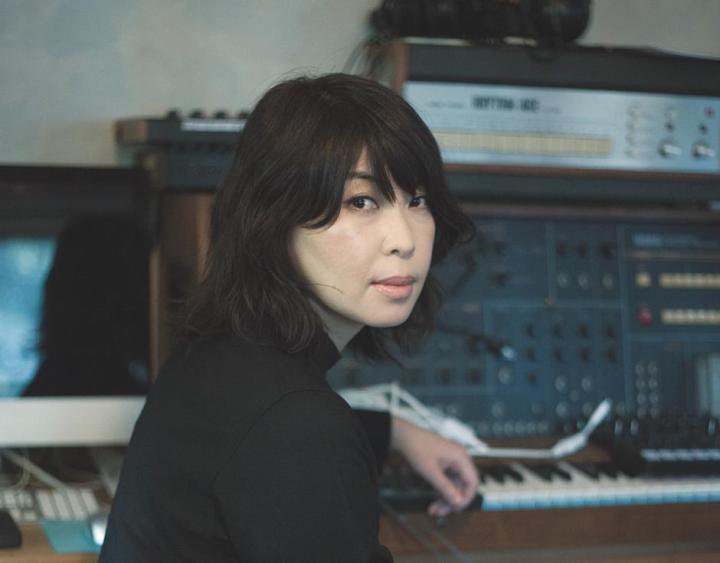
Ahead of the release of her soundtrack for Ryûsuke Hamaguchi’s new film Evil Does Not Exist, Japanese musician Eiko Ishibashi talks to Ilia Rogatchevski about influential composer director partnerships and her own approaches to scoring film. Photo: Eiko Ishibashi in Hokuto, Japan, October 2018, The Wire 418 by Mayumi Hosokura

Evil Does Not Exist, Ryûsuke Hamaguchi’s award winning meditation on nature and our role in its custodianship, originated from a collaborative music led project with the Japanese composer Eiko Ishibashi. Requiring visuals for a live performance, Ishibashi presented the director with a few demos of electronic compositions. The result was the short silent film Gift that later developed into a feature length production.

Their previous collaboration Drive My Car – an adaptation of Haruki Murakami’s short story about a widowed actor – engages in the patient unfolding of human drama by bridging the sparse dialogue and rich cinematography with Ishibashi’s jazz infused motifs. Ishibashi won the Best Original Music accolade at the Asian Film Awards for both soundtracks, in 2024 and 2023 respectively. So integral is the music that it’s difficult to imagine the visuals of either film being paired with alternative scores.

Eiko Ishibashi “Smoke” From Evil Does Not Exist (2023, Ryûsuke Hamaguchi)

The Wire asked Ishibashi to provide a list of composer-director partnerships that she considers influential. We used some of the names on that list as starting points for our conversation. Special thanks to Jim O’Rourke for interpreting.

Ilia Rogatchevski: Film was important for you when you were growing up. Were there any soundtracks that influenced the way you think about scoring for film now?

Eiko Ishibashi: At a young age, the ones that really stuck out for me were John Barry’s scores for Midnight Cowboy (1969) and Walkabout (1971). And also Jack Nitzsche’s score for One Flew Over the Cuckoo’s Nest (1975).

What was it about Jack Nitzsche’s soundtrack that you found so interesting?

It wasn’t anything direct like wanting to use those instruments or anything like that. It was more the way that his music had an attitude towards what the content of the film was. It’s almost coming in at an angle. It’s not necessarily directly connected.

You’ve talked before about how Nitzsche’s music opens up American life, nature and history. David Lynch and Angelo Badalamenti also focus a lot on American life – its seedy underbelly. What is it about their work that attracts you?

Strangely enough, the thing of theirs that I was most moved by was the video of Badalamenti explaining how he wrote the theme for Twin Peaks. I was profoundly moved by that.

You’ve also mentioned Ennio Morricone being an influence and his work is closely associated with the grandeur of the American landscape. You live in the Yamanashi Prefecture and Evil Does Not Exist was filmed in the area. For Drive My Car, Ryûsuke Hamaguchi also asked that your music “be like a landscape”. Do your rural surroundings impact how you write or think about developing a narrative idea through sound?

Maybe more so than the visual element of living here, it’s the convenience of things being much quieter. The fact that it’s quiet is probably more influential than anything about the area in terms of what it does visually. There’s not the constant roar of the city like when I lived in Tokyo.

What do you find interesting about the partnership of Alan Pakula and Michael Small? You previously described Small’s work as having “distance”. What do you mean by this within the context of their work together?

Distance doesn’t mean that it’s disconnected. It means more that it’s acting like a counterpoint to the images and the editing as opposed to highlighting something in the image or something that’s happening in the narrative. It’s more like another layer to the film. It has almost a physical distance from what’s happening.

Michael Small “Main Theme” From The Parallax View (dir Alan Pakula)

What I like about Michael Small’s music is the degree to which he builds suspense with minimal means, like with the main theme for The Parallax View (1974) for example.

There are two elements to Michael Small’s music that I’m interested in. The first is that his music seems to be referring to things that are beyond the frame of the image. The second… you kind of have to see The Parallax View to understand this. Warren Beatty is a reporter who is looking into the assassination of a politician. He stumbles upon this CIA-like group that basically tries to find people to turn into assassins or patsies.

He wriggles his way into this programme and, at one point, he is taken into a room to watch a film that’s going to be introducing the company. In that scene, we see Warren Beatty watching the film but then the film that he’s watching takes up the whole screen. There is music in that film, which is Michael Small’s music. The film he’s watching becomes the film that you’re watching. The music then changes what its purpose is. I was very impressed with that intelligence in his music and by how he dealt with that situation. Most composers wouldn’t think about that extra element.

The piano leading the theme from Klute (1971) is another example of tension being built up with relatively few elements. The piano is your main instrument and you learnt it at a young age. Is it always the first place you go to for generating ideas or do you also use more unorthodox approaches when working for film?

Even if I take another approach, I usually have to use the keyboard. Sometimes, it starts on the piano but, for instance, the score for the strings on Evil Does Not Exist had to be recorded first using the keyboard so that the sheet music could be created.

You’re also a drummer. How important is rhythm when you’re thinking about the sequential structure of moving images?

For instance, with Drive My Car, the rhythm came first – finding the right rhythm for the image. The music kind of came from that.

You’ve previously referred to Hamaguchi’s cinematic style as being musical. I like that framing. Can you elaborate on what you mean by this?

Hamaguchi is very deliberate about the sounds he uses in the films: the sound of a car, the sound of a door. Especially the recording quality of the actors and the rhythms of the dialogue that he writes for them. It’s almost like there’s already a structure that the music can hang on to because there are definite rhythms and colours to the sounds in his films.

He’s very particular about the sound mix. That in itself already starts to conjure ideas for how the music can fit. Lots of films don’t have a rhythm outside of certain cutting [editing] rhythms. His early documentary trilogy about Fukushima and the Tōhoku earthquake is just people talking, but it has these amazing rhythms to it – the silence and speaking.

What strikes me about your work with Hamaguchi is how sparingly the music is used. In Drive My Car there is often no music at all and in Evil Does Not Exist it gets cut unexpectedly, and very deliberately, for dramatic effect. Do you have any influence over how your compositions are used in the final edit?

Hamaguchi has a very strong idea of where he wants the music to be and where it should end. I do go to the final mixes with him but I generally trust his ideas for how he places the music.

Let’s get back to the list. What about the work of Hiroshi Teshigahara and Tōru Takemitsu? Is it the waltz from The Face Of Another (1966) that you had in mind?

The music in Japanese films – now and for a long time – is always heartwarming and guides the audience along. I was really struck by how dry and almost aggressive the music in The Face Of Another is to the audience. It’s very jarring, not lulling at all. It’s very unusual for Japanese films.

Tōru Takemitsu “Waltz” From The Face Of Another (1966, dir Hiroshi Teshigahara)

Have you seen Teshigahara’s documentary Antonio Gaudí (1984)?

No.

The film is almost without any dialogue and centres on Gaudí’s architecture. It’s a point of view tour of his buildings and very much driven by Takemitsu’s score. I see a similar impressionistic approach in your work, too.

My work is more about wanting to avoid explaining what’s in the image and instead trying to find the spot that’s overlooked, or something that isn’t an important part of what’s happening. Finding that can usually guide me more. Part of it is purposefully not wanting to explain the image, so avoiding that helps.

What about the partnership of Rainer Werner Fassbinder and Peer Raben?

With Peer Raben and Fassbinder – we don’t actually know if Raben chose where to put the music but, for instance, in a typical Fassbinder film a horrible character will go to sleep and, all of a sudden, a light-hearted romantic lullaby starts. It’s that kind of combination that creates something between irony and cynicism that I like very much in their work together. The audience has to think all the time to understand what the meaning of the musical combination is.

You’ve written and arranged music for the Fassbinder play Garbage, The City & Death. Was this juxtaposition something you were channelling for that project?

In the script for the play it actually says what music to use. Daniel Schmid had made a film of that play (Shadow Of Angels, 1976) and Peer Raben had done music for it. When the play was done in Japan [in 2013], we also used Peer Raben’s music. Only one of my original compositions was used.

Last on the list are Peter Greenaway and Michael Nyman. Nyman has a flair for the baroque. I’m thinking in particular about The Cook, The Thief, The Wife And Her Lover (1989), the score for which is opulent, decadent even. Is this what you were thinking too or is there another element of Nyman’s music that influences you?

In this case, it’s a little bit special because Greenaway is taking advantage of Nyman a little bit. All of Greenaway’s films are very angry, but using Nyman’s apparently elegant music in his films creates an incredible tension between the anger going on in the script and image. It creates this veneer, especially in relation to England, where you see its history and how the upper class continues to have its façade. It’s a very striking combination at work.

Ryusuke Hamaguchi’s Evil Does Not Exist is in cinemas now. Eiko Ishibashi’s soundtrack is released by Drag City.

Wire subscribers can read James Hadfield’s 2018 interview with Eiko Ishibashi and Jim O’Rourke in The Wire 418 online via the digital library of back issues.

Ilia Rogatchevski
Originally published by The Wire, April 2024

comment 0

Cassie Kinoshi’s seed.

Cassie Kinoshi with seed. + NikNak + London Contemporary Orchestra
Barbican, London, UK | Photo by The Red Beanie.

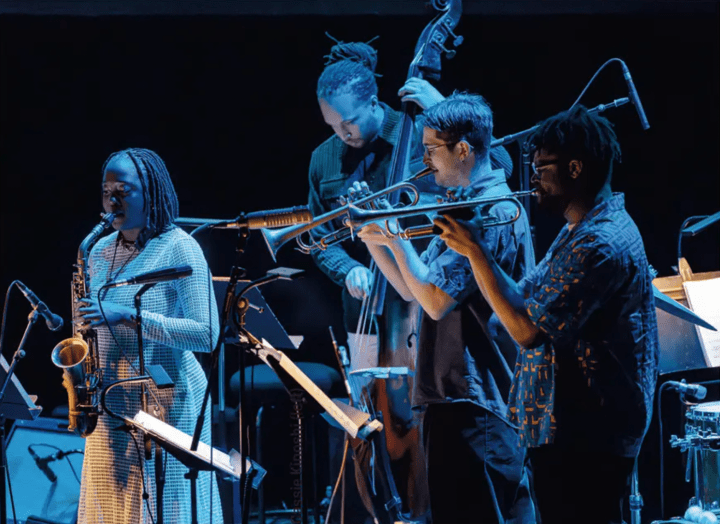
The Barbican’s stage is crowded. Cassie Kinoshi, the alto saxophonist, composer and former member of Kokoroko, leads the ten piece seed. ensemble for the presentation of her new work gratitude. Joining them are five members of London Contemporary Orchestra and the turntablist NikNak.

Kinoshi counts in the strings, which swell cautiously like dawn breaking, the piano tiptoeing around them. NikNak energetically scratches the vinyl. The slippery records echo the strings’ glissando in an imitation of birdsong. As the rest of the band kick in, it feels as though the sun itself has risen, throwing light and warmth onto a brutal winter morning.

Trumpeter Joseph Oti-Akenteng takes the first solo as the artist GURIBOSH’s collaged visuals flicker in the background. Seascapes and fields crossfade inside of circular spyglass frames, while Oti-Akenteng’s melancholic horn paints abstract glyphs in the air. Not long after, Shirley Tetteh’s eloquent guitar compels the band to bop their heads in appreciation. Kinoshi’s own solo is white-hot like an infinitely bright polar day.

There’s some expressive back and forth, too. Trumpeter Jack Banjo Courtney trades feverish lines with saxophonist James Akers, while flautist Clare Bennett and NikNak’s exchange momentarily evokes that wonky Belbury Poly nostalgia for a nonexistent rural yesteryear. So rich are the collective frequencies that, for the most part, the acoustic instruments drown out the DJ. It’s only during mellower interludes, when the brass and reeds relinquish their dominance, that the electronics feel present in the mix.

Initially performed last year at London’s Southbank Centre, gratitude has been released by Chicago’s International Anthem label. In the record’s paratext, Kinoshi explains that the work is inspired by her mother who keeps a gratitude book where “she writes one thing, no matter how big or small, every day that helps to refocus her mind”. For Kinoshi, composing the piece became an act of endurance, but ultimately led to more positive practices with respect to her own mental health.

At one point in the set, the literary artist Belinda Zhawi comes on and urges us to “give thanks for the sun that rises in the East and sets somewhere between a rock and a hard place”. The band fall silent as Zhawi talks about housing estates built on marshes and “hands that can build, but only break”. She evokes an image of a solitary dove, framed against an endlessly overcast sky, with no olive branch in its beak. It is a bleak hint towards the growing inequalities of our brazen century.

After gratitude concludes, Kinoshi introduces a new piece commissioned by the Serious Trust for International Women’s Day. The first three movements are inspired by female musicians who were prominent during the interwar period, but have since faded from public consciousness: jazz vocalist Evelyn Dove, composer Annette Mills, and saxophonist and bandleader Ivy Benson.

Perhaps in reference to the recent scandal surrounding the Arts Council England and its threat to remove funding from individuals or organisations who express “overtly political” opinions, Kinoshi dedicates the final movement to those unafraid to speak out. With their increased tempos and physical rhythms, these four movements share a sense of urgency largely absent from the first half of the set. While gratitude encourages the listener to appreciate the ephemeral, the final suite reminds us to seek out, engage with and amplify unheard voices.

Ilia Rogatchevski
Originally published by The Wire, April 2024

comment 0

Mariam Rezaei

Mariam Rezaei + Angharad Davies + Atzi Muramatsu + Semay Wu
Cafe Oto, London UK

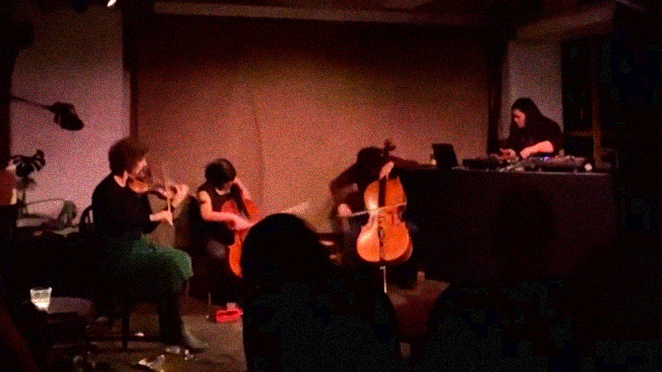
The first night of Mariam Rezaei’s three day residency at Cafe Oto considers the unmet potential of a string quartet. The musicians play two improvised sets with no prior discussion about what direction the music might take. Cellists Atzi Muramatsu and Semay Wu, violinist Angharad Davies and turntablist Rezaei fuse their instruments so efficiently that it’s hard to believe this is the quartet’s first show together.

Rezaei takes the helm of a digital vinyl system, which allows her to select and control a bank of samples using a regular turntable set-up. She has around 200 sounds to choose from. Some of these were recorded by the residency’s participants: violins by Davies and drums by Lukas Koenig, who performs with Rezaei, Gabriele Mitelli and Mette Rasmussen on the final night. The expansive variety of the samples means that Rezaei can be flexible in her approach, developing the composition in unexpected ways.

The first set begins with swelling strings and bows tapping on wooden bodies. Wu’s fingers scratch her cello, drawing out pig-like grunts from the instrument. Davies listens before committing. She plays, fully immersed, with her eyes shut for virtually the whole concert. Both players use effects pedals, but sparingly. Sometimes it is difficult to tell the original source. Is that slippery glissando the result of Rezaei stretching digital audio files or created by Muramatsu with acoustic means?

The diversity of sounds ranges from cacophonous air raid sirens and boiling kettles to Sputnik bleeps and rewinding tape. If you close your eyes, the soundscape feels overburdened with mechanical manipulation until you realise that Rezaei has dropped out long ago and the strings alone are creating the sensation of time collapsing in on itself.

All four improvisors leave spaces for each other. Muramatsu is the most cautious, playing with determined gestures only when appropriate. Wu, meanwhile, wrestles drones from her cello, inviting Davies to garnish them with accents. Rezaei is talking in the same language. Her technique is precise: dropping needles, cutting faders, twisting EQs and scratching records with confident determination. She follows the growing intensity of the strings, reaching an industrial crescendo together with the others.

There is a brief moment of uncertainty in the second set, when the strings fall silent, but soon the pace picks up and the temperature rises again. Cellos duel under the fumbling contact sound of the turntable stylus, and percussion takes centre stage. Davies keeps the beat with her violin bow, as if skipping stones across a trinitite lake, predating the harsh metallic snares to come. Ecstatic noise, droning strings and Koenig’s drum samples coalesce into a terrifying climax.

Reflecting on the performance after the show, Rezaei tells me: “I don’t think anybody knew it was going to go there tonight.” She explains that the residency as a whole, which also includes a duo with Edward George, is about challenging the restrictive confines of genre. Turntables still have a strong affiliation with hiphop, but the instrument has always been about experimentation. Within the context of digital vinyl systems, there’s a secondary element to composition where you have to estimate how the sample might be used live and work backwards from there. “It’s mainly a creative challenge to myself,” Rezaei says. “What can I make the turntable do to work with these very different ensembles and combinations? The turntable can play anything. It can stretch anything. I believe that within it, something new can be found.”

Ilia Rogatchevski
Originally published by The Wire, February 2024

comment 0

HUUUM

The Vienna based trio create a riotous fusion of traditional Iranian instrumentation, electronic processing and theatrical headgear. HUUUM: (from left) Omid Darvish, Rojin Sharafi, Alvaro Collao León. Image: Rezzarte/TE-R

HUUUM’s self-titled debut opens with the foreboding “Dibāche”. The fluctuating breath that delivers a mournful saxophone melody is twinned with the crashing of synthetic waves and other digitally processed sounds. Foreshadowing the dark and mysterious themes to come, a male voice swells like the charcoal skies of an oncoming storm. “Hanābandān” kicks in with an electric scream and “Yezle” bares its teeth in a maelstrom of heightening intensity brought on by a gnashing riff and sinister violins.

An untrained ear might hear influences of free jazz, dank clubs and doom metal, but at its core the Vienna based three-piece investigate the different languages and dialects of Iran as well as the diverse music native to Persian culture. “I wanted to show the capacity of folk music in Iran,” explains vocalist Omid Darvish. “When we talk about Iranian music in Europe, we think about people sitting on stage, playing this traditional instrument. You know, this stereotype.”

Originally hailing from Kermanshah, Darvish was surrounded by music from an early age. He studied the tambur and Kurdish music – alongside Western classical, jazz and rock – and wanted to channel the different facets found inside Iranian folk into HUUUM. The project, named after a mythological plant, began during Covid when Darvish took to studying music based on the sorna, an ancient double-reed instrument. The idea was to mimic its textural and melodic characteristics with the saxophone. “It was very much a learning process,” remembers producer Rojin Sharafi, who also plays synths and drum machines. She gravitated to Vienna from Tehran to study music. “It was a big challenge,” she continues, “not only because of the microtones, but also finding these colours and techniques.”

The band, who were at that time completed by saxophonist Astrid Wiesinger, held group listening sessions that contributed to expanding the instrument’s mimetic potential. After a period of covering famous folk songs from different parts of Iran, HUUUM started composing original material. While the electronics and saxophone derive their sounds from traditional forms, Darvish’s singing is the authentic backbone around which everything else pivots. “Singing techniques in Iran are totally different,” Darvish explains. “For example, in the West the vocal sound comes from deep inside, but when you go to the East, it comes up from behind the nose. I’m singing in maybe five or six different languages [on the album] and in each track I used the technique from [a specific] area. If you listen to “Hahre Tavil”, you will hear the Tehrani accent, but how they sang in Tehran 100 years ago.”

Following our interview, the band send me translated lyrics that expand on what is innately felt when listening to their songs. “Āzmān” is inspired by the music of Baluchestan and sung in Baluchi. It has a unique colour to the vocal which, Darvish says, can’t be heard in music from other areas. The lyrics, initially set against a buoyant melody, describe an inner voice that strives to be recognised by its owner. Halfway through, the hopeful sax fades, only to be replaced with tectonic beats, shrill pulses and a chant that proclaims, “Without me, death is your instant omen”. The mood darkens on “Chapi”, sung in the Lori dialect. Sharafi’s machine rhythms take the helm in an ode to the funeral dancing ceremonies of Lorestan. Meanwhile, the sax shapeshifts into a shepherd’s pipe playing “the melody of death” for slain youth.

HUUUM’s line-up changed in the summer of 2023, when Wiesinger left due to health issues. “It was hard for us, because we three started together,” Sharafi says. “We were looking for saxophonists. There are lots of great musicians in Vienna, but we wanted to have someone who, like us, comes from different practices.” Álvaro Collao León, originally from Chile, is their new addition. Always interested in expanding his range, León’s versatile technique combines classical, contemporary and South American influences.

Although the group haven’t performed often, their stage show expands on the studio recordings. Improvisation is a key factor that involves Sharafi processing the saxophone and vocal signals live, but so is a sense of ritual. “I think an important thing for us is to interact with the audience,” declares Sharafi. “Six months after HUUUM formed we played in a club. That was the best, because people were not always dancing, but listening to the music. Some friends in the audience were doing kel [ululation usually performed during communal rituals such as weddings].” This experience encouraged the band to embrace theatrical elements and fold these into their work. Each member wears their own distinctive headpiece: Sharafi’s represents modern culture; Leon’s – nature; Darvish’s – roots. “I have very different characters in each song,” says Darvish. “I’m acting, playing different people. When I wear the mask, you don’t know who is behind it.”

These amorphous identities are echoed in the album sleeve, a near-featureless portrait painted by Darvish’s sister Hosna Darvishi. The band see themselves reflected in its reticent stranger with many stories to tell. “It’s exactly like what we are doing in HUUUM,” asserts Darvish. “Maybe you cannot understand anything about this music, but if you listen, you will understand that everything is natural, even the electronic beats. We didn’t invent anything.” Sharafi agrees: “What I like about folk music is its openness. You can change it. Having this freedom is very attractive to us.” ● HUUUM’s HUUUM is released by Accidental Meetings

Ilia Rogatchevski
Originally published by The Wire, December 2023

comment 0

Ukrainian Field Notes

Gianmarco Del Re (Editor)
система | system Pbk 567 pp

Ukrainian Field Notes was initiated by film maker Gianmarco Del Re, who became interested in Ukrainian experimental music after the 2014 Revolution of Dignity, but started researching the country’s diverse scenes more intensively after the Russian invasion in February 2022. His interviews with Ukrainian musicians took a diaristic day by day approach and were initially published on the website A Closer Listen. Some questions raised pragmatic concerns like how Westerners can support the Ukrainian war effort, while others focused on how artists manage their creative process in times of conflict.

The project is still ongoing, but 170 interviews from the first year of the war have been compiled into this single tome. A sister compilation featuring some of the artists involved has also been released by c  cTeMa | system. Including over 80 tracks running to almost eight hours, the compilation follows the chronological order of the interviews. Recorded after 24 February 2022, the overall sensation of the music is sombre reflection.

Although the tracklist is dominated by instrumental electronic compositions, other genres and moods also make an appearance. They range from the thundering drums and protracted metal dirge of Nonsun (“Days Of Thunder Bring New Wisdom”), through the melancholy dark jazz of Whaler (“Zrada”), to sorrowful field recordings. Documenting squawking birds on a winter day, Myroslav Protsan’s “Ravens On The Cemetery” suggests the harsh emptiness of grief.

The combined reading and listening experience brings to the surface emotions from the first days of the war: a sickening disbelief in the unfolding events. In the early stages of the conflict many interviewees couldn’t make or listen to music. Their energies instead focused on survival, fundraising and volunteering. Del Re equates war to another recent trauma, that of the global pandemic, and asks how the artists lived during that time. “There is a big difference between lockdown and war,” replies Hanna Svirska. “During lockdown you knew that you would survive by staying at home. War gives you no guarantees.”

About 50 pages into the book, the interviews expand. Gianmarco’s questions become more involved and better researched. Further insights are gained into the experience of displaced artists (across Europe and within Ukraine) as well as the country’s different music scenes. SA Tweeman, for example, the co-founder of queer rave VESELKA, is asked to reflect on the development of Ukraine’s LGBTQIA+ club scene and whether electronic music has a role to play in the current situation.

Each artist is also tasked with recommending a book or film that will give readers a better understanding of Ukrainian culture. Sergei Loznitsa’s Donbass (2018), Sergei Parajanov’s Shadows Of Forgotten Ancestors (1965) and the Ukraïner media platform are recommended simultaneously by several different people. Later conversations consider misconceptions about the conflict. “The West thinks that we are at war with people who have human concepts, values and orientations,” say the indie five-piece Latexfauna. “In fact, we are fighting against a completely inhumane, misanthropic system that is endless in its bloodlust.”

Although it makes for emotionally charged reading, Ukrainian Field Notes is an important document with a practical purpose. All proceeds from its sales go to fund the Musicians Defend Ukraine charity.
Almost two years into this war, the book’s publication is all the more vital.

Ilia Rogatchevski
Originally published by The Wire, December 2023

comment 0

Midori Takada: Japan On Film

Kings Place, London, UK
Photo: Monika S. Jakubowska

The dark stage is peppered with cymbals that resemble flowers gazing at an artificial sun. A solitary bell is heard but its source is unclear. Midori Takada emerges from an aisle and ascends onto the stage, intermittently striking an upturned metal bowl. She walks through the field of alloy disks, picking between them, emphasising their tonal differences, before stopping at a suspended gong. Various textures are drawn from it. Takada scrapes the surface with brushes, then her thumb, persuading the instrument to sing like a migrating whale. She removes her black cloak, letting it drop to the floor – a deliberate gesture bookending her theatrical entrance.

Tonight’s performance centres around new scores for silent films about Japan. These surviving shorts, which are held at the BFI National Archive, date back to the end of the Meiji era, when Western film makers fixed their collective gaze on the country. Captured by outsiders at the dawn of the 20th century, Japan’s landscapes, buildings, fashions, customs and people are inevitably exoticised. However, the films remain vital records of a nation transitioning into modernity, and their restoration and digitisation was done to coincide with the 2020/21 Tokyo Olympics.

Takada’s live score makes full use of the percussive palette incorporating cymbals, variously pitched toms, marimba, grand piano and prerecorded sounds. The emphasis is always on the melodic potential of the instruments, particularly where the drums are concerned. Two of the toms are turned sideways, positioned at head height, while the remaining drums rest on the floor. Takada darts across them, with each isolated hit conjuring up an unexpected melodious note. Collectively, her rolls are evocative of countless liberated cobblestones flying across city barricades and raining fast onto the street.

As images of the Dotonbori Canal in Osaka flash upon the screen, Takada moves over to the marimba. Her complex repeating patterns instantly remind me of Philip Glass or, more precisely, Christoph Sietzen’s marimba rendering of the Glassworks track “Opening”. Whereas that piece is steeped in a fragile melancholy, Takada’s playing is vibrant, especially when synced to visions of urban life lost to time: people under parasols escaping the rain, street food vendors, a bonsai tree market, children lining up for school, silk factories, a parade celebrating the country’s victory in the 1904–05 Russo-Japanese War.

The most arresting film is The Ainus Of Japan, which documents the cultural rites of an Indigenous group native to Hokkaido and Russia’s far east. We are shown dancing rituals, a drinking ceremony and married women marked by moustache-like facial tattoos. The Ainu were forced to assimilate into Japanese society and this anthropological record is a rare window into their culture.

The films are not showing constantly and when they’re turned off, Takada’s playing is brought to the centre. As she sits behind the piano and jams to prerecorded sounds emanating from the PA, there is a sense she is duetting with ghosts. Throughout the concert, Takada speaks to the audience about “beautiful memories from childhood” like the taste of honey and dates, a coconut tree standing on a desert hilltop or the “sound of red thread being torn”. These brief quizzical phrases contain a quotidian kind of poetry that complements the picturesque visions of Japan from 100 years ago. Like most memories, these images are emotionally vivid but fleeting and prone to distortion.

Ilia Rogatchevski
Originally published by The Wire, December 2023