The residents of central London’s sprawling creative hub subvert its institutional history with dance, performance and archival stories
Somerset House, London, UK
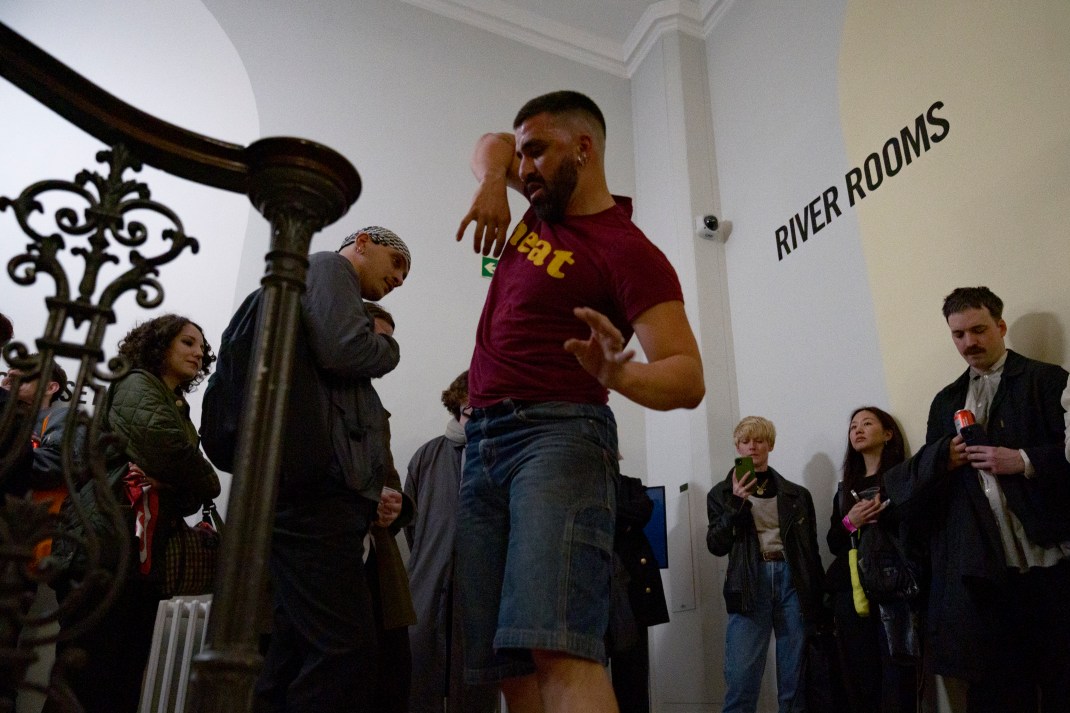
Photo: Samir Kennedy at Assembly by Anne Tetzlaff
Returning to the palatial interiors of Somerset House for the fifth time, Assembly is a festival of contemporary music that showcases the studio residents of the central London complex and arts space. This year themes of diasporic experiences and cultural identity are present in many of the performances. Onyeka Igwe’s No archive can restore this chorus of (diasporic) shame uses archival footage and a 13 strong choir to explore the legacy of Nigeria’s protest movement. Songs from the Abeokuta Women’s Revolt, sourced from the archive of activist and educator Funmilayo Ransome-Kuti – mother of Fela – are reworked by Tanya Auclair. Sung a cappella, but punctuated on occasion with traditional percussion, the songs are designed to cement solidarity, filling the room with mantras like “Lagos women do not pay any tax”.
One staircase is given a makeover with blue lighting and indigo fabrics hanging from the balustrades. The audience snakes down the steps, at the bottom of which is a paddling pool, home to a “wellkeeper” pounding a water drum. Seyi Adelekun’s (un)drowned uses Black feminist theory to examine colonial attitudes to black bodies. Spoken word testimonies emanate from loudspeakers, interacting with singers on different floors. The vocal group harmonises individual syllables, the cycles extending and spiralling into the phrase “I dive deeper”. The piece comes to an optimistic conclusion with blue ribbons falling through the air as the choir descends to join the drummer in a symbolic baptism.
Hanne Lippard and Renato Grieco’s minimalist performance centres on a fictitious email exchange between a scammer ‘donating’ a piano and a naive school board representative. Lippard and Grieco exchange absurd observations about “hands acting out of hand”, count in different languages, and spin an unthreaded tape spool for the rhythm track. The performance is austere but humorous, in the vein of Andy Kaufman or Bastard Assignments, concluding with the punchline “there’s no such thing as a free piano”.
In an adjacent corridor, Samir Kennedy pushes through the waiting crowd, dancing vigorously and body slamming the walls. Most pretend he isn’t there, but it’s surely the frontispiece for Relay, his collaboration with Hannan Jones. Once inside the concert hall, tape loop hiss envelops the auditorium. Jones teases out half-remembered fragments of melody from an archive of Algerian cassettes. Kennedy joins her, intoning on the mic over fluttering echo, while swooping synths draw knives.
Polish artist felicita’s czysta forma (pure form) follows Jones and Kennedy’s meditation on body and memory with a ballet score inspired by Polish folk and the experimental playwright SI Witkiewicz aka Witkacy. The dancers are replaced with a cyberpunk string quartet that moves between avian modulations, deep note glissandos and clapping games. Chiptune breakbeats deliver an 8-bit rendering of the classical form while Xiaoqiao drifts in to deliver serene wordless vocals across organ playback and a bowed saw. Mark Fell and Mohammad Reza Mortazavi also turn tradition on its head with refracted beats that bounce around the room like beads in a marble run. Fell’s granular pulses are in dialogue with Mortazavi’s drumming on the tombak and daf. The irregularity of the rhythm and timbre suggest an infinite number of plains shifting in size and dimension. It’s percussion without edges, softly focused, like living inside a perpetually glitching startup screen. Despite this collaboration being more exciting for the mind than the eyes, it’s among the more alluring pieces at the festival.
Ilia Rogatchevski
Originally published by The Wire, May 2026
 Ilia Rogatchevski