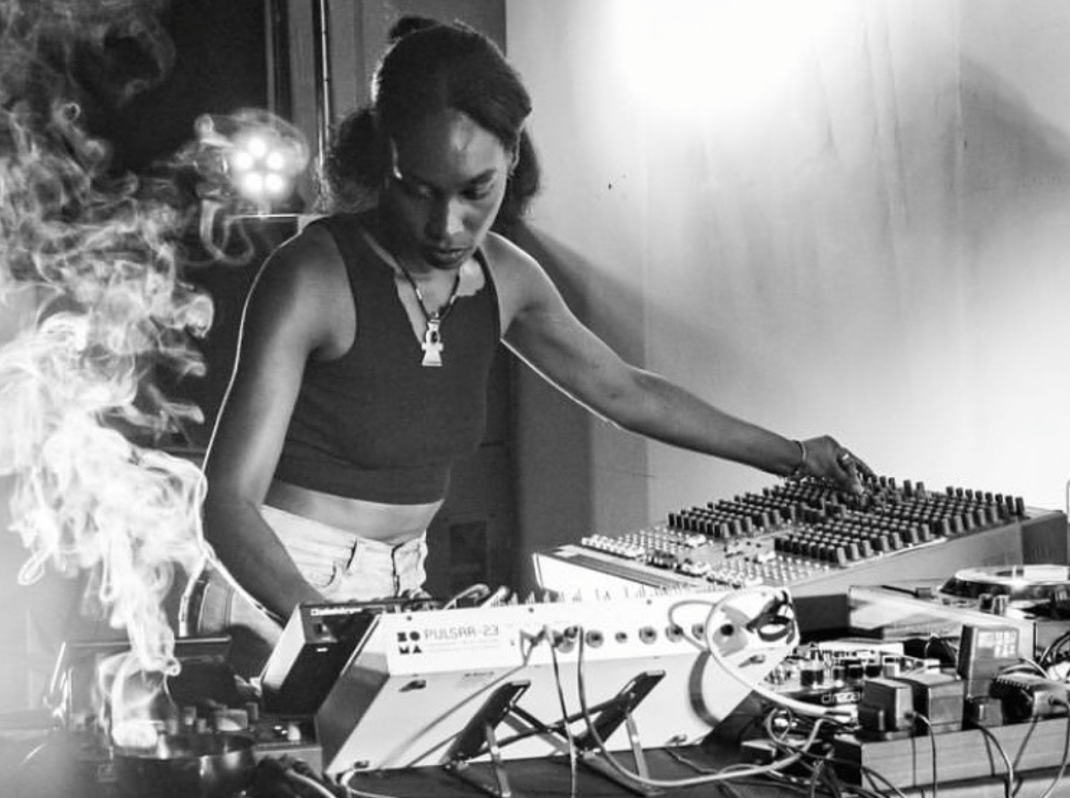
Nkisi, Iklectik, London, UK
Photo: Jonathan Crabb
In the concluding chapter of Kick It: A Social History Of The Drum Kit, author Matt Brennan notes that drums have infiltrated music production to the extent that “we are all drummers now”. This is especially true of electronic music where sampled or synthesized beats form the backbone of virtually every dance, hiphop and pop track. “Rather than drummers being replaceable,” he argues, “the art of the drum kit, drummers, and drumming has now been normalised to the point where it is an indispensable part of contemporary music culture.”
Brennan’s assessment comes to mind when listening to Nkisi’s set at Iklectik, the first concert in the Black Industrial/Noise event series. With her bank of synths, drum machines and CDJs, Nkisi positions complex polyrhythms to the centre of our attention. Deep bass drums interchange between the left and right channels, while chemical washes dominate the higher frequencies. The beginning is slow, almost ambient, but the set quickly builds into a panicked dialogue between malfunctioning appliances, laser pitched toms and floor shattering kicks.
In a conversation with the artist and scholar Hannah Catherine Jones before her set, Nkisi discusses the function of rhythm and ritual in her work. She explains that witnessing the ceremonies at Benin’s Ouidah Vodun Festival showed her how music can affect the environment by welcoming spiritual energies into the performance space. In addition, she notes that the construction of cross rhythms – conflicting patterns played simultaneously – are instrumental to her practice, particularly in a live setting.
Nkisi’s fluctuating dynamics between the different rhythmic layers encourage the audience to actively participate. The heaving groove and unexpected accents shift all the bodies in the room to dance, even those who initially parked themselves on the floor. With the temple-like interior bathed in ultramarine light, and infectious beats pulsating from all sides, it’s impossible not to surrender your mind and body.
Jones likens this idea to Sylvia Wynter’s concept of consciousness reversal, which states that drums, and the multitude of grooves expressed through them, bind the self to the collective social experience of dancing and listening. Nkisi also sees her music as a conduit for spiritual technologies that runs counter to the demonisation of voodoo by Hollywood, and helps to keep ancient energies alive by bringing them into a contemporary art-music context.
In the Kongo culture, nkisi are sculptural objects inhabited by spirits. These days, Nkisi says, they are often “imprisoned in museums”, permanently exposed to the public, divorced from their intended ritualistic function. It’s easy to draw a parallel between the spiritual activation of such objects and the fetishisation of gear in electronic music. For Nkisi, however, sonic practice is a sincere form of channelling that allows outside forces to take over. “Noise is connected to the non-representation of nature – ancestors,” she says. “The spirit loves to communicate through electricity.” Her music is also connected to decolonial practices and asks “how to take care of the invisible forces without trying to expose them or continuing the violence” directed towards the occult.
During their talk, Jones muses on the idea that “repetition makes us learn something”. Through repetition, mediated by electricity, Nkisi initiates the audience into ancestral musical practices, teaching us the power that rhythm has over the collective experience and ensures that ancient rituals continue to exist in the present.
Ilia Rogatchevski
Originally published by The Wire, August 2023.
 Ilia Rogatchevski