Various venues, Montreal, Canada
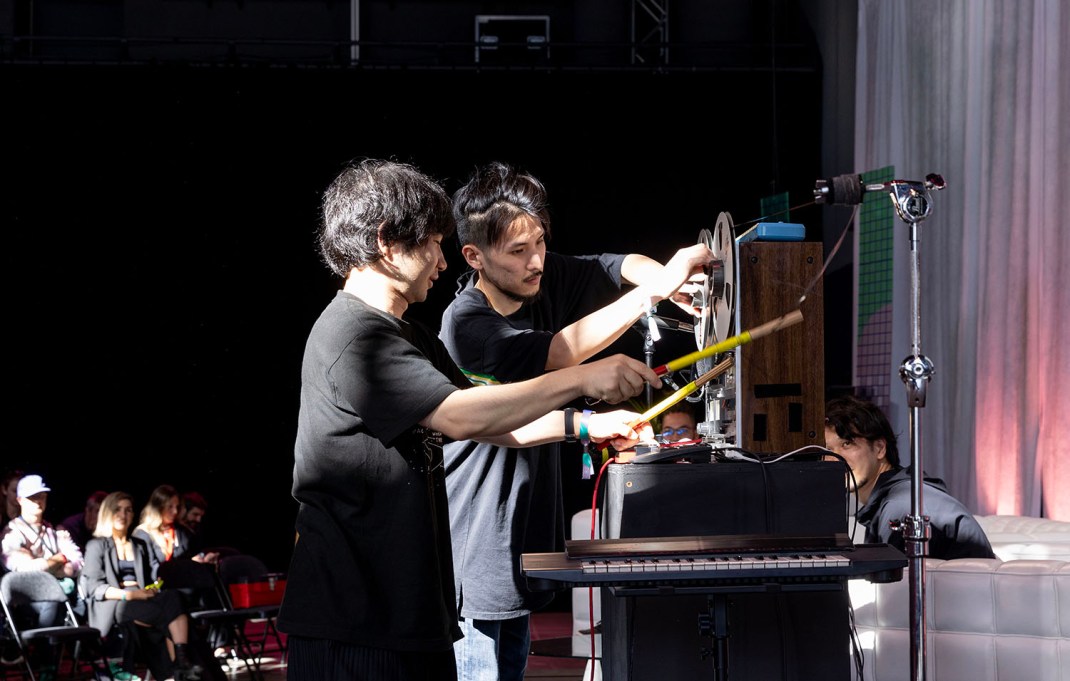
Photo: Open Reel Ensemble at MUTEK Forum by Maryse Boyce
This year is the 24th edition of Montreal based festival Mutek, which investigates how new technologies are applied in the creative industries while also exploring tech’s symbiotic relationship with electronic music. It takes place over six days with around 120 artists performing in various venues. At a conference running parallel to the gigs, more than 70 speakers – AI experts, XR (extended reality) professionals, and climate activists – present keynotes, workshops and panel discussions on the theme of Future Currents.
Grand River aka Aimée Portioli opens the festival at New City Gas, a remodelled gasworks that once powered Montreal’s street lights. Her carefully sculpted pulses glow with intensity, threatening to consume everything in their search for a universal rhythm. Premiering material from his latest album No Highs, Tim Hecker is even less forgiving. The set is dominated by avalanche-like frequencies that kidnap the body and inspire Vincent de Belleval to summon atmospheres of burning furnaces and oceanic emergencies in his synchronised light installation.
Performing at Société Des Arts Technologiques (SAT) is Open Reel Ensemble, a trio from Japan who play reel-to-reel recorders. They scratch the reels, bow exposed tape and hit long loops with drumsticks, weaving a rich tapestry of sounds from seemingly unremarkable sources. Call and response sections are recorded live and seamlessly folded back into the groove. In an artist Q&A, band leader Ei Wada explains how he sees these obsolete machines as “exotic folk instruments from the past” that allow the musician to move through time.
More dance-focused sets, albeit ones utilising inventive projections, come courtesy of acts like Efe Ce Ele, Paraadiso and SUFYVN (with visuals by Kaminska). For those with the stamina to keep going all through the night, the ornate MTELUS concert hall hosts the likes of .VRIL and Eris Drew. Ambient performances, meanwhile, are held at Les 7 Doigts. Erin Gee’s ASMR-influenced work Affect Flow is the most memorable of these. Gee hooks up five volunteers to biosensors which control the sound in various ways. The mood oscillates from overwhelming metallic washes to organ-like tones while Gee mediates the seance with her muted monologue and closemiked objects.
The central city square of Esplanade Tranquille is taken over by free performances throughout the week. Toddlers in ear defenders share the dancefloor with seasoned ravers. Out of the expanded programme, Canadian trio Randy’s Calling stands out the most. They encircle themselves with a daisy chain of countless defective ring modulator pedals and generate irresistible waves of feedback laced with a rhythmic electric crackle.
Another highlight is Alessandro Cortini and Marco Ciceri’s concert at the Théâtre Maisonneuve. Ciceri’s hyperreal visuals of undetermined objects resemble AI hallucinations, with the details elusive and constantly shifting. Cortini’s modular set, meanwhile, imitates obliteration by first harmonising mosquitoes with an aircraft engine and ending the piece with tectonic plates grinding against each other.
One of the main draws is the Satosphère, a domed space on the top floor of SAT housing immersive experiences. Projections of cascading viscous liquid – created by BunBun and Alex Vlair – morph into flowerlike apertures opening to reveal the night sky above. When combined with Nadia Struiwigh’s textural techno and the sweat lodge temperature on the dancefloor, these dreamlike images usher everyone in the room into a communal psychedelic experience.
By contrast France Jobin and Markus Heckmann’s Entanglement makes more cerebral use of the same space. This time we’re parked on beanbags, looking up at the ceiling. Geometric structures, inspired by quantum physics, untangle in front of our eyes, as string-infused drones, loaded with static, hang heavily in the air. I view the same piece on a virtual reality headset before the show. It’s one of the more successful XR experiences at Mutek, because it constructs an alternative abstract world rather than trying to supplement or augment our present one.
At the conference, the discourse around AI and XR is generally idolatry, but cracks of critique are also visible. Chris Salter, who co-produced the climate crisis-themed XR play Animate – also staged at the festival – admits to the limitations of what he calls “body extension” and traces XR’s origins to the Vietnam War (when pilots landed their helicopters in the dark using infrared sensors and headsets). Despite the technology’s dominance in the military and computer games, Salter states that artists are the ones who test its limits, citing Marshall McLuhan’s belief in art as an early warning system that monitors changes in society.
Ilia Rogatchevski
Originally published by The Wire, October 2023
 Ilia Rogatchevski