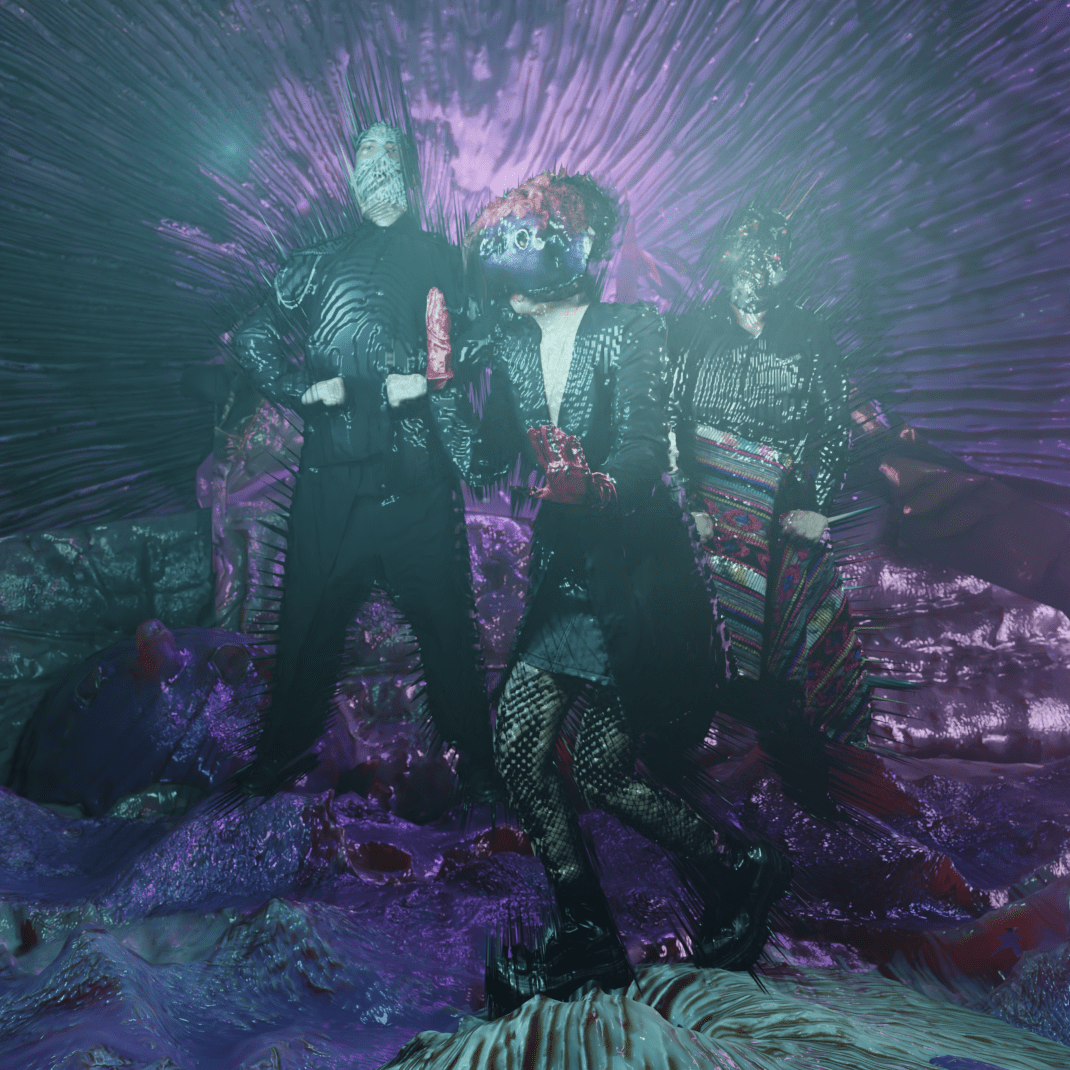
The Vienna based trio create a riotous fusion of traditional Iranian instrumentation, electronic processing and theatrical headgear. HUUUM: (from left) Omid Darvish, Rojin Sharafi, Alvaro Collao León. Image: Rezzarte/TE-R
HUUUM’s self-titled debut opens with the foreboding “Dibāche”. The fluctuating breath that delivers a mournful saxophone melody is twinned with the crashing of synthetic waves and other digitally processed sounds. Foreshadowing the dark and mysterious themes to come, a male voice swells like the charcoal skies of an oncoming storm. “Hanābandān” kicks in with an electric scream and “Yezle” bares its teeth in a maelstrom of heightening intensity brought on by a gnashing riff and sinister violins.
An untrained ear might hear influences of free jazz, dank clubs and doom metal, but at its core the Vienna based three-piece investigate the different languages and dialects of Iran as well as the diverse music native to Persian culture. “I wanted to show the capacity of folk music in Iran,” explains vocalist Omid Darvish. “When we talk about Iranian music in Europe, we think about people sitting on stage, playing this traditional instrument. You know, this stereotype.”
Originally hailing from Kermanshah, Darvish was surrounded by music from an early age. He studied the tambur and Kurdish music – alongside Western classical, jazz and rock – and wanted to channel the different facets found inside Iranian folk into HUUUM. The project, named after a mythological plant, began during Covid when Darvish took to studying music based on the sorna, an ancient double-reed instrument. The idea was to mimic its textural and melodic characteristics with the saxophone. “It was very much a learning process,” remembers producer Rojin Sharafi, who also plays synths and drum machines. She gravitated to Vienna from Tehran to study music. “It was a big challenge,” she continues, “not only because of the microtones, but also finding these colours and techniques.”
The band, who were at that time completed by saxophonist Astrid Wiesinger, held group listening sessions that contributed to expanding the instrument’s mimetic potential. After a period of covering famous folk songs from different parts of Iran, HUUUM started composing original material. While the electronics and saxophone derive their sounds from traditional forms, Darvish’s singing is the authentic backbone around which everything else pivots. “Singing techniques in Iran are totally different,” Darvish explains. “For example, in the West the vocal sound comes from deep inside, but when you go to the East, it comes up from behind the nose. I’m singing in maybe five or six different languages [on the album] and in each track I used the technique from [a specific] area. If you listen to “Hahre Tavil”, you will hear the Tehrani accent, but how they sang in Tehran 100 years ago.”
Following our interview, the band send me translated lyrics that expand on what is innately felt when listening to their songs. “Āzmān” is inspired by the music of Baluchestan and sung in Baluchi. It has a unique colour to the vocal which, Darvish says, can’t be heard in music from other areas. The lyrics, initially set against a buoyant melody, describe an inner voice that strives to be recognised by its owner. Halfway through, the hopeful sax fades, only to be replaced with tectonic beats, shrill pulses and a chant that proclaims, “Without me, death is your instant omen”. The mood darkens on “Chapi”, sung in the Lori dialect. Sharafi’s machine rhythms take the helm in an ode to the funeral dancing ceremonies of Lorestan. Meanwhile, the sax shapeshifts into a shepherd’s pipe playing “the melody of death” for slain youth.
HUUUM’s line-up changed in the summer of 2023, when Wiesinger left due to health issues. “It was hard for us, because we three started together,” Sharafi says. “We were looking for saxophonists. There are lots of great musicians in Vienna, but we wanted to have someone who, like us, comes from different practices.” Álvaro Collao León, originally from Chile, is their new addition. Always interested in expanding his range, León’s versatile technique combines classical, contemporary and South American influences.
Although the group haven’t performed often, their stage show expands on the studio recordings. Improvisation is a key factor that involves Sharafi processing the saxophone and vocal signals live, but so is a sense of ritual. “I think an important thing for us is to interact with the audience,” declares Sharafi. “Six months after HUUUM formed we played in a club. That was the best, because people were not always dancing, but listening to the music. Some friends in the audience were doing kel [ululation usually performed during communal rituals such as weddings].” This experience encouraged the band to embrace theatrical elements and fold these into their work. Each member wears their own distinctive headpiece: Sharafi’s represents modern culture; Leon’s – nature; Darvish’s – roots. “I have very different characters in each song,” says Darvish. “I’m acting, playing different people. When I wear the mask, you don’t know who is behind it.”
These amorphous identities are echoed in the album sleeve, a near-featureless portrait painted by Darvish’s sister Hosna Darvishi. The band see themselves reflected in its reticent stranger with many stories to tell. “It’s exactly like what we are doing in HUUUM,” asserts Darvish. “Maybe you cannot understand anything about this music, but if you listen, you will understand that everything is natural, even the electronic beats. We didn’t invent anything.” Sharafi agrees: “What I like about folk music is its openness. You can change it. Having this freedom is very attractive to us.” ● HUUUM’s HUUUM is released by Accidental Meetings
Ilia Rogatchevski
Originally published by The Wire, December 2023
 Ilia Rogatchevski