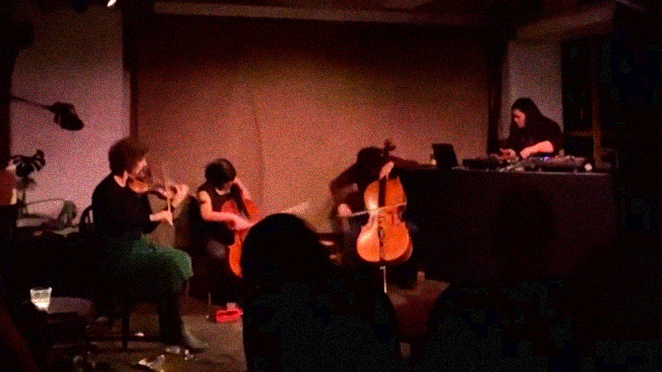
Mariam Rezaei + Angharad Davies + Atzi Muramatsu + Semay Wu
Cafe Oto, London UK
The first night of Mariam Rezaei’s three day residency at Cafe Oto considers the unmet potential of a string quartet. The musicians play two improvised sets with no prior discussion about what direction the music might take. Cellists Atzi Muramatsu and Semay Wu, violinist Angharad Davies and turntablist Rezaei fuse their instruments so efficiently that it’s hard to believe this is the quartet’s first show together.
Rezaei takes the helm of a digital vinyl system, which allows her to select and control a bank of samples using a regular turntable set-up. She has around 200 sounds to choose from. Some of these were recorded by the residency’s participants: violins by Davies and drums by Lukas Koenig, who performs with Rezaei, Gabriele Mitelli and Mette Rasmussen on the final night. The expansive variety of the samples means that Rezaei can be flexible in her approach, developing the composition in unexpected ways.
The first set begins with swelling strings and bows tapping on wooden bodies. Wu’s fingers scratch her cello, drawing out pig-like grunts from the instrument. Davies listens before committing. She plays, fully immersed, with her eyes shut for virtually the whole concert. Both players use effects pedals, but sparingly. Sometimes it is difficult to tell the original source. Is that slippery glissando the result of Rezaei stretching digital audio files or created by Muramatsu with acoustic means?
The diversity of sounds ranges from cacophonous air raid sirens and boiling kettles to Sputnik bleeps and rewinding tape. If you close your eyes, the soundscape feels overburdened with mechanical manipulation until you realise that Rezaei has dropped out long ago and the strings alone are creating the sensation of time collapsing in on itself.
All four improvisors leave spaces for each other. Muramatsu is the most cautious, playing with determined gestures only when appropriate. Wu, meanwhile, wrestles drones from her cello, inviting Davies to garnish them with accents. Rezaei is talking in the same language. Her technique is precise: dropping needles, cutting faders, twisting EQs and scratching records with confident determination. She follows the growing intensity of the strings, reaching an industrial crescendo together with the others.
There is a brief moment of uncertainty in the second set, when the strings fall silent, but soon the pace picks up and the temperature rises again. Cellos duel under the fumbling contact sound of the turntable stylus, and percussion takes centre stage. Davies keeps the beat with her violin bow, as if skipping stones across a trinitite lake, predating the harsh metallic snares to come. Ecstatic noise, droning strings and Koenig’s drum samples coalesce into a terrifying climax.
Reflecting on the performance after the show, Rezaei tells me: “I don’t think anybody knew it was going to go there tonight.” She explains that the residency as a whole, which also includes a duo with Edward George, is about challenging the restrictive confines of genre. Turntables still have a strong affiliation with hiphop, but the instrument has always been about experimentation. Within the context of digital vinyl systems, there’s a secondary element to composition where you have to estimate how the sample might be used live and work backwards from there. “It’s mainly a creative challenge to myself,” Rezaei says. “What can I make the turntable do to work with these very different ensembles and combinations? The turntable can play anything. It can stretch anything. I believe that within it, something new can be found.”
Ilia Rogatchevski
Originally published by The Wire, February 2024
 Ilia Rogatchevski