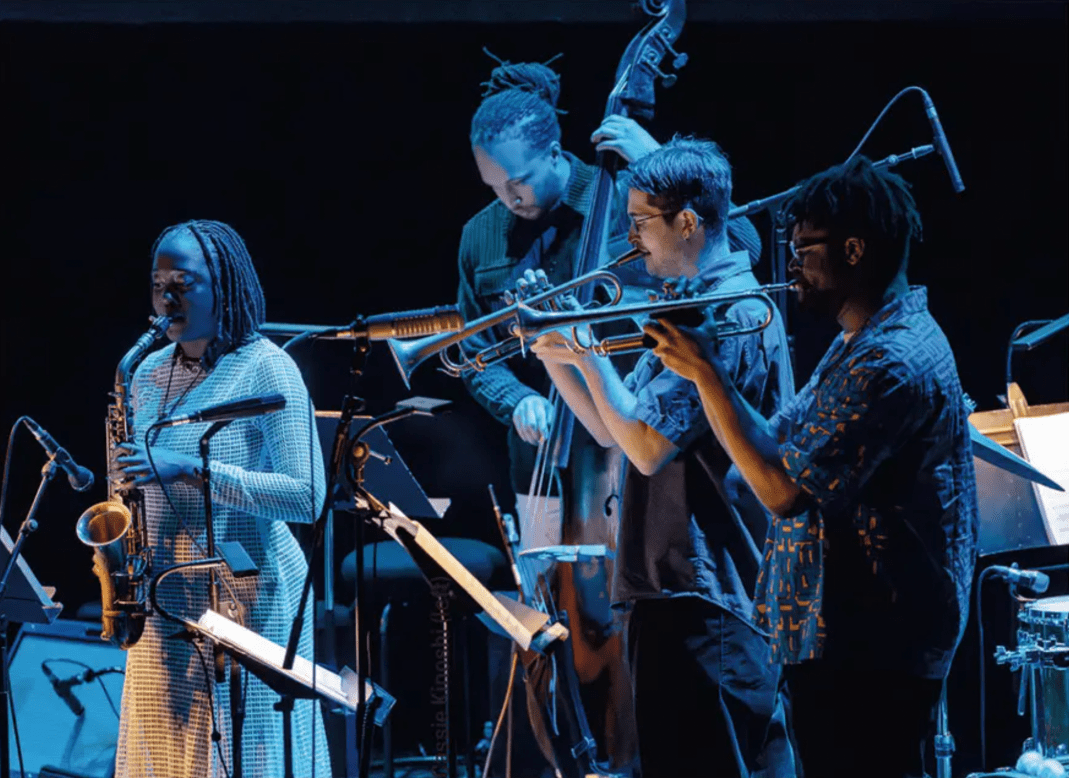
Cassie Kinoshi with seed. + NikNak + London Contemporary Orchestra
Barbican, London, UK | Photo by The Red Beanie.
The Barbican’s stage is crowded. Cassie Kinoshi, the alto saxophonist, composer and former member of Kokoroko, leads the ten piece seed. ensemble for the presentation of her new work gratitude. Joining them are five members of London Contemporary Orchestra and the turntablist NikNak.
Kinoshi counts in the strings, which swell cautiously like dawn breaking, the piano tiptoeing around them. NikNak energetically scratches the vinyl. The slippery records echo the strings’ glissando in an imitation of birdsong. As the rest of the band kick in, it feels as though the sun itself has risen, throwing light and warmth onto a brutal winter morning.
Trumpeter Joseph Oti-Akenteng takes the first solo as the artist GURIBOSH’s collaged visuals flicker in the background. Seascapes and fields crossfade inside of circular spyglass frames, while Oti-Akenteng’s melancholic horn paints abstract glyphs in the air. Not long after, Shirley Tetteh’s eloquent guitar compels the band to bop their heads in appreciation. Kinoshi’s own solo is white-hot like an infinitely bright polar day.
There’s some expressive back and forth, too. Trumpeter Jack Banjo Courtney trades feverish lines with saxophonist James Akers, while flautist Clare Bennett and NikNak’s exchange momentarily evokes that wonky Belbury Poly nostalgia for a nonexistent rural yesteryear. So rich are the collective frequencies that, for the most part, the acoustic instruments drown out the DJ. It’s only during mellower interludes, when the brass and reeds relinquish their dominance, that the electronics feel present in the mix.
Initially performed last year at London’s Southbank Centre, gratitude has been released by Chicago’s International Anthem label. In the record’s paratext, Kinoshi explains that the work is inspired by her mother who keeps a gratitude book where “she writes one thing, no matter how big or small, every day that helps to refocus her mind”. For Kinoshi, composing the piece became an act of endurance, but ultimately led to more positive practices with respect to her own mental health.
At one point in the set, the literary artist Belinda Zhawi comes on and urges us to “give thanks for the sun that rises in the East and sets somewhere between a rock and a hard place”. The band fall silent as Zhawi talks about housing estates built on marshes and “hands that can build, but only break”. She evokes an image of a solitary dove, framed against an endlessly overcast sky, with no olive branch in its beak. It is a bleak hint towards the growing inequalities of our brazen century.
After gratitude concludes, Kinoshi introduces a new piece commissioned by the Serious Trust for International Women’s Day. The first three movements are inspired by female musicians who were prominent during the interwar period, but have since faded from public consciousness: jazz vocalist Evelyn Dove, composer Annette Mills, and saxophonist and bandleader Ivy Benson.
Perhaps in reference to the recent scandal surrounding the Arts Council England and its threat to remove funding from individuals or organisations who express “overtly political” opinions, Kinoshi dedicates the final movement to those unafraid to speak out. With their increased tempos and physical rhythms, these four movements share a sense of urgency largely absent from the first half of the set. While gratitude encourages the listener to appreciate the ephemeral, the final suite reminds us to seek out, engage with and amplify unheard voices.
Ilia Rogatchevski
Originally published by The Wire, April 2024
 Ilia Rogatchevski