Eventim Apollo, London, UK
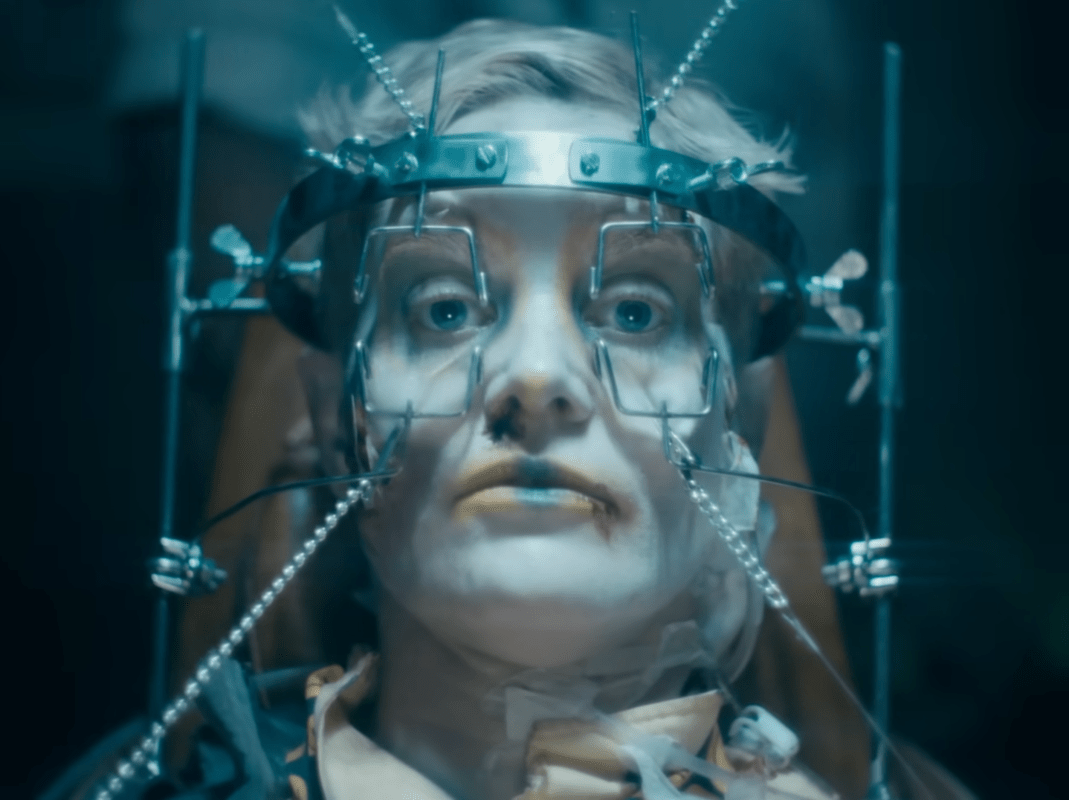
Image: Still from Shiver, dir. Martin Falck
The key protagonist of Fever Ray’s third album Radical Romantics is Main, a meek white collar drone who, by submitting to the objects of their desire, casts off their awkward shell and embraces love in all its complexity. Main’s transformation is played out in the visual language of the album, its artwork, publicity photos, music videos, costumes and stage design.
This radically romantic universe was conceived by Fever Ray’s Karin Dreijer and creative director Martin Falck. Within it Dreijer adopts various personae that each symbolise divergent aspects of human emotions, the ones that Dreijer recognises in their self. In the video for “What They Call Us”, Main imagines escaping the constraints of social normativity and in “Kandy” their wish is granted. Romance, a Sméagol-like character in a seedy club – also played by Dreijer – seduces the besuited Main with a lap dance, enabling an ecstatic but potentially toxic union.
These carnal themes are extended to the concert itself. A solitary streetlight is placed centre stage, suggesting a midnight cruising spot. The lamp’s vaporous glow promises an erotic encounter with a stranger but also hints at the fears and inhibitions Main must overcome to realise this promise. On stage, Fever Ray are completed by backing singers Maryam Nikandish and Helena Gutarra, drummer Romarna Campbell, and Minna Koivisto on synths.
The set begins with the nervy slow build of “What They Call Us” – all aquamarine hues and aluminium beats. Main emerges from insular darkness to confidently massage the audience into a frenzy during “To The Moon And Back”, a song from Plunge that explores the blinding rapture of a burgeoning romance. Dreijer throws roses into the crowd while singing that it’s time to “breathe some life into a fantasy”.
Nikandish and Gutarra sidle on either side of Dreijer. Their respective costumes – a fetishised business suit and a gold sequined jumpsuit embellished with zodiac symbols – suggest they are the proverbial devil and angel sitting on Main’s shoulders. The three singers converge during the sensuous “Shiver”. As the house lights turn pink and the streetlamp pulsates like a throbbing heart, their splintered personalities fuse under the heat of orgasm.
The colours fade and the keytars come out for the gothic revenge anthem “Even It Out”. Co-produced by Trent Reznor and Atticus Ross of Nine Inch Nails, the track’s industrial drive spawns psychopathic visions and invites you to methodically “cut, cut, cut” anyone who has ever wronged you. The music video shows Dreijer, in a Divine-like Demona Lisa persona, getting their own back on a bully. The film is inspired by John Waters, his saturated palette transposed to a bleak winter setting. Live, the song loses none of its power, resonating with the feelings of injustice that all of us harbour.
In the closing third of the set, “Carbon Dioxide” is another peak. The lyrics are inspired by the Lovers of Valdaro, a couple of ancient human skeletons found entwined. The song opens with the words “Sucking on what’s mine/Love’s carbon dioxide” and progressively shifts gears with the key refrain pointing to the need for both caution and abandon while falling in love. In an Instagram post, Dreijer muses that perhaps the skeletons’ passion was so intense that they couldn’t stop kissing and suffocated to death. Of all the ways to leave this wretched Earth, that’s probably the sweetest.
Ilia Rogatchevski
Originally published by The Wire, May 2024
 Ilia Rogatchevski