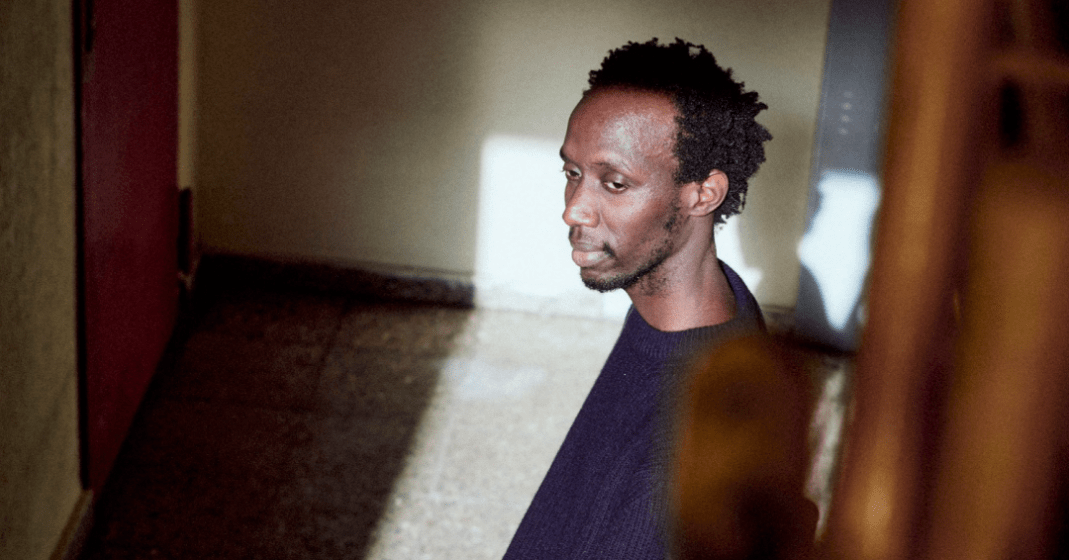
The Kenyan born producer and artist finds a sense of place via field recordings, music and installations, giving voice to ethnographic sounds and archived objects By Ilia Rogatchevski Photography by Laura Schaeffer
Listening to Disconnect, KMRU’s collaborative album with Kevin Martin, fills your gut with contradictory feelings of dread and elation. “Lately, I’ve been thinking about sound on a very physical level,” Joseph Kamaru, the Berlin based producer who releases under the KMRU alias, explains over video call. “I know most of The Bug stuff, and really enjoyed his Pressure album. With Kevin’s work, it’s interesting how he can push style and alter bass frequencies to extremes. I think that’s how we connected.”
The whispering drones on “Differences” evolve gradually out of silence, swirling around Kamaru’s wordless intonations, as steady percussive pulses carry the composition forward. Intense trepidation swells like the oncoming wave of an ecstasy high while his voice, softly spoken but authoritative, recites a monologue about “understanding the Other”. The text in “Arkives” discusses African traditions and artefacts within the context of colonial violence. The words are set against monochromatic chords and despondent chanting that suggest an imminent dystopian collapse.
“Differences” and “Arkives” are the core of the record and, in true dub fashion, the tracks that follow strip away certain elements while contributing new ones: the subtle bass drum and shuffling snare brush on “Difference”, for example, or the repeating minimal synths on “Differ”. Even the track titles resemble fading echoes by truncating the original text as you progress through the album.
Kamaru’s alliance with KRM is far from the only collaboration he has undertaken. Limen, his 2022 release with the French sound artist Niamké Désiré aka Aho Ssan, was described by Vanessa Ague in The Wire 460 as “a means to harness destruction and build something anew”. The album’s key track “Resurgence” was a Berlin Atonal commission. Paired with visuals of volcanic activity, its layers of digital noise and ceaseless crescendos share the density of a neutron star. The rest of the album is no less extreme. Despite the apocalyptic mood of the music, the collaboration itself came easy. “Limen was very spontaneous,” Kamaru says. “We had this one track and were like, let’s explore something together. Similar to Kevin’s collaboration, it was also online, but with Désiré it was so seamless, cohesive.” The two albums share a curiosity for the darker sides of the human condition – Limen is partly inspired by Katsuhiro Otomo’s cyberpunk manga Akira as well as the mythical phoenix bird – but whereas Disconnect concerns itself with solitude and soul searching, Limen is focused solely on cathartic intensity.
Martin – credited here under his initials KRM – first became aware of his collaborator’s work after watching Coco Em’s short documentary Under The Bridge (2020). The film opens with Kamaru collecting stones and throwing them against the concrete walls of a roadbridge, with recorder in hand. He uses their skittering as the starting point of a new track. The recordings are looped or augmented; drones are layered on top of each other with a tone generator. The process is broken down as if in a YouTube tutorial. He speaks directly to camera and shares screen recordings of his Ableton session, demystifying his methods.
So KRM contacted KMRU on social media, and at first the musicians shared music with each other, leading to a collaboration in 2021. “He reached out about making an album together based on my voice,” says Kamaru. “We shared sketches, although both of us were busy touring, and it wasn’t until late last year when we decided to finish the tracks. The timing was sort of interesting, because I was writing this paper in school [Universität der Künste, Berlin]. It was presented as an audio paper and I was like, maybe I can explore this voice in conjunction with the theme of the project, this idea of being removed or distant.”
Kamaru’s paper looked at Audre Lorde’s ideas about differences and how they should be harnessed to spark creativity within culture rather than be perceived as a threat to it. “She was writing about otherness and disagreement,” he says. “Like this friction happening; being in a place and trying to orient yourself in a world that’s dissolving, but still trying to push forward. The tracks evolved to carry the weight of how we were thinking about being in this dystopian situation alone. It’s dark, in a very beautiful way, with the simple, heavy, repetitive motifs led by the voice. There’s this hope”.
Kamaru’s A|||oy project with the Welsh vocalist and producer Freya Edmondes aka Elvin Brandhi explores similar themes but from an improv angle. “Most of [my collaborations] have been online, but this one with Freya is very different because it’s live improvisation. We performed at Atonal last year and she was the only one that I could do a big show with, only having three weeks to prepare.” In what way is improvising different from producing in the studio? “For improvising, it’s like this headspace that I have. So bringing instruments that I know are very reactional; field recordings; extreme processing with pedals. The last improv show with Freya was the first one I used my voice live.”
Elvin Brandhi performs with a microphone and a Roland SP-404 sampler. Kamaru was impressed by how extreme and layered her music could be from such a minimal set-up. It inspired him to lean away from established ways of working to a more spontaneous, non-linear approach. In his solo work, Kamaru is best known for the explorative ambient compositions that have roots in his home city of Nairobi. He grew up in Kariokor, a bustling neighbourhood with high levels of traffic and street noise. “I became more aware of sound growing up with public transport in Kenya. I liked the boomier, fancier sound systems in the matatus [public buses]. The louder the sound, the more I enjoyed it. As kids we used to watch for the boomiest one to come. Thinking back now it’s like, wow, I enjoyed loud music. It was mostly hiphop and rap.”
A young Kamaru played Lil Wayne bangers on the home theatre system while his parents were out. “I was cranking it super loud, seeing how it encompassed the space. Having that knowledge about the force of sound and what you can do with it was amazing – that you can push sound to its extreme.” As a teenager, he moved with his family to the suburbs in Rongai which attuned his ear to a different soundscape. Suddenly he was surrounded by nature and birdsong, a novel quietude that contrasted with the familiar sounds of Nairobi.
He was named after his maternal grandfather Joseph Kamaru, a popular benga musician and political activist whose presence and hits such as “Celina” and “Thina Wa Kamaru” were everywhere. “My connection with him was becoming more apparent in school when I introduced myself as Kamaru,” he recalls. “My teachers would ask if I could sing too. Studying his legacy at university drew me closer to his music and activism, and we became closer when he realised I’ll carry the music torch.” The two had aspirations of working together, before the elder Kamaru passed away in 2018. “I felt a need to keep his music alive and started reissuing his work online. His spontaneity and realness is something I got from his music and him as a person. Being honest with oneself creatively is the advice I got from him, I must say.”
Music was part of the younger Kamaru’s daily encounters, from daily commutes on matatus to mangling tapes and dubbing radio onto cassettes. “I remember being involved in a choir, but it wasn’t until high school that I pursued this fully.” He undertook a music technology degree at Kenyatta University and his early work, like the psychedelic single “Laibon”, leaned towards progressive house. “That’s where I got myself into DAWs. I was initially producing a lot on FL Studio. The intention was to make beats and share them with friends. I got into Ableton later but had to learn it the hard way as I didn’t know anyone using the software. It prompted me to start hosting the Nairobi Ableton User Group – workshops for music makers.”
It was around this time that Kamaru began to critically engage with his surroundings. An extended train journey across Kenya for the East Africa Soul Train artist residency resulted in the EAST EP. Produced together with Manch!ld – whom Kamaru met on the train – the music fuses sun-soaked electric piano and delicate four to the floor beats with snatches of passengers’ conversations. “This was my first experience with so many creatives together from all disciplines working on stuff. The concept was great and afforded a collaborative atmosphere, meeting artists with whom I still work like Kampire and Hibotep.”
Incidental sounds from this journey, such as the mechanical rhythms on “African”, were captured on his MP3 player which had a sound recording function. “I was finding myself travelling a lot and having to listen in a specific way. You’re constantly listening, but you sort of bring it to the foreground, like this attunement or awareness. Through field recording you realise the different nuances of a particular sound and how you’re supposed to listen to them, or how you’re supposed to record them.” This experience opened up new possibilities of incorporating environmental sound and Kamaru began using field recordings as the baseline for his compositions. Chris Watson’s album El Tren Fantasma – a radiophonic journey across Mexico’s railways – served as a blueprint for this method, showing that field recordings can possess their own drama and musicality.
Purchasing a Zoom recorder changed Kamaru’s approach to listening. Its onboard microphones enhanced the details of his surroundings, but this wasn’t the only way he recorded sounds in the field. “I was trying to extend this idea of not only listening with the ear. Sketching was something I was trying to do. Not replicating the environment with an image but trying to frame it like the sketch is the ‘recording’ of the environment.” Photography also plays a vital role in his practice. Documents of daily life often end up as album artwork. Deadpan shots of street furniture and ordinary objects, such as the solitary climbing frame on the cover of Dissolution Grip, give his releases an uncanny edge. Studying at Universität der Künste inevitably changed Kamaru’s relationship to composition, listening and performance, not least because his tutors found it difficult to separate KMRU the artist from Kamaru the scholar. On a practical level, sound synthesis has become more prevalent in his recent output, namely on Limen and Dissolution Grip, where he’s actively pushing new boundaries. “I was thinking about field recordings as the basis of sound but using the waveforms as raw recordings, the extreme ends – just sine and saw waves – and trying to replicate field recordings on a synthetic level.” The technique of blurring waveforms to create a tapestry of sounds stemmed from experiences with improvisation and live performance as well as from collaborator Aho Ssan. “Désiré is an influence because he starts making music with just pure tones and then it becomes so abstracted. I’m sure he played a role in this when we were working on Limen ”.
The theoretical side of academia contributed to expanding the contextual dimension of Kamaru’s projects. While Limen presents a widescreen depiction of planetary devastation, his multifaceted project Temporary Stored, which won an honorary mention at the 2023 Prix Ars Electronica, explores archives and the Western representation of the Other. Presented as an album, installation and radiophonic piece, Temporary Stored compiles sounds from the Royal Museum for Central Africa in Tervuren, Belgium. Ambient drones spiral around ethnographic recordings of indigenous African voices from across the continent (songs, dances, mourning rituals), recorded between the 1950s and 80s, reconfiguring the way we think about recordings from the past.
“Temporary Stored took lots of back and forth with the museum to get the archive,” he explains. “There wasn’t much negotiation, but more institutional protocols of working with an archive: going through digital catalogues with little or no information of the recordings; not being able to hear the recordings until I compiled a list of metadata. The project took almost a year to realise and [for me to] decide to engage with the work.”
Reflecting on the extraction of cultural property in an article published by Urgent Pedagogies in March 2023, Kamaru notes that the representation of African artefacts, when viewed from a Eurocentric perspective, strips away their original purpose. In Africa, many of these “objects” are not considered to be objects at all, but rather historical carriers and spiritual beings that are passed down through generations. Their inaccessibility perpetuates the colonial pattern of discourse, and Temporary Stored is Kamaru’s attempt to repatriate these artefacts.
I ask if his approach is any different when working for installation, given his recent contribution to the immersive piece Oceanic Refractions. Presented by CTM and transmediale at Berlin’s Silent Green earlier this year, the piece features testimonies of Fijian, i-Kiribati and Papua New Guinean elders on kinship, self-determination and care in the context of climate change. “The aesthetic of my work always changes based on the project that I’m doing with other people. Oceanic Refractions was one of the only installations that I’ve done on a large scale. So many people were involved and I wasn’t just the sound guy making the sound piece but involved in the project from the ground.”
At the same time, Kamaru recognises the limitations of gallery based installations, particularly when it comes to accessibility. The work is presented in a single location and only for a specific amount of time. This is why a stereo mix for a multichannel piece, or a radiophonic version of Temporary Stored, for example, gives more people the opportunity to engage with the work. However, he also acknowledges the benefits of leaving things unsaid. “The last works I’ve been exploring are engaging with things happening outside of music. I still battle with contextualising things. Sometimes it doesn’t have to be knowable or tangible. I like leaving room for opaqueness and not having to explain everything”.
Even before moving to Berlin, Kamaru regularly performed at various events across the world such as Uganda’s Nyege Nyege Festival, an annual showcase of contemporary African music,
and Gamma Festival in St Petersburg. After largely self-releasing his work, like the plaintive piano-led Erased EP from 2019, the breakthrough came the following year. The global pandemic didn’t stop him putting out three albums in 2020: Opaquer on Dagoretti, Jar on Seil Records and Peel with Editions Mego. Out of the three, Peel is especially good at highlighting a talent for combining melodic passages and drawn out textural electronics with field recordings of activated objects. Comparisons have been drawn with Tim Hecker, who treads similar waters, but the compositions have a subtle eeriness that is largely absent from the work of the Canadian producer.
He planned to release the record himself, but pitched it to Mego after Aho Ssan passed on the late Peter Rehberg’s email address “I was excited but also had three other records [coming out] and was thinking maybe Peter would just want Peel to be on its own. He was easy going, like: ‘I don’t care. We can release this and you can release another album [with someone else]. It’s fine.’ Having that confidence and trust from him is something that I appreciated. Most of the labels I release with have a community of listeners. Sharing music doesn’t have to have all this external pressure that changes how you relate to the record.”
Continuing in the spirit of independence, he launched his own OFNOT imprint in 2023, with Dissolution Grip as its debut. “I’m still a huge fan of self-releasing,” he says. “This stems from when I was sharing music with my friends in Nairobi on SoundCloud. I appreciate this idea of autonomy, of just being free to experiment. Lately, I’ve been thinking that my grandfather was so prolific, putting out so many albums. I’m creating so much. The decision to start OFNOT was based on all the music that I had made at university – just so much material. Some of them are long [compositions] and others are experiments I’ve done, but I’ll also possibly release music by friends or other people”.
Moving to Berlin made Kamaru reassess his listening once more. Compared to Nairobi, the German capital is sonically calmer, the odd police siren excepted. Kamaru’s approach to field recording is broad. Rarely does he look for something specific but makes room for chance, play and experimentation. “When I’m in the field, I carry different microphones. I’ll bury a hydrophone in the ground to see what happens. Other times, it’s mostly playing things that make sounds and recording that. As a listener, it’s the idea of taking time to be with the sound until a point where the self and the thing being listened to become porous. It’s a bit abstract, but I’m finding myself in these thresholds.”
In July, he will be releasing Natur on Touch, his first record with the label. Natur consists of a single piece derived from Kamaru’s experiments with electromagnetic frequencies. Evoking the work of Christina Kubisch, the piece reflects on the voices hidden inside our urban infrastructure and electronic devices. Static noise gives way to unexpected harmonies, rattling bass and birdsong. “The whole album is based on this recording I did with an electromagnetic microphone. It’s an interesting project because I performed it live for two years,” he says. Kamaru met Touch’s Mike Harding when on tour with Fennesz in the US, back in 2022, but the process to get the composition ready for release took its time. I ask how it feels to arrive here, considering that pivotal train journey in Kenya and the influence of Chris Watson, as well as all the other artists who have contributed to the label’s legacy. “Touch is a ‘listening’ label….They took a whole year just listening to the record and I appreciate that. I feel like it’s the perfect place for this kind of work”.
● KRM & KMRU’s Disconnect is released by Phantom Limb; KMRU’s Natur is released by Touch
Ilia Rogatchevski
Originally published by The Wire, June 2024
 Ilia Rogatchevski