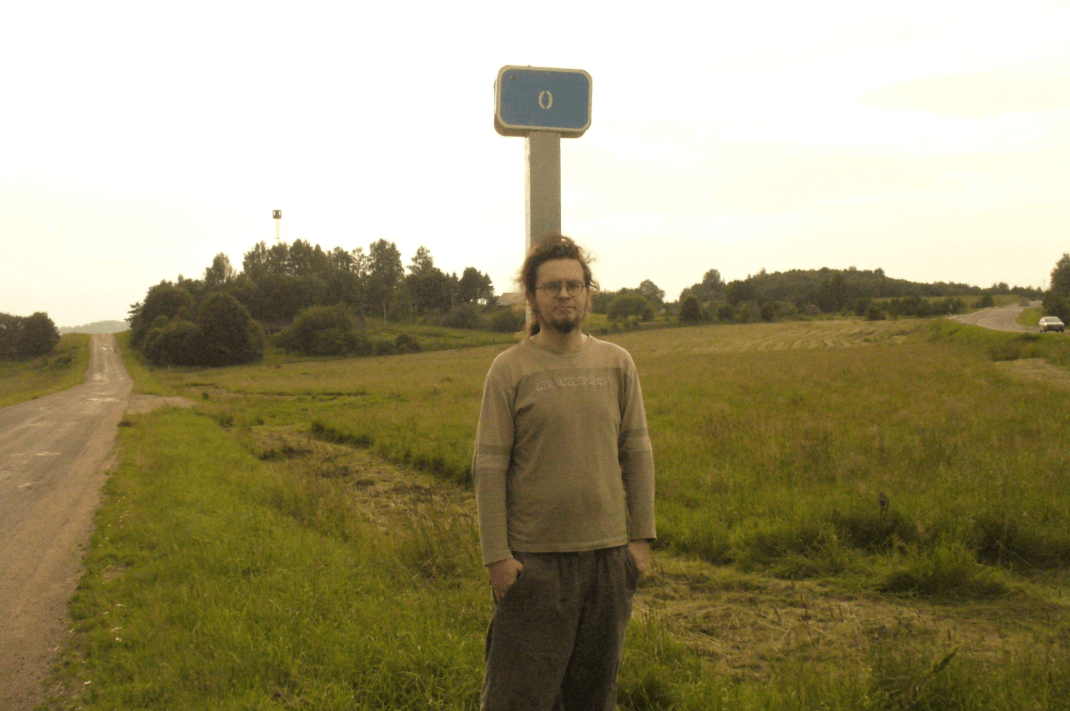
Working from exile in Poland, the Belarusian musician, poet and broadcaster keeps his home country’s avant garde flame alive. Photo by Jury Siemianuk.
Pramzona #7, the latest release in Viktar Siamaška’s arsenal of archival recordings, opens with a percussive conversation between found objects. The low rumble of what sounds like a plastic pipe flutters loosely as wooden sticks brush across metal railings and glass debris sweeps the floor. Prefiguring Siamaška’s brooding clarinet, a distant cuckoo contributes to the industrial clamour. Recorded in 2018 at the cultural complex Dalina Aniołaŭ (the Valley of Angels) in Mazyr, Belarus, it investigates the inert acoustics of abandoned spaces by activating them through improvised performance – just like the other albums in the Pramzona series.
“I’ve always wanted to go beyond the domestic recording process to environments with vast natural acoustics such as hills and forests,” reveals Siamaška. “Deserted industrial buildings became the best places for creative encounters. In light of recent events [the 2020-21 Belarusian anti-government protests], it became a bitter metaphor for my homeland. These buildings are scattered across the country, and the word pramzona (industrial zone) is used to refer to places where thousands of Belarusian political prisoners are currently being made to work.”
Born in Minsk in 1980, one of his earliest memories is Soviet leader Leonid Brezhnev’s state funeral on TV. “The music had to conform to the moment,” he recalls. “My artist father was worried that after the General Secretary’s death something bad would follow. He was right. The USSR, of which Belarus was then part, began the ‘tightening of the screws’ [political and cultural repression] which lasted until Perestroika.”
Within this context Siamaška first began improvising at home on the family piano. “It came naturally to me. I liked making sounds, observing them and proposing what should come next. In that sense, my childhood experiments haven’t changed: improvisation, for me, is music in its totality.”
In the 1990s, Siamaška’s attention turned to early Pink Floyd, Russian composer Alfred Schnittke and the “self-analytical” free jazz of The Ganelin Trio. Late-Soviet avant garde innovators like trumpeter Vyacheslav Guyvoronsky, cellist Vlad Makarov and composer Sergey Kuryokhin were also influential, along with concerts by Knyaz Myshkin. “They were a Minsk based improv group that played with a new line-up every time and had an open mic in case anyone from the audience wanted to join in,” Siamaška remembers. “I often played in a duo with the band leader Leonid Narushevich, which was a colossal experience. The gigs varied qualitatively and some ended with women asking for autographs. Others with bandits threatening violence.”
After cutting his teeth with Knyaz Myshkin, music-poetry duo Kuzniec & Siamania and psychedelic folk outfit Nagual, Siamaška formed Fantastyčnyja Płyŭcy (Fantastic Swimmers) in the mid-2000s. Initially, their idea was to anchor the music around the piano. As members joined and fell away, the project pitched horns against reeds (Chronograph, 2010), reshaped the blues (Duplet, 2011) and deconstructed Pink Floyd’s “Interstellar Overdrive” (2015). “It was important to have different musicians for different sessions,” says Siamaška. “This expanded our network of like-minded people, formulating a separate section of pianists, the Kum-Kuma choir, as well as musicians based in Minsk and Warsaw, who have now consolidated after the mass emigration from Belarus.”
Their early recordings often documented performances at various art centres around Belarus, but in recent years Fantastic Swimmers have increasingly spent more time in the studio. Bonaventura (2022), for example, was recorded at Warsaw’s Quality Studio. Gosia Zagajewska’s haunting vocals ride atop a life raft hurriedly constructed by Alaksiej Varsoba’s accordion and Vital Appow’s bassoon. Piotr Dąbrowski’s cascading snares lap at the sides, while Siamaška’s frenetic piano threatens to puncture the hull.
Also a poet, Siamaška published five books of verse between 2010–23. His project Viktar Siamaška Dy Kumpanija developed from solo concerts that incorporated psychedelic effects into his poetry readings, although recordings such as Duxo (2023) prioritise sonics over semantics. “In my opinion, there are two forms of art – musical and graphic,” Siamaška reflects. “The former is realised in time, the latter in space. Poetry and music are both time-based media, it’s just that music operates with abstract sounds while poetry is affirmed by linguistic meaning.”
His parallel career as a broadcast journalist provided Siamaška with an opportunity to research music stemming from Belarus. Local scenes blossomed before many people were forced into exile in 2020 (Siamaška himself is now based in Poland). His first show Terra Nova showcased new emerging sounds while his current programme Krakatuk – broadcasting on Białystok based Radio Racyja – dives into the archives exploring Belarusian jazz and avant garde music from the 20th century, among other eras and genres.
Siamaška has produced over 500 episodes and considers the programme his contribution to restoring Belarusians’ cultural DNA. “Right now, inside Belarus, everyone is risking their freedom while the diaspora comes to terms with integration. But all this will lead to the second stage of the revolution when the exiles return and there will be extensive synergy. I estimate this will happen within the decade.” ● Viktar Siamaška’s Pramzona #7 is released via Bandcamp. His Krakatuk archive and links to his other projects can be found at mixcloud.com/vvsiamashka
Ilia Rogatchevski
Originally published by The Wire, September 2024
 Ilia Rogatchevski
Pingback: Брытанскі часопіс эксперыментальнай музыкі The Wire зрабіў артыкул пра беларускага музыку. Хто ён? — REFORM.news (ранее REFORM.by)
Pingback: Бень, Рыжкоў, Краўчанка: 5 артыстаў, якіх можна і пачытаць, паслухаць – Белліт