In Focus: Michael Snow
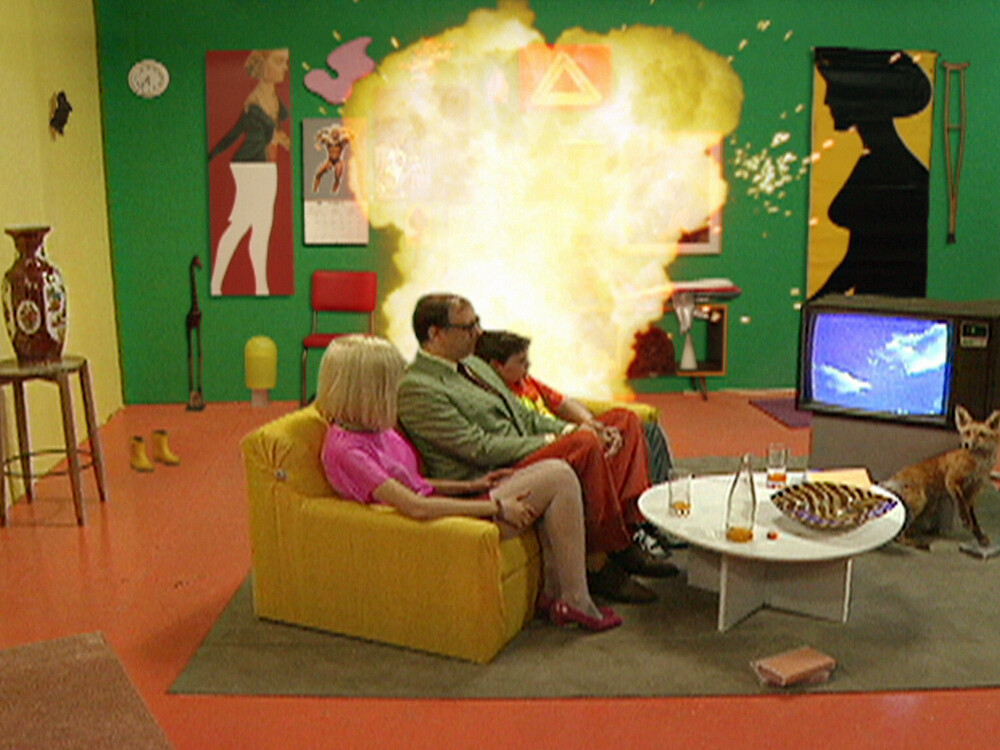
ICA, London, UK | Image: still from *Corpus Callosum (2002)
Michael Snow’s films are largely about film itself: its structure, texture, purpose and aesthetics. Presented by Dream Of Light, this weekend of screenings celebrates the late Canadian artist’s cinematic works, which are here being shown together in the UK for the first time in 16 years.
Wavelength (1967) takes place in a spartan New York loft. The story ostensibly revolves around a mystery death but the principal focus is the room itself. Over 45 minutes, the camera zooms incrementally to the opposing wall. We hear traffic and a sine tone that starts at 50 hertz and gradually ascends in pitch to 12kHz. As the lighting conditions and colour filters vary, you begin thinking about rooms and their depictions in art: Van Gogh’s Bedroom In Arles, David Lynch’s neglected TV series Hotel Room, Richard McGuire’s graphic novel Here. These works reflect on the apparent stillness in the experience of linear time with the room acting as the anchor around which events unfold.
Snow’s path to the screen led through fine art, and it’s useful to analyse the bare formality of Wavelength in relation to painting. When writing about the film in 2023, Jonathan Rosenbaum noted that “its primary obstacle is in fact the intimidating richness of what it has to offer”. Snow’s films are all obstacles in the sense that they challenge the notion of cinema as entertainment.
La Région Centrale (1971) takes this idea to the extreme. Once described by Jean-Luc Godard as “pure cinema”, the 190 minute feature is essentially an epic landscape painting devoid of narrative or human presence. Snow, his partner Joyce Wieland and their colleagues mounted a camera to a robotic arm in a remote location in northern Quebec. The camera pans, tilts and rotates, moving continuously in every conceivable direction. The mountainous landscape and the sky beyond it appear alien, particularly as the only sound present is the whirring robotic mechanism. The act of watching becomes a meditation of sorts. As the camera picks up speed, the film climaxes in abstraction with terrestrial colours swimming past the eye.
Sometimes Snow uses humour to deconstruct our conception of film. So Is This (1982) explicitly asks the audience to consider the author’s intentions in its playful use of language. Words flash on the screen one at a time with sentences taking left turns. There is no sound – only the dynamic shifts in the rhythm of the words and the changing tone of the ‘narrator’. Blurring the lines between communal reading and cinema, it’s a strangely novel experience that signposts to preceding text based works by Richard Serra, Su Friedrich and others.
Sshtoorrty (2005) and *Corpus Callosum (2002) both see Snow return to the study of human subjects. The former repeatedly superimposes two strands of the same story, the room again holding the centre, while the latter experiments with early digital techniques to subvert notions of identity and social structures. Office workers and a family of rotating characters experience a constantly shifting reality. Objects disappear, bodies are distorted and time stretches to comical ends. Named after the nerve fibres connecting the two cerebral hemispheres, *Corpus Callosum prophetically encapsulates the hallucinatory chaos of social media saturation that we find ourselves immersed in today. Many of Snow’s films are available online but meeting their demand of prolonged unreserved engagement can only happen at the cinema.
Ilia Rogatchevski
Originally published by The Wire, March 2025.
 Ilia Rogatchevski