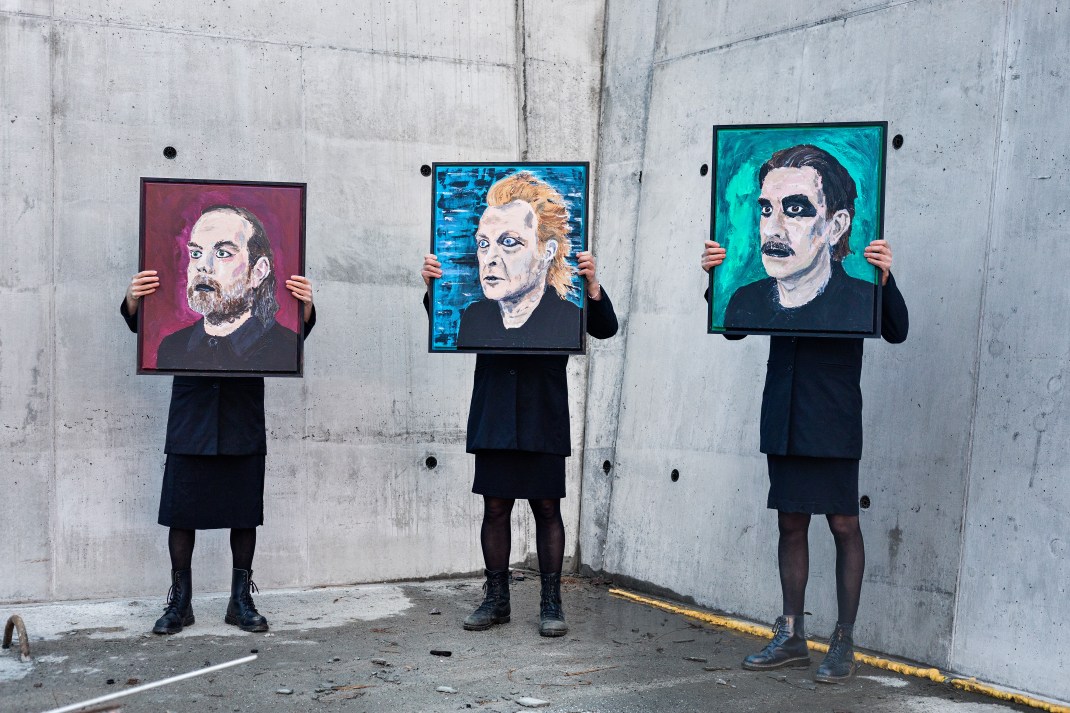
The Finnish trio’s cleaning robot alter egos make industrial music from the contents of a linen cupboard around sci-fi themes that are anything but domestic. From left: CW04 (Tero Vänttinen), CW01 (Risto Puurunen), CW03 (Timo Kinnunen) – Photo by Jussi Karjalainen.
In the music video for “Ricewestern” the cosmic track opening Cleaning Women’s 2001 debut Pulsator the Finnish trio teleport themselves across the Russian border to Saint Petersburg to perform on their modified clothes horses before bemused bystanders. The grainy 8 mm footage documents this absurd happening like it was captured by an amateur film maker. “In the early 2000s, we played there many times and had a following,” reveals Tero Vänttinen aka CW04. “The atmosphere was free. The Soviet Union collapsed less than ten years before and there was a big need for influences from outside. We had strange instruments and costumes. They didn’t know what to think of us.”
Reissued on vinyl in February, Pulsator remains Cleaning Women’s mission statement: three androgynous cleaning robots (CW01, CW03 and CW04), from the planet Clinus, adapt salvaged household materials into DIY instruments and compose what they describe as a “combination of cinematic sci-fi western and sparkling trash can disco”. Brusque Beefheartian delivery echoes through their lyrics, while their rhythmic instrumentals and image recall early Kraftwerk.
Cleaning Women were formed in 1996 by Risto Puurunen aka CW01 and Anu Keränen aka CW02, who left a few years later. Dialling in from Vacuum Sound Space, their airless rehearsal studio, Puurunen explains their origins: “When I arrived in Helsinki, I bought a laundry rack. CW03 [Timo Kinnunen] and I had been experimenting with contact mics [for another project when both living in Kuopio]. I put a microphone on the rack and sent it through some effects. The sounds became interesting, almost musical. CW02 programmed parties at our art school and said we should make something. That’s how we started. It was more like an experimental sound performance. Much different from what we are now.”
After finding the ‘natural’ sound of the clothes horses too limiting, they began adding other materials to create variations in pitch and timbre. “We like dogmas,” explains Puurunen, “we have rules like all the instruments have to be built by ourselves.” Kinnunen adds: “We mostly find everything in the recycling centre. You just take some metallic stuff in your hand and start thinking about what it could be.”
This method of explorative tinkering has evolved over the last 30 years, and their arsenal of instruments has expanded to include a coffee can bouzouki, closet hanger bass, melodic kling klang and hammered dulcimer among other self-made constructions all held together with twists of tape and wire. “We are really old school,” declares Vänttinen. “We play everything live no backing tracks, no samples, no click tracks. Everything comes from the instruments and from us on stage. We’ve been really strict with that.”
Aside from being an accessible live act whose music revolves around the interplay of hypnotic rhythms, Cleaning Women are also composers of nuanced film scores. They have performed bespoke music for silent classics like Sergei Eisenstein’s Battleship Potemkin (1925) and Fritz Lang’s Metropolis (1927), and composed soundtracks for contemporary films including Alice Rohrwacher’s Oscar-nominated short Le Pupille (2022). “[Dziga Vertov’s 1930 film] Enthusiasm was the first one [we did],” remembers Vänttinen, “and it was an accident. There was a guy who ran a film festival [in Russia]. He said we should make music for that film and come to his festival to perform it. We rehearsed, made the score and went to Saint Petersburg to play but they had forgotten the whole idea! That was the first screening it never happened!” Instead they unveiled the score at Helsinki’s Riemu festival in 2003. It was soon followed by more commissions.
When Cleaning Women released their soundtrack to the 1924 Soviet sci-fi film Aelita as their second album in 2004, it included additional material that didn’t make the final score. Directed by Yakov Protazanov and based on Aleksey Tolstoy’s novel, Aelita follows the story of an engineer who overthrows the Martian ruling class with help from the titular alien queen. Cleaning Women’s Aelita score goes into darker territories than its predecessor. “Secret Passenger”, for example, mirrors the terse industrial sounds of Einstürzende Neubauten. Longtime Neubauten member Alexander Hacke mixed Cleaning Women’s 2019 Intersubjectivity album, and hackedepicciotto toured with them in Finland.
“Our first album was made without us knowing what we were doing, because no one had recorded a laundry rack before,” says Vänttinen. “After that we have been figuring out how this band should be recorded. For Intersubjectivity, we found a method of recording where we use a PA system in the studio to get some air to the sound.”
Cleaning Women used the same method on their new album Washer. Although not as conceptually tight as some of their previous work, singles like “1984” and “City Of Confusion” are saturated with dystopic tension, reflecting the trio’s desire to evolve. “Timo getting bored with playing the drums was an offset for the new album,” Vänttinen admits. “The overall feeling was that everything sounds the same. There are only three of us so if Timo doesn’t play the beat, and the other two need to play string instruments, then we have to figure out how to make things sound new. Now we share the beats with Timo. They come from both of us. It’s like a monster that has three arms.”
Cleaning Women’s Pulsator and Aelita reissues are out now, Washer is released this month, all via Svart
Ilia Rogatchevski
Originally published by The Wire, October 2025
 Ilia Rogatchevski