comment 0

Tickling In My Head: ASMR At The Design Museum

With a tingle running down the back of his spine, Ilia Rogatchevski explores the world of ASMR at London’s Design Museum. All photos: Ed Reeve for the Design Museum.

In the centre of the Design Museum’s subterranean exhibition space is a room constructed from scaffolding and long curling beanbags. When viewed from above, these intertwining cushions resemble the folds of a human brain. It’s an appropriate staging for a show examining the cerebral world of ASMR. The room is busy, but the atmosphere here is tranquil. People are lying on the beanbags, relaxing with their headphones on, watching one of the many TV screens hanging from the ceiling. Each screen shows footage that may trigger a pleasurable physical response in the viewer. This could be something benign like a series of close-miked cooking tutorials or a film featuring a young Björk explaining how television works.

The term ASMR (Autonomous Sensory Meridian Response) was coined by ethical hacker Jennifer Allen to describe the physical sensations of euphoria, tingling or deep calm that can arise from auditory stimulation. Textural sounds such as whispering or tapping can trigger ASMR, but the feeling is highly subjective. Allen first encountered this phenomenon in her twenties, later documenting her experiences on a health forum in 2009. As it turns out, many other people experienced tingling in this context and it wasn’t long before a decentralised ASMR community grew online. Allen launched the first ASMR Facebook group and lobbied Wikipedia to reinstate the original entry about the phenomenon, after it was found not to have met the editors’ standards. Reproductions of documents from Allen’s archive, which relate to the movement’s early manifestations are displayed on the gallery walls.

ASMR is a child of the internet, flourishing on video sharing platforms such as YouTube and Twitch. Its proponents, otherwise known as ASMRtists, generate content that ranges in genre, from whispered roleplay videos to looping digital animations. In recent years, ASMR has exploded in popularity, with some videos racking up millions of views online. One creator, Gibi ASMR, boasts around 4.24M subscribers on YouTube. Weird Sensation Feels Good: The World of ASMR is the first time that this popular interest which is, conversely, rather niche at the same time, makes itself palatable for an IRL mainstream audience.

In a short trailer for the show, the exhibition’s curator James Taylor-Foster of ArkDes (Swedish Centre for Architecture and Design) puts ASMR’s popularity down to an innate desire for slowness and tactility in a culture dominated by ubiquitous and alienating digital devices. “ASMR came out at a moment in which our smartphones were becoming quicker, bandwidth was becoming more plentiful,” he says. “This strange constellation of things was designed to make our lives more efficient. ASMR harnessed them and, within that, carved out a space for slowness, softness and sweetness.” He goes on to say that ASMR is often designed to help deal with loneliness, social anxiety or insomnia. It satisfies our need for intimacy and is ultimately trying to replicate the feel of human touch.

Aside from supporting Taylor-Foster’s argument for ASMR’s use as self-medication, the exhibition also highlights the phenomenon’s relationship with audio technology. In an effort to make your experiences as sensorial as possible, many ASMRtists employ binaural microphones for their recordings. A few of these are on display, such as the Neumann KU 100 Dummy Head, and great fun can be had whispering into the microphones, especially if somebody else is wearing the headphones.

The London-based artist and researcher Julie Rose Bower takes the opportunity for somatic exploration further with a specially commissioned piece Meridians Meet. Bower’s installation is a live-studio environment where visitors are invited to interact with a variety of tactile materials: a desk with an assortment of brushes, a faux leather mountain range, a cave with multiple suspended speakers urging you to clap into the microphone and listen out for the generated echoes. For those who lack access to microphones or simply have little experience in music technology, it can feel empowering to experiment with sound and texture. Children seem to revel in this participatory element, as do many of the adults.

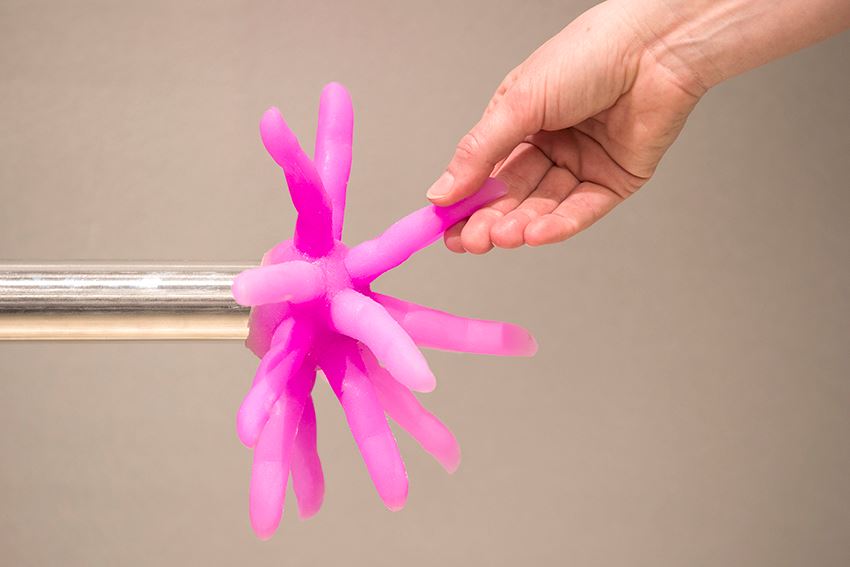
ASMR can also be a disconcerting experience. One of its converse characteristics is misophonia: the emotionally-driven hatred of sounds such as eating, yawning or chewing typically made by other people. Next to a bank of TVs featuring popular ASMRtists, who attempt to define their vocation on camera, stands a sculpture by Tobias Bradford. That feeling//immeasurable thirst (2021) is a disembodied rubber tongue, which writhes and salivates in a perpetual loop. The artificial organ is convincing in its imitation of the tongue and is all the more unsettling for it. Nearby, Marc Teyssier’s Prototype for Artificial Skin for Mobile Devices (2019-2020) and The Voice of Touch (a skin-like silicone tablet that triggers vocal bursts upon contact), from 2022, further invert the generally positive spin of the exhibition and summon a grotesque Cronenbergian future where your Instagram feed can be stroked, pinched and squeezed.

Thankfully, there is a Bob Ross chill out room to placate any dystopian associations. Ross was an American painter and host of the long-running instructional TV show The Joy of Painting. In around thirty minutes, the viewer would be shown how to create a landscape painting step by step. Ross’s soft spoken demeanour, combined with the sounds of palette knives mixing oil paint and brushes scratching canvas, made him the ‘Godfather of ASMR’ in the popular imagination. His show is indeed hypnotic. Despite the banal outcome of the actual paintings, the finished versions of which flank the walls, the programme is a pleasurable watch. At the time of writing, the Bob Ross YouTube channel has 5.27M subscribers and there are plenty of certified Bob Ross instructors who carry the torch forward.

Artists like Holly Herndon, in collaboration with Claire Tolan (‘Lonely At The Top’, 2015), were already treating ASMR as an aesthetic concern several years ago. However, their work reached a largely underground audience, many of whom would have been well versed in online culture. It’s fitting that an institution such as the Design Museum is finally recognising the aesthetic significance of ASMR, just as the movement reaches adolescence and strives for maturity.

Taylor-Foster, who has met the challenge of curating an exhibition largely composed of digitally native content, sees ASMR as an important contributor to the future of design: “ASMRtists are some of the most finely attuned material culture-ists of the world. They understand that all these materials don’t just have a function, but they’re sensory objects. All these questions of close-looking, close-listening and close-feeling are going to become even more important for designers in the coming years.”

Weird Sensation Feels Good: The World of ASMR is at London’s Design Museum until 16 October 2022

Ilia Rogatchevski
Originally published by The Quietus, June 2022

comment 0

Unlimited Editions: Radio Art Zone

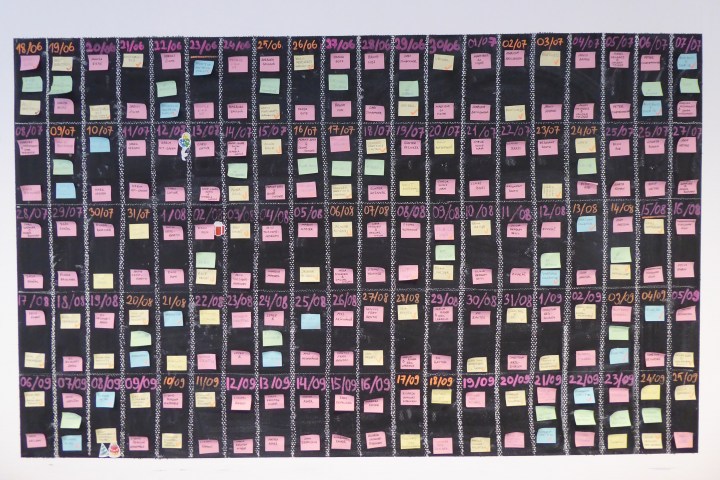
A radical space on the airwaves is opened up by Radio Art Zone whose forthcoming 100 day project brings together experimental broadcasters from around the world. Image: Radio Art Zone event calendar

Imagine a radio station that sounds different every day. This is the key premise of Radio Art Zone (RAZ), an ambitious project that will broadcast for 100 days as part of the European Capital of Culture Esch2022. On air from 18 June to 25 September, the station will feature only two programmes each day: a bespoke 22-hour piece and an informal 2-hour lunchtime show. For the former programme, which will transmit different compositions every day, over 100 artists, groups and collectives were invited to contribute their durational radio artworks. Meanwhile, the latter show is a space for cooking, eating and relaxed conversations that will broadcast live from different kitchens in the Esch-sur-Alzette community in Luxembourg.

RAZ was conceived by Sarah Washington, Knut Aufermann and Luxembourg’s community broadcaster Radio ARA. Washington and Aufermann have been collaborating since the early 2000s, helping to establish London’s Resonance FM before creating the itinerant initiative Mobile Radio, in 2005. Mobile Radio fosters a global network of practitioners by creating temporary stations at festivals, conferences, and one-off events. Their previous projects include Radio Revolten festival held in Halle in 2016, as well as Mobile Radio BSP, a station set up in 2012 coinciding with the 30th São Paulo Bienal.

Over email, I asked Washington how Mobile Radio approached curating its new project. “The concept this time was to offer the largest on-air exhibition of radio art the world has so far seen,” she explained. “It’s part of our determination to enable more people to become aware of what thousands of artists have been working on for decades, typically with little recognition or recompense.” 

Planning began five years ago after Radio ARA approached Knut and Sarah about joining Radia, the international radio art network they co-founded. A meeting with producer Sandra Laborier led to a proposal for Esch2022. “One of my long-standing wishes was to run a radio station for a year, which [would] feature only live work by a different artist each week,” said Washington. “Working within the Esch2022 framework meant that we were obliged to reduce the scope of our ambition. The overall concept was to draw on as many disciplines as possible: radio, installation, performance, drama, algorithmic composition, spoken word, documentary, plunderphonics.”

RAZ has already transmitted several taster broadcasts in the run up to the main event, including an improvisation by Limpe Fuchs and Hartmut Geerken, who met for the first time live on air, and a textural turntablist set from dieb13. The complete list of upcoming participants reads like a who’s who of the radio art world. It ranges from familiar names like Radiophrenia’s Mark Vernon to American teenager Echo Roe, the youngest programme maker on the list.

With so much material, what are the pieces that stood out to Washington the most? “We were lucky enough to contact artists in the Democratic Republic of the Congo and Haiti. Mega Mingiedi & Jaguar Ntumi operate their show out of Mega’s taxi, instigating interactions with passengers to excavate the cultural, social and political histories of Kinshasa. Jean-Daniel Lafontant presents the Easter rituals of Temple Na-Ri-VéH, a spiritual compound that provides shelter, food and services to the local community in Port-au-Prince. I’ve also been taken aback by the artists who decided to carry out endurance feats. Ralf Wendt will walk the highways and byways of the Capital of Culture area broadcasting his encounters live for the entire 22 hours of his show.” 

Aside from broadcasting on Radio ARA’s new 87.8 FM frequency, RAZ will be syndicated to a dozen international partner stations, including Wave Farm in the US and ∏Node in France, each of whom are free to choose how much of the stream to relay. Community project lumbung Radio will transmit some of the stream during documenta 15, while Resonance Extra will broadcast the entire 100 days.

Considering RAZ’s idiosyncratic programming, the whole project can be viewed as an artwork. Washington admitted that the station is also an opportunity to examine radio as an art form. “[It is] radio by artists,” she said. “We have refused to define it further for decades, fearing that any particular canon may emerge and become fixated upon. The beauty of radio art is that it is freeform and performed upon an endless canvas.” | radioart.zone

Ilia Rogatchevski
Originally published by Wire, May 2022

comment 0

Off The Wall: Art, Photography, & The Album Sleeve

A new exhibition at The Photographers’ Gallery sheds new light on the relationship between records and their covers. Exhibition photographs by the author.

“In the very beginning, I was hanging books on the walls like art pieces,” explains Antoine de Beaupré over email. “I realised that sometimes people were looking at me in a strange way. I then started to swap the books with records and suddenly a lot of ideas arose.” De Beaupré is a book dealer, publisher, and curator. Librairie 213, his Parisian bookshop, specialises in rare and out-of-print photography books. His primary passion, however, has always been music. “I started to buy my first records as a teenager in the mid-80s. LPs were cheap because CDs were taking over. I became a collector without realising it!” 

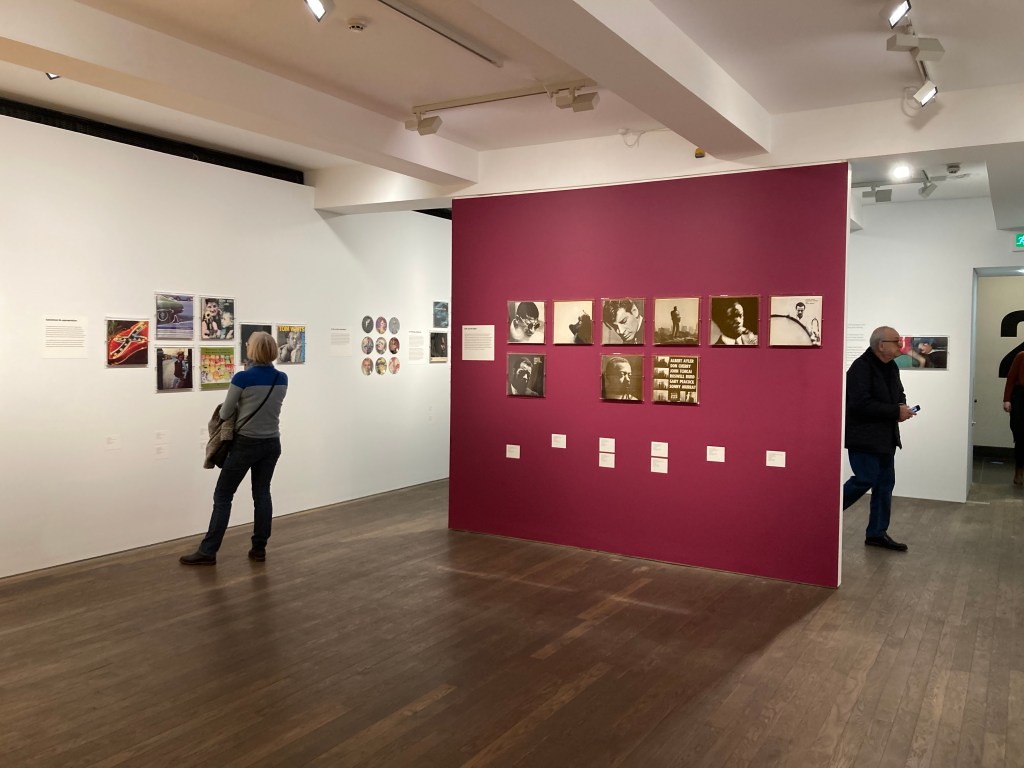
This month, For The Record: Photography & The Art Of The Album Cover opens at The Photographers’ Gallery in London. The show utilises de Beaupré’s extensive record collection as an opportunity to explore the interrelationship of photography and music as manifested in the medium of the album cover. The show is composed of many iconic and some lesser known LPs displayed in Plexiglas frames. The covers are grouped by themes, which closely follow the structure of Total Records, a catalogue of the original exhibition (co-curated by De Beaupré, Serge Vincendet and Sam Stourdzé) held at the Rencontres d’Arles, France, in 2015.

There is an evident attempt to redress the narrative, where the musicians take centre stage, by giving equal credit to the photographers and graphic designers responsible for visualising the music. Aside from Andy Warhol’s infamous banana, which donned the cover of The Velvet Underground & Nico, and Hipgnosis’s conceptual photo shoots that communicated the epic nature of bands like Pink Floyd, there are more obscure covers on display. A collection of “race records”, which were created for African American consumption, are noteworthy not only for the music they documented, but also for their depiction of a segregated United States. Records released by labels Yazoo and Riverside portrayed the daily lives of communities stigmatised by institutional racism, as shot by Dorothea Lange and Jack Delano, while Bluesville prominently featured blues legends from the Mississippi Delta on its covers. 

A small section of the exhibition is dedicated to visual artists who utilised the record as an extension of their practice. These limited edition pressings include documentation of a Joseph Beuys performance, a lecture on happenings by Allan Kaprow as well as Misch- U. Trennkunst, an experimental spoken word release by Dieter Roth and Arnulf Rainer. “Transartistic”, the chapter dedicated to the same theme in Total Records, includes many other works, such as Harry Bertoia’s Sonambient series. It’s understandable that the curators chose not to dedicate more gallery space to these works – mainstream concerns are much more likely to draw the crowds – but it’s a pity nevertheless. 


Jazz is shown to be responsible for influencing both the way that photographers approached their subjects and the aesthetics of album cover design. Lee Friedlander, who is best known for his urban social landscapes, launched his career working for Atlantic Records. Friedlander’s enigmatic portrait of Miles Davis for In A Silent Way, released by Columbia in 1969, is displayed here alongside photos of Ray Charles and Ornette Coleman. It is said in the curators’ notes that jazz taught the young Friedlander a sense of improvisation. Although this isn’t evident on these particular LPs, the sense of freedom that jazz evokes can be seen on releases by ESP-Disk. You can practically hear the saxophone skronk when looking at Sandra H. Stollman’s double exposure portrait of Albert Ayler (Spirits Rejoice, 1965), while the same photographer poses Sonny Simmons, on a rock in New York’s Central Park, to resemble a monument to self-expression (Staying On The Watch, 1966). 

Blue Note’s visual identity is well documented and it’s always a pleasure to view these covers up close. The catalogue for the original exhibition shows the photographs as they appear on the albums alongside the uncropped originals. Considering Blue Note’s famed attention to detail, it’s a shame that the original prints are not displayed here, only the records. In order to dive deeper into the story behind the images you have to buy the book. 

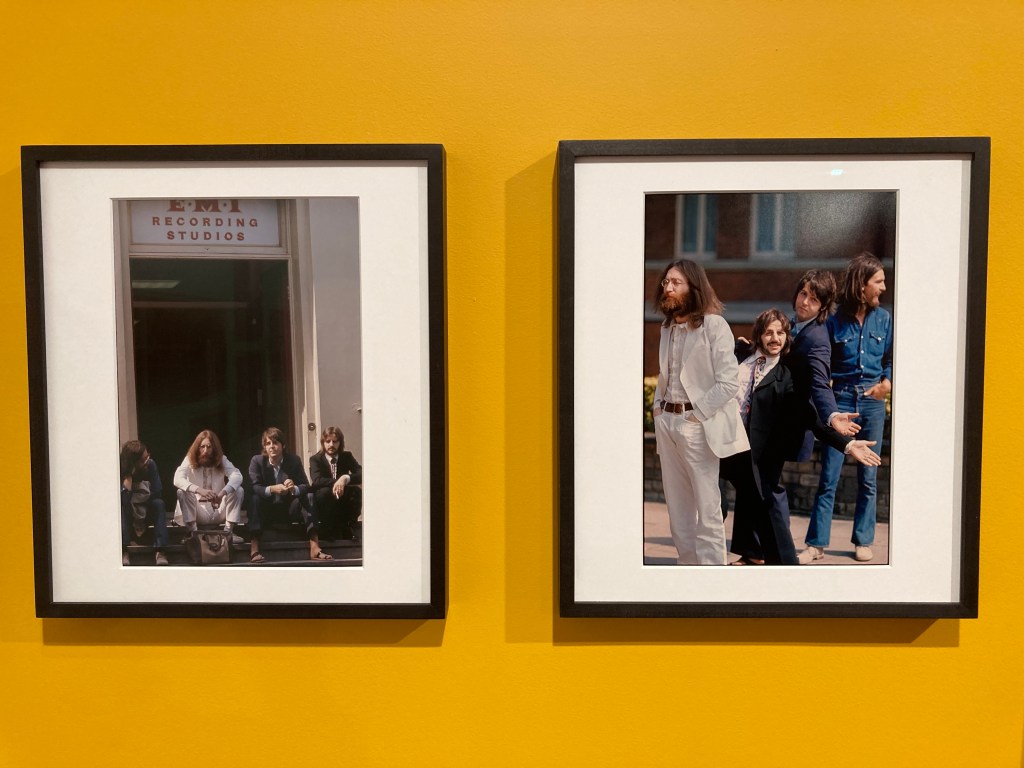
Thankfully, a series of prints by Linda McCartney allows the public to make a comparison between the moment as it was captured, and the final product. Iain Macmillan’s portrait of The Beatles for Abbey Road is woven into our cultural fabric to such a degree that copycat covers have become a cliché. This is best exemplified by the nearly naked Red Hot Chili Peppers crossing the same street with socks on their cocks (The Abbey Road E.P., 1988; not on display). McCartney’s behind the scenes shots, however, show The Beatles as human beings grown tired of their iconic status, but who are willing to play along one final time. A shot of a passer-by talking to Ringo Starr, while the rest of the band wait to cross, is touching. 


Another highlight is a wall dedicated to political records. Some releases use sound as propaganda, such as Mai-68, a 7” that features field recordings made on the barricades during the May 1968 uprisings in Paris. Others, like Rage Against The Machine’s eponymous debut, co-opt the image of revolt (in this case Malcolm Browne’s Pulitzer-winning photograph of Thích Quảng Đức’s self-immolation) to align themselves with an anti-establishment ideology. 

The adjacent wall shows albums that have fallen victim to censorship. This is a potentially excellent case study that could have been better realised. Out of a handful of examples, only two censored albums sit alongside their uncensored siblings: Beggars Banquet by The Rolling Stones and Jimi Hendrix’s Electric Ladyland. A graffitied toilet, shot by Barry Feinstein, was initially rejected by the Stones’ label in favour of a mediocre typographic cover, while Jimi Hendrix himself disapproved of David Montgomery’s photograph of nineteen nude women lounging against a black background. The image was still used for the UK release of Electric Ladyland, but the album was sold in brown paper bags by retailers. 

Despite some flaws, For The Record challenges the idiom that a book shouldn’t be judged by its cover. This notion is problematic, because it assumes that design is subordinate to the content inside. Even if a well designed book jacket doesn’t reflect the prose, at least you still have a great cover to look at, Germano Facetti’s design direction for Penguin being a case in point. The same goes for records. Before streaming, the cover would be your first connection to the music and, for many photographers, shooting covers was an additional platform for their craft, replete with its own set of nuances.

The way in which many of us consume music may have changed, but the album cover remains an essential conduit between artist and listener. Antoine de Beaupré agrees: “From my perspective, great covers shine through [with] their visual language or the esthétisme established by the record labels. We all have a relationship with vinyl. What I did was to contextualise a popular object, to see it in a different way. When you walk out of the show, you may stop in a record shop and buy a record, just for the cover, and put it on your wall.”

For the Record: Photography & the Art of the Album Cover will be on display at The Photographers’ Gallery, London from 8 April until 12 June 2022.

Ilia Rogatchevski
Originally published by The Quietus, April 2022

comment 1

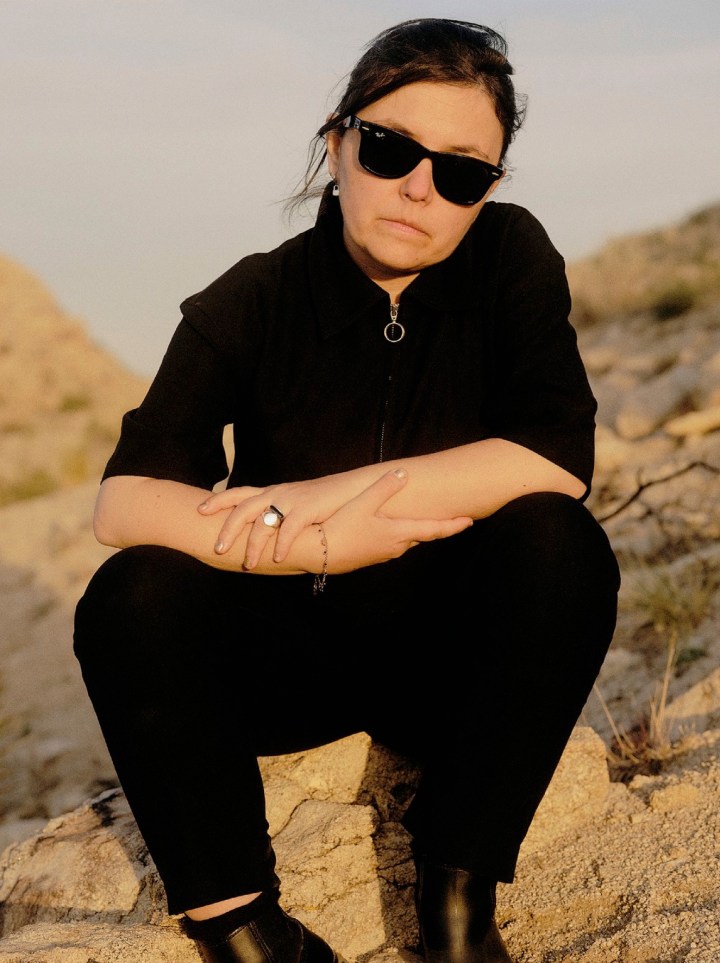
Valentina Magaletti

Art brut and surrealism help defeat the boredom of repetition for Italian drummer Valentina Magaletti whose projects range from gamelan ensemble work to orchestral improv, and hauntological dream pop to dub. Photography by Amanda Hakan.

Valentina Magaletti leans forward in her chair, drumsticks in hand. She’s sitting in the front row at London’s Cafe Oto, listening attentively to the nine piece Ensemble Nist-Nah. She was invited to play with the French gamelan ensemble by the percussionist and band leader Will Guthrie, and after the latter’s brief introduction, Magaletti jumps behind Oto’s battered house kit for the fourth composition of the set, “Rollin”. Guthrie conducts the ensemble behind a red Premier kit on the opposite side of the stage, and the space between the two drummers is filled with metallophones, gongs of various sizes, bells and Indonesian percussion instruments.

There’s a temperate duel between Guthrie and Magaletti, with each drummer repeatedly striking their handheld cymbal before muting it on the snare. Before long, Magaletti kicks in with the bass drum on each quarter note, giving the composition a house music flavour. By the time the other players come in on the sarons and bonang, Magaletti is in full swing, moving around the drums in brisk but carefully articulated movements. Her cymbal work is light, leaving space for the pitched gongs and metallophones. In her signature gestural style Valentina rolls across the toms and disengaged snare, bringing to attention their complementary timbres.

Magaletti is a prolific drummer who manoeuvres between disparate sound worlds. She has worked with experimental musicians like Lafawndah, Julian Sartorius and Gnod’s Marlene Ribeiro, as well as more mainstream acts such as Bat For Lashes, Gruff Rhys and Nicolas Jaar. In 2017, at the suggestion of This Heat’s Charles Hayward, Magaletti stood in for the late Jaki Liebezeit playing alongside Sonic Youth’s former drummer Steve Shelley in The Can Project, who blasted through a live rendition of Can’s debut album Monster Movie with original vocalist Malcolm Mooney at London’s Barbican Centre.

Magaletti was one half of acclaimed electronic duo Tomaga, until Tom Relleen’s death in 2020. She has released solo work, notably 2020’s A Queer Anthology Of Drums on Cafe Oto’s Takuroku imprint. Her other projects include Avvitagalli, CZN, UUUU and Holy Tongue, but each outfit has its own pool of collaborators and a direction different from anything else that she is involved with, with Vanishing Twin, her art rock trio with Cathy Lucas and Susumu Mukai, probably the most accessible of her projects. 

Magaletti and I speak a few days prior to her performance with Nist-Nah and subsequent departure to the US for a Vanishing Twin tour. Over a video call, interrupted only briefly by Magaletti’s cat Ashby, I ask how she manages to collaborate so frequently and with such a varied strata of musicians. “I never slag off any opportunity, if I like the people,” she replies. “You always learn something, or you learn what you don’t want to do. I’m always being told that I’m a softie and should say no more. It’s very clear when it’s me writing and producing, and when I play for someone else. Yes, it’s my drumming, but it’s serving someone else’s music. I don’t see them being connected.”

Magaletti started drumming around the age of 12, when a music school opened near her parents’ house in Bari in southern Italy. She was introduced to the idea that drumming could be a profession by seeing Debbi Peterson playing with The Bangles on MTV. “They looked fantastic. All of them. Not the drumming style, but the vibe. I thought it was a fantastic job. I wanted to study drums and see what it was about. The main thing that separates you from playing the drums or not is having access to a drum kit.” Her first set came piecemeal with a snare and hi-hat given as Christmas presents over a couple of years. After realising that she wouldn’t give up, her parents eventually caved in and bought her a white Rogers set. “To this day, I don’t think my mum knows what a drum kit is,” she laughs. “If she cleans my room in Italy, she dismantles it.”

One of Magaletti’s teachers was Agostino Marangolo of the prog rock band Goblin, known for their scores for the Italian horror film director Dario Argento. Another was the jazz drummer Michele Di Monte. While Di Monte’s traditional methods informed Magaletti’s early bebop style, Marangolo’s beastly breaks and penchant for time signature changes influenced her search for more unconventional sounds. She also studied marimba and vibraphone and experimented with prepared percussion. 

Along with her ideas as a composer, these early experiences informed Valentina Plays The Batterie Fragile, a 2017 live recording from the Super Flux festival at the Musée des Beaux-Arts de Tours in France. On it, Magaletti plays a porcelain kit, conceived by visual artist Yves Chaudouët and made under the supervision of ceramicist Marjorie Thébault. By applying wire brushes, wooden reeds and rubber beaters to the static white material, Magaletti’s strokes summon unusual textures that range from wobbly cello-like tones to something akin to a steel pan.

“It’s an instrument that is totally fragile,” she says. “I was transfixed by the idea of presenting something that has different connotations to it being a macho instrument. A drum kit made of the most delicate material, conceptually, is fantastic.” The success of this performance led to a second ceramic kit being made specifically for her. A follow-up recording of the second kit has been produced with engineer Leon Marks, who, along with Portuguese sculptor João Pais Filipe, collaborates with Valentina on the ritualistic percussion project CZN. 

The Batterie Fragile is an instrument that rewards delicacy while inviting the player to experiment with texture. Anything more, and the drummer risks destroying the artwork. How important is texture to the rest of Magaletti’s music? “Texture is everything. I’ve always had this idea of playing Lego when playing music; playing with frequencies and finding what’s missing. I’ve been using contact mics probably for 15 years now. I can flip between tribal and industrial. It’s very versatile to me.”

Our conversation recalls one of my earliest drum memories: John Bonham’s lengthy solo on “Moby Dick”, as documented on Led Zeppelin’s 1976 concert film The Song Remains The Same. Even as a child, his performance struck me as ego-driven and boring, as if the drums served only to show off Bonham’s technique in the loudest way possible. “It’s already such an ego boost to have a solo show that you really have to keep it in a box,” she nods. “You have to make sure that everyone who has paid for a ticket to see you gets to have the same fun that you do. I think there’s a social responsibility there for every performer.” 

She moved to London in her early twenties and almost immediately started working in the music scene. One of her first bands was Econoline, a Fugazi-inspired quartet who landed a John Peel session in 2002. Since then she’s worked with Gum Takes Tooth and Raime, among many other projects. In the early 2010s, she joined Demian Castellanos’s psych rock vehicle The Oscillation, where she met bassist Tom Relleen. “[Psych rock] has never been my music,” she admits. “I’ve always found it really boring. I think the most important thing in my life was that Tom felt exactly the same. We departed quite naturally away from the guitar and started Tomaga. The freedom of it was incredible: hours of field recording, hours in the studio, micro recording, dictaphones, hydrophones. It was very stimulating, creatively, because there was never one point of reference that we would emulate.”

Between 2013 and Relleen’s death in 2020 after being diagnosed with stomach cancer, Tomaga collaborated with artists such as French composer Pierre Bastien, and released a substantial body of work on labels like Hands In The Dark and Meakusma, compiling three terabytes of sound and music, according to Magaletti. Relleen’s compositions, combined with Magaletti’s post-jazz inflections, often suggest a rediscovered library music archive. It’s a paranormal sound world that’s forever peppered with a healthy dose of oblique recordings. Tomaga’s final album Intimate Immensity was completed just prior to Relleen’s death. Possibly their finest work, the record shifts between states of joy, melancholia and paranoia, managing to be psychedelic without ever slipping into predictability or acid trip cliche. 

The collage-style approach to composition is also apparent in Magaletti’s other projects. Due Matte, her collaboration with Marlene Ribeiro, grew out of a 2019 residency at Sonoscopia in Porto. As part of the Hysteria project, the duo ran percussion workshops for female artists who were keen to explore new working methods. iPhone recordings from these sessions became the groundwork for the record. A patchwork of lo-fi sources – tribal drums, rattling fence posts, grainy woodwinds – intermingle with sweeping horns, spatial effects and the occasional spoken word piece. These recordings are akin to a leftfield dub album, and the overall impression is of an outsider artwork that fears empty spaces. 

With so much raw material, I wonder how Magaletti organises her work into a coherent whole. “I approach it in a very Kurt Schwitters way: hard-cut edits, putting them together, making sure that the narrative is uninterrupted.” Allusions to visual art have crept up in previous interviews, specifically dada and art brut. To what extent does visual art feed into her aesthetic? “It’s never been a problem for me to feel connected with that way of conceiving and producing art. I think it’s an exercise to defeat boredom, to create an ongoing surprise in the listener. You know when you listen to a record, and you know exactly what it’s going to sound like? My challenge is to always surprise; to turn the page so you don’t know what the fuck is going on.” 

The stratification and layering inherent to collage is an important factor in how she perceives her own work. In the same way that a collage can be viewed from various perspectives, when you listen to a sound piece assembled from various sources, new details present themselves to the listener every time. 

Although such qualities are evident on solo recordings like A Queer Anthology Of Drums – a dark and intimate diary of her London lockdown days, where drones, recordings and modulated percussive objects serve as foundations for Valentina’s explorative drum work – the concept of montage is best embodied by Avvitagalli. This sound art project also evolved from lockdown sessions, this time spent with Pino Montecalvo in southern Italy. The duo produced a couple of limited edition cassettes, Avvitagalli and Onde Curiosa, for the Bari based “un-folk” label Music À La Coque. Replete with unique covers appropriated from vintage exercise manuals and gambling books, these albums layer recordings of Montecalvo’s toys, handmade instruments and pilfered radio broadcasts with Magaletti’s percussive prowess. 

Avvitagalli’s third instalment, None Corsa, is due for imminent release on vinyl via Horn Of Plenty. Most of the same sound sources are there, but this time the spectral radio voices and wayward sound effects are conceptually tied. “It’s about absence and presence,” Magaletti explains. “[The album] comes with a photographic book. We trespassed a mansion [with photographer Adele di Nunzio] that burned down a day before a big wedding. Everything there – the tables, this beautiful piano, frames on the wall – all destroyed. The fire left these crazy prints on the wall. It’s really ghostly.” 

The idea of ghostliness is also present in Vanishing Twin, who began life as a quintet in 2015 before recently downsizing to a trio. The band name is a reference to vocalist and multi-instrumentalist Cathy Lucas absorbing her own twin sibling in utero, and Vanishing Twin’s music is evocative of phantoms residing in dilapidated radiophonic equipment. Visually, their aesthetic is steeped in op art and surrealism, but their waltzy interplay of bass, melody and synthetic textures recalls the hauntological dream pop of Broadcast. More recent work like 2021’s Ookii Gekkou sees them channel Piero Umiliani film scores as well as Alice Coltrane and The Art Ensemble Of Chicago by employing soulful jazz, lounge and funk elements. The shift is especially prominent in the playing of Susumu Mukai and Magaletti’s rhythms.

To date, most of Vanishing Twin’s recordings have been made at Malcolm Catto’s Quatermass Sound Lab studio in London. Catto, drummer and leader of the cosmic jazz group The Heliocentrics, collects vintage analogue equipment, and utilises it to achieve the late 60s and early 70s sound of soul and psych. Will the band’s fourth album be in a similar retro style to their previous ones? “I don’t think so. We’re changing direction this time. The next album will be more experimental and free.”

Magaletti has several other experimental ventures on the horizon. First up is Modern Dance Gold: Vol 1, the debut record by her new band Better Corners, featuring mastering engineer Sarah Register, who also plays guitar with Kim Gordon’s touring band, and Wire’s Matthew Simms. Evolving from Simms and Magaletti’s previous collaboration UUUU, the album was recorded remotely and weaves together prepared piano, flutes and modular boxes to create a drone-laden soundscape. Valentina’s distorted rhythms on “It Feels Like Forever” are particularly harrowing, next to the album’s more ambient passages. 

Holy Tongue, a dub project with producer Al Wootton, is also preparing a couple of releases: a cassette of their live set at London’s Servant Jazz Quarters is in the works and a third studio EP scheduled for release before the end of the year. “We’ve almost finished the album. It’s going to be massive. We’re taking it to another level with flamenco and this massive brass [section].” London improvisation figurehead and dub music veteran Steve Beresford, who has previously worked with Magaletti and double bassist Pierpaolo Martino on 2020’s Frequency Disasters, appears on two tracks. This is a dream come true, as Beresford played on some of Magaletti’s favourite dub tracks, from The Slits’ Return Of The Giant Slits to Vivien Goldman’s “Private Armies”. In the past, Magaletti and Beresford had also performed together as part of London Improvisers Orchestra.

But Magaletti has a more personal record on the cards. “I was awarded the [PRS Foundation] Women Make Music fund this year. Thanks to them, I’ve just finished my solo album. It has been produced and mixed by Marta Salogni. It’s my most proud work, because I play all the instruments, not just drums. It’s a 360 degree diary, in the vein of Dean Blunt: prankster sonic collage, programmed beats, drums and poetry.” As a drummer-composer, Magaletti eschews convention. Not interested in using the same kit, cymbals or brands as other drummers, she is always on the lookout for alternative textures to add to her palette, whether they be manifested in found materials, effects or handmade instruments created by collaborator João Pais Filipe.

Throughout the conversation, Magaletti talks about drumming as a language that can convey a certain narrative or story. I asked her to unpack this idea. What does it mean to project a narrative through drumming? “In terms of message, it’s never a case of showing people that I can play drums, or feeling like an animal in a circus: the woman playing drums,” she explains. “It’s more about ingoing and outgoing energies between me and the audience. I want to achieve that balance of the absence and presence of sounds. Making sure that everyone in the room can resonate with what I’m saying and not just be listening to a person drumming, which would be excruciatingly tedious, from my point of view, as a listener.” 

Avvitagalli’s None Corsa is released by Horn of Plenty.
Better Corners’s Modern Dance Gold: Vol 1 is released by The state51 Conspiracy.

Ilia Rogatchevski
Originally published by Wire, April 2022
comment 0

Deliaphonic

Coventry Cathedral & Drapers Hall, Coventry, UK

Deliaphonic celebrates the life, work and legacy of pioneering electronic musician and Coventry native Delia Derbyshire. Prior to her death in 2001, Derbyshire envisioned creating an event – along with Spacemen 3’s Peter Kember – called Multi-sensory Electronic Sound, Music and Arts. Its function aimed to go beyond the typical music festival format and incorporate workshops where participants could try out various instruments such as the VCS3 synthesizer or theremin. The idea was to make sound making technology accessible to everyone. This fourth edition of Deliaphonic, which is part of the Coventry UK City of Culture initiative, attempts to realise Derbyshire’s family-friendly vision.

Inside the cathedral, which serves as the principal venue of this four-day festival, can be found various multisensory installations and workshops. Many are aimed at children, who are actively encouraged to interact. In the undercroft, festival co-founder Alex Miles demonstrates a collection of devices that convert light vibrations into sound, while upstairs Dan Mayfield’s School of Noise project invites attendees to play vegetables connected to an ototo, an instrument which allows any conductive material to generate sound. Another highlight is Caro C’s Coolicon Lampshade Installation. Eight lampshades, suspended inside a tent, can be played by the public with beaters. The lampshades’ enamel-coated steel bodies resonate like bells and are said to have been Derbyshire’s favourite sounding objects.  

A screening of the film Delia Derbyshire: the Myths and the Legendary Tapes puts the proceedings into context. Directed by Caroline Catz, who also stars in the leading role, the film is somewhere between a documentary and Brechtian theatre. The aesthetic language of the movie is saturated with what Julian House of Ghost Box Records calls the “background of tape”, by which he means Op Art, BBC title cards, and magnetic tape effects. Aside the festival logo designed by House, this flirtation with 1960s modernism is also present in the creative direction of a number of artists at the festival. Vanishing Twin’s waltzy interplay of bass, melody and synthetic textures is the most prominent example of this. Their sound is heavily indebted to Broadcast and, by extension, early electronic psychedelia such as Derbyshire’s band White Noise. 

For others, the link to modernism is less apparent. For example, both the warped footwork of Friday headliner Loraine James and The Specials founder Jerry Dammers’s dissonant soundtrack to George Shaw’s hyperrealist suburbia paintings feel very contemporary in the alienation they espouse. Future Rave Memory by Richard Fearless, meanwhile, uses treated double bass to create brooding dystopian atmospheres. The piece works well in the acoustics of the cathedral and a fitting antithesis to the Radiophonic Workshop’s playful reworkings of Derbyshire’s signature Doctor Who theme. 

Marra! by Natalie Sharp (formerly known as Lone Taxidermist) rises above all other performances in terms of its subject and originality. The theatrical piece examines the dialect, ceremonies and rituals of Cumbria, which has been home to both Sharp and Derbyshire (in her post-BBC years). Footage of cattle auctions, champion gurners and pub folk singers are juxtaposed with recordings of Seychelles moutya drum rituals, car alarm loops and discordant electronic noise. Through her immersive exaggerated theatrics (there are four costume changes during the set and a butcher-led crowd intervention) Sharp, a first-generation immigrant, portrays how strange local customs can appear to an outsider. Marra! not only feels relevant, but also aligns itself with Derbyshire’s experimental spirit and outsider myth.

Ilia Rogatchevski
Originally published by Wire, April 2022
comment 0

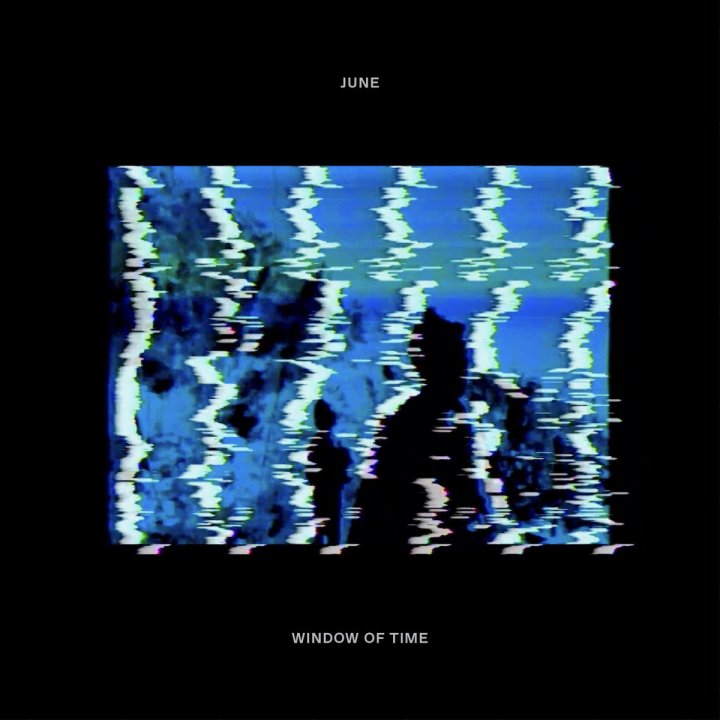
June – Window Of Time

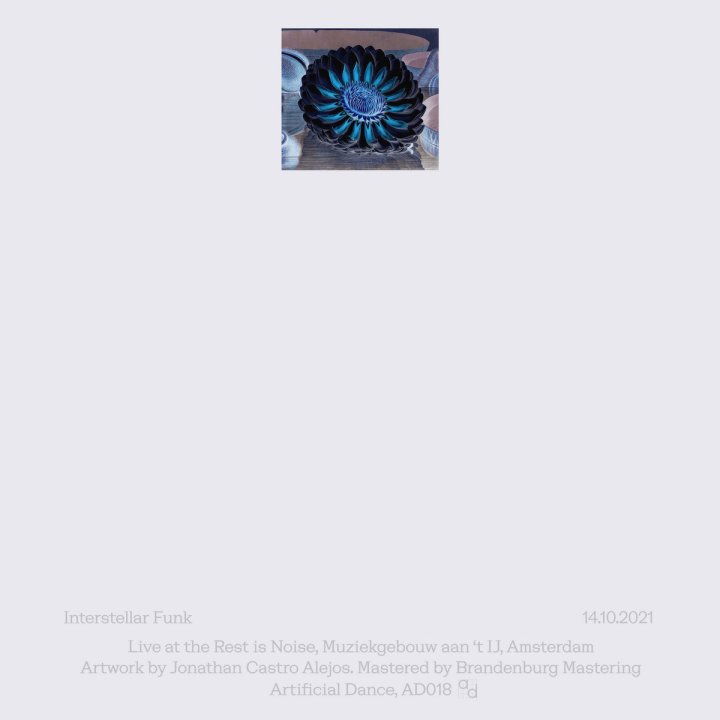
On his new album for Artificial Dance, Tsampikos Fronas aka June takes a departure from his dance orientated earlier work. Recorded between 2018 and 2020, Window of Time sees the Berlin-based producer explore sparser arrangements than his previous releases.

The record unravels like a dystopian cyberpunk novel, something akin to William Gibson’s Neuromancer. Both the title track and ‘Stratagem / Predator’ create an increasing tension that builds through repetitive sequences. The arpeggiated synths on ‘Year 2092’ evoke images of sprawling metropolitan cityscapes, while the claustrophobic mood of ‘The Master of Electricity’, the first track written for the album, wouldn’t go amiss on a soundtrack to a sci-fi thriller like Blade Runner.

Created using modular synthesizers, analog sequencers and analog polyphonic synths, Window of Time eschews melody in favour of cold, pulsating rhythms. Combined with haunting choral toplines and minimalistic flourishes, such as those on album closer ‘Elegy’, June invites the listener on a free dive into their subconscious; to navigate boundless, unexplored territories.

comment 0

Francesco Fusaro | Froz – Fin Qui 

Friday 18th March 2022 sees the release of Fin Qui, a new compilation by MFZ Records co-founder Francesco Fusaro aka Froz.

Fin Qui (Italian for “Until here/now”) consists of 14 tracks, released over the last five years, which span the musician’s forays into various electronic subgenres. Previously published as part of albums, singles or EPs, this new recontextualisation of Froz’s work can be considered both a ‘Best Of’ and a love letter to the legacy of electronic music. Speaking recently about the album, Francesco said:

“It’s a collection of my favourite pieces, which reference the sounds of labels such as Warp and Rephlex, and also hint at my love for the funkier, psychedelic and downtempo sounds of Odd Future and the like.”

The record is certainly varied. Album opener ‘Slowrave’ and its cousin ‘Session Twelve (Borders)’, which was created using only the Novation Circuit Groovebox, wouldn’t feel out of place if played at a cold wave club at 3am. Tracks such as ‘Piano & Claps’ may recall the signature melodic groove of Robert Miles, while ‘Steppin’ and ‘Wait What’ are evocative of the heady days of ‘90s jungle and drum & bass. On the uptempo ‘LDN B GOOD 2 ME’, Froz reflects on his love for London and the electronic sound he grew up with. ‘So Chilled’ is online-native chillhop, but with a sinister topline that might suggest your revision days are over. The pitch shifted vocal on ‘Procrastinator’ certainly seems to corroborate this.

Clocking in at just over 50 minutes Fin Qui manages to pack a lot of nostalgia-inducing ideas that would equally suit a warehouse acid rave, an intimate house party or a solitary late-night listen.

comment 0

Klein

Barbican, London, UK

The concert opens in a confrontational vein. A sharp spotlight fixes itself on the audience while a heated debate about gender roles, sampled from the BKChat LDN webseries, booms out of the PA. The atmosphere becomes increasingly disconcerting as the spotlight moves around the auditorium, momentarily blinding anyone it falls upon. Gradually, two choral voices fade in before collapsing into a hyperdigital crescendo. This primes us for the journey to come: a varied set that includes elements of theatre, noise, contemporary composition and ironic humour.

Visibly excited, South London musician Klein, who performs atop a scaffolding platform, jokes that “this is the last show I’m doing, so shake your bum. I’m becoming a librarian!” just before bursts of timber-shaking bass explode out of the speakers. The sound is often brutal, with feedback occasionally breaching the limits of bearability. 

Such moments of extreme tension are counterbalanced with phrases of quieter, more accessible compositions. One memorable piece is a duet between Klein’s trumpet and Khush Jandu Quiney’s haunting saxophone melodies. The stage, shrouded in a cloud of haze which is illuminated by flashing red lights, evokes an otherworldly Lynchian mood, as if we are witness to some late-night roadside emergency. Quiney’s bold silhouette breaks through the fog, acting as a visual anchor for the duration of the piece. 

Other credited collaborators include Bunny, Josiane M H Pozi, ​​Aminat D Seriki and Nellie Owusu can often be found grouped together on stage left, moving in time to the music or mirroring the rhythms of unintelligible time-stretched speech with their bodies. At one point the house lights go up and Pozi reads out intentionally bad jokes. Her forced, sarcastic laughter is then looped and used as a backing track. 

Rapper Jawnino, who also opens the show as a support act, improvises with beaters and a bass drum. His harsh blows, which are not backed by any other music, respond to a set of automated drums sitting on top of the scaffold. Programmed by Klein and kinetic sculptor Tobias Bradford, these snares and toms are played by robotic drumsticks. These and similar improvised segments stitch together more recognisable elements of Klein’s catalogue, such as the ethereal-sounding “Hope Dealers” from last year’s Harmattan album, the stems of which are triggered using a MIDI guitar.

The central focal point throughout the show is a large screen directly underneath Klein’s platform. Its projected visuals cycle through détourned videos, photographs and internet ephemera. During the swelling detuned synths of Klein’s new track “whos on the panel” the phrase “Hug A Hoodie” appears on screen. While the track title refers to a 2011 diss by grime MC Ghetts, which commented on exclusion in the music industry, the hoodie quote recalls former UK prime minister David Cameron’s much ridiculed attempt to reconstitute the Conservative Party’s image as modern and inclusive. 

When these recontextualised references are considered alongside unsettling synth pads, a pitched comedy sketch about racism and an elevator LED display prop that is always either ascending or descending but never settling on any one floor, the overarching theme of the performance reveals itself. For all the lip service paid by those in power, institutional racism is a huge factor in how our society functions and we have some distance to go before this can be overthrown.

Ilia Rogatchevski
Originally published by Wire, March 2022

comment 0

Linien II 1948–49

A new release from the Institute for Danish Sound Archaeology explores the pioneering sound work of Danish visual artists, Richard Winther, Hans “Bamse” Kragh-Jacobsen, Niels Macholm, Ib Geertsen and Gunnar Aagaard Andersen

Photo: Linien II in 1947 by Vittus Nielsen Ritzau / Scanpix.
From left – Ib Geertsen, Richard Winther, Bamse Kragh-Jacobsen; On top – Niels Macholm.

Linien II (Danish for The Line) was an artists’ association set up in post-war Denmark. Concerning itself with concrete art, the group consisted of Richard Winther, Hans “Bamse” Kragh-Jacobsen, Niels Macholm, Ib Geertsen and Gunnar Aagaard Andersen. Linien II operated in a new creative reality divorced from traditional subject matter. Its artists created ‘synthetic’ work and, in a utopian fashion typical of modernism, opposed ‘classical’ art, which was, in their view, full of superfluous naturalism.

Working in a constructivist style – not dissimilar to the paintings of Theo van Doesburg or László Moholy-Nagy – the Linien II artists wanted to achieve a synthesis between sculpture, film, and sound by extending the aesthetic problems of painting into the temporal field. Winther called this approach “space-time modulation”. At a time when Pierre Schaeffer was developing his own theories on concrete music, in the late 1940s, Winther and his group recorded their parallel experiments in concrete sound art.

Released by the Institute for Danish Sound Archaeology, Linien II 1948–49 compiles five sound works and two interviews (conducted with Winther and Aagaard Andersen by composer Ole Buck in 1971). Four of the recordings were made directly onto lacquer discs, in 1948 and 1949, at the privately owned Wifos Lydstudio. Originally produced for an exhibition at Den Frie Udstillingsbygning and two events at Politikens Hus in Copenhagen, the fragile originals have been stored at the SMK National Gallery of Denmark’s sound archive since the 1990s.


‘Bruitistisk koncert nr. 1’ (Bruitist Concert No. 1) by Bamse Kragh-Jacobsen employed the sound of a studio test-plate which, when played back, would emit sine tones of descending frequencies every fifteen seconds. An additional horn can be heard every ten seconds, after which Kragh-Jacobsen would begin a piano figure in a recurring A-B, A-BB, A-BBB, A-BBBB, A-BBBBB pattern. The figure starts over once the horn sounds again and so on until the end.

Winther’s ‘Maskinsymfoni nr. 2’ (Machine Symphony No. 2) employs a similar principle of dividing time, but does so by repeating the same four-tone piano chord – again played by Kragh-Jacobsen – for minute-long or half-minute intervals. In between these intervals, Winther can be heard using an electric buzzer and horn, while Niels Macholm rubs pieces of sandpaper against each other. The other works on Side A include Winther’s ‘Bruitistisk improvisation’ and an untitled sound poem by Ib Geertsen. The latter involved fireworks exploding during the session, which led to Geertsen audibly choking in the smoke-filled studio.

The fifth composition, Gunnar Aagaard Andersen’s score-based piece ‘Koncert for fem violiner og et lysbilledapparat’ (Concert for Five Violins and a Projector), takes up the majority of Side B. Originally conceived in 1949, the piece was performed by Gruppen for Alternativ Musik in the early 70s with alternate instrumentation: violin, oboe, organ, cello and horn. It is the only known recording of the work.

Above: Excerpt from the graphic score for Koncert for fem violiner og et lysbilledapparat, 1949.
Below: Spectral analysis of the recording of the work from 1971.

‘Koncert for fem violiner og et lysbilledapparat’ developed from Aagaard Andersen’s compositional studies at the Louvre, where he would subdivide canvases of the old masters into new geometric formations. These studies led to new abstract paintings and, eventually, the graphic score. Drafted on graph paper, each violin of the title was given its own colour and required to follow an ascending or descending figure based on a twenty-one semitone scale. The resulting composition is discordant yet interestingly precise. When comparing the score to a spectral analysis of the recording, Aagaard Andersen’s graphic notation is recognisable in the harmonic patterns created by the instruments.

If judged on musical merit alone, this album is unlikely to be enjoyed by a wide audience. It is, however, a very important document that chronicles a small group of visual artists who saw sound as an ineluctable medium for the development of their aesthetic principles. An extensive illustrated booklet, written by curator Magnus Kaslov, details the art historical context within which these recordings were made. For Kaslov, whether or not an individual work succeeds is not as important as “the seriousness of the experiment that must convince the audience of the project’s potential”. Along with the album, Kaslov’s text provides a window into a way of thinking that favoured presentation over representation; one of modernism’s last attempts to cast off the past and colonise the future.

Ilia Rogatchevski
Originally published by The Quietus, February 2022

comment 0

Other, Like Me

COUM Transmissions performance outside Ferens Art Gallery, Hull (1971)
Image: Cosey Fanni Tutti

Marcus Werner Hed & Dan Fox (Directors)
Willow Glen Films 2020, 82 min 

COUM Transmissions was a multidisciplinary art collective whose practice evolved from carnivalesque performances on city streets to transgressive actions in art galleries. Originally commissioned by the BBC, Other, Like Me was conceived as a documentary about COUM only, beginning in late 1960s Hull and ending with their infamous Prostitution show at London’s ICA in 1976. Somewhat inevitably, the project evolved to encompass Throbbing Gristle (or TG) – the pioneering industrial band that COUM mutated into as the collective’s experiments in music, electronics and performance art developed over time.

Founded in 1969 by Genesis Breyer P-Orridge, COUM was influenced by Dada and aimed to disrupt the humdrum order of daily life through theatre, music and the construction of situations by exploring taboo subjects like sex, violence and the manipulation of the human body. Making reference to the aforementioned ICA exhibition, Conservative MP Nicholas Fairbairn famously described the group as “wreckers of civilisation”, but this film shows the collective’s participants, in the words of its core member Cosey Fanni Tutti, as “even more civilised” than their detractors.  

COUM’s other prominent early members included Spydeee Gasmantell, Les Maul, John Lacey and Foxtrot Echo, all of whom appear in the documentary. Notably absent from the film are Chris Carter, who declined to be interviewed, and Dr Tim Poston, who accepted but passed away before the filmmakers were able to speak with him. The late Peter Christopherson is present mainly through stills, although some archival interviews were also used. P-Orridge died during production, in March 2020, making these interviews some of h/er last.

Many of the members maintained rich archives documenting their work and Other, Like Me makes great use of these materials. Forays into mail art, photos of early performances and images of Genesis and Cosey’s Merzbau-like squat at Prince Street, Hull are all worthwhile windows into their developing art practice. Throbbing Gristle’s 1980 gig at Oundle School also makes for entertaining viewing, particularly when a chorus of students start singing ‘Jerusalem’ in an effort to reclaim their social space back from the band. 

Those who have read Cosey Fanni Tutti’s 2017 memoir Art Sex Music or visited COUM’s retrospective at the Humber Street Gallery in Hull that same year would be familiar with the narrative of how COUM and TG are inextricably intertwined. 

Personal relationships between members, while discussed, are sidelined in the film. P-Orridge’s tendency for angry, violent outbursts is briefly alluded to by Les Maul, but the alleged abuse experienced by Fanni Tutti at the hands of Genesis, during their romantic and professional relationship, is relegated to a title card at the end. Both COUM and TG regularly used violence as their source material. It might have been useful to further interrogate the dynamic between abhorrent human behaviours and the art actionism that draws its power from them.

The post-TG worlds of Coil, Psychic TV and Chris & Cosey are skimmed over in around a minute. This is a pity, but understandable, too, as including those projects would have bloated and confused the principal narrative arc.

Ultimately, as John Lacey points out, “the idea of COUM is about companionship”. Other, Like Me is a concise and compelling story about dropouts and autodidacts who infiltrated the art world and changed music culture indefinitely. TG’s emphasis on timbre, frequency and volume, coupled with transgressive lyrical themes, deconstructed established notions of musicality and gave the world Industrial music. 

Ilia Rogatchevski
Originally published by Wire, February 2022