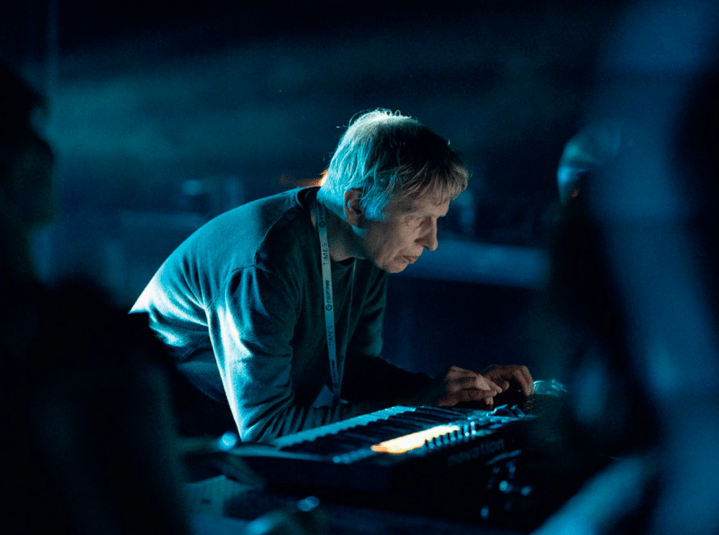
Various Venues, Tromsø, Norway Image: Ismistik at Insomnia Festival by Celine Richard
Inspired by the sleepless nights imposed by the midnight sun, Insomnia takes place in Tromsø, which lies beyond the Arctic Circle. Since 2002, the festival has fostered a culture of inclusive and forward thinking electronica that builds on the city’s foundations as Norway’s techno stronghold. The programme opens with a screening and lectures at Tromsø’s historic Verdensteatret cinema. Harun Farocki’s video installation series Serious Games, alongside presentations by Holger Pötzsch and Noura Tafeche, interrogate the double standards of Western thinking in relation to conflicts in the Middle East, particularly when refracted through media. Although not explicitly related to the curated musical acts, the forum points to the cultural critique inherent to some of the artists appearing this year.
The Palestinian artist Bint Mbareh presents an open air performance at Strandtorget. Facing a harbour and the snowcapped mountains beyond, this square is the weekly meeting place for Palestinian solidarity marches. Mbareh’s work uses the parallels between sound and water waves as a metaphor for dissolutions between states of being, blending her voice and looping buzuq into swelling tides of fractured drones that recall 1990s Seefeel. The Lofoten based sound artist Lasse Marhaug follows up with a delightfully disorientating laptop set in which digital blips, fireworks and foghorns blast off in six directions at once. It sounds like the world grinding on its axis, and turns some bemused heads from the flocks of tourists trying to escape the rain.
Back in Verdensteatret, the Tuvan throat singer Sainkho Namtchylak improvises around Θ (theta)’s bleak temporal basslines. Alternating between Russian and English phrases, primal screams and glossolalic overtone singing, Namtchylak activates the entire range of her vocal ability. Arms beating like a crow’s wings, she calls on the audience to join her in the “dangerous asylum”. Some heed the invitation and sign up for a two day throat singing workshop at the Nordnorsk Kunstmuseum.
Most of the action happens at Bryggeriet, a club with three stages on Storgata, Tromsø’s main shopping strip. Valentina Magaletti and YPY aka Koshiro Hino of goat (jp) don -fluorescent vests as they deliver a jackhammer thunderstorm. Hino’s percussive samples fuse with Magaletti’s kit like pneumatic tools on a well-oiled construction site. Getting the most out of their trip to Norway, the artists reappear elsewhere: Magaletti with the motorik dub trio Holy Tongue (locked grooves impossible to break away from) and Hino in KAKUHAN, his duo with the cellist Yuki Nakagawa.
With custom turntables, an orphaned air pump and disembodied bass strings, Evicshen delivers an onslaught of theatrical noise that is possibly the most polarising set of the festival. A lot of people are here to dance and for them there’s local legend Ismistik and eclectic selections from DJ Marcelle, not to mention the Iranian duo Temp-Illusion who distill techno to its darkest essence and propel the dancefloor into complete abandon. Hailing from the Nyege Nyege scene, the Afrofuturist collective HHY & The Kampala Unit do much the same, albeit with jouissance channelled through blazing brass arrangements and the dancer Exocé Kasongo, whose tireless energy hypes the crowd into a single mass. The Bug & Warrior Queen close the festival, obliterating the senses with blinding lights and dub cuts exploding out of totemic bass cabs positioned on the edge of the stage. It’s so intense that I have to leave early and I’m not sure if I’ll ever recover completely.
Ilia Rogatchevski Originally published by The Wire, December 2025
For the last few months I’ve been working away behind the scenes, with a team of great US-based physicians, on a podcast about American healthcare.
It’s called Doctor Friends and foregrounds candid conversations about what it means to be a healthcare provider in a system that is often difficult to navigate for patients and doctors alike.
My comfort zone is usually art and music so researching the ins and outs of the American healthcare system has been a fun challenge.
The first few episodes are out now and I would be grateful if you gave it a listen and a follow. It’s available on all major platforms.
The duo of Koshiro Hino and Yuki Nakagawa team up with Polish percussionist Adam Gołębiewski for an album composed and recorded in a single improvised session
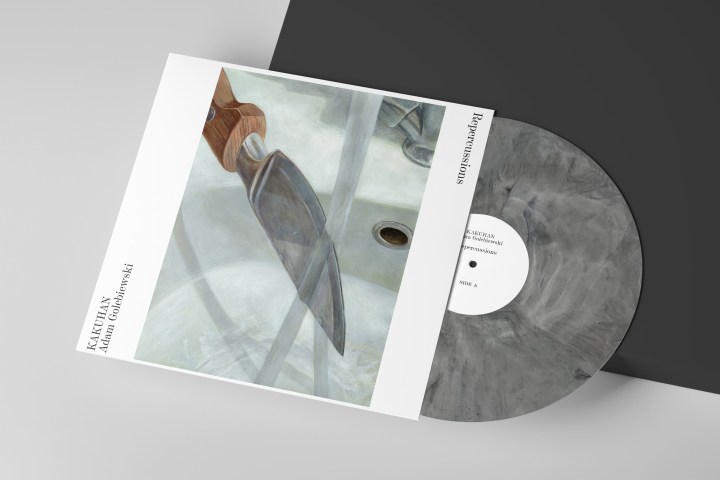
Watching KAKUHAN at last week’s Insomnia festival in Tromsø, Norway, I was struck by how a duo performing with only a sampler and cello can sound simultaneously amorphous and cohesive. Consisting of Koshiro Hino – he of Osaka’s goat (jp) – and cellist Yuki Nakagawa, KAKUHAN forged their sound on the 2022 debut Metal Zone. Hino’s percussive abrasions pan, pop and cascade as Nakagawa’s use of echo boxes and other effects dissolve expectations of what the cello ought to sound like. The duo slip between sonic states like lucid dreamers, combining dance rhythms, scraping drones, post-classical footwork, artillery snares and a frigid bass that hits the body like oceanic waves. Live it is sometimes difficult to tell who is responsible for which sound, a characteristic formally exploited on Repercussions, their collaborative album with the Polish percussionist Adam Gołębiewski.
Gołębiewski has worked with experimental luminaries like Yoko Ono, Thurston Moore, Kevin Drumm, Mats Gustafsson and Ken Vandermark. His approach to the kit is gestural, creating moments of tension and resistance between different materials that have, as he told Claire Biddles in a recent tQ interview, “something in common with almost every instrumental practice, as well as the traditional method of firestarting.” Cymbals are bowed, wood is caned and metal filed. Nothing is extraneous with each movement considered for its impact and textural potential. Gołębiewski, Hino and Nakagawa first combined forces at Unsound in Kraków in 2023. Their improvised set was soon followed by a recording session, engineered by Rafał Drewniany at KPD Studio, that capitalised on their new-found momentum and chemistry.
The ten compositions on Repercussions (notice the wordplay evoking recurring percussion) came together spontaneously and this is echoed in the numerical tracks titles. The atmosphere evolves gradually with Gołębiewski responding to Hino’s skittering beats with rasping cymbal work and intermitted hi-hats on ‘II’. Nakagawa comes in with tentative pizzicato towards the end but his cello on ‘XIII’ takes on a prominent role. Using a curved bow, which allows all four strings to connect with the horse hair, Nakagawa summons a sound not unlike wounded bears grunting in the distance. Gołębiewski responds with his own bow, which slides across the cymbal edge to generate highly textured overtones that recall freight trains braking in the depot at midnight.
Throughout the album each member finds ample opportunities to mimic his colleagues. Whether it’s Gołębiewski’s pounding snare on ‘I’ that screams to be digitised, Hino’s rumbling samples that cosplay beaters rubbing against drumheads, or indeed Nakagawa’s chameleonic strings, which on ‘IV’ evoke tainted flutes, but elsewhere masquerade as electrical signals, it seems improbable that Repercussions was composed and recorded in a single improvised session. While Alicja Pakosz’s cover painting of a knife splitting a jet of water points to the more abrasive passages of the record, the album title suggests a quietly confident intention. Performing together, KAKUHAN & Adam Gołębiewski are drawing on their extended collective experience in sound to form and ignite a credible world out of thin air.
Ilia Rogatchevski Originally published by The Quietus, October 2025
The Finnish trio’s cleaning robot alter egos make industrial music from the contents of a linen cupboard around sci-fi themes that are anything but domestic. From left: CW04 (Tero Vänttinen), CW01 (Risto Puurunen), CW03 (Timo Kinnunen) – Photo by Jussi Karjalainen.
In the music video for “Ricewestern” the cosmic track opening Cleaning Women’s 2001 debut Pulsator the Finnish trio teleport themselves across the Russian border to Saint Petersburg to perform on their modified clothes horses before bemused bystanders. The grainy 8 mm footage documents this absurd happening like it was captured by an amateur film maker. “In the early 2000s, we played there many times and had a following,” reveals Tero Vänttinen aka CW04. “The atmosphere was free. The Soviet Union collapsed less than ten years before and there was a big need for influences from outside. We had strange instruments and costumes. They didn’t know what to think of us.”
Reissued on vinyl in February, Pulsator remains Cleaning Women’s mission statement: three androgynous cleaning robots (CW01, CW03 and CW04), from the planet Clinus, adapt salvaged household materials into DIY instruments and compose what they describe as a “combination of cinematic sci-fi western and sparkling trash can disco”. Brusque Beefheartian delivery echoes through their lyrics, while their rhythmic instrumentals and image recall early Kraftwerk.
Cleaning Women were formed in 1996 by Risto Puurunen aka CW01 and Anu Keränen aka CW02, who left a few years later. Dialling in from Vacuum Sound Space, their airless rehearsal studio, Puurunen explains their origins: “When I arrived in Helsinki, I bought a laundry rack. CW03 [Timo Kinnunen] and I had been experimenting with contact mics [for another project when both living in Kuopio]. I put a microphone on the rack and sent it through some effects. The sounds became interesting, almost musical. CW02 programmed parties at our art school and said we should make something. That’s how we started. It was more like an experimental sound performance. Much different from what we are now.”
After finding the ‘natural’ sound of the clothes horses too limiting, they began adding other materials to create variations in pitch and timbre. “We like dogmas,” explains Puurunen, “we have rules like all the instruments have to be built by ourselves.” Kinnunen adds: “We mostly find everything in the recycling centre. You just take some metallic stuff in your hand and start thinking about what it could be.”
This method of explorative tinkering has evolved over the last 30 years, and their arsenal of instruments has expanded to include a coffee can bouzouki, closet hanger bass, melodic kling klang and hammered dulcimer among other self-made constructions all held together with twists of tape and wire. “We are really old school,” declares Vänttinen. “We play everything live no backing tracks, no samples, no click tracks. Everything comes from the instruments and from us on stage. We’ve been really strict with that.”
Aside from being an accessible live act whose music revolves around the interplay of hypnotic rhythms, Cleaning Women are also composers of nuanced film scores. They have performed bespoke music for silent classics like Sergei Eisenstein’s Battleship Potemkin (1925) and Fritz Lang’s Metropolis (1927), and composed soundtracks for contemporary films including Alice Rohrwacher’s Oscar-nominated short Le Pupille (2022). “[Dziga Vertov’s 1930 film] Enthusiasm was the first one [we did],” remembers Vänttinen, “and it was an accident. There was a guy who ran a film festival [in Russia]. He said we should make music for that film and come to his festival to perform it. We rehearsed, made the score and went to Saint Petersburg to play but they had forgotten the whole idea! That was the first screening it never happened!” Instead they unveiled the score at Helsinki’s Riemu festival in 2003. It was soon followed by more commissions.
When Cleaning Women released their soundtrack to the 1924 Soviet sci-fi film Aelita as their second album in 2004, it included additional material that didn’t make the final score. Directed by Yakov Protazanov and based on Aleksey Tolstoy’s novel, Aelita follows the story of an engineer who overthrows the Martian ruling class with help from the titular alien queen. Cleaning Women’s Aelita score goes into darker territories than its predecessor. “Secret Passenger”, for example, mirrors the terse industrial sounds of Einstürzende Neubauten. Longtime Neubauten member Alexander Hacke mixed Cleaning Women’s 2019 Intersubjectivity album, and hackedepicciotto toured with them in Finland.
“Our first album was made without us knowing what we were doing, because no one had recorded a laundry rack before,” says Vänttinen. “After that we have been figuring out how this band should be recorded. For Intersubjectivity, we found a method of recording where we use a PA system in the studio to get some air to the sound.”
Cleaning Women used the same method on their new album Washer. Although not as conceptually tight as some of their previous work, singles like “1984” and “City Of Confusion” are saturated with dystopic tension, reflecting the trio’s desire to evolve. “Timo getting bored with playing the drums was an offset for the new album,” Vänttinen admits. “The overall feeling was that everything sounds the same. There are only three of us so if Timo doesn’t play the beat, and the other two need to play string instruments, then we have to figure out how to make things sound new. Now we share the beats with Timo. They come from both of us. It’s like a monster that has three arms.”
Cleaning Women’s Pulsator and Aelita reissues are out now, Washer is released this month, all via Svart
Ilia Rogatchevski Originally published by The Wire, October 2025
Tonight’s edition of Boundary Condition, an event series curated by the Egyptian artist Alaa Yousry aka Cerpintxt, centres around the launch of her new album Refugees Of The Symbolic Network. The record’s identity is rooted in an impulse response (a process that allows you to replicate the reverb of a given space) gathered at the King’s Chamber in the Pyramid of Giza. Its sonic footprint was then applied to compositions based around texts by Izz al-Din Manasirah and Sargon Boulus, poets who worked with mythology and surrealist imagery to explore Middle Eastern identity. Their deconstructed verses are transposed onto a spectral netherworld populated by, as Yousry notes in The Wire 499, a “collective of individuals who have been systemically oppressed and exiled out of existence”.
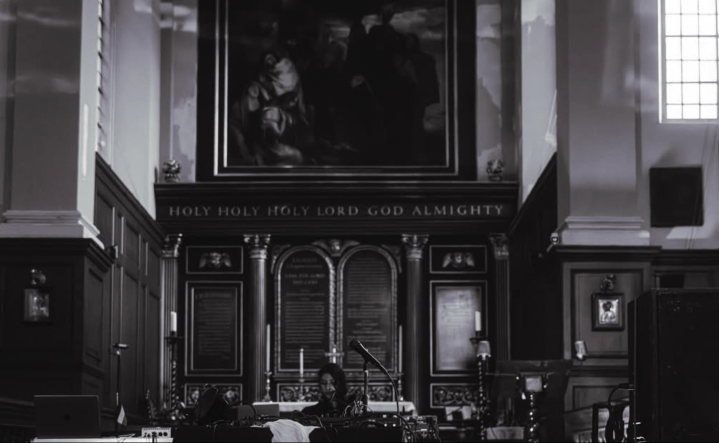
This transposition happens in the physical space too. Reconstructed by Sir Christopher Wren after the original medieval building was destroyed in the Great Fire of London, St James Garlickhythe boasts an opulent decor, large rounded windows and an impossibly tall ceiling. As the sun sets and the theatrical lighting intensifies, the impression that you’re lying entombed at the foot of a great monument becomes more pervasive. It’s an appropriate setting for contemplating with a soundtrack to match. mortality –
Heavy drones flow out of the PA and grow perceptibly louder as the audience file into the pews. Recordings of rainfall indicate the start of the opening set by BEORHTA, who walks through the nave holding a wind instrument shaped like three terracotta papayas fused at the stems. The ceramic innato flute emits haunting tones that counterpoint the masonry rattling bass at the climax of the ritualistic performance. The focal point is BEORHTA’s voice, which fills every crevice of the church with sorrow and is informed by caoineadh, the Gaelic Celtic tradition of vocal lament for the dead.
Plasma-like projections are cast on the walls behind Daniela Huerta, who co-created the artwork for Refugees Of The Symbolic Network, and performs pieces from her recent Soplo album. Created in part from soundtracks for films by the Colombian artist Iván Argote, Huerta combines ambiguous pulses and disembodied voice into a soundscape that is embedded with unease. She uses the SOMA Pipe, a voice-activated synthesizer, to augment her vocals into a multitude of blazing fractals while shifting drones contribute to the overall sense of disquiet.
Cerpintxt is billed between the above performers. Yousry is joined by pianist Ruben Sonnoli and cellist Nina Hitz (formerly of The Kilimanjaro Darkjazz Ensemble), both of whom appear prominently on her album. The start is unamplified and unannounced. Sonnoli tinkers away at piano keys at the back of the church, while Hitz is hidden somewhere near the pulpit, holding steady a disconcerting drone. Yousry, meanwhile, layers whispered intonations like a stream of sinful confessions.
The sounds connect in a diagonal spatial formation, making good use of the building’s acoustics, but the unamplified instruments soon give in to Yousry’s dominating electronic set-up. Hitz makes her way to the chancel, bowing on a piece of aluminium foil to mirror shimmering feedback. Sonnoli soon joins her on keyboards as Yousry’s voice slithers around stretched and distorted samples, and the trio continue fully amplified. While there is an element of stasis to their sound, like the remnants of dreams that stalk your waking life, the atmosphere is designed to evoke the an ushering into a dark eternal subterranean realm.
Ilia Rogatchevski Originally published by The Wire, October 2025
The composer and field recordist draws on a painterly sensibility to layer loops and samples into documentary narratives that are startling, funny and human. Photography by Ashley Markle
Poised over a laptop at a recent Cafe Oto show in London, Vanessa Rossetto pulls up spliced recordings of disparate voices, looping ephemera and snatches of incidental melody. She gestures and lipsyncs to the samples, layering clips on the fly and improvising new transient spaces from unremarkable fragments of time. Prior to her 2025 European tour, Rossetto had only played a handful of shows, even though she’s been producing music since the late 2000s. “I haven’t played live very much and I’m still working that out,” she confides over a video call from her Staten Island home. “Some elements are more constructed, some are not. In Lithuania, [April’s] Jauna Muzika festival had the theme of the amateur and so I sourced recordings of people singing their favourite songs. I made a backing track and set mics up so that people in the audience could come up and sing. I was ready to sing the whole 30 minutes myself if I had to, but every time I looked up there were different people doing it.” The recordings created on this tour will most likely see publication next year as The Professional, a double album on the Erstwhile Records imprint ErstSolo, which will “explore the idea of being put into that sort of situation, as an untrained and inexperienced practitioner, and the humorous situations that would undoubtedly ensue”.
The original meaning of amateur is a lover of something, and Rossetto’s journey in composition reflects this. Initially trained as a painter, she began working with sound almost 20 years ago by habitually recording her surroundings and constructing epic compositions from hundreds of layers. Her latest release Pictures Of The Warm South spans 142 minutes across two CDs. It’s her longest work to date, but the soundworlds present on the recordings are far from random, focusing on Rossetto’s relationship with her mother Toni. “She was liquidating her possessions and selling the house so that she could move into an apartment complex for older people. For almost four months I was helping her do this and recording the whole time. She moved to Alabama and then passed away. I went there and recorded her funeral at the apartments.”
Toni’s monologues are woven into an impressionistic documentary featuring street musicians, traffic, commercials and domestic minutiae that together underpin the traces that our lives leave behind. Listening to Pictures Of The Warm South is like being a guest in a strange house. You surreptitiously wander into different rooms and examine the objects there, which together form a portrait of the host, their tastes and personality. Familial complexities inevitably come into play, as in the piece “pool water, salt water, and the water in your head” in which Rossetto is heard crying and her mother berates her for it. Towards the end, “the chapel” captures the ritual of mourning at Toni’s funeral. Rossetto’s eulogy encourages those in attendance to dance rather than grieve. Even though the ones we love leave us, life carries on.
Rossetto’s mother is also the central voice on the 2019 album You & I Are Earth, in which she recalls memories of being a young girl during the London Blitz. The Actress, from 2022, is also dedicated to her. “She was so influential to me in ways that she will now never realise,” Rossetto explains. “I don’t know if she understood what I was doing, if it made sense to her as an artform. She found it confusing that I recorded things and put them together, but the whole reason I went on the European tour was because when I was at her house helping her pack, people from the Archipel festival in Geneva contacted me. I wasn’t sure if I should go. She was like, ‘You have to do this.’ She made me promise that I would go.” Rossetto grew up in New Orleans and considers the city to be pivotal to her development as an artist, not only because of its rich musical heritage but its outdoor culture. Toni sold paintings on Jackson Square and Vanessa spent a lot of time in the French Quarter, which is the centre for tourism, Mardi Gras, bar culture and street life. “As a kid I was down there all the time with her. She hung her paintings on a fence and sold them like that. I remember waiting for her to pack up and listening to all these sounds overlapping. When I got older, I would go walking and listening, seeing all this crazy behaviour – people go wild there. That really influenced me and I don’t know if I appreciated it as much at the time as I do now in retrospect.”
Her mother would set up an assembly line in their kitchen, and Vanessa helped by colouring the paintings. Seeing that it was possible to make a living from art drove Rossetto to study it herself, first at the University of Texas at Austin and later at Tulane University in New Orleans. Despite being immersed in Austin’s slacker scene and being into “ridiculous out there stuff” like Butthole Surfers and Scratch Acid, Rossetto’s transition towards working with sound wasn’t immediate. “At the time, I was really just trying to paint well but I was interested in performance art too. I had this microcassette recorder and was trying to record my entire inner monologue. I wish I still had the tapes.”
Rossetto had some gallery shows, but became increasingly frustrated with the limitations of painting as a medium. She began producing autobiographical comics and briefly considered making films. “I wanted to deal with narrative and time. Those were two things that I didn’t know how to approach. Film making seemed too complicated and intimidating. Narrowing it down to sound was like taking a slice of that and isolating it, which seemed more approachable to me as someone with no musical background.” Having friends in “quote unquote weird bands” gave Rossetto access to instruments and recording equipment, but she didn’t start making music in earnest until her late thirties. “I was drifting around and trying different things. It took me a long time to attempt anything with sound. I had friends with mixers and started recording whatever was happening in my house – just leaving it running and recording my activity or lack of activity – and making things out of that. I was aware of field recording but not its possibilities, other than documentary capture of an instance.” Rossetto’s first musical project was Catrider, a duo with the Australian musician Michael Donnelly. Their self-titled album was recorded in 2006 in a few days while Donnelly was staying in Austin. “From Mirrors Are Oceans”, which appears on the Music Your Mind Will Love You label’s 2008 Hand-Rolled Oblivion compilation, is awash with a claustrophobic combination of scratched objects, pawed strings and reverb. The same CD-R album also features “Arnold School 1” by The Mighty Acts Of God. This early solo project of Rossetto’s saw her experimenting with her housemate’s instruments, layering and processing them into anxious soundscapes, a method that led her to embrace chamber instrumentation more widely across her work.
Around this time, she was also turned on to the I Hate Music (IHM) forum by the composer Steven Flato, whom she met on MySpace and collaborated with as part of the improvisation duo Hwaet. “I was finding out about all these things [on IHM] and the floodgates opened to all the possibilities of what could be done. I started just making things, fulfilling something that painting had not for me. Something clicked at that point.” A wide spectrum of experimental music was discussed on the forum including noise, classical and musique concrète. It proved to be an invaluable resource and a pathway to collaborations with likeminded artists in different corners of the world. Over the years these have included Lee Patterson, Lionel Marchetti and Moniek Darge.
Imperial Brick, Misafridal and Whoreson In The WIlderness, a trilogy of albums released on her own Music Appreciation label in 2008, largely discarded effects and documented Rossetto’s raw droning improvisations on viola. Each album bore a minimalist black cover that suggested the sparse sounds within. It wasn’t until Dogs In English Porcelain, released the following year, that Rossetto hit her stride with measured and intentional composition. Constructed over the course of ten months, the 41 minute piece combined countless field recordings of domestic activities and aural snapshots from daily life. “Dogs In English Porcelain was the first one where I feel like I was using the actual form that I’m still using now: edited and augmented field recordings. When I first started learning how to operate a recorder and software, I would begin with a substrate layer – the length of whatever I wanted the track to be – look at where things were happening and build around those. I was trying to figure out a process of how to make things coalesce.” Dogs In English Porcelain caught the attention of Graham Lambkin, whose Salmon Run album influenced Rossetto’s early work. Lambkin asked her to produce a 7″ for his Kye label, a project that evolved into 2010’s Mineral Orange album. Feeling uncertain about what shape the tracks should take, she sent unfinished compositions to Lambkin for feedback. “He had a lot of input on that, because, at the time, I was very unsure about what I was doing. I was probably a pain in the ass sending him partially done things. I would never do that now!”
Two more Kye releases followed, 2012’s Exotic Exit and 2014’s Whole Stories, both of which intensified Rossetto’s method of splicing hundreds of recordings and carefully layering them to construct new narratives from the resulting juxtapositions. “That’s why it takes me a long time to make them,” she says. “I actually work often and for long periods of time, but some of the files are ridiculously huge. I use Audacity too and that’s maybe part of it. It’s actually analogous to the way I used to paint, because I mixed a lot of medium with my paint. The layers were translucent so you could see down into the paintings. I feel there is some relation there.”
Exotic Exit saw her expand the sonic palette to include violin, cello, dulcetina and glockenspiel on top of recordings from quotidian settings, language tapes and incidental conversations. The material developed from a live collaboration with Lambkin for the 2011 edition of the AMPLIFY festival in New York, which was organised by Erstwhile founder and IHM alumnus Jon Abbey. Rossetto used the live performances leading up to AMPLIFY as an opportunity to mould the material into what Matthew Revert referred to in a 2013 article for Surround as “a canvas where fragments of life are assembled into fictions”. Revert, a writer and multidisciplinary artist based in Melbourne, is Vanessa’s most frequent collaborator and life partner, even though they live on different continents. Revert was also a contributor to IHM, but their paths crossed properly during the making of Exotic Exit when Rossetto commissioned him to create the album cover, after being impressed by his book jacket designs.
“We met online,” she recalls. “We started working on things together and he came to visit me when I was performing at the Kye showcase at ISSUE Project Room [New York, 2014]. He was the secret guest and we did a duo set together. While he was here we were recording the whole time, quickly assembling an album. I would say my biggest influence is probably Matthew because he’s such a brave performer. He is creatively free and knowledgeable about a wide variety of artforms.”
Earnest Rubbish, the result of these sessions, came out on Erstwhile in 2016. Commissioned by Abbey, most Erst duos bring together musicians who would not have played together before and perhaps don’t even know each other. By this point he had already put out Severe Liberties, her collaboration with Kevin Parks, and liked what Rossetto and Revert sent in, pairing their release with Christian Wolff and Michael Pisaro’s Looking Around.
Earnest Rubbish, released in 2016, and its 2018 follow-up Everyone Needs A Plan, are looser in the way they combine ephemeral sounds when compared with Rossetto’s other work. The latter album in particular drifts from hissing drones and swollen strings to fractious synthesizer tones. Across 75 minutes, Rossetto and Revert’s late night voice notes drop in and out of the liminal soundscape. They suggest a scripted but elusive narrative that filters through as you slip into semi-consciousness while falling asleep to the radio. Rossetto thrives on longform pieces and when I mention that her work is perfect for the medium of experimental broadcasts she lights up. “I’ve actually been thinking a lot about radio plays and things of that nature,” she enthuses. “That’s one of the things that influenced the concept of mine and Matt’s next one. I have a lot of ideas but I don’t want to give them away. It will have ‘vignettes within a framework’ and follow the trajectory of the other two.” Rossetto is fastidious about planning which elements appear where in a given composition, sitting with a notebook and mapping them out. “Sometimes I draw, not a graphic score, but the shape of where I want things to be. I have really particular ideas about that, which has pissed off some collaborators before. There have been people who said, ‘Oh, you just put stuff wherever!’ as if I’m just throwing a bunch of things in together, but it’s all very intentional. Every single bit of it is individually placed to a microscopic degree.”
An example of her attention to detail can be heard on The Way You Make Me Feel and Erased De Kooning, both created in 2014 but released a few years apart. These works are composed from what Rossetto refers to as interstices or “the silences between deliberate acts”. Inspired by the Robert Rauschenberg artwork, the latter album sourced its sounds from the Experimental Music Year Book, which between 2009–19 published an online repository of works by composers working in experimental music. But The Way You Make Me Feel came from a more personal place. “I suffer from lifelong depression and anxiety and I was going through a very bad period around that time. I was also paradoxically going through really wonderful things but I was not allowing myself to experience them. I was removing myself from the possibility of being happy because I was so ill. In trying to remove most of the intentionality and leaving only the interstices in those recordings, I was trying to express that.”
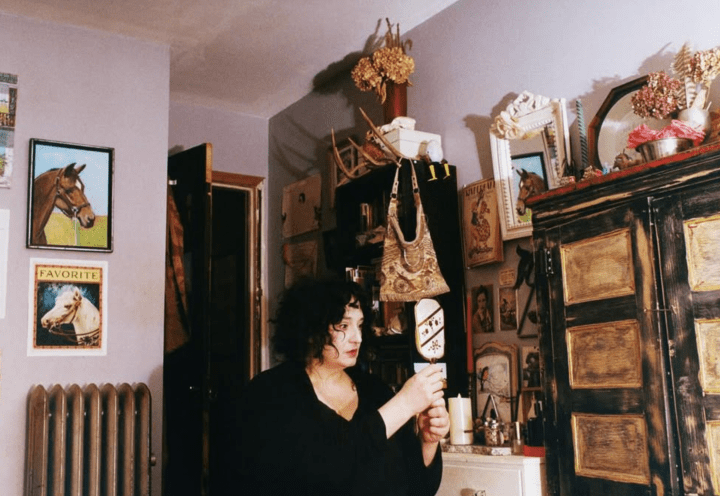
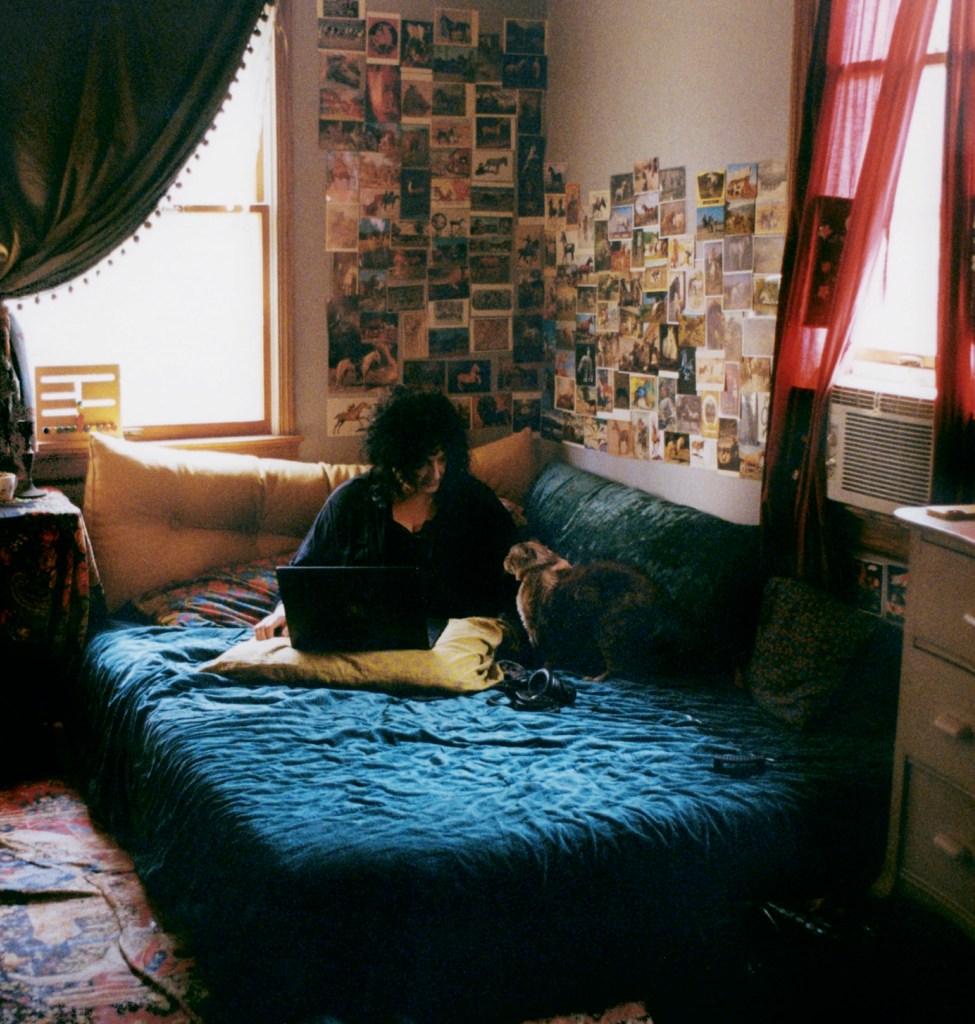
These sentiments are evident in pictorial form, too. Rossetto’s Bandcamp bio jokingly claims that she is a horse. This has flowered into a meme among her fans and resulted in many horse-related gifts over the years, some of which decorate the walls of her apartment. Revert’s cover design for 2022’s The Actress depicts an erased horse. With its ghostly outline lingering in a field, this image can also be interpreted as the subconscious removal of self – although Rossetto maintains that she simply preferred the background to the horse. Over time Rossetto has become more present in her pieces. Her voice appears regularly, from Exotic Exit through to her sonic collaborations with Revert and beyond, and anchors the ear at critical points in the narrative. “This Is A Recorder”, which takes up the first side of Whole Stories, is a good example of her authorial presence. “I was in New Orleans during Mardi Gras. People were all drunk and uninhibited and I had my recorder with a big fluffy windscreen on it. This guy came up to me and asked what it was and I was like, I record things, cut them up and reassemble them so that they have some narrative structure. This is the point where I felt like I was making my intentionality clear. I was trying to make sense of the world and that’s still what I’m trying to do.”
Rossetto continues that she would like to go further by forcing interactions and being more active in public to see what happens. When I bring up that the recordist’s presence can often be seen as taboo, particularly in wildlife recording, due to the perception that it undermines the purity of the natural environment, she responds: “I have a lot of respect for nature recordists but if there are no people, I’m not interested. That element is important to me. I want to go where there is interaction and human life. What’s interesting about most artforms is seeing the hand of the creator in them. Otherwise it’s sterile to me. I love street performers, cars passing by, getting in and out of Ubers with different songs on the radio, doors closing and delineating one space from another. I like the mistakes and bumped recorders in your bag. The unintentional is sometimes the most interesting.” ● Vanessa Rossetto’s Pictures Of The Warm South is released by ErstSolo
Ilia Rogatchevski Originally published by The Wire, July 2025
Dave Welder, a prolific Brighton project led by the film maker Ben Wheatley and music producer Simon Byrt, have amassed over a dozen eclectic lo-fi releases on Bandcamp since August 2024. Seated behind synths, laptops and MIDI controllers, the duo push out warp engine basslines laced with a lamentful sci-fi soliloquy that borrows the template of The Orb’s Adventures Beyond The Ultraworld. In a further nod to their ambient house forebears, the projection behind the group shows mirrored images of fluffy clouds. Looped piano sequences and sampled soul vocals later lift us out of the deep space odyssey, segueing nicely into warmly discordant industrial spaces.
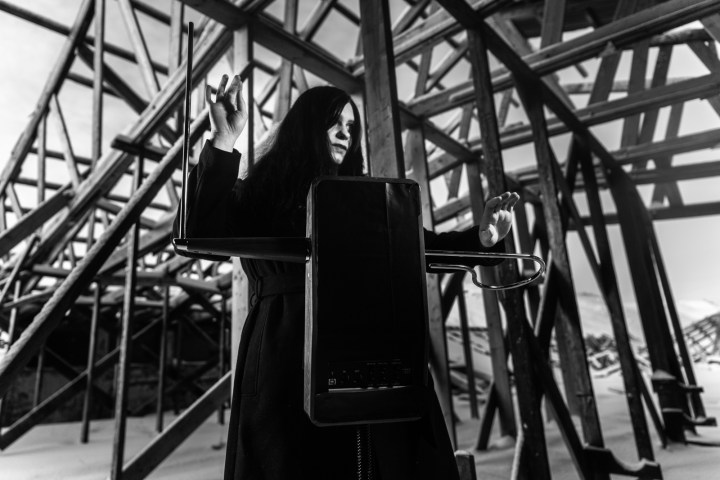
This sets the scene for the richly gothic timbres of the headliner. Iceland’s Hekla Magnúsdóttir is a theremin player who embraces the instrument’s associations with the supernatural, leaning into horror movie tropes evoked by its sinuous tones, while conversely steering the sounds to somewhere new. Her merch, for example, includes a pin badge showing disembodied hands hovering in the dark – spectral warnings of the devastation to come.
She begins with an improvised piece, its rattling subs and metallic sirens quickly engulfing the room. Bathed in vampiric light, Hekla teases clandestine melodies out of the air that murmur and disappear as the viscous low end spreads across the venue like swamp fog. Hekla’s right hand controls the pitch – poised as if pulling invisible threads – while her left hand droops inside a curved antenna responsible for the amplitude. Her equipment consists of little more than a Moog Claravox and a modest collection of pedals that loop and augment the sounds created by the instrument, yet this minimal set-up is more than enough to create vast sonic environments.
Hekla comes from a classical background, initially learning cello, and “bought the theremin on a whim”. She joined Bárujárn in the late 2000s, adding atmospheric textures to the band’s brooding surf rock. After going solo, Hekla began exploring the theremin’s unnerving potential, feeling drawn to darker themes prevalent in doom metal and drone. “It can be quite a dramatic instrument,” she tells me, “with the high notes, bass and vibrato. It’s often compared to a human voice – you get this fragility. Even though it’s a simple wave, the pedals allow you to pitch-shift and distort the signal to get these different colours. It opens a whole new dimension of sound.”
This dimension is fully explored in the remainder of the set, which is dominated by compositions from her last two albums Xiuxiuejar and Turnar. The melancholy topline on “Silfurofinn” recalls the human voice, wordlessly beckoning the listener into the depths, while Hekla’s own vocals on “The Whole” makes this invitation explicit: “Come to the hole… let it cover you up and blind your senses”.
Hekla later explains that it’s necessary to have an awareness of your whole body when playing the theremin because minor movements affect the pitch: “You’re playing in the air – drawing the music.” Turnar was partially recorded in a French castle and tracks like “Var” and “Gráminn” replicate the physicality of the tower’s medieval structure, evoking the candlelit uncertainties of the Old World. These emotions are then brought forward and combined with the theremin’s neoteric language, creating music that is at once ancient, futuristic and imbued with phantasmagorical apprehension.
Ilia Rogatchevski Originally published by The Wire, April 2025
In Focus: Michael Snow ICA, London, UK | Image: still from *Corpus Callosum (2002)
Michael Snow’s films are largely about film itself: its structure, texture, purpose and aesthetics. Presented by Dream Of Light, this weekend of screenings celebrates the late Canadian artist’s cinematic works, which are here being shown together in the UK for the first time in 16 years.
Wavelength (1967) takes place in a spartan New York loft. The story ostensibly revolves around a mystery death but the principal focus is the room itself. Over 45 minutes, the camera zooms incrementally to the opposing wall. We hear traffic and a sine tone that starts at 50 hertz and gradually ascends in pitch to 12kHz. As the lighting conditions and colour filters vary, you begin thinking about rooms and their depictions in art: Van Gogh’s Bedroom In Arles, David Lynch’s neglected TV series Hotel Room, Richard McGuire’s graphic novel Here. These works reflect on the apparent stillness in the experience of linear time with the room acting as the anchor around which events unfold.
Snow’s path to the screen led through fine art, and it’s useful to analyse the bare formality of Wavelength in relation to painting. When writing about the film in 2023, Jonathan Rosenbaum noted that “its primary obstacle is in fact the intimidating richness of what it has to offer”. Snow’s films are all obstacles in the sense that they challenge the notion of cinema as entertainment.
La Région Centrale (1971) takes this idea to the extreme. Once described by Jean-Luc Godard as “pure cinema”, the 190 minute feature is essentially an epic landscape painting devoid of narrative or human presence. Snow, his partner Joyce Wieland and their colleagues mounted a camera to a robotic arm in a remote location in northern Quebec. The camera pans, tilts and rotates, moving continuously in every conceivable direction. The mountainous landscape and the sky beyond it appear alien, particularly as the only sound present is the whirring robotic mechanism. The act of watching becomes a meditation of sorts. As the camera picks up speed, the film climaxes in abstraction with terrestrial colours swimming past the eye.
Sometimes Snow uses humour to deconstruct our conception of film. So Is This (1982) explicitly asks the audience to consider the author’s intentions in its playful use of language. Words flash on the screen one at a time with sentences taking left turns. There is no sound – only the dynamic shifts in the rhythm of the words and the changing tone of the ‘narrator’. Blurring the lines between communal reading and cinema, it’s a strangely novel experience that signposts to preceding text based works by Richard Serra, Su Friedrich and others.
Sshtoorrty (2005) and *Corpus Callosum (2002) both see Snow return to the study of human subjects. The former repeatedly superimposes two strands of the same story, the room again holding the centre, while the latter experiments with early digital techniques to subvert notions of identity and social structures. Office workers and a family of rotating characters experience a constantly shifting reality. Objects disappear, bodies are distorted and time stretches to comical ends. Named after the nerve fibres connecting the two cerebral hemispheres, *Corpus Callosum prophetically encapsulates the hallucinatory chaos of social media saturation that we find ourselves immersed in today. Many of Snow’s films are available online but meeting their demand of prolonged unreserved engagement can only happen at the cinema.
Ilia Rogatchevski Originally published by The Wire, March 2025.
Various venues, Sheffield & Rotherham, UK Photo: Lord Spikeheart by James Ward
After taking a year out in 2023, No Bounds returns with a sprawling programme for its seventh edition. Things begin in a low key fashion with a lecture at Sheffield University’s Firth Hall. The American composer John Chowning, now in his nineties, explains how he accidentally discovered FM synthesis in 1967. His early compositions, which consist of various synthetic timbres, ping across the room through a quadraphonic set-up. The evening closes with Voices, where his partner and soprano Maureen Chowning controls a Max/MSP patch with her voice.
Sheffield’s Emergence Collective kick things off in earnest the following night at the cathedral. Ten improvisors circle around repeating modes, constructing seemingly archaic compositions that slot beautifully into the grand architectural setting. Oram Award winner Lola de la Mata follows with a minimal set that employs the inherent acoustics of the building. Backed with dramatic red lighting, the choreography and growling theremin elicits near universal awe from the audience. Over at the Hallamshire Hotel, local electronica legends The Black Dog take over with two AV sets. As the music shifts from murky ambient to dark minimal house, distorted monochrome images of brutalist buildings dissolve into impossible ruins and Gaudí-like towers dreamt up by AI. What initially looks like a paean to postwar architecture reveals itself to be a critique of utopian thinking.
Safety concerns mean that Mark Fell’s multi-channel installation Cole’s Hidden Corners is cancelled outright. Instead I head to the basement of Exchange Place Studios for Flow State. Co-created by Aaron Spall, Daniel Bacchus and Dr Joan Ramon Rodriguez-Amat, the installation features various mutating forms projected onto walls while squelchy sounds pour down from speakers hidden in the overhead pipework. The piece utilises data gathered from the Don and Sheaf rivers that bring into focus the history and ecology of these vital ecosystems. Nearby at SADACCA – Sheffield and District African Caribbean Community Association – several rooms are given over to a group exhibition. White Teeth explore the impact of Sheffield’s pirate radio scene in a film multicast on multiple portable TV sets, while What Your Sound Can Do by Ashley Holmes dives into the cultural legacy of dub production techniques with a visual poem featuring grainy footage of a nighttime cityscape.
The late night programme takes place at Hope Works, a repurposed industrial estate outside the city centre. This is the festival’s spiritual home, and there’s an overwhelming number of acts scheduled into the early hours. Kenya’s Lord Spikeheart fuses extreme vocal delivery with furious industrial beats that polarise some attendees, while Batu’s set unites the crowd into a heaving sweaty organism. Back at SADACCA, tech difficulties mean Tom Payne’s immersive performance Storm Cloud is delayed. After waiting for 40 minutes in the cold, the intimate DIY space Delicious Clam provides a welcoming alternative with Micromoon’s shifting time signatures and hiphop-infused shoegaze.
On Sunday, focus shifts to neighbouring Rotherham. Chapel Of Our Lady is a tiny church sitting atop a bridge. Inside, Akhmad Kharoub – a Syrian refugee whose journey to the UK is scarred with traumatic experiences – performs what he calls a “mix of flamenco and war music”. Improvising alone on an acoustic guitar, Kharoub draws out serene melodies that are loaded with tension and despair. Despite the festival’s evident desire to max out the programme, the more understated performances make the most impact.
Ilia Rogatchevski Originally published by The Wire, November 2024
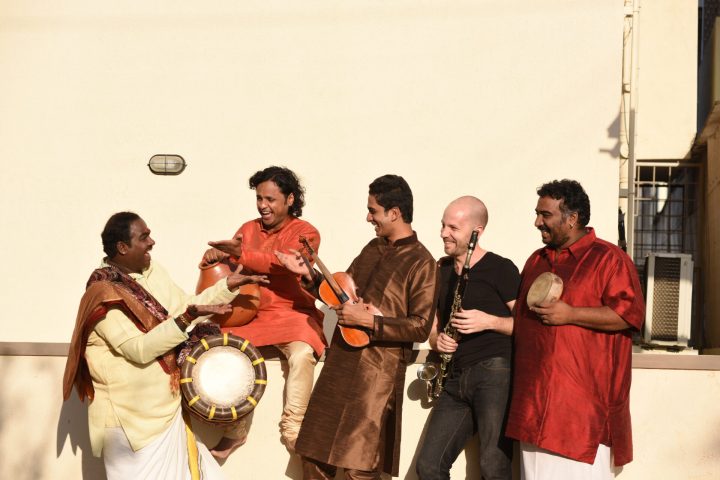
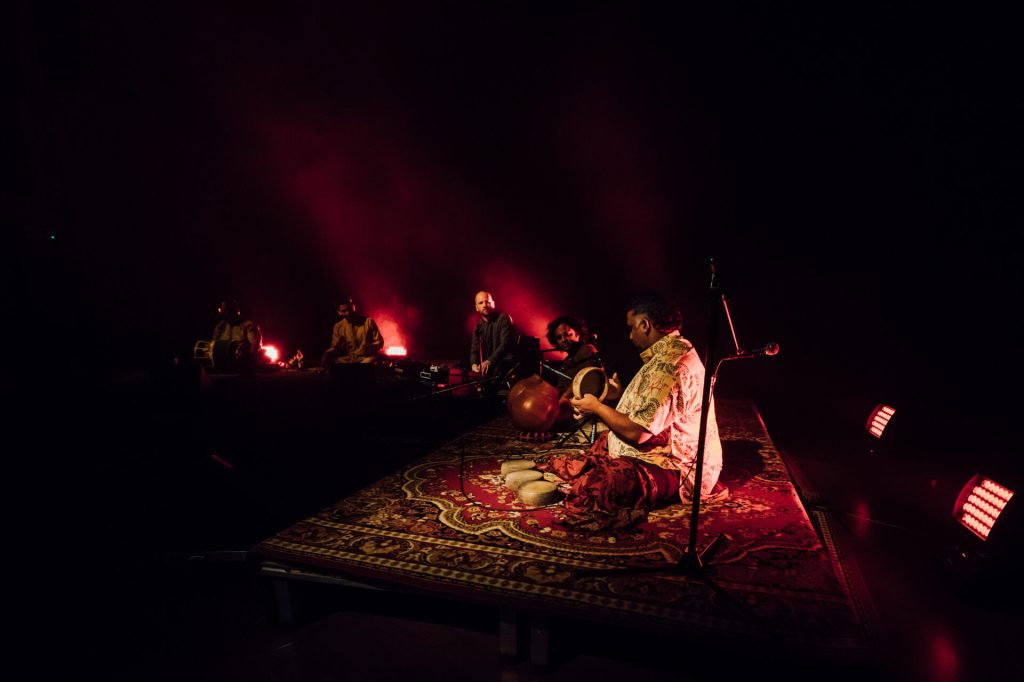
Ilia Rogatchevski speaks to Polish multi-instrumentalist Wacław Zimpel and master ghatam player Giridhar Udupa about their parallel journeys through music, and their combination as “interstellar folk” project Saagara. Photo by Rakesh Maiya.
In the first few seconds of ‘God Of Bangalore’, the track that opens Saagara’s latest album 3, eccentric rhythms fuse with bulging basslines and sequenced percussion. Synth pads are stalked by a serpentine violin as the steady thud of the ghatam builds up anticipation. Before the first minute has elapsed, we’re thrown into a world that combines musical languages from across the globe.
“It might have been 2016,” remembers Wacław Zimpel, the Polish multi-instrumentalist who, along with the master ghatam player Giridhar Udupa, is one of the main drivers behind Saagara, as he looks back to the song’s origin. “I was in India, walking around Giridhar’s neighbourhood with my field recorder. There was this amazing procession with drummers and folk musicians. I was recording the intensity of the rhythms and it became the inspiration for the track. The rhythm has changed [since then] – everything has changed – but the original vibe comes from the streets of Bangalore.”
tQ speaks with Zimpel and Udupa via video call, each of us dialling in from different parts of the world. We discuss their parallel journeys through music and the roads that led them to develop a style that Zimpel has christened “interstellar folk”. Both musicians are classically trained and began playing at a young age. Udupa was first taught the mridangam – a double headed drum that typically leads in Carnatic ensembles – by his father Ullur Nagendra Udupa, before switching to the ghatam, a tuned earthenware pot. “When I was 9 years old, my father organised a concert and asked me to be part of it,” Udupa the younger says. ”Since there was already a mridangam player, he said I should play ghatam. They belong to the same family. The language is the same but the technique is different. Since then, when I perform classical music in India, I play only ghatam.”
Zimpel also changed instrument early on, from violin to clarinet, absorbing influences from Western classical, jazz and improvised music. He continues to master new sounds and, in recent years, has been incorporating electronics into his work. Last year’s solo album Train Spotter, for example, used field recordings from Warsaw in combination with an arsenal of synthesisers, keyboards and plugins to construct a pulsating portrait of the Polish capital. Saagara’s story, however, goes all the way back to 2012 when Zimpel and Udupa performed together for the first time. “I was very lucky that Giridhar was in Poland that summer,” Zimpel explains. “Our mutual friend Jacek Mazurkiewicz invited us to collaborate – that’s how we met. Before that, I had a big interest in Indian music. Mostly Hindustani music, which is from north India.”
Photo by Maciej Kaczyński
Zimpel was listening to a lot of Ravi Shankar, Ali Akbar Khan and Bismillah Khan along with minimalists like Terry Riley and La Monte Young who studied with Pandit Pran Nath. A desire to understand their compositional approach led Zimpel to Bangalore. “Giridhar introduced me to the flute maestro Ravichandra Kulur who has experience in both Carnatic and Hindustani music. Because I was in south India, and because Ravichandra is mostly a Carnatic musician, he taught me the fundamentals of Carnatic music.” Initially, Zimpel found it difficult to integrate his playing with Carnatic rhythms because he couldn’t follow what the other musicians were doing. However, studying konnakol (a vocal technique through which complex patterns are mapped out using percussive syllables) allowed him to better understand these rhythm cycles, freely improvise within that system, and thereby engage in a dialogue with the other musicians.
Saagara’s eponymous debut, released in 2015, was partially inspired by John McLaughlin’s acoustic fusion group Shakti. “It was a very important band for me, Giridhar and the other guys from Saagara,” Zimpel admits. “They’re legendary and a huge inspiration for us to make a real connection between West and East. Not just being on stage together, but really discovering our own language. My goal was to improvise with Giridhar, Aggu Baba [who plays khanjira], K Raja [thavil] and Mysore N. Karthik [violin] – who joined the band later – on a high level of understanding.” Even though it isn’t unusual to hear synths replacing tambura drones in Carnatic music, there were no electronics employed at that stage. “I told Wacław that it’s nice to have some pads, just a couple,” says Udupa. “And he was so particular: ‘No, let’s make everything acoustic’. So he brought two shruti boxes – manual things. We did two tours like this. From that to Saagara 3 is a drastic change. A complete evolution.”
The band’s 2017 album 2 articulates this careful transformation from an ensemble examining the roots of Carnatic music to one that embraces the studio as a separate instrument. “I wanted us to be as original as possible,” Zimpel says. “But when I started working more in the studio, I started feeling that I needed more control. We used to work with the producer Mooryc and he brought a lot of electronic sounds to our second album. Shortly after, I met James Holden and Sam Shackleton, and playing with those guys was like university for me.” The first song to be recorded for 3 predates the pandemic. ‘The Rite Of Rain’ maps out a new direction with looping synth and organ notes, backed by incisive rhythms, interlocking with Karthik’s violin. Holden mixed the track but also showed Zimpel how to connect the natural timing of Indian drums with sequencers using the Humanizer plugin. “It’s the heart of this whole production,” Zimpel says. “It allows you to translate the natural timing of the drummer to the sequencer, and those sequences start sounding more organic”. Zimpel produced the track in 2018, but it took him several years, and many albums in between, to master the skills required to complete the album.
Photo by Rakesh Maiya
This journey resulted in a record that has as much in common with its Carnatic roots as it does with a basement jazz club, or indeed a sweat lodge dancefloor. ‘Sunbeam Spirits’ is a delightful track that bridges these spaces. Strings are chopped into a flickering stereo attack before the ghatam breakdown leads you into a joyous clarinet solo that commands attention like a street corner preacher. Considering how Indian classical performances can stretch to three hours in duration, as well as psychedelic heights that their own work can reach, I ask if framing Saagara as trance music is valid. “The spiritual aspect of Indian music was something which brought me into it,” Zimpel says. “It’s about emptying your mind and experiencing the sound, rhythm, raga and harmony going through your body and being open to processes beyond your intellectual capacity.” The best part is that it’s enjoyable, Udupa hastens to add. “Starting from the first note, when we look at each other, we have fun. That’s what connects us to the audience.”
Saagara will be touring Europe in November in support of the new album. Meanwhile, their music has also been received well in India, not only because the group is disciplined and honest about how they experiment with traditional forms, but also because of the energy they bring to the stage. Zimpel concludes: “It is amazing how musicians in India are very particular about the energy in the room, what kind of thoughts or conversation we have in the tour bus, what kind of attitude we have towards one another. We try to bring the best from ourselves. It’s much less the theory about sequencers, Carnatic rhythms and ragas. What’s most important is when we’re all experiencing something extraordinary, something bigger than us. That is what Saagara is about – bringing this energy and spreading it to the world. That’s our mission.”
Saagara’s 3 is released by Tak:til on 18 October.
Ilia Rogatchevski Originally published by The Quietus, October 2024



 Ilia Rogatchevski