comment 0

Once Upon A Time In Vilnius

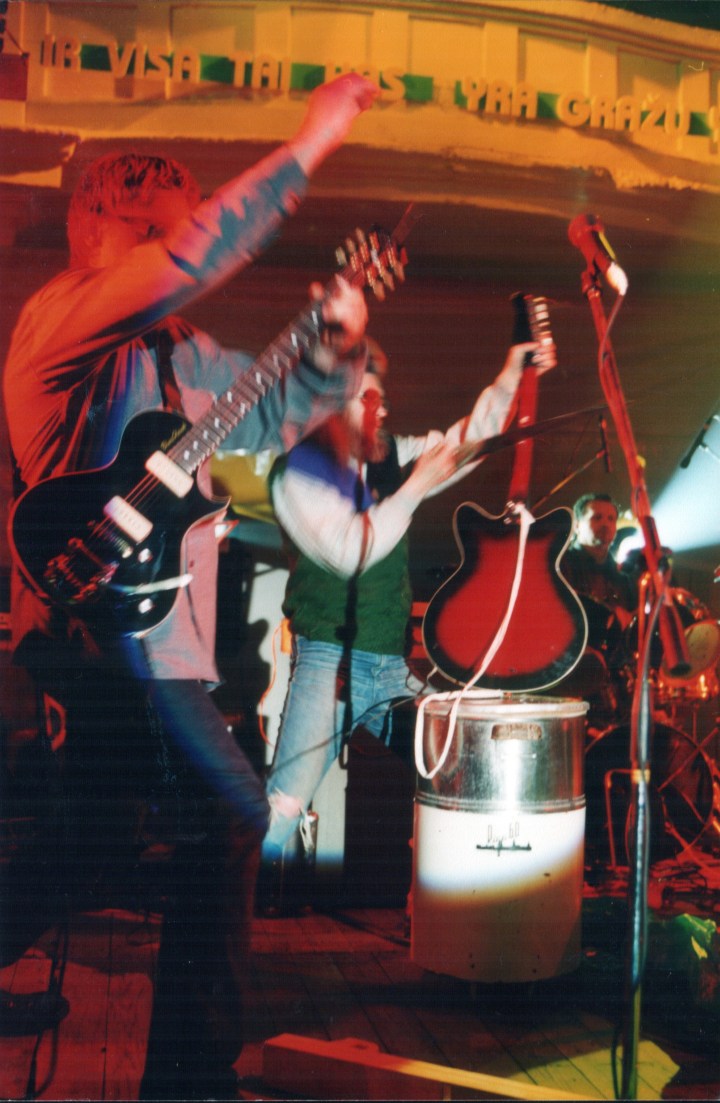
The interweaving stories of avant rock band Ir Visa Tai Kas Yra Gražu Yra Gražu, jazz improvisors Haruspic and radical film maker Artūras Barysas provide a window into Lithuania’s underground from the Soviet era to the present day. Lead image: Juozas Milašius, Artūras Barysas in 2000. All photos courtesy of the IVTKYGYG Archive.

On the bank of the Vilnia River, in the northern part of Vilnius Old Town, stands the Lithuanian National Culture Centre. This unassuming building is home to the Plokštelinė recording studio. The avant rock band Ir Visa Tai Kas Yra Gražu Yra Gražu (And Everything That Is Beautiful Is Beautiful, often shortened to Gražuoliai – The Handsome Ones – or abbreviated to IVTKYGYG) invited me here to witness the recording of Catastropicum, their first studio album in six years.

IVTKYGYG’s leader Artūras Šlipavičius aka Šlipas greets me warmly and immediately offers a glass of whisky, which, he tells me, helps to warm up the vocal cords and stave off the cold in the cavernous studio. The ceiling of the live room is adorned with triangular diffusers, hanging upside down like stalactites, which were installed during the Soviet era. The studio was formerly run by the state-owned record label Melodiya and is famed for having recorded acts such as the ska-infused post-punk band BIX.

Although IVTKYGYG formed in 1987, they had never recorded in this legendary space before, until a grant from the Ministry of Culture of Lithuania financed their new project. The sessions took place in early February 2022 amid rising geopolitical tensions in the region. When I arrive, the band are in the midst of recording a semi-improvised track called “Spletni” (“Gossip”). “There is so much gossip in Lithuania right now about the Russian tanks standing on Ukraine’s border,” Šlipas tells me afterwards. “There are so many emotions. We are recording this at a period when war could start next week.” Russia’s full-scale invasion of Ukraine commenced two weeks after my trip.

Unlike their contemporaries Antis, who took an active part in the Singing Revolution of the late 1980s – a series of peaceful protests, which paved the way for independence of all three Baltic republics from the Soviet Union – IVTKYGYG claim never to have been overtly political. “It’s totally different with these guys,” says Radvilė Buivydienė, director of the Music Information Centre Lithuania. “Antis, they were mainstream. Everybody was talking about them. IVTKYGYG are the real underground. I think that IVTKYGYG is a gem for real diggers, because the context is very rich.” The Baltic republics had a relatively relaxed attitude to rock in the late 1960s and early 70s. The popularity of The Beatles spawned many bands who imitated their sound. Countercultural youth movements such as the khippi (hippies) were initially tolerated by the state, because the authorities knew that many Western hippies were ideologically opposed to capitalism. Estonians had access to Finnish TV and radio broadcasts and, in many parts of Lithuania, you could tune in to Radio Luxembourg. In the southwest of the country Polish TV and FM radio were also available. Rock flourished as a result and khippi youth would regularly congregate in the Baltic states during the summer, often travelling from all corners of the USSR.

This all changed in 1972, when 19 year old student Romas Kalanta burned himself to death in front of the Kaunas State Musical Theatre in protest against the Soviet regime in Lithuania. The police attempted to suppress his funeral, which angered the khippi community of Kaunas and the city fell into rioting. After order was restored, the authorities cracked down on anything seen to be countercultural. Men with long hair would be arrested on the streets and forcibly shorn. Rock was banned and many musicians gave up playing altogether.

Kaunas had been the temporary capital of independent Lithuania during the interwar period and was the country’s cultural centre before Kalanta’s self-immolation. After 1972, Vilnius became the bedrock of the nation’s culture. Until the early 80s, performing in a band meant playing state-approved compulsory repertoire in restaurants. Clubs only started reopening in the late 70s, as disco became popular. Slowly, amateur bands formed, but instruments and sound equipment were extremely hard to come by. The guitar body could be fashioned out of wood, but the strings, pickups and amplifiers had to be sourced from elsewhere.
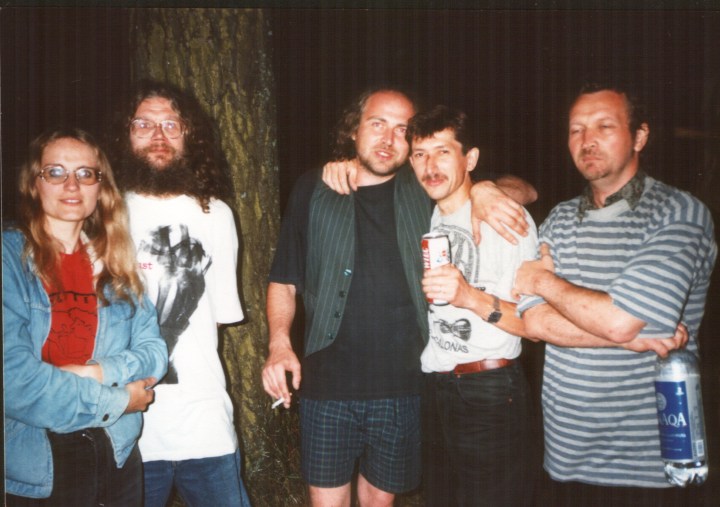
From left: Ara Šlipavičienė, Artūras Barysas, Artūras Šlipavičius,
Gedas Simniškis, Vaclovas Nevčesauskas in Poland, 1998

IVTKYGYG’s bassist Gediminas Simniškis aka Gedas tells me how they obtained bass strings during this time: “In our music school there stood an unused piano under the stairs. My brother and his friend decided to cut a few strings from it. I stood guard. Later, I asked my brother how they chose the strings – did they pick them out by their notes? He replied that they chose them by eye, judging by their thickness.” Payphones would be similarly vandalised, with the handset microphones appropriated and refashioned into DIY guitar pickups. Amplifiers were made from stolen loudspeakers. Everything was handmade. “We had essentially been playing punk rock on homemade instruments before they played punk rock in the UK,” Gedas recollects.

Gedas is a prolific bass player who also worked with Antis and the new wave group Foje, both of which achieved significant success in Lithuania in the late 80s. Around this time, he was listening to Billy Cobham and Frank Zappa (who has a monument dedicated to him in Vilnius despite having no connection to the city) as well as prog bands Emerson, Lake & Palmer and Yes. Šlipas also mentions Zappa as a principal influence along with Gong, Faust and Fred Frith.

This music came into their possession due to Lithuania’s large expat population. Relatives and acquaintances living in the West would often send LPs back home. These albums would then be sold, copied, and traded underground.

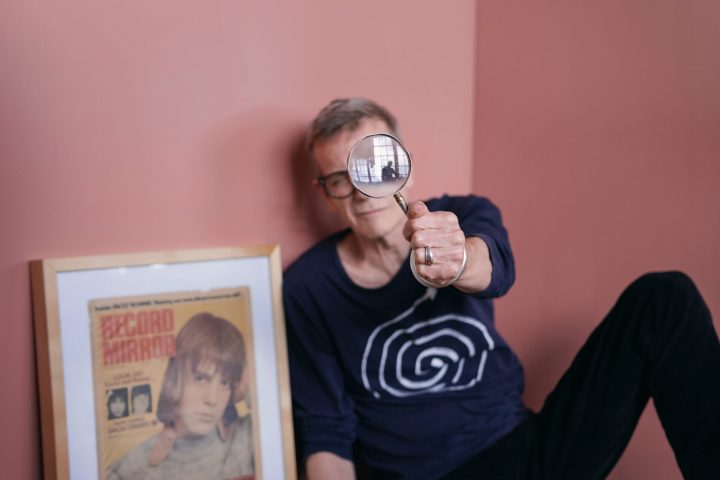
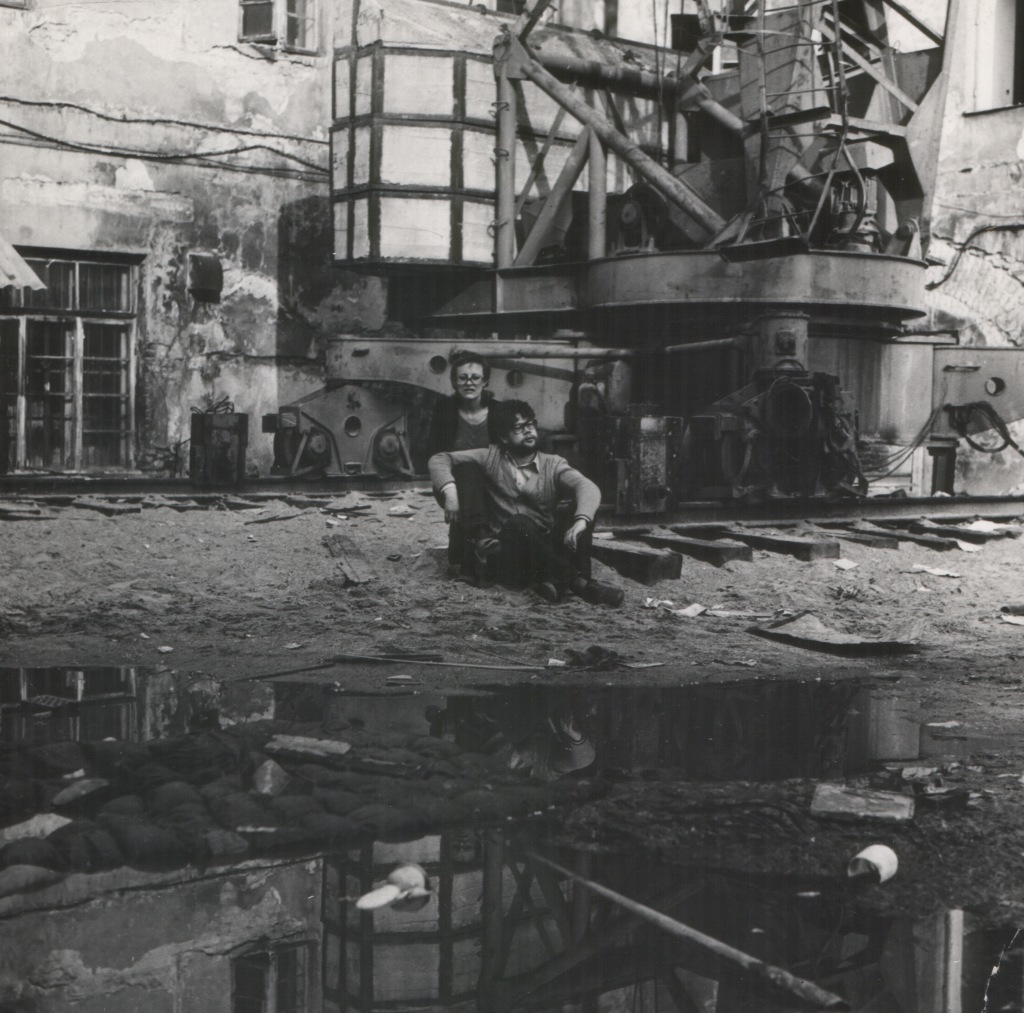
The most esteemed record collector in Vilnius was a jobless man called Artūras Barysas aka Baras. Bearded, shaggy-haired and bespectacled, he was well known in alternative circles. His apartment was stacked with rare books, vinyl and antique paraphernalia. It was a criminal offence to be unemployed in the Soviet Union, but due to Baras’s myopia he was able to claim disability. He sustained himself by selling rare books to collectors in the West and LPs to curious youth at home. He also made absurd experimental films, in the Fluxus style, that bring to mind the work of Lithuanian expat avant garde film maker Jonas Mekas. For example, the short 16mm film Tie Kurie Nežino Paklauskite Tų Kurie Žino (Those Who Don’t Know Should Ask Those Who Know), from 1975, has Baras playing a messianic figure who incites his disciples to fight among themselves before walking away from the carnage to the sound of Kraftwerk’s “Kometenmelodie 2”.

By the late 80s, the combined fallout from perestroika and glasnost shifted the cultural mood in Lithuania, not to mention the rest of the USSR. Bands began performing openly and organising festivals without fear of reprisal from the authorities. One such festival, Roko Maršas (Rock March), was initiated by Antis leader Algirdas Kaušpėdas. The festival toured various cities in Lithuania in the summers of 1987–89 and soon became a vehicle for the Sąjūdis independence movement, as documented in Giedrė Žickytė’s 2012 film Kaip Mes Žaidėme Revoliuciją (How We Played the Revolution). It was within this social context that IVTKYGYG began their journey. The morning after IVTKYGYG’s recording session at Plokštelinė, Šlipas picks me up in his green 4×4 outside the Aušros Vartai (Gates of Dawn), the historic entrance to Vilnius Old Town, to take me to his dacha, the countryside studio where he spends half of his working week. The vehicle is decorated with photos of IVTKYGYG’s members and logo. He wants to show me his paintings and, on the way, he reveals how he started making music. “I was a bard,” he explains, referring to the Soviet singer-songwriter genre. “Lots of complicated guitar parts. I had some fans, but not many.”

This was 1985, the era of the Soviet-Afghan War. Teachers were not required to serve in the army, so to avoid conscription, Šlipas took up a post teaching art at a school in Rudamina, a village just outside Vilnius. There he met jazz saxophonist Vytautas Labutis, who had performed alongside Vladimir Chekasin, Sergey Kuryokhin and many other influential Soviet jazz players. Labutis was also dodging the draft by teaching music. The two got together and improvised around Šlipas’s paintings, christening their project Haruspic (the name refers to an ancient divination practice that utilised animal entrails to make predictions).

Inspired by the Lithuanian symbolist Mikalojus Konstantinas Čiurlionis, Šlipas’s paintings depict surreal netherworlds inhabited by tortured figures. Posed in the Orthodox icon style, and often based on his own family members, these figures may be seen dining on eyeballs or, in a curious recurring motif, pickled cucumbers. The facial expressions of the sitters are distant, as if mourning a lifetime of mistakes and missed opportunities. Haruspic’s music reflects these themes on tracks like “The Flood”, in which two flutes, played by Šlipas and his wife Ara Šlipavičienė, intertwine with Labutis’s violin in a pseudo-medieval danse macabre. “Music like that you can only listen to once a year,” Šlipas says. “It’s very conceptual. You can’t drive, dance or drink wine to it. You have to look at the paintings and think.”

Running in parallel to Haruspic, but not directly connected to visual art, was IVTKYGYG. Despite having no musical ability, Baras was encouraged to start playing with Šlipas by pioneering punk musician Nėrius Pečiūra, who also drummed with IVTKYGYG for a short time. The band’s early work mixed energetic post-punk with accents of sonic eccentricity reminiscent of Pere Ubu or The Residents. Rehearsals took place twice a week, in the small basement of a residential house, with reel-to-reel recorders left running. These lo-fi recordings document a band on a vector separate from their contemporaries. Gedas tethered the band with his Peter Hook-like bass riffs as Šlipas’s raw guitar seared across the sonic spectrum. Baras, meanwhile, yowled lyrics appropriated from newspapers or other found materials. On “Eiti Eiti Eiti”, for example, Baras repeats, “Eiti eiti, dirbti dirbti, dar susitvarkyti” (“Go go, work work, sort it out afterwards”) – an ironic mantra ridiculing the Soviet obsession with labour as a symbol of economic citizenship.

Their self-titled debut, affectionately known as The Yellow Album on account of its cover art, was an underground hit when released on cassette in the early 90s (first under the patronage of Berlin’s Radio Marabu and later reissued by Lithuania’s Bomba Records). Recorded between 1989–91, the album reflects IVTKYGYG’s energetic early stage shows. The band would perform no more than a few live takes onto primitive equipment, before committing to a recording everyone could agree on. This resulted in an uncompromising sound that referenced the group’s appreciation of experimental music, while infusing the songs with a punk-like urgency. The album standout “Šunparkis” (“Dogpark”) references a rundown yard situated behind the Presidential Palace in Vilnius. The place was popular with punks and street drinkers, and was frequented by Baras himself. The song became a hit, particularly with students, and still elicits a jubilant response from the audience when performed today, due to the infectious riff Šlipas plays on his modified rubab.

Baras was a charismatic frontman, but the gigs were unpredictable. Gedas remembers one concert where the small stage had been extended by placing tables end to end. “For some reason, there was one table missing, which created a gap,” he says. “Baras was walking backwards [on the stage] and didn’t notice there was a table missing. He fell right into that hole.”

Another story recounts one of IVTKYGYG’s notorious washing machine concerts. Inspired by Fred Frith’s experimental guitar playing, Šlipas realised that everything had a sound potential, and all you needed was a microphone to amplify the signal. The band set up four Riga brand washing machines and put various objects, such as tennis balls, inside their upright cylindrical drums, creating a disorientating rhythmical din. One year, at the Muzyka W Krajobrazie (Music In The Landscape) festival in Poland, IVTKYGYG were performing one of these experimental sets. Baras’s machine refused to switch on. Eventually, the frontman realised it wasn’t plugged in, but instead of finding a spare socket, he unplugged an extension cable connected to other equipment and cut power to the PA. Perhaps echoing an anti-hero from one of his own films, Baras revelled in the ensuing chaos.

Baras drank heavily, before shows and in everyday life. His addiction eventually led to him being incarcerated in a “therapeutic labour dispensary” (a state-mandated rehab centre for problem drinkers) and inevitably caused tensions within the band. Ara Šlipavičienė, who played various instruments in IVTKYGYG before largely leaving the band to concentrate on her family and career in insurance, recalls that towards the end of his life, the frontman’s drinking became increasingly problematic.

“He was, at that time, very ill,” she recalls. “We had a really important gig and we guarded Baras for three days so that he wouldn’t drink. Still he demanded it. We gave him water, but told him it was vodka. He couldn’t tell the difference. We all thought it was funny at the time but, of course, it isn’t funny at all.”

In one of his last films, Suvokimas (Perception), Baras plays a man possessed by a woollen blanket – a metaphor for the perception-altering qualities of alcohol – who murders an artist in his studio. He is later arrested but released without charge. The short film is at once a delirious allegory of alcoholism and a self-reflective look into how addiction can destroy creativity. “Half the film was shot in my studio,” remembers Šlipas. “[Baras] wanted to show how seriously ill he was. How hard [alcohol addiction] is.”
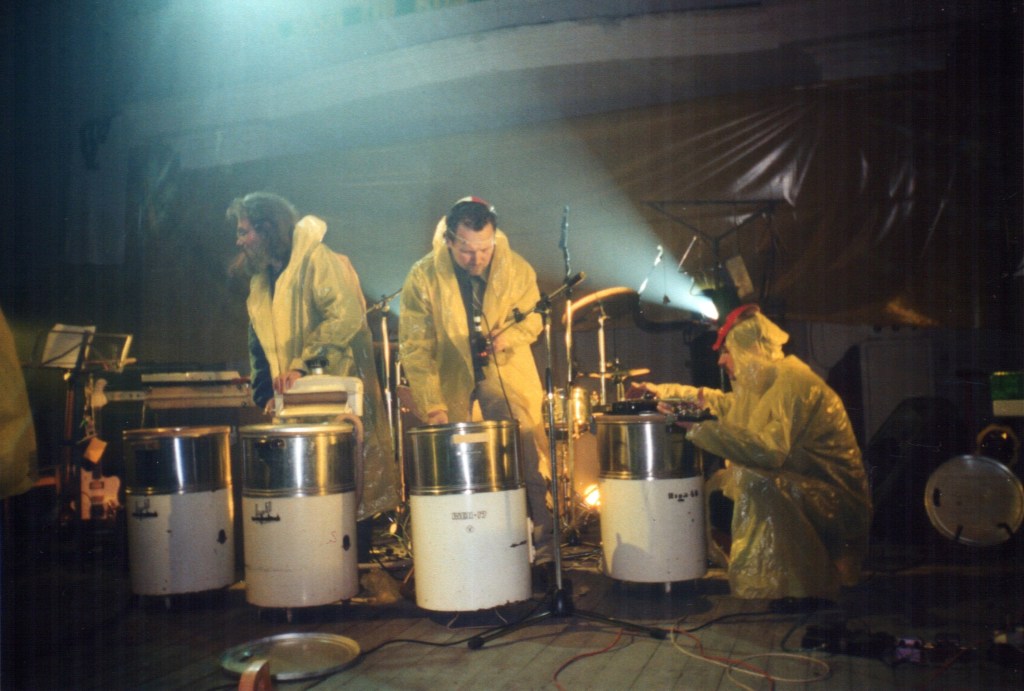
From left: Artūras Barysas, Vaclovas Nevčesauskas and Gediminas Simniškis at Mėnuo Juodaragis Festival, 2001

Baras died in 2005, the night before IVTKYGYG were due to record their washing machine project. The band paid their respects with an art action near the Neris River. They lit a fire inside of Baras’s washing machine, burned the scarf in which he died, and threw the washing machine over a bridge. Says Šlipas: “Baras once said that he wanted his ashes to reach the White Sea. We felt that in this way, it will happen.” During one of Baras’s extended spells in state-enforced rehab in the mid-90s, Šlipas decided to change the band’s direction. By this time, they had already begun experimenting with different forms, amassing a rich archive of so-called Birthday Tapes.

These recordings ranged from standard rehearsal recordings to quirky birthday songs composed for each of the band members. A horn section was added, a singular concept developed and the arrangements began displaying elements of progressive rock, jazz and esoteric folk music.

Released in 1996 by Bomba Records, IVTKYGYG’s second album Linkėjimai Falkenhanui (Greetings To Falkenhann) is considered by Šlipas and Ara to be the band’s finest work. The album is informed by the horrors of the First World War and its title references the Prussian general Erich von Falkenhayn, the commander responsible for deploying poison gas on the Western Front. The album is composed of nine tracks, most of which are instrumental. The saxophones (played by Artūras Martinaitis, Darius Kodikas and Vytautas Labutis) often lead the way, cutting through percussive undergrowth or repetitively raging against IVTKYGYG’s rhythm section. With the lead vocalist largely absent, the interplay of melody and texture became principal concerns for the group.

The credits list 11 personnel playing a wide range of instruments that include some unusual sounding objects: kitchen kerbs, kaziukas, haruspik. In the studio, Gedas shows me a surviving haruspik, one that the band still perform with today. It is fashioned out of a long metal cylinder that eerily resembles an amputated tank gun. Categorically, the instrument sits somewhere between an electrified tube zither and a percussive outsider art sculpture. The haruspik was built by the band themselves and they consider it to be their signature instrument.

“For music lovers in Lithuania, this project passed with a bang,” Šlipas says of the album. “It’s completely different, because I was different. The band needed to evolve. It’s my masterpiece.” On his return from rehab, Baras was angered to find that Šlipas had recorded the album without him. What was he going to do on stage, if there weren’t any songs to sing? The two fell out, but eventually reached a compromise by having Baras viscerally shout “Falken-hann” over and again on the title track. Arranged in 3/4 time, the sinister song closes the album, and is described by Šlipas as “the final waltz – the waltz of death”. Surprised by its power, Šlipas was moved to tears listening back to the finished work for the first time.

Live, the band’s theatrics are reminiscent of Peter Gabrielera Genesis. In contrast to the British prog rock band, however, IVTKYGYG’s staging is laced with irony. Footage from their 25th anniversary concert in 2012 shows Rimas, Šlipas’s brother – a stained glass artist and collaborator who designed the band’s logo and wrote “Šunparkis” – wearing a yellow hazmat suit and gas mask. The costume evokes the spectre of Erich von Falkenhayn and the spirits of those who fell in conflict as a result of chemical weapons. Rimas mimes sawing off his own forearm with a bow-like object, while Ara and Arvydas Makauskas aka Makys (the band’s post-Baras vocalist) exchange rhythmic scat lines.
The band’s work is steeped in ambiguity and it can be difficult to unpack the messages behind their songs. IVTKYGYG’s percussionist and archivist Robertas Kancius sent over some translated lyrics. “Aš Aš” (“That’s Me, That’s Me”), from the 2016 album Paradas (Parade), is a bossa nova-like ska fusion that derives its lyrics from tabloid newspapers and celebrity magazines. “It’s a collage of the actual headings from the yellow press,” explains Kancius. “X did this and that, Y had dinner from plates made of chocolate, Z opened a bottle of champagne with a sword. We just skipped the names and left the actions only.” The result is a critique of the celebrity-driven personality cult. “Saldus Saldainis” (“Sweet Candy”), which appears on the 2002 album Lavonai (Corpses), treads similar ground. The only lyrics you hear are “saldus saldainis įstrigo mano gerklėje ir gargaliuoja” (“the sweet candy got stuck into my throat and gargles”). Kancius says: “[It] looks like nonsense, but that sweet candy can be anything from pop culture (in the worst sense of this word) or politicians’ promises, to anything the masses are fed to be stupid, happy and obedient.”

Their most problematic song is “Pigūs Norai” (“Cheap Desires”), the recording of which I witnessed at the studio. Although it was written in response to China’s blockade of Lithuanian goods (a measure intended to overturn the Baltic state’s ties with Taiwan), and is clearly engaged with a postmodern play on meaning and meaninglessness, the track’s execution comes across as a reactionary cultural appropriation. Ara sings lyrics mediated by an online translator in a faux-Chinese accent, while Šlipas’s melodic motifs imitate Chinese folk music.

Despite the track title’s apparent critique of globalisation, I ask Šlipas to clarify his intentions. He collects his thoughts before replying: “I lived for three months in the USA, in New York and Chicago. I exhibited my multimedia works, drank wine with [Jonas] Mekas. I wanted to buy some tableware for my dacha, but everything for sale was ‘made in China’. You begin to understand that maybe your brains are made in China, perhaps your ears are too. Do you hear what you’re supposed to? All the trains have been blocked by China, because a de facto Taiwanese embassy was opened in Vilnius. Everything is really bad in Lithuania currently. All the products, everything is stuck [at customs].”

In 2002, a few years before his death, Baras was invited to screen his films and read poetry at The Horse Hospital in London. He was received well by the Lithuanian expat community who attended the event, and was introduced to John Balance and Stephen Thrower of Coil, whose work he greatly admired. The event’s organiser David Ellis later played a significant role in bringing Baras’s work, as well as the music of IVTKYGYG, to a wider audience. Strut Records is releasing a compilation chronicling Ir Visa Tai Kas Yra Gražu Yra Gražu’s idiosyncratic compositions. The album, co-curated by Ellis and Strut founder Quinton Scott, taps into the band’s archive, shining light on long out of print recordings, recontextualising their better-known works, and making some of their rehearsal tapes public for the first time.

Baras’s films have also been restored and made public. Dovydas Bluvšteinas (founder of Zona Records, the first independent label in the Eastern Bloc) and Robertas Kundrotas (co-founder and former editor of the experimental music magazine Tango) undertook the project, for which Ellis was a creative advisor. With the help of Baras’s son, video editor Vytis Barysas, they began digitising the prints. The soundtracks to the original films contained unlicensed music collaged together. To get around the issue of copyright, several contemporary Lithuanian artists were asked to contribute new compositions.

How were the participants selected? “At the very least, they had to know who Baras was,” says Kundrotas. “Better still, if they knew him. They’re all serious artists: underground musicians, noiseniks, experimentalists.”
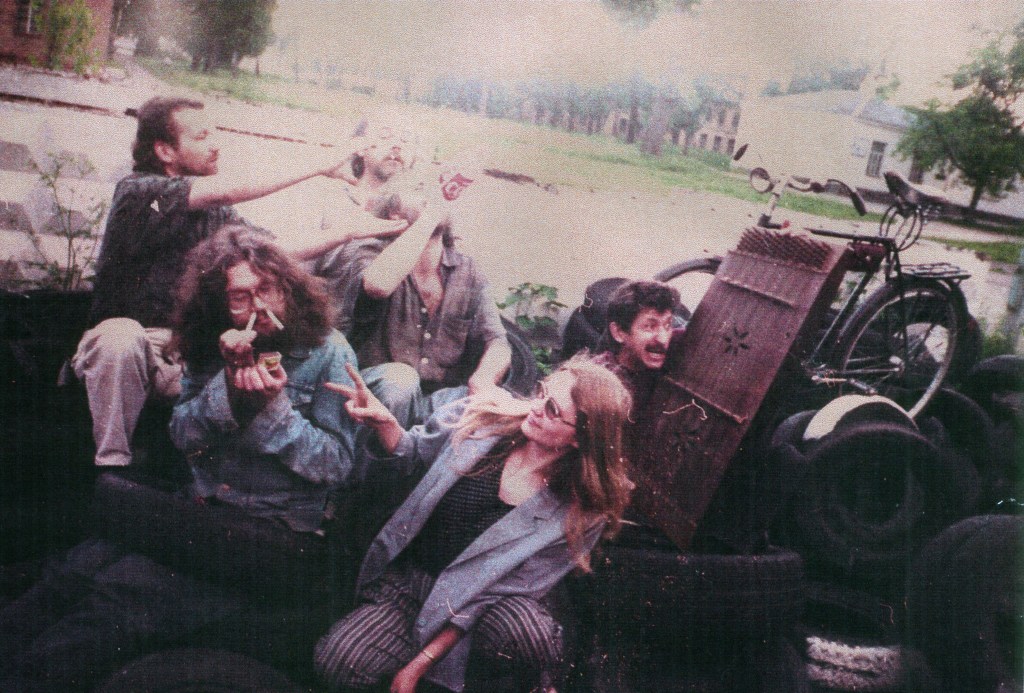
From left: Vaclovas Nevčesauskas, Artūras Barysas, Artūras Šlipavičius,
Rimas Šlipavičius, Ara Šlipavičienė and Gedas Simniškis, circa 1990s

Baras: Contemporary Lithuanian Composers Scores To Artūras Barysas Short Films 1972–1982 was released on Zona Records in April 2022, and features 15 tracks from contributors such as Gintas K, McKaras and Arturas Bumšteinas. Many of the compositions feature ambient soundscapes, drones and field recordings. For example, Bumšteinas, who soundtracked Romas, Renata, Rimas (1977), blended the sounds of cicadas with organ drones and shortwave radio broadcasts. Coupled with saturated visuals of three friends swimming in a river and picking flowers in the nude, the result is a carefree impression of summer. Haruspic also contributed music for Tas Saldus Žodis (That Sweet Word, 1977) and Intelektuali Popietė (An Intellectual Afternoon, 1982), which can be viewed, along with the other restored films, on the website of the Lithuanian public broadcaster LRT. Towards the end of my visit, I’m invited to preview Balti Sparnai/ White Wings, Haruspic’s first album in two decades. Labutis’s studio is located on an industrial estate in the Žirmūnai district, on the north bank of the Neris. Erected in the Soviet era, the buildings in this complex all contain underground bomb shelters, later converted for alternative use. Labutis’s basement bunker, which he has occupied for 16 years, is filled with various instruments, electronic equipment, cables and computer monitors. The walls and ceilings are covered with carpet tiles to dampen the sound. Šlipas drives me here, and after shutting off the outside world with a steel blast door we listen to some key tracks together.

This record is very different from their earlier albums Haruspicija and Lethe. Whereas before Haruspic leaned heavily on free jazz and folk, this time musique concrète, samples and electronics all make an appearance. On “Menui Menas/Art For Art’s Sake”, Bluvšteinas recites a tautological manifesto inspired by the Italian Futurists. His voice is transformed with a vocoder, perhaps a nod to David Lynch’s “Strange And Unproductive Thinking”, before being chopped, repitched and pelted with disorientating dubstep bass drops.

Elsewhere more traditional rock structures emerge, as on “Manjana/Mañana”, but Haruspic subvert old tropes with nonsensical ironic humour. Labutis cites Russian musician Sergey Kuryokhin as an influence, recalling one concert in which a horse was brought onstage. It defecated next to the string quartet and was led off again. Kuryokhin’s infamous televised hoax Ленин — гриб (Lenin Was A Mushroom, 1991) also impacted this project. In the 60 minute interview, the po-faced composer reasoned, with reference to ‘evidence’, that the Bolshevik revolutionary and founder of the Soviet Union was in fact a mushroom. I ask about the change in direction. “It’s radical and we’re conscious that it’s different,” admits Labutis. “It’s not that it wasn’t working before, it’s just that a lot of time has passed since our early recordings.”

The worlds of Haruspic and Ir Visa Tai Kas Yra Gražu Yra Gražu have cross-pollinated over the years, the projects imbuing each other with avant garde ideas or more straightforward rock freakouts. In many ways, Šlipas is a modernist, but uses postmodernist techniques to achieve his aims. “It’s no coincidence we are named Haruspic,” concludes Labutis. “Because divination is what we do. We never give an answer, only provide associations. We know nothing ourselves.” ● The self-titled compilation Ir Visa Tai Kas Yra Gražu Yra Gražu will be released by Strut Records in May 2025

Ilia Rogatchevski
Originally published by The Wire, October 2024

comments 2

Viktar Siamaška

Working from exile in Poland, the Belarusian musician, poet and broadcaster keeps his home country’s avant garde flame alive. Photo by Jury Siemianuk.

Pramzona #7, the latest release in Viktar Siamaška’s arsenal of archival recordings, opens with a percussive conversation between found objects. The low rumble of what sounds like a plastic pipe flutters loosely as wooden sticks brush across metal railings and glass debris sweeps the floor. Prefiguring Siamaška’s brooding clarinet, a distant cuckoo contributes to the industrial clamour. Recorded in 2018 at the cultural complex Dalina Aniołaŭ (the Valley of Angels) in Mazyr, Belarus, it investigates the inert acoustics of abandoned spaces by activating them through improvised performance – just like the other albums in the Pramzona series.

“I’ve always wanted to go beyond the domestic recording process to environments with vast natural acoustics such as hills and forests,” reveals Siamaška. “Deserted industrial buildings became the best places for creative encounters. In light of recent events [the 2020-21 Belarusian anti-government protests], it became a bitter metaphor for my homeland. These buildings are scattered across the country, and the word pramzona (industrial zone) is used to refer to places where thousands of Belarusian political prisoners are currently being made to work.”

Born in Minsk in 1980, one of his earliest memories is Soviet leader Leonid Brezhnev’s state funeral on TV. “The music had to conform to the moment,” he recalls. “My artist father was worried that after the General Secretary’s death something bad would follow. He was right. The USSR, of which Belarus was then part, began the ‘tightening of the screws’ [political and cultural repression] which lasted until Perestroika.”

Within this context Siamaška first began improvising at home on the family piano. “It came naturally to me. I liked making sounds, observing them and proposing what should come next. In that sense, my childhood experiments haven’t changed: improvisation, for me, is music in its totality.”

In the 1990s, Siamaška’s attention turned to early Pink Floyd, Russian composer Alfred Schnittke and the “self-analytical” free jazz of The Ganelin Trio. Late-Soviet avant garde innovators like trumpeter Vyacheslav Guyvoronsky, cellist Vlad Makarov and composer Sergey Kuryokhin were also influential, along with concerts by Knyaz Myshkin. “They were a Minsk based improv group that played with a new line-up every time and had an open mic in case anyone from the audience wanted to join in,” Siamaška remembers. “I often played in a duo with the band leader Leonid Narushevich, which was a colossal experience. The gigs varied qualitatively and some ended with women asking for autographs. Others with bandits threatening violence.”

After cutting his teeth with Knyaz Myshkin, music-poetry duo Kuzniec & Siamania and psychedelic folk outfit Nagual, Siamaška formed Fantastyčnyja Płyŭcy (Fantastic Swimmers) in the mid-2000s. Initially, their idea was to anchor the music around the piano. As members joined and fell away, the project pitched horns against reeds (Chronograph, 2010), reshaped the blues (Duplet, 2011) and deconstructed Pink Floyd’s “Interstellar Overdrive” (2015). “It was important to have different musicians for different sessions,” says Siamaška. “This expanded our network of like-minded people, formulating a separate section of pianists, the Kum-Kuma choir, as well as musicians based in Minsk and Warsaw, who have now consolidated after the mass emigration from Belarus.”

Their early recordings often documented performances at various art centres around Belarus, but in recent years Fantastic Swimmers have increasingly spent more time in the studio. Bonaventura (2022), for example, was recorded at Warsaw’s Quality Studio. Gosia Zagajewska’s haunting vocals ride atop a life raft hurriedly constructed by Alaksiej Varsoba’s accordion and Vital Appow’s bassoon. Piotr Dąbrowski’s cascading snares lap at the sides, while Siamaška’s frenetic piano threatens to puncture the hull.

Also a poet, Siamaška published five books of verse between 2010–23. His project Viktar Siamaška Dy Kumpanija developed from solo concerts that incorporated psychedelic effects into his poetry readings, although recordings such as Duxo (2023) prioritise sonics over semantics. “In my opinion, there are two forms of art – musical and graphic,” Siamaška reflects. “The former is realised in time, the latter in space. Poetry and music are both time-based media, it’s just that music operates with abstract sounds while poetry is affirmed by linguistic meaning.”

His parallel career as a broadcast journalist provided Siamaška with an opportunity to research music stemming from Belarus. Local scenes blossomed before many people were forced into exile in 2020 (Siamaška himself is now based in Poland). His first show Terra Nova showcased new emerging sounds while his current programme Krakatuk – broadcasting on Białystok based Radio Racyja – dives into the archives exploring Belarusian jazz and avant garde music from the 20th century, among other eras and genres.

Siamaška has produced over 500 episodes and considers the programme his contribution to restoring Belarusians’ cultural DNA. “Right now, inside Belarus, everyone is risking their freedom while the diaspora comes to terms with integration. But all this will lead to the second stage of the revolution when the exiles return and there will be extensive synergy. I estimate this will happen within the decade.” ● Viktar Siamaška’s Pramzona #7 is released via Bandcamp. His Krakatuk archive and links to his other projects can be found at mixcloud.com/vvsiamashka

Ilia Rogatchevski
Originally published by The Wire, September 2024

comment 0

Signal To Noise Ratio: Simon Fisher Turner Interviewed

Ilia Rogatchevski speaks to the child star turned artist, musician and composer about his excellent new album Instability Of The Signal and his many collaborations with Derek Jarman. Portraits by Marta Ruly

On a torrid June morning, I’m invited to speak with Simon Fisher Turner at the Mute offices in South East London. The interview takes place in a converted loft that was once Daniel Miller’s residence but is now home to his label. Framed commemorative discs of Moby’s Play lean against the corridor walls, their former glory partially obstructed by a row of hanging coats. Turner is already here, setting up his red Edirol recorder on the balcony to capture trains screeching on the railway bridge below. “I collect sounds,” Turner tells me as we sit down in a large room filled with records, books and synthesisers. “But I don’t think of myself as a sound library. It’s a discipline where I must do something. That’s why I’ve stuck the microphone out the back there.”

Instability Of The Signal, his latest album for Mute, is a multifaceted record that incorporates many such field recordings alongside synthetic “slivers”, surreptitious strings, snatches of piano, the occasional detuned guitar and the composer’s own voice. The seeds germinated during Covid, when Turner came across some brooding noise experiments by David Padbury, who records as Salford Electronics. “I heard a piece by David and really liked it,” Turner recalls. “I sent him an email and suggested this idea of slivers of sounds. It’s something I’ve been after for ages. The older I got the less I played instruments, working with either my recordings or other people’s recordings. I asked David for these slivers, tiny bits of stuff, and started to make a piece out of the bits he sent me.”

Working at night, due to the compressed lifestyle that the pandemic impressed upon his household, Turner shaped Padbury’s foraged sounds and samples into blueprints for new compositions. Over thirty recordings, each one clocking in at around a minute in length, were manipulated into new structures, but only five made the cut. The lead single ‘Barefeet’ is a good example of this process. A looping phrase, something akin to a repitched elevator ping, holds court to deep pulses, sparse guitar and intrusions of electronic noise. You can also hear unmanipulated sounds of buzzing insects and dice thrown across the floor. In the music video, which is largely composed from still photographs taken by the filmmaker Sebastian Sharples, we see snapshots from everyday life: a desolate Soho street during lockdown, barren tree branches in winter, a car boot filled with trainers. These images document fleeting quotidian moments and echo Turner’s own enthusiasm for collecting “life recordings”, as he calls them.

Tying all these sounds together is Turner himself who sings spontaneously constructed poems. “At the end of Covid, I called up Daniel and told him about the slivers and that I’d love to sing. He said that the Mute studio is closing down but Francine Perry is finishing up there and we could record with them for a few days.” Perry is an award-winning producer who is one half of the minimal techno duo ORKA and also releases experimental electronica as La Leif. “Francine works really fast and I work really fast,” says Turner. “We were just naturally riffing. The vocals were made up on the spot, William Burroughs cut-up stylee. Just using this book [Taking On A Name: Videotapes 1986-94] about Breda Beban and Hrvoje Horvatic, and two poems by Harold Pinter, ‘Democracy’ and ‘The Special Relationship’. They’re war poems. I think they were just one take and that’s it.” Both texts reference the 2003 invasion of Iraq but the latter poem (“The bombs go off / The legs go off / The heads go off”) feels especially chilling when framed by Turner’s unsettling drones. The curt macabre imagery resonates with the interminable horrors unfolding in present day Gaza and Ukraine.

Beban and Horvatic were experimental filmmakers from war-torn Yugoslavia who settled in Britain in the 1990s. Using the aforementioned monograph (printed for the occasion of their 1994 retrospective at the Whitechapel Gallery) as source material for his lyrics was Turner’s way of paying homage to them. “They were video artists, filmmakers and friends of ours who both died [Horvatic in 1997, Beban in 2012]. It was just tragic. They were very, very influential and sort of a continuation of, for me, artists like Derek Jarman, who were just doing their own thing, and were really kind and generous.” Flipping through the book, Turner would arrive at a phrase or sentence that possessed some kind of magnetism and truncate it, divorcing it from its original context. For example, in the song ‘She Lowers Her Arms’ the original sentence reads “She lowers her arms and turns to walk slowly out of the frame”. Turner elaborates: “I was seeing that as a line. We’d track it and then go to the next line. I’m a big fan of William Burroughs’s cut-ups, through liking David Bowie, you know, from 40 or 50 years ago, whenever it was. It just made sense.”

Memories from this time surface on the track ‘Toast’, a song that evokes Turner’s childhood growing up in London. “I’ll get my own toast and read a comic / I like the war ones / I love my comics”, Turner reminisces in the song’s opening seconds. He sings about the joy of riding an old Routemaster bus, discovering the city by bicycle and living on his own as “a little thief”. The final refrain “my time in my time / my time in my mind”, which bounces up against a steady bass loop and scrawny guitars, is evidence of his nostalgia. Turner was a child actor before embarking on a career as a “non-popstar”, starring in Tom Brown’s Schooldays and The Intruder, among other TV series. Income from acting afforded the freedom to see bands regularly. “I saw The Spiders From Mars at Slough Technical College – that was life changing. All the universities used to put on gigs. There was the Marquee, the Lyceum, the Roundhouse. I saw everybody in the 70s. Once I discovered gigs, I was in heaven, really.”

While still a teenager, Turner signed to Jonathan King’s UK Records, releasing Simon Turner in 1973. His debut album is full of tepid covers but included a version of Bowie’s ‘The Prettiest Star’ which pulled Turner into the orbit around David and his then wife Angie. Turner spent time with the couple in Switzerland and looked after their apartment in New York. “I was friends with Angie and she was brilliant. She was a super strong woman and not given enough credit for supporting Mr. Jones. We had a great time and I ended up in very strange situations because of that. It was all part of MainMan, Tony Defries’s management company, who looked after Iggy Pop and Lou Reed. It was all very mad, but I learned that you have to fight for what you want.” Despite having rubbed shoulders with rock giants as a young adult, Turner’s time in the spotlight was brief. “I was in lots of magazines, but I wasn’t a popstar. And thank goodness. If I had been wildly successful, I wouldn’t be alive. I would have succumbed to everything. I had no control.” 

In the early 1980s, when working for Cherry Red Records, Turner joined Matt Johnson and Colin Lloyd-Tucker in an early lineup of The The. Over the course of a single summer, the three-piece played swathes of support gigs on the London club circuit. “We all got our skinhead cuts, wore sweaters and jeans and carried our guitars in black plastic bags,” Turner remembers. “Just three of us playing Matt’s songs, one of Colin’s, one of mine. We didn’t have any drums so we were a good support band because we could just turn up and play.” Becoming increasingly more interested in “music [that] seemed light and touched our feminine side”, Turner and Lloyd-Tucker later splintered off to form the fictional French female duo Deux Filles, which blended ambient soundscapes with a post punk sensibility.

His other musical exploits included gallantly masquerading as The King of Luxembourg, performing baroque revisions of pop songs alongside his own opulent originals. “The first record [Royal Bastard, 1987] was a covers record. Mike Alway from Él chose all the songs. Then on the second record [“Sir”, 1988], I decided to write my own. As soon as you start to put words to music, then it has to be heartfelt and proper. If it’s insincere, lyrically, then it doesn’t make any sense to me. I can’t sing ‘Hey, baby, I love you’ unless I really mean it.” Turner also branched out into film scores around this time, working closely with Derek Jarman on projects including Caravaggio (1986), Edward II (1991) and Blue (1993). This led to more commercial work, such as the David Lynch-produced vampire flick Nadja (1994), and soundtracks for restored versions of The Great White Silence and The Epic of Everest (for which Turner received an Ivor Novello Award). Both films were originally completed in 1924 and depict two respectively tragic expeditions to the far corners of the planet: Captain Scott’s attempt to reach the south pole, and George Mallory and Andrew Irvine’s fatal effort to scale the summit of Mount Everest. 

Over the years, Turner has been increasingly interested in experimenting with variations on texture, sound collage and noise. Soundescapes, his 2011 collaboration with the Norwegian filmmaker Espen J. Jörgensen foregrounds the fragmentation of samples in a similar vein to David Padbury’s slivers, while A Quiet Corner In Time from 2020 positions recordings of Edmund de Waal’s spinning ceramics as “sound solos” against alkaline washes of ambient drone. Meanwhile, his two albums for Editions Mego, Giraffe and Care (the latter being made in collaboration with Klara Lewis), released in 2017 and 2018 respectively, both experimented with harder edged industrial structures.

Despite his impressive résumé, Turner insists that his career was entirely accidental. “I went to ballet school. They had an agent so I started doing radio work and TV. I became an actor by accident, a bit like becoming a musician by accident. It was a period of time where you seemed to have accidents, which would lead to something else. It sums up my approach, without really even thinking about it.” One such accident was a chance encounter with the producer Guy Ford that led to Turner working with Jarman. “I was sitting on the street and Ford, who worked on Sebastiane (1976) and Jubilee (1978), came up and said: ‘I interviewed you when you were 16 years old. You were really obnoxious! Do you want a job?’ And suddenly I was working on The Tempest (1979). I drove the catering van and helped Heathcote Williams and Toyah Willcox test their lines. We were filming outside London and I just got involved.”

Because the shoot took place over several months at a remote location, Turner brought with him a keyboard and a Revox reel to reel recorder, contributing to concerts and happenings on the set during his downtime. This caught Jarman’s attention. He hired Turner to compose soundtracks for a string of Super 8 films and the historical feature Caravaggio. Their working partnership continued into the 90s, culminating in Jarman’s final film Blue. The famously emotive work chronicles the director’s experience of AIDS, and the partial blindness it inflicted on him, along with diaristic impressions of everyday life contrasted with dreamlike sequences. Consisting of a single shot of International Klein Blue, the work is held together by the strength of the narration and sound design. “Derek’s role in my life was like a teacher without teaching,” Turner says. “He’s constantly on my mind. He was wise and curious, instilling in me a sort of bravery. He used to talk about things I’d never heard of: Yves Klein, Caravaggio. I had no idea who these people were. He was capable of so much and made incredible images. He could do a narrative film like Edward II and then do The Last of England (1987) or The Garden (1990), which don’t have a normal structure. And then you have Blue, which is not so much a story, but observations about life and death and love in this frame, this void, of Yves Klein Blue: nothing and everything.”

After completing the voiceovers, Jarman tasked Turner with filling in the silences. Brian Eno lent them his house to record in and the producer Markus Dravs engineered the sessions. “The whole experience was mind blowing. The fact that it ended up as a film, this crazy idea, and all these people involved like Vini Reilly [The Durutti Column], is incredible. We had to structure it around the dialogue, so we were making it up as we went along.” Since its premiere in 1993, and Jarman’s death from an AIDS-related illness several months later, Blue has continued to evolve. Turner admits that the film is impossible to recreate live, which is why performances of the score tend to stretch Jarman’s original framing by experimenting with the setting, language, narrators, and duration. Last year’s Blue Now – directed by Neil Bartlett – restaged the project in venues like the Tate Modern and featured Russell Tovey, Travis Alabanza, Jay Bernard and Joelle Taylor as the narrators, consciously contrasting with, in Turner’s words, the “very English, white middle class actors” from the original film. 

Turner considers Blue to be a seminal work, “as important as ‘Mona Lisa’”, and is visibly enlivened when talking about it. “Doing Blue live is great because it’s a different kettle of fish, much more fluent. For instance, I did it a few weeks ago in Italy, with only two performers, all in Italian. I had a piano and a computer. It was very focused. The concerts now illustrate the words far better than they do in the film. It’s just a fantastic opportunity [to experiment and improvise] because the words are there, the blue is there, and all we have to do is start. It’s really sexy and dangerous, a great palette to work against.” He explains that the project will resurface in the winter with more performances, this time featuring the cellist Lucy Railton and a looser sonic framework. Turner wants the music to avoid the trappings of illustrative sound effects, preferring it instead to be “like a mattress” that the actors can “jump on top of”. 

Jarman’s legacy can be felt on Instability Of The Signal, too. Some of the sounds that made it to the album, albeit in different mixes, were first recorded for a documentary produced by The Derek Jarman Lab, a research media hub based at Birkbeck, University Of London. Directed by Tilda Swinton and Bartek Dziadosz, The Hexagonal Hive and a Mouse In A Maze (2024) is an essay film about how education is experienced across the world. “It’s a story of life – how every culture thinks about learning in different ways. For instance, there’s no point being in a village in Nigeria and learning about computer sciences if you haven’t got electricity. The more we looked into making a film about learning the more complicated it became, because it’s a big world and everybody has different ideas.” On the album, Turner’s textures, cut-ups and slivers are bridged with instrumentals performed by the contemporary classical Elysium Collective. These sessions were initially recorded for an exhibition of Jarman’s Super 8 portraits held at the LUMA Arles, France (2021-22). Later finding their way to the record, tracks like ‘Turning Slowly’ and ‘Purr’ inject a sense of drama to the proceedings. The strings cut across Turner’s drones like sirens through fog, while the prepared piano and closely miked whispers on ‘I Can’t Hear Anything’ fill the air with paranoid trepidation.

Never straying too far from moving image, Turner continues to collaborate with filmmakers. The deceptive simplicity of Chris Newby’s juxtapositions seamlessly complement the cold tranquillity of ‘Bless Your Hands (Part 1 And 2)’. Waves lap against the walls of a church, while children walk along its snow capped roof, recalling the frozen stillness in The Hunters In The Snow (1565) by Pieter Bruegel the Elder. The Japanese filmmaker Isao Yamada also contributed a Super 8 video for ‘Turning Slowly’. Edited from a much longer film inspired by Instability Of The Signal, it features shaky street scenes exposed onto expired film stock. The images are awash with a fading blue tint reminiscent of indeterminate memories left out in the sun. 

Yamada features on the album’s cover, listening to the record for the first time, seemingly enraptured by the experience. At one point, another photo was considered for the cover, taken by Andy Warhol, of a young Turner partying with Fran Lebowitz on top of the World Trade Center. Why was that photo not used? “The Warhol thing would have been great. It was 48 years ago – a party for Dolly Parton – the contact sheets are all online. I went with Danny Fields, who managed the Stooges, Iggy, and the Ramones. I called Danny, who hadn’t spoken to me for years, and we went down this chain of trying to get permission, but they [The Andy Warhol Foundation] asked for a lot of money, £5,000 pounds or whatever. It was ridiculous.”

As we wrap up, Turner wonders if the SD card in his recorder maxed out. I take the opportunity to ask him about the ethics of collecting sound. Has he ever felt like he’s eavesdropping or using something he shouldn’t? “There was a Mute concert at the Roundhouse [in 2011] and I had been recording stuff from YouTube of the war in Syria. I saw this terrifying footage of a young couple who were on the roof of their house with tanks in the square below them. All you heard were these engines, the most horrific sounds. I played it with Mira Calix and Laura Moody and it was really, really disturbing because nobody would have known what it was but they would have felt that it was heavy. It was as political as I’ve ever been. I’m actually not interested in that kind of intensity but with this [points to a copy of the new album], with ‘Democracy’, I can say it with Pinter’s words. That’s as far as I can go.”

Simon Fisher Turner’s Instability Of The Signal is released via Mute on 2 August

comment 0

Occupy Pop! Your Guide To Revolution by Mary Ocher

Berliner takes radical politics and 12th-century Persian poetry and sets them to an infectious disco beat, finds Ilia Rogatchevski

Mary Ocher reclines on a rubber dinghy that is perilously adrift at sea. Her voice lifts above the waters as a shuffling backbeat dominates the track. We see several characters inhabiting an island made of trash. They’re absorbed in their phones, seemingly unaware of their dire surroundings, watching Ocher signalling for help on their screens. As the synths and drums (performed by Mats Folkesson and Theo Taylor of Ocher’s backing band Your Government) lock into a propulsive groove, and the sea burns around her, Ocher urges the listener to “sympathize with us, because our corpses are nice”.

This is the video for ‘Sympathize’, the lead single from Ocher’s seventh album Your Guide To Revolution. Like most of her work, Your Guide… is a political record and follows the thread first initiated by The West Against The People (2017), which analysed the changing identity of the West. Your Guide… is more didactic in its approach. ‘Sympathize’ in particular speaks of the cynicism intrinsic to politics and the injustice it engenders. The symbolism in the video and lyrics not only point to those who manipulate public opinion about refugees but also acknowledges our complicity in the crisis through our inaction. As much of Europe shifts to the right and culture wars dominate political discourse, ‘Sympathize’ – somewhat perversely – captures the zeitgeist with an infectious disco beat.

As an artist, Ocher’s political perspective leans radically leftward. Her tendency to question authority, nationalism, capitalism, and religious dominance can be traced to her early life growing up in Israel as a Moscow-born émigré of Jewish-Ukrainian descent. Her experience of xenophobia and nationalism in the Israeli school system is recounted in her autobiographical comic MOOP! and mirrored in the album’s penultimate track ‘Museum Of Childhood Terror’. Possibly channelling a prison guard with her vocal performance, Ocher describes an exhibition of distressing things experienced in childhood including the “terrible fear of not belonging here” and the “horrible fright of others in sight”.

Rejecting this environment led Ocher to resettle in Berlin in 2007. At the time, the city was cheap, particularly if you lived communally, and these circumstances allowed her to focus on making a living exclusively from music. It’s a seemingly impossible proposition today, and yet Your Guide… comes packaged with an essay explaining how to do just this. In A Guide to Radical Living, Ocher draws from her experience of “living comfortably with just enough” and suggests ways of “resisting the rules by finding ways of survival that are not presented to us as options”, like making the most of grant money or refusing to buy things on credit. The revolution that Ocher proposes is not a militaristic coup but instead a form of cultural reconditioning that prompts us to reassess the roles we play within the capitalist framework.

Two of the album’s etudes flirt with humour. ‘Digital Molam’ distorts the essence of Thai folk with a kaleidoscopic prism that could have been designed by Kieran Hebden of Four Tet. ‘Autotune’, on the other hand, recalls recent debates about AI by suggesting that your life could be improved by tuning it artificially. Significant sections of the album are energetic instrumentals. The bass thumps and teasing melody on ‘Earthmother’, for example, could easily score a Soviet cartoon, while in the short and sweet ‘Swedish Samoa’ Ocher seasons the prevalent Cumbia rhythms with her cascading saturated synth. In the song’s accompanying video, directed by the digital artist Stacie Ant, we see the band, dressed in sparkling swimsuits, jiving in a hyperpop jungle that teems with unicorn skeletons and luminescent tentacles.

There are several collaborations, too. ‘I Am The Occupation’, which features Serafina Steer’s hallucinatory harp playing, evokes the spirit of The Raincoats with its elastic riff. The track invites us to dance and “sing along on a hell-bound ride” as the narrator admits that she “gamble[s] with lives”. ‘When God Held My Hand’, written and performed with the Irish musician Nina Hynes, features nebulous voices guided by percussive strings that blanket the composition in an eerie mist. Elsewhere, Yukari Aotani and Anselmo Holm’s violins on the album’s final track ‘For All We Know (The World May End Tomorrow)’ underpin Ocher’s sorrowful piano. Subtle at first, the strings swell in the middle section as Ocher mourns humanity’s unwillingness to step away from the precipice of its own making.

The album peaks with ‘The Rubaiyat Medley’. This suite of three tracks reimagines Dorothy Ashby’s late 1960s compositions inspired by the 12th century Persian poet Omar Khayyam. The Rubaiyat of Dorothy Ashby is an excellent example of spiritual mind-expanding jazz and even demonstrates Ashby’s command of the koto. Ocher’s take is psychedelic too but plays down the content of Khayyam’s text by masking the words with a vocoder. Part I transcends the smoky backrooms of its beginnings with a funky bassline and hot snares that bring to mind the Anatolian grooves of bands like Tel Aviv’s Şatellites. Meanwhile, Parts II & III prime the room for a good time with the slow and seductive interplay of bass, synth and percussion that recall Patrick Cowley’s pioneering sleazy electronica. Following through with the retro vibes is the suite’s highly stylised music video. Directed by Ocher, it channels Sergei Parajanov’s poetic masterwork The Color of Pomegranates (1969), but distils the ambitions of the original down to a modest DIY scale.

The origins of the album go back to 2019 when Ocher toured the US with Your Government. Much of the material was written on the road as the band navigated bemused audiences, unreliable vehicles and toy drum kits. The bulk of the recording took place later that year with the microtonal tuba player and sound artist Peder Simonsen at Palazzo Stabile, in Italy, and mixed in the UK by Mike Lindsay of Tunng. Momentum slowed down due to the pandemic, but the resulting body of work was eventually spread across two sister albums: last year’s pensive Approaching Singularity: Music for The End of Time and Your Guide to Revolution. Both records swing but whereas the former is laced with an insular melancholy, the latter looks outward and is often uplifting in spite of the loaded subject matter.

Ilia Rogatchveski
Originally published by The Quietus, June 2024

comment 0

KMRU: Different Every Time

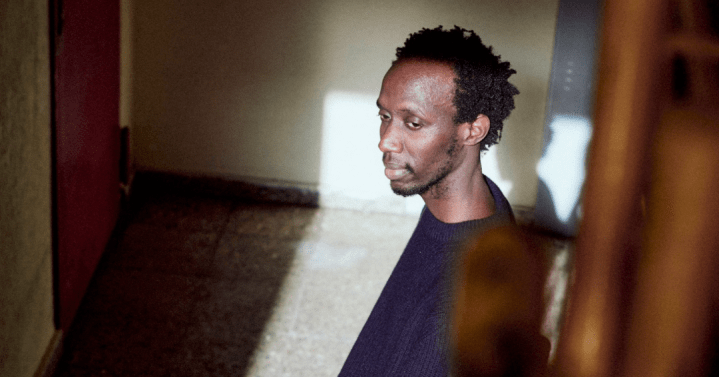
The Kenyan born producer and artist finds a sense of place via field recordings, music and installations, giving voice to ethnographic sounds and archived objects By Ilia Rogatchevski Photography by Laura Schaeffer

Listening to Disconnect, KMRU’s collaborative album with Kevin Martin, fills your gut with contradictory feelings of dread and elation. “Lately, I’ve been thinking about sound on a very physical level,” Joseph Kamaru, the Berlin based producer who releases under the KMRU alias, explains over video call. “I know most of The Bug stuff, and really enjoyed his Pressure album. With Kevin’s work, it’s interesting how he can push style and alter bass frequencies to extremes. I think that’s how we connected.”

The whispering drones on “Differences” evolve gradually out of silence, swirling around Kamaru’s wordless intonations, as steady percussive pulses carry the composition forward. Intense trepidation swells like the oncoming wave of an ecstasy high while his voice, softly spoken but authoritative, recites a monologue about “understanding the Other”. The text in “Arkives” discusses African traditions and artefacts within the context of colonial violence. The words are set against monochromatic chords and despondent chanting that suggest an imminent dystopian collapse.

“Differences” and “Arkives” are the core of the record and, in true dub fashion, the tracks that follow strip away certain elements while contributing new ones: the subtle bass drum and shuffling snare brush on “Difference”, for example, or the repeating minimal synths on “Differ”. Even the track titles resemble fading echoes by truncating the original text as you progress through the album.

Kamaru’s alliance with KRM is far from the only collaboration he has undertaken. Limen, his 2022 release with the French sound artist Niamké Désiré aka Aho Ssan, was described by Vanessa Ague in The Wire 460 as “a means to harness destruction and build something anew”. The album’s key track “Resurgence” was a Berlin Atonal commission. Paired with visuals of volcanic activity, its layers of digital noise and ceaseless crescendos share the density of a neutron star. The rest of the album is no less extreme. Despite the apocalyptic mood of the music, the collaboration itself came easy. “Limen was very spontaneous,” Kamaru says. “We had this one track and were like, let’s explore something together. Similar to Kevin’s collaboration, it was also online, but with Désiré it was so seamless, cohesive.” The two albums share a curiosity for the darker sides of the human condition – Limen is partly inspired by Katsuhiro Otomo’s cyberpunk manga Akira as well as the mythical phoenix bird – but whereas Disconnect concerns itself with solitude and soul searching, Limen is focused solely on cathartic intensity.

Martin – credited here under his initials KRM – first became aware of his collaborator’s work after watching Coco Em’s short documentary Under The Bridge (2020). The film opens with Kamaru collecting stones and throwing them against the concrete walls of a roadbridge, with recorder in hand. He uses their skittering as the starting point of a new track. The recordings are looped or augmented; drones are layered on top of each other with a tone generator. The process is broken down as if in a YouTube tutorial. He speaks directly to camera and shares screen recordings of his Ableton session, demystifying his methods.

So KRM contacted KMRU on social media, and at first the musicians shared music with each other, leading to a collaboration in 2021. “He reached out about making an album together based on my voice,” says Kamaru. “We shared sketches, although both of us were busy touring, and it wasn’t until late last year when we decided to finish the tracks. The timing was sort of interesting, because I was writing this paper in school [Universität der Künste, Berlin]. It was presented as an audio paper and I was like, maybe I can explore this voice in conjunction with the theme of the project, this idea of being removed or distant.”

Kamaru’s paper looked at Audre Lorde’s ideas about differences and how they should be harnessed to spark creativity within culture rather than be perceived as a threat to it. “She was writing about otherness and disagreement,” he says. “Like this friction happening; being in a place and trying to orient yourself in a world that’s dissolving, but still trying to push forward. The tracks evolved to carry the weight of how we were thinking about being in this dystopian situation alone. It’s dark, in a very beautiful way, with the simple, heavy, repetitive motifs led by the voice. There’s this hope”.

Kamaru’s A|||oy project with the Welsh vocalist and producer Freya Edmondes aka Elvin Brandhi explores similar themes but from an improv angle. “Most of [my collaborations] have been online, but this one with Freya is very different because it’s live improvisation. We performed at Atonal last year and she was the only one that I could do a big show with, only having three weeks to prepare.” In what way is improvising different from producing in the studio? “For improvising, it’s like this headspace that I have. So bringing instruments that I know are very reactional; field recordings; extreme processing with pedals. The last improv show with Freya was the first one I used my voice live.”

Elvin Brandhi performs with a microphone and a Roland SP-404 sampler. Kamaru was impressed by how extreme and layered her music could be from such a minimal set-up. It inspired him to lean away from established ways of working to a more spontaneous, non-linear approach. In his solo work, Kamaru is best known for the explorative ambient compositions that have roots in his home city of Nairobi. He grew up in Kariokor, a bustling neighbourhood with high levels of traffic and street noise. “I became more aware of sound growing up with public transport in Kenya. I liked the boomier, fancier sound systems in the matatus [public buses]. The louder the sound, the more I enjoyed it. As kids we used to watch for the boomiest one to come. Thinking back now it’s like, wow, I enjoyed loud music. It was mostly hiphop and rap.”

A young Kamaru played Lil Wayne bangers on the home theatre system while his parents were out. “I was cranking it super loud, seeing how it encompassed the space. Having that knowledge about the force of sound and what you can do with it was amazing – that you can push sound to its extreme.” As a teenager, he moved with his family to the suburbs in Rongai which attuned his ear to a different soundscape. Suddenly he was surrounded by nature and birdsong, a novel quietude that contrasted with the familiar sounds of Nairobi.

He was named after his maternal grandfather Joseph Kamaru, a popular benga musician and political activist whose presence and hits such as “Celina” and “Thina Wa Kamaru” were everywhere. “My connection with him was becoming more apparent in school when I introduced myself as Kamaru,” he recalls. “My teachers would ask if I could sing too. Studying his legacy at university drew me closer to his music and activism, and we became closer when he realised I’ll carry the music torch.” The two had aspirations of working together, before the elder Kamaru passed away in 2018. “I felt a need to keep his music alive and started reissuing his work online. His spontaneity and realness is something I got from his music and him as a person. Being honest with oneself creatively is the advice I got from him, I must say.”

Music was part of the younger Kamaru’s daily encounters, from daily commutes on matatus to mangling tapes and dubbing radio onto cassettes. “I remember being involved in a choir, but it wasn’t until high school that I pursued this fully.” He undertook a music technology degree at Kenyatta University and his early work, like the psychedelic single “Laibon”, leaned towards progressive house. “That’s where I got myself into DAWs. I was initially producing a lot on FL Studio. The intention was to make beats and share them with friends. I got into Ableton later but had to learn it the hard way as I didn’t know anyone using the software. It prompted me to start hosting the Nairobi Ableton User Group – workshops for music makers.”

It was around this time that Kamaru began to critically engage with his surroundings. An extended train journey across Kenya for the East Africa Soul Train artist residency resulted in the EAST EP. Produced together with Manch!ld – whom Kamaru met on the train – the music fuses sun-soaked electric piano and delicate four to the floor beats with snatches of passengers’ conversations. “This was my first experience with so many creatives together from all disciplines working on stuff. The concept was great and afforded a collaborative atmosphere, meeting artists with whom I still work like Kampire and Hibotep.”

Incidental sounds from this journey, such as the mechanical rhythms on “African”, were captured on his MP3 player which had a sound recording function. “I was finding myself travelling a lot and having to listen in a specific way. You’re constantly listening, but you sort of bring it to the foreground, like this attunement or awareness. Through field recording you realise the different nuances of a particular sound and how you’re supposed to listen to them, or how you’re supposed to record them.” This experience opened up new possibilities of incorporating environmental sound and Kamaru began using field recordings as the baseline for his compositions. Chris Watson’s album El Tren Fantasma – a radiophonic journey across Mexico’s railways – served as a blueprint for this method, showing that field recordings can possess their own drama and musicality.

Purchasing a Zoom recorder changed Kamaru’s approach to listening. Its onboard microphones enhanced the details of his surroundings, but this wasn’t the only way he recorded sounds in the field. “I was trying to extend this idea of not only listening with the ear. Sketching was something I was trying to do. Not replicating the environment with an image but trying to frame it like the sketch is the ‘recording’ of the environment.” Photography also plays a vital role in his practice. Documents of daily life often end up as album artwork. Deadpan shots of street furniture and ordinary objects, such as the solitary climbing frame on the cover of Dissolution Grip, give his releases an uncanny edge. Studying at Universität der Künste inevitably changed Kamaru’s relationship to composition, listening and performance, not least because his tutors found it difficult to separate KMRU the artist from Kamaru the scholar. On a practical level, sound synthesis has become more prevalent in his recent output, namely on Limen and Dissolution Grip, where he’s actively pushing new boundaries. “I was thinking about field recordings as the basis of sound but using the waveforms as raw recordings, the extreme ends – just sine and saw waves – and trying to replicate field recordings on a synthetic level.” The technique of blurring waveforms to create a tapestry of sounds stemmed from experiences with improvisation and live performance as well as from collaborator Aho Ssan. “Désiré is an influence because he starts making music with just pure tones and then it becomes so abstracted. I’m sure he played a role in this when we were working on Limen ”.

The theoretical side of academia contributed to expanding the contextual dimension of Kamaru’s projects. While Limen presents a widescreen depiction of planetary devastation, his multifaceted project Temporary Stored, which won an honorary mention at the 2023 Prix Ars Electronica, explores archives and the Western representation of the Other. Presented as an album, installation and radiophonic piece, Temporary Stored compiles sounds from the Royal Museum for Central Africa in Tervuren, Belgium. Ambient drones spiral around ethnographic recordings of indigenous African voices from across the continent (songs, dances, mourning rituals), recorded between the 1950s and 80s, reconfiguring the way we think about recordings from the past.

“Temporary Stored took lots of back and forth with the museum to get the archive,” he explains. “There wasn’t much negotiation, but more institutional protocols of working with an archive: going through digital catalogues with little or no information of the recordings; not being able to hear the recordings until I compiled a list of metadata. The project took almost a year to realise and [for me to] decide to engage with the work.”

Reflecting on the extraction of cultural property in an article published by Urgent Pedagogies in March 2023, Kamaru notes that the representation of African artefacts, when viewed from a Eurocentric perspective, strips away their original purpose. In Africa, many of these “objects” are not considered to be objects at all, but rather historical carriers and spiritual beings that are passed down through generations. Their inaccessibility perpetuates the colonial pattern of discourse, and Temporary Stored is Kamaru’s attempt to repatriate these artefacts.

I ask if his approach is any different when working for installation, given his recent contribution to the immersive piece Oceanic Refractions. Presented by CTM and transmediale at Berlin’s Silent Green earlier this year, the piece features testimonies of Fijian, i-Kiribati and Papua New Guinean elders on kinship, self-determination and care in the context of climate change. “The aesthetic of my work always changes based on the project that I’m doing with other people. Oceanic Refractions was one of the only installations that I’ve done on a large scale. So many people were involved and I wasn’t just the sound guy making the sound piece but involved in the project from the ground.”

At the same time, Kamaru recognises the limitations of gallery based installations, particularly when it comes to accessibility. The work is presented in a single location and only for a specific amount of time. This is why a stereo mix for a multichannel piece, or a radiophonic version of Temporary Stored, for example, gives more people the opportunity to engage with the work. However, he also acknowledges the benefits of leaving things unsaid. “The last works I’ve been exploring are engaging with things happening outside of music. I still battle with contextualising things. Sometimes it doesn’t have to be knowable or tangible. I like leaving room for opaqueness and not having to explain everything”.

Even before moving to Berlin, Kamaru regularly performed at various events across the world such as Uganda’s Nyege Nyege Festival, an annual showcase of contemporary African music,

and Gamma Festival in St Petersburg. After largely self-releasing his work, like the plaintive piano-led Erased EP from 2019, the breakthrough came the following year. The global pandemic didn’t stop him putting out three albums in 2020: Opaquer on Dagoretti, Jar on Seil Records and Peel with Editions Mego. Out of the three, Peel is especially good at highlighting a talent for combining melodic passages and drawn out textural electronics with field recordings of activated objects. Comparisons have been drawn with Tim Hecker, who treads similar waters, but the compositions have a subtle eeriness that is largely absent from the work of the Canadian producer.

He planned to release the record himself, but pitched it to Mego after Aho Ssan passed on the late Peter Rehberg’s email address “I was excited but also had three other records [coming out] and was thinking maybe Peter would just want Peel to be on its own. He was easy going, like: ‘I don’t care. We can release this and you can release another album [with someone else]. It’s fine.’ Having that confidence and trust from him is something that I appreciated. Most of the labels I release with have a community of listeners. Sharing music doesn’t have to have all this external pressure that changes how you relate to the record.”

Continuing in the spirit of independence, he launched his own OFNOT imprint in 2023, with Dissolution Grip as its debut. “I’m still a huge fan of self-releasing,” he says. “This stems from when I was sharing music with my friends in Nairobi on SoundCloud. I appreciate this idea of autonomy, of just being free to experiment. Lately, I’ve been thinking that my grandfather was so prolific, putting out so many albums. I’m creating so much. The decision to start OFNOT was based on all the music that I had made at university – just so much material. Some of them are long [compositions] and others are experiments I’ve done, but I’ll also possibly release music by friends or other people”.

Moving to Berlin made Kamaru reassess his listening once more. Compared to Nairobi, the German capital is sonically calmer, the odd police siren excepted. Kamaru’s approach to field recording is broad. Rarely does he look for something specific but makes room for chance, play and experimentation. “When I’m in the field, I carry different microphones. I’ll bury a hydrophone in the ground to see what happens. Other times, it’s mostly playing things that make sounds and recording that. As a listener, it’s the idea of taking time to be with the sound until a point where the self and the thing being listened to become porous. It’s a bit abstract, but I’m finding myself in these thresholds.”

In July, he will be releasing Natur on Touch, his first record with the label. Natur consists of a single piece derived from Kamaru’s experiments with electromagnetic frequencies. Evoking the work of Christina Kubisch, the piece reflects on the voices hidden inside our urban infrastructure and electronic devices. Static noise gives way to unexpected harmonies, rattling bass and birdsong. “The whole album is based on this recording I did with an electromagnetic microphone. It’s an interesting project because I performed it live for two years,” he says. Kamaru met Touch’s Mike Harding when on tour with Fennesz in the US, back in 2022, but the process to get the composition ready for release took its time. I ask how it feels to arrive here, considering that pivotal train journey in Kenya and the influence of Chris Watson, as well as all the other artists who have contributed to the label’s legacy. “Touch is a ‘listening’ label….They took a whole year just listening to the record and I appreciate that. I feel like it’s the perfect place for this kind of work”.

● KRM & KMRU’s Disconnect is released by Phantom Limb; KMRU’s Natur is released by Touch

Ilia Rogatchevski
Originally published by The Wire, June 2024

comment 0

Unofficial Channels: A Moon Age Daydream

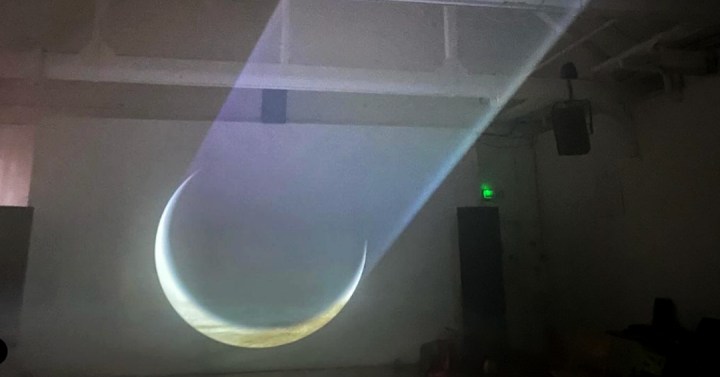
Image: ‘Darkside of the Cone‘ screened at IKLECTIK by Jason Brooks

As YouTube wormholes go, A Moon Age Daydream is possibly one of the more refined playlists on the platform. Curated by London artist and researcher Jason Brooks, the list charts the cultural connections between transportation, time and music from 1850 to the present. Scroll down its 500 plus tracks and you’ll find yourself stumbling across Captain Beefheart’s “Yellow Brick Road”, hitching a ride on John Coltrane’s “Blue Train” and flying high with Bridget St John. Less obvious examples include The Fall’s “Totally Wired”. Rather than physical transportation, the track explores the hyperactive change in perception experienced by someone on caffeine and uppers.

The project was inspired by David Bowie’s Ziggy-era, which mirrored the cultural obsession with propulsion and space travel prevalent at the time. The playlist formed in 2019 when Brooks was working for the UK’s Department of Transport. When it was marking the centenary of its formation, Brooks decided to investigate how much music had been influenced by various modes of transportation during its timespan. Soon after, the playlist expanded its scope, going further back to the beginnings of recorded sound and the development of combustion engines, before arriving at the cut off point of 1850 – the nascent days of the petroleum industry.

One surprise he came across in his research was the very first recording of Harry Dacre’s 1892 song “Daisy Bell”, about the then new bicycle craze. “The interesting aspect of this song was its reappearance as the first song made by a computer in the 1950s,” Brooks explains. “It was then famously used in 2001: A Space Odyssey as Hal the computer slowly dies.” The playlist’s sister Instagram account adds further context to tracks. For example, Tomorrow’s “My White Bicycle” is matched with the story of Amsterdam’s Witte Fietsenplan, Luud Schimmelpennink’s 1960s initiative concerning bike sharing.

The playlist took five years to complete and echoes the notion of evolutionary voyage suggested in Stanley Kubrick’s intergalactic odyssey by concluding with “The Big Ship” by Brian Eno. We are, after all, riding an enormous living vessel hurtling through time and space. “Rarely is the music about the mode itself,” Brooks reflects. “It’s a medium for a destination towards or away from the self, someplace, or someone.” ● youtube.com/@a.moonagedaydream

Ilia Rogatchevski
Originally published by The Wire, June 2024

comment 0

The breath is the body: an interview with Keeley Forsyth

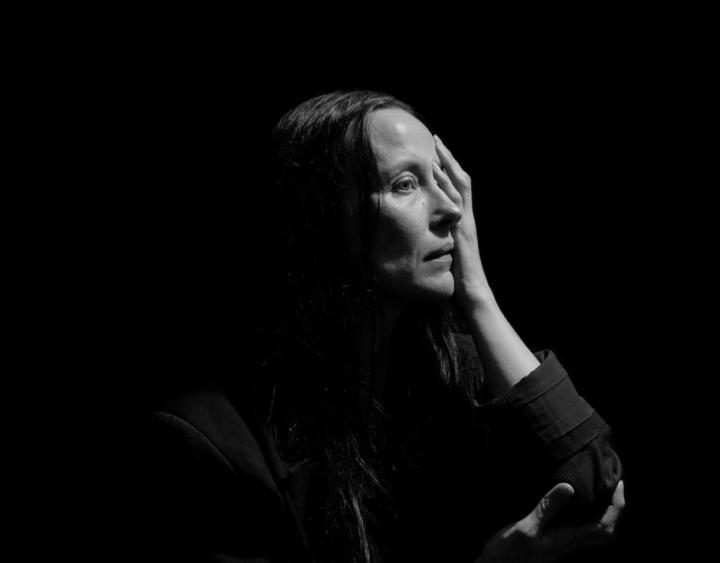
Ahead of a full performance of her new album The Hollow at London ICA, actor and artist Keeley Forsyth talks to Ilia Rogatchevski about Pina Bausch, Béla Tarr, genderless vocals, and perceiving the world as light and shade

Keeley Forsyth’s third album The Hollow explores the essence of solitude through a stark minimal framework. Composed with producer Ross Downes, the album takes its inspiration from an abandoned mineshaft in the North Yorkshire countryside near to where Forsyth is based. The small excavated room became a metaphor for how Forsyth saw her own voice – a resonating chamber channelling complex emotions – which is often compared to the likes of Scott Walker and Anohni.

Like its predecessor, Limbs (2022), the visual aesthetic of The Hollow is largely rooted in the landscape and mediated through monochromatic storytelling that echoes the work of the Hungarian film maker Béla Tarr. The album’s first single “Horse” reimagines Mihály Víg’s soundtrack for Tarr’s final film The Turin Horse (2011) with the music video picking up on the film’s themes of domestic duty, poverty and love.

Forsyth’s background in acting and dance informs her performative stage presence as well as the characters that inhabit her desolate musical world. Ahead of her concert at the ICA in London on 23 May, which will see The Hollow performed in full, we discuss her love for Pina Bausch, collaboration with Colin Stetson and the political dimensions of the voice.

Ilia Rogatchevski: The Hollow feels like an extension of your previous record Limbs, both aesthetically – the gestures, electronics, monochromatic palette – and in terms of the symbolism. What were the concepts and emotions that you were exploring for this album?

Keeley Forsyth: I definitely haven’t ventured out of that space. I don’t know whether it’s possible. I think the only way I travel emotionally, when I’m making work, is the reverse. I travel into that sweet spot of feeling where you’re so connected, but at the same time evoking something singular. The sense of what you know; the sense of daily life.

I like to take myself to that pinpoint, which made sense when coming across the mineshaft that The Hollow is based around. Walking into that reminded me of the psychology of where I go when I’m making work. You’re leaving something, but entering a space that feels truthful. It feels like this is where everything has come from. It’s telling the everyday stories of people’s lives.

Can you tell me about this mineshaft? You came across it on a walk in the moors?

Ross and I were in the middle of writing the record and just went for a bit of air. We were going on walks on the moors and found this abandoned place. When we came back, we realised that there was a part of us that was still in the mineshaft. It made sense, because, vocally, I’m always interested in the mouth area: the throat, the carcass of what we are. When I’m singing, I try to become this hollow space. So having that visual in my head with a mineshaft really helped.

I’m from the north [of England] and never thought that I would be making work around this kind of landscape. Every time I’m offered a chance to connect [with it] I have to throw myself into it. This is what the mineshaft became and the fact that it was partly dangerous and abandoned made sense. It became the set for the visuals of the music.

The landscape comes up again and again in your work. You have a performance piece called Bog Body and, in other music videos such as “Bring Me Water” and “Debris”, you examine the landscape, earth and soil. Why do you keep returning to the landscape as material?

It’s not the actual textures of what that feeling gives us, it’s about light and shade. There’s a reason why the visual work is black and white, because I feel that there’s a light and shade to the stuff that I want to make. When I’m going underneath and inside, it doesn’t mean that it’s in a lower or higher resonance of one’s being. Sometimes there’s the ability to come out of it, which is when the greys happen, but it’s a very black and white world that I’m in.

With Béla Tarr, you can put all of his work together. Sátántangó is like 430 minutes long. Not that I’m comparing my work to Béla Tarr, but it’s the same sense of being able to put this whole montage together of sounds and visuals. It’s one piece. I’m only doing little snippets, but it all makes sense. I decided a long time ago that I would plant myself out in the moors and it will stay that way for the duration of my music career.

When did you come across the work of Béla Tarr?

I can’t even remember. More so since working with Ross. He is a massive film fanatic. Our conversations are definitely film based when we’re talking about music. He’s encouraged that to come to the surface. Obviously, you don’t want to recreate someone else’s work, but it’s a feeling that you get which you then run with yourself. Ross and I have that same feeling with Béla Tarr and a few other artists. It’s really difficult to make work in such simple ways.

What was it about The Turin Horse that moved you to reimagine the soundtrack?

It was the character of the woman in it [Erika Bók]. I don’t know whether this kind of exercise is from being an actor, but you watch something and you slowly become it. I was watching The Turin Horse and I was going through the gestures with her. From that character started the muttering. If she could speak, what would she be saying? Even the house reminded me of that Beckett play [Quad, 1982] where it’s just four figures and they’re moving around. There are no words, just movement.

How does the composition process work for you? This time you’re mostly collaborating with Ross Downes, but [English composer] Matthew Bourne was somebody you worked with on Debris (2020). What is it that you’re striving for when working together?

The core team is myself, Ross Downes and Matthew Bourne. All three of us work together on the performance side of things. In the studio, it’s usually a direct conversation with one or the other, because my background is as a dancer, actor and a singer. I’m not a musician so I work with these guys to help me build a sound world.

That sound world might start with a tone on the pedal harmonium and then I can come in singing. I also work with an amazing guy called Adrian Shaw who sends me these stream of consciousness rants and poems. It’s a very visceral way of writing that he has. I’ll take these words like pieces of flesh.

I wouldn’t say I’m a collaborator. I find it hard to work with people. This core team will always remain, because without them, I wouldn’t have any records. Matthew is the most talented person you could ever meet, very generous. Ross is the same. I’ve somehow managed to attach myself to them. They have the energy to really take it where it needs to be.

The track “Turning” features Colin Stetson. How did that collaboration come about and what does he bring to the saxophone that other players do not?

There’s a similarity in how Colin and I approach what we do. The breath is the body. When I’m singing, I don’t actually think of the voice coming from here [points to the mouth], I think of another element coming in and making the voice, like you would push an instrument.

I’ve not had a conversation with him about this. This is only my interpretation of how he works, but that seems to be a thing that he embodies. I’ve worked with Evelyn Glennie before and she has the same thing with her instrument. It just becomes part of the whole thing that you are, not just the skill that someone has.

I didn’t think Colin would say yes. He seems to have such a work ethic. I’m not personally into artists drenched in suffering. I’m more attracted to the kind of person who is clear with their boundaries, like they’re clocking in and out of work. I had to raise my game working with someone like him.

Keeley Forsyth featuring Colin Stetson “Turning”

You sometimes get compared to Scott Walker, Nico and Anohni. What I find interesting about those singers is that their vocal range is always beyond gender. You’ve previously talked about adapting the naturally low tone of your voice to a higher pitch, when teased about it at school. So even in ordinary situations the voice becomes politicised. Is this something that you consciously investigate with your music?

It’s definitely genderless and the singers that I’m drawn to have that element. To get that independent thought you really have to dig and dismiss all preconceived ideas of oneself. My struggle with the voice, for a long time, was that I didn’t know where to place it. But that’s just human existence, isn’t it? We’re all trying to work out where we fit and then we realise that the ‘fitting’ is just a self-imposed myth anyway.

The moment I really started to feel massively free as a singer was hearing Scott Walker. He was the first person who gave me permission to stand in the same spaces and not feel that I had to justify what I was doing, why I was doing it, why it was sounding this way. When I first started making music, the people in my family would cover their ears and just say it’s horrible, you know? It was not something I felt upset about because, in that [Antonin] Artaud way, it’s like poking at something, making them feel uncomfortable.

You’ve mentioned Artaud, as well as Beckett. Pina Bausch is also an important influence for you. Is this what informs how you move on stage and the characters you inhabit?

Yeah, the performance side is the thing that I love the most. The record is part of it but it’s only within that framework of the stage that I can really understand what’s going on. It’s like your carcass has expanded to the outside of the mineshaft and it feels like that on stage.

I’m completely in awe of Pina Bausch. There are those artists that, when you come across their work, you just know it. Like, I am supposed to be here right now experiencing this. I recognise it and, through recognising their work, I recognise a part of myself.

How does The Hollow translate onto the stage? Are you performing it in its entirety?

Yeah, this is the first time that I’ve done that. It’s the whole record in its entirety and there’s also a middle section as well. In an ideal world, I would love to do the kind of bigger master show but equally I’m happy just dragging a chair on stage like Pina Bausch in Café Müller. You don’t need anything else. It is a piece of theatre that I’m trying to make. I’m not there yet, but, you know, I’m on the journey.

Keeley Forsyth will be performing at London’s ICA on 23 May. The Hollow is released by 130701.

Ilia Rogatchevski
Originally published by The Wire, May 2024

comment 0

Fever Ray

Eventim Apollo, London, UK
Image: Still from Shiver, dir. Martin Falck

The key protagonist of Fever Ray’s third album Radical Romantics is Main, a meek white collar drone who, by submitting to the objects of their desire, casts off their awkward shell and embraces love in all its complexity. Main’s transformation is played out in the visual language of the album, its artwork, publicity photos, music videos, costumes and stage design.

This radically romantic universe was conceived by Fever Ray’s Karin Dreijer and creative director Martin Falck. Within it Dreijer adopts various personae that each symbolise divergent aspects of human emotions, the ones that Dreijer recognises in their self. In the video for “What They Call Us”, Main imagines escaping the constraints of social normativity and in “Kandy” their wish is granted. Romance, a Sméagol-like character in a seedy club – also played by Dreijer – seduces the besuited Main with a lap dance, enabling an ecstatic but potentially toxic union.

These carnal themes are extended to the concert itself. A solitary streetlight is placed centre stage, suggesting a midnight cruising spot. The lamp’s vaporous glow promises an erotic encounter with a stranger but also hints at the fears and inhibitions Main must overcome to realise this promise. On stage, Fever Ray are completed by backing singers Maryam Nikandish and Helena Gutarra, drummer Romarna Campbell, and Minna Koivisto on synths.

The set begins with the nervy slow build of “What They Call Us” – all aquamarine hues and aluminium beats. Main emerges from insular darkness to confidently massage the audience into a frenzy during “To The Moon And Back”, a song from Plunge that explores the blinding rapture of a burgeoning romance. Dreijer throws roses into the crowd while singing that it’s time to “breathe some life into a fantasy”.

Nikandish and Gutarra sidle on either side of Dreijer. Their respective costumes – a fetishised business suit and a gold sequined jumpsuit embellished with zodiac symbols – suggest they are the proverbial devil and angel sitting on Main’s shoulders. The three singers converge during the sensuous “Shiver”. As the house lights turn pink and the streetlamp pulsates like a throbbing heart, their splintered personalities fuse under the heat of orgasm.

The colours fade and the keytars come out for the gothic revenge anthem “Even It Out”. Co-produced by Trent Reznor and Atticus Ross of Nine Inch Nails, the track’s industrial drive spawns psychopathic visions and invites you to methodically “cut, cut, cut” anyone who has ever wronged you. The music video shows Dreijer, in a Divine-like Demona Lisa persona, getting their own back on a bully. The film is inspired by John Waters, his saturated palette transposed to a bleak winter setting. Live, the song loses none of its power, resonating with the feelings of injustice that all of us harbour.

In the closing third of the set, “Carbon Dioxide” is another peak. The lyrics are inspired by the Lovers of Valdaro, a couple of ancient human skeletons found entwined. The song opens with the words “Sucking on what’s mine/Love’s carbon dioxide” and progressively shifts gears with the key refrain pointing to the need for both caution and abandon while falling in love. In an Instagram post, Dreijer muses that perhaps the skeletons’ passion was so intense that they couldn’t stop kissing and suffocated to death. Of all the ways to leave this wretched Earth, that’s probably the sweetest.

Ilia Rogatchevski
Originally published by The Wire, May 2024

comment 0

Scoring the overlooked: an interview with Eiko Ishibashi

Ahead of the release of her soundtrack for Ryûsuke Hamaguchi’s new film Evil Does Not Exist, Japanese musician Eiko Ishibashi talks to Ilia Rogatchevski about influential composer director partnerships and her own approaches to scoring film. Photo: Eiko Ishibashi in Hokuto, Japan, October 2018, The Wire 418 by Mayumi Hosokura

Evil Does Not Exist, Ryûsuke Hamaguchi’s award winning meditation on nature and our role in its custodianship, originated from a collaborative music led project with the Japanese composer Eiko Ishibashi. Requiring visuals for a live performance, Ishibashi presented the director with a few demos of electronic compositions. The result was the short silent film Gift that later developed into a feature length production.

Their previous collaboration Drive My Car – an adaptation of Haruki Murakami’s short story about a widowed actor – engages in the patient unfolding of human drama by bridging the sparse dialogue and rich cinematography with Ishibashi’s jazz infused motifs. Ishibashi won the Best Original Music accolade at the Asian Film Awards for both soundtracks, in 2024 and 2023 respectively. So integral is the music that it’s difficult to imagine the visuals of either film being paired with alternative scores.

Eiko Ishibashi “Smoke” From Evil Does Not Exist (2023, Ryûsuke Hamaguchi)

The Wire asked Ishibashi to provide a list of composer-director partnerships that she considers influential. We used some of the names on that list as starting points for our conversation. Special thanks to Jim O’Rourke for interpreting.

Ilia Rogatchevski: Film was important for you when you were growing up. Were there any soundtracks that influenced the way you think about scoring for film now?

Eiko Ishibashi: At a young age, the ones that really stuck out for me were John Barry’s scores for Midnight Cowboy (1969) and Walkabout (1971). And also Jack Nitzsche’s score for One Flew Over the Cuckoo’s Nest (1975).

What was it about Jack Nitzsche’s soundtrack that you found so interesting?

It wasn’t anything direct like wanting to use those instruments or anything like that. It was more the way that his music had an attitude towards what the content of the film was. It’s almost coming in at an angle. It’s not necessarily directly connected.

You’ve talked before about how Nitzsche’s music opens up American life, nature and history. David Lynch and Angelo Badalamenti also focus a lot on American life – its seedy underbelly. What is it about their work that attracts you?

Strangely enough, the thing of theirs that I was most moved by was the video of Badalamenti explaining how he wrote the theme for Twin Peaks. I was profoundly moved by that.

You’ve also mentioned Ennio Morricone being an influence and his work is closely associated with the grandeur of the American landscape. You live in the Yamanashi Prefecture and Evil Does Not Exist was filmed in the area. For Drive My Car, Ryûsuke Hamaguchi also asked that your music “be like a landscape”. Do your rural surroundings impact how you write or think about developing a narrative idea through sound?

Maybe more so than the visual element of living here, it’s the convenience of things being much quieter. The fact that it’s quiet is probably more influential than anything about the area in terms of what it does visually. There’s not the constant roar of the city like when I lived in Tokyo.

What do you find interesting about the partnership of Alan Pakula and Michael Small? You previously described Small’s work as having “distance”. What do you mean by this within the context of their work together?

Distance doesn’t mean that it’s disconnected. It means more that it’s acting like a counterpoint to the images and the editing as opposed to highlighting something in the image or something that’s happening in the narrative. It’s more like another layer to the film. It has almost a physical distance from what’s happening.

Michael Small “Main Theme” From The Parallax View (dir Alan Pakula)

What I like about Michael Small’s music is the degree to which he builds suspense with minimal means, like with the main theme for The Parallax View (1974) for example.

There are two elements to Michael Small’s music that I’m interested in. The first is that his music seems to be referring to things that are beyond the frame of the image. The second… you kind of have to see The Parallax View to understand this. Warren Beatty is a reporter who is looking into the assassination of a politician. He stumbles upon this CIA-like group that basically tries to find people to turn into assassins or patsies.

He wriggles his way into this programme and, at one point, he is taken into a room to watch a film that’s going to be introducing the company. In that scene, we see Warren Beatty watching the film but then the film that he’s watching takes up the whole screen. There is music in that film, which is Michael Small’s music. The film he’s watching becomes the film that you’re watching. The music then changes what its purpose is. I was very impressed with that intelligence in his music and by how he dealt with that situation. Most composers wouldn’t think about that extra element.

The piano leading the theme from Klute (1971) is another example of tension being built up with relatively few elements. The piano is your main instrument and you learnt it at a young age. Is it always the first place you go to for generating ideas or do you also use more unorthodox approaches when working for film?

Even if I take another approach, I usually have to use the keyboard. Sometimes, it starts on the piano but, for instance, the score for the strings on Evil Does Not Exist had to be recorded first using the keyboard so that the sheet music could be created.

You’re also a drummer. How important is rhythm when you’re thinking about the sequential structure of moving images?

For instance, with Drive My Car, the rhythm came first – finding the right rhythm for the image. The music kind of came from that.

You’ve previously referred to Hamaguchi’s cinematic style as being musical. I like that framing. Can you elaborate on what you mean by this?

Hamaguchi is very deliberate about the sounds he uses in the films: the sound of a car, the sound of a door. Especially the recording quality of the actors and the rhythms of the dialogue that he writes for them. It’s almost like there’s already a structure that the music can hang on to because there are definite rhythms and colours to the sounds in his films.

He’s very particular about the sound mix. That in itself already starts to conjure ideas for how the music can fit. Lots of films don’t have a rhythm outside of certain cutting [editing] rhythms. His early documentary trilogy about Fukushima and the Tōhoku earthquake is just people talking, but it has these amazing rhythms to it – the silence and speaking.

What strikes me about your work with Hamaguchi is how sparingly the music is used. In Drive My Car there is often no music at all and in Evil Does Not Exist it gets cut unexpectedly, and very deliberately, for dramatic effect. Do you have any influence over how your compositions are used in the final edit?

Hamaguchi has a very strong idea of where he wants the music to be and where it should end. I do go to the final mixes with him but I generally trust his ideas for how he places the music.

Let’s get back to the list. What about the work of Hiroshi Teshigahara and Tōru Takemitsu? Is it the waltz from The Face Of Another (1966) that you had in mind?

The music in Japanese films – now and for a long time – is always heartwarming and guides the audience along. I was really struck by how dry and almost aggressive the music in The Face Of Another is to the audience. It’s very jarring, not lulling at all. It’s very unusual for Japanese films.

Tōru Takemitsu “Waltz” From The Face Of Another (1966, dir Hiroshi Teshigahara)

Have you seen Teshigahara’s documentary Antonio Gaudí (1984)?

No.

The film is almost without any dialogue and centres on Gaudí’s architecture. It’s a point of view tour of his buildings and very much driven by Takemitsu’s score. I see a similar impressionistic approach in your work, too.

My work is more about wanting to avoid explaining what’s in the image and instead trying to find the spot that’s overlooked, or something that isn’t an important part of what’s happening. Finding that can usually guide me more. Part of it is purposefully not wanting to explain the image, so avoiding that helps.

What about the partnership of Rainer Werner Fassbinder and Peer Raben?

With Peer Raben and Fassbinder – we don’t actually know if Raben chose where to put the music but, for instance, in a typical Fassbinder film a horrible character will go to sleep and, all of a sudden, a light-hearted romantic lullaby starts. It’s that kind of combination that creates something between irony and cynicism that I like very much in their work together. The audience has to think all the time to understand what the meaning of the musical combination is.

You’ve written and arranged music for the Fassbinder play Garbage, The City & Death. Was this juxtaposition something you were channelling for that project?

In the script for the play it actually says what music to use. Daniel Schmid had made a film of that play (Shadow Of Angels, 1976) and Peer Raben had done music for it. When the play was done in Japan [in 2013], we also used Peer Raben’s music. Only one of my original compositions was used.

Last on the list are Peter Greenaway and Michael Nyman. Nyman has a flair for the baroque. I’m thinking in particular about The Cook, The Thief, The Wife And Her Lover (1989), the score for which is opulent, decadent even. Is this what you were thinking too or is there another element of Nyman’s music that influences you?

In this case, it’s a little bit special because Greenaway is taking advantage of Nyman a little bit. All of Greenaway’s films are very angry, but using Nyman’s apparently elegant music in his films creates an incredible tension between the anger going on in the script and image. It creates this veneer, especially in relation to England, where you see its history and how the upper class continues to have its façade. It’s a very striking combination at work.

Ryusuke Hamaguchi’s Evil Does Not Exist is in cinemas now. Eiko Ishibashi’s soundtrack is released by Drag City.

Wire subscribers can read James Hadfield’s 2018 interview with Eiko Ishibashi and Jim O’Rourke in The Wire 418 online via the digital library of back issues.

Ilia Rogatchevski
Originally published by The Wire, April 2024

comment 0

Cassie Kinoshi’s seed.

Cassie Kinoshi with seed. + NikNak + London Contemporary Orchestra
Barbican, London, UK | Photo by The Red Beanie.

The Barbican’s stage is crowded. Cassie Kinoshi, the alto saxophonist, composer and former member of Kokoroko, leads the ten piece seed. ensemble for the presentation of her new work gratitude. Joining them are five members of London Contemporary Orchestra and the turntablist NikNak.

Kinoshi counts in the strings, which swell cautiously like dawn breaking, the piano tiptoeing around them. NikNak energetically scratches the vinyl. The slippery records echo the strings’ glissando in an imitation of birdsong. As the rest of the band kick in, it feels as though the sun itself has risen, throwing light and warmth onto a brutal winter morning.

Trumpeter Joseph Oti-Akenteng takes the first solo as the artist GURIBOSH’s collaged visuals flicker in the background. Seascapes and fields crossfade inside of circular spyglass frames, while Oti-Akenteng’s melancholic horn paints abstract glyphs in the air. Not long after, Shirley Tetteh’s eloquent guitar compels the band to bop their heads in appreciation. Kinoshi’s own solo is white-hot like an infinitely bright polar day.

There’s some expressive back and forth, too. Trumpeter Jack Banjo Courtney trades feverish lines with saxophonist James Akers, while flautist Clare Bennett and NikNak’s exchange momentarily evokes that wonky Belbury Poly nostalgia for a nonexistent rural yesteryear. So rich are the collective frequencies that, for the most part, the acoustic instruments drown out the DJ. It’s only during mellower interludes, when the brass and reeds relinquish their dominance, that the electronics feel present in the mix.

Initially performed last year at London’s Southbank Centre, gratitude has been released by Chicago’s International Anthem label. In the record’s paratext, Kinoshi explains that the work is inspired by her mother who keeps a gratitude book where “she writes one thing, no matter how big or small, every day that helps to refocus her mind”. For Kinoshi, composing the piece became an act of endurance, but ultimately led to more positive practices with respect to her own mental health.

At one point in the set, the literary artist Belinda Zhawi comes on and urges us to “give thanks for the sun that rises in the East and sets somewhere between a rock and a hard place”. The band fall silent as Zhawi talks about housing estates built on marshes and “hands that can build, but only break”. She evokes an image of a solitary dove, framed against an endlessly overcast sky, with no olive branch in its beak. It is a bleak hint towards the growing inequalities of our brazen century.

After gratitude concludes, Kinoshi introduces a new piece commissioned by the Serious Trust for International Women’s Day. The first three movements are inspired by female musicians who were prominent during the interwar period, but have since faded from public consciousness: jazz vocalist Evelyn Dove, composer Annette Mills, and saxophonist and bandleader Ivy Benson.

Perhaps in reference to the recent scandal surrounding the Arts Council England and its threat to remove funding from individuals or organisations who express “overtly political” opinions, Kinoshi dedicates the final movement to those unafraid to speak out. With their increased tempos and physical rhythms, these four movements share a sense of urgency largely absent from the first half of the set. While gratitude encourages the listener to appreciate the ephemeral, the final suite reminds us to seek out, engage with and amplify unheard voices.

Ilia Rogatchevski
Originally published by The Wire, April 2024