comment 0

Mariam Rezaei

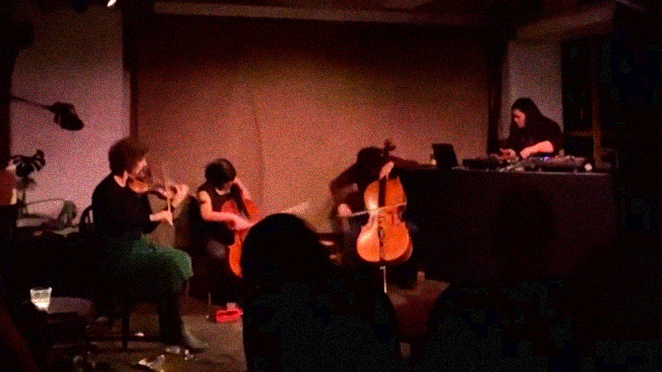
Mariam Rezaei + Angharad Davies + Atzi Muramatsu + Semay Wu
Cafe Oto, London UK

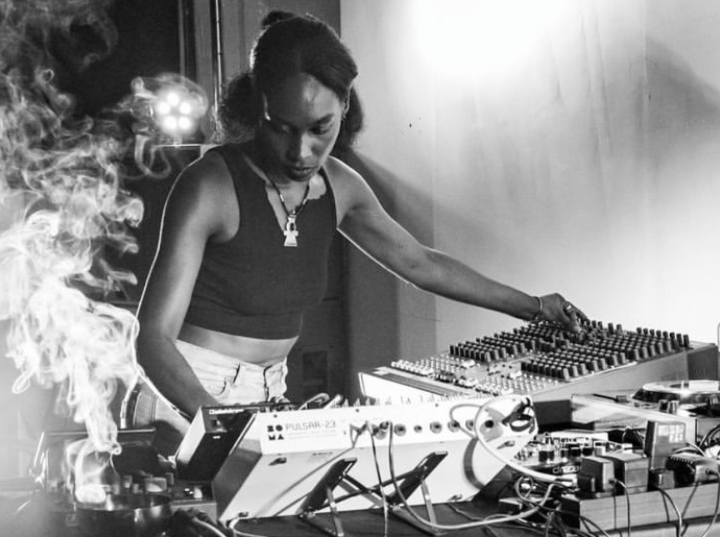
The first night of Mariam Rezaei’s three day residency at Cafe Oto considers the unmet potential of a string quartet. The musicians play two improvised sets with no prior discussion about what direction the music might take. Cellists Atzi Muramatsu and Semay Wu, violinist Angharad Davies and turntablist Rezaei fuse their instruments so efficiently that it’s hard to believe this is the quartet’s first show together.

Rezaei takes the helm of a digital vinyl system, which allows her to select and control a bank of samples using a regular turntable set-up. She has around 200 sounds to choose from. Some of these were recorded by the residency’s participants: violins by Davies and drums by Lukas Koenig, who performs with Rezaei, Gabriele Mitelli and Mette Rasmussen on the final night. The expansive variety of the samples means that Rezaei can be flexible in her approach, developing the composition in unexpected ways.

The first set begins with swelling strings and bows tapping on wooden bodies. Wu’s fingers scratch her cello, drawing out pig-like grunts from the instrument. Davies listens before committing. She plays, fully immersed, with her eyes shut for virtually the whole concert. Both players use effects pedals, but sparingly. Sometimes it is difficult to tell the original source. Is that slippery glissando the result of Rezaei stretching digital audio files or created by Muramatsu with acoustic means?

The diversity of sounds ranges from cacophonous air raid sirens and boiling kettles to Sputnik bleeps and rewinding tape. If you close your eyes, the soundscape feels overburdened with mechanical manipulation until you realise that Rezaei has dropped out long ago and the strings alone are creating the sensation of time collapsing in on itself.

All four improvisors leave spaces for each other. Muramatsu is the most cautious, playing with determined gestures only when appropriate. Wu, meanwhile, wrestles drones from her cello, inviting Davies to garnish them with accents. Rezaei is talking in the same language. Her technique is precise: dropping needles, cutting faders, twisting EQs and scratching records with confident determination. She follows the growing intensity of the strings, reaching an industrial crescendo together with the others.

There is a brief moment of uncertainty in the second set, when the strings fall silent, but soon the pace picks up and the temperature rises again. Cellos duel under the fumbling contact sound of the turntable stylus, and percussion takes centre stage. Davies keeps the beat with her violin bow, as if skipping stones across a trinitite lake, predating the harsh metallic snares to come. Ecstatic noise, droning strings and Koenig’s drum samples coalesce into a terrifying climax.

Reflecting on the performance after the show, Rezaei tells me: “I don’t think anybody knew it was going to go there tonight.” She explains that the residency as a whole, which also includes a duo with Edward George, is about challenging the restrictive confines of genre. Turntables still have a strong affiliation with hiphop, but the instrument has always been about experimentation. Within the context of digital vinyl systems, there’s a secondary element to composition where you have to estimate how the sample might be used live and work backwards from there. “It’s mainly a creative challenge to myself,” Rezaei says. “What can I make the turntable do to work with these very different ensembles and combinations? The turntable can play anything. It can stretch anything. I believe that within it, something new can be found.”

Ilia Rogatchevski
Originally published by The Wire, February 2024

comment 0

HUUUM

The Vienna based trio create a riotous fusion of traditional Iranian instrumentation, electronic processing and theatrical headgear. HUUUM: (from left) Omid Darvish, Rojin Sharafi, Alvaro Collao León. Image: Rezzarte/TE-R

HUUUM’s self-titled debut opens with the foreboding “Dibāche”. The fluctuating breath that delivers a mournful saxophone melody is twinned with the crashing of synthetic waves and other digitally processed sounds. Foreshadowing the dark and mysterious themes to come, a male voice swells like the charcoal skies of an oncoming storm. “Hanābandān” kicks in with an electric scream and “Yezle” bares its teeth in a maelstrom of heightening intensity brought on by a gnashing riff and sinister violins.

An untrained ear might hear influences of free jazz, dank clubs and doom metal, but at its core the Vienna based three-piece investigate the different languages and dialects of Iran as well as the diverse music native to Persian culture. “I wanted to show the capacity of folk music in Iran,” explains vocalist Omid Darvish. “When we talk about Iranian music in Europe, we think about people sitting on stage, playing this traditional instrument. You know, this stereotype.”

Originally hailing from Kermanshah, Darvish was surrounded by music from an early age. He studied the tambur and Kurdish music – alongside Western classical, jazz and rock – and wanted to channel the different facets found inside Iranian folk into HUUUM. The project, named after a mythological plant, began during Covid when Darvish took to studying music based on the sorna, an ancient double-reed instrument. The idea was to mimic its textural and melodic characteristics with the saxophone. “It was very much a learning process,” remembers producer Rojin Sharafi, who also plays synths and drum machines. She gravitated to Vienna from Tehran to study music. “It was a big challenge,” she continues, “not only because of the microtones, but also finding these colours and techniques.”

The band, who were at that time completed by saxophonist Astrid Wiesinger, held group listening sessions that contributed to expanding the instrument’s mimetic potential. After a period of covering famous folk songs from different parts of Iran, HUUUM started composing original material. While the electronics and saxophone derive their sounds from traditional forms, Darvish’s singing is the authentic backbone around which everything else pivots. “Singing techniques in Iran are totally different,” Darvish explains. “For example, in the West the vocal sound comes from deep inside, but when you go to the East, it comes up from behind the nose. I’m singing in maybe five or six different languages [on the album] and in each track I used the technique from [a specific] area. If you listen to “Hahre Tavil”, you will hear the Tehrani accent, but how they sang in Tehran 100 years ago.”

Following our interview, the band send me translated lyrics that expand on what is innately felt when listening to their songs. “Āzmān” is inspired by the music of Baluchestan and sung in Baluchi. It has a unique colour to the vocal which, Darvish says, can’t be heard in music from other areas. The lyrics, initially set against a buoyant melody, describe an inner voice that strives to be recognised by its owner. Halfway through, the hopeful sax fades, only to be replaced with tectonic beats, shrill pulses and a chant that proclaims, “Without me, death is your instant omen”. The mood darkens on “Chapi”, sung in the Lori dialect. Sharafi’s machine rhythms take the helm in an ode to the funeral dancing ceremonies of Lorestan. Meanwhile, the sax shapeshifts into a shepherd’s pipe playing “the melody of death” for slain youth.

HUUUM’s line-up changed in the summer of 2023, when Wiesinger left due to health issues. “It was hard for us, because we three started together,” Sharafi says. “We were looking for saxophonists. There are lots of great musicians in Vienna, but we wanted to have someone who, like us, comes from different practices.” Álvaro Collao León, originally from Chile, is their new addition. Always interested in expanding his range, León’s versatile technique combines classical, contemporary and South American influences.

Although the group haven’t performed often, their stage show expands on the studio recordings. Improvisation is a key factor that involves Sharafi processing the saxophone and vocal signals live, but so is a sense of ritual. “I think an important thing for us is to interact with the audience,” declares Sharafi. “Six months after HUUUM formed we played in a club. That was the best, because people were not always dancing, but listening to the music. Some friends in the audience were doing kel [ululation usually performed during communal rituals such as weddings].” This experience encouraged the band to embrace theatrical elements and fold these into their work. Each member wears their own distinctive headpiece: Sharafi’s represents modern culture; Leon’s – nature; Darvish’s – roots. “I have very different characters in each song,” says Darvish. “I’m acting, playing different people. When I wear the mask, you don’t know who is behind it.”

These amorphous identities are echoed in the album sleeve, a near-featureless portrait painted by Darvish’s sister Hosna Darvishi. The band see themselves reflected in its reticent stranger with many stories to tell. “It’s exactly like what we are doing in HUUUM,” asserts Darvish. “Maybe you cannot understand anything about this music, but if you listen, you will understand that everything is natural, even the electronic beats. We didn’t invent anything.” Sharafi agrees: “What I like about folk music is its openness. You can change it. Having this freedom is very attractive to us.” ● HUUUM’s HUUUM is released by Accidental Meetings

Ilia Rogatchevski
Originally published by The Wire, December 2023

comment 0

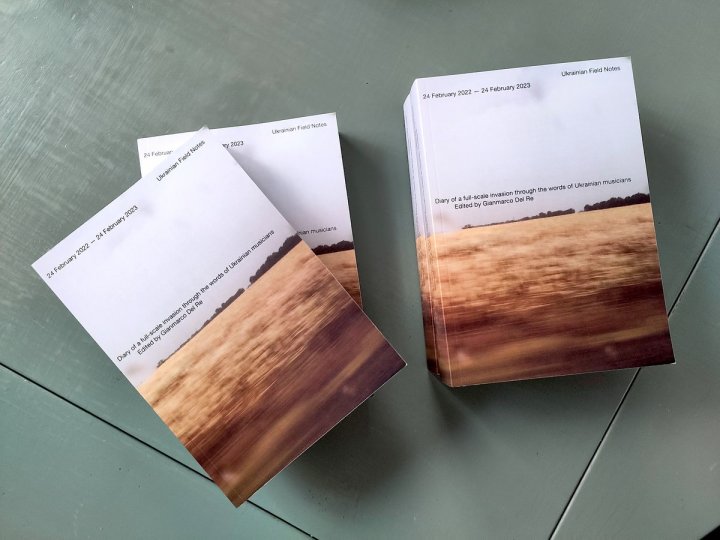
Ukrainian Field Notes

Gianmarco Del Re (Editor)
система | system Pbk 567 pp

Ukrainian Field Notes was initiated by film maker Gianmarco Del Re, who became interested in Ukrainian experimental music after the 2014 Revolution of Dignity, but started researching the country’s diverse scenes more intensively after the Russian invasion in February 2022. His interviews with Ukrainian musicians took a diaristic day by day approach and were initially published on the website A Closer Listen. Some questions raised pragmatic concerns like how Westerners can support the Ukrainian war effort, while others focused on how artists manage their creative process in times of conflict.

The project is still ongoing, but 170 interviews from the first year of the war have been compiled into this single tome. A sister compilation featuring some of the artists involved has also been released by c  cTeMa | system. Including over 80 tracks running to almost eight hours, the compilation follows the chronological order of the interviews. Recorded after 24 February 2022, the overall sensation of the music is sombre reflection.

Although the tracklist is dominated by instrumental electronic compositions, other genres and moods also make an appearance. They range from the thundering drums and protracted metal dirge of Nonsun (“Days Of Thunder Bring New Wisdom”), through the melancholy dark jazz of Whaler (“Zrada”), to sorrowful field recordings. Documenting squawking birds on a winter day, Myroslav Protsan’s “Ravens On The Cemetery” suggests the harsh emptiness of grief.

The combined reading and listening experience brings to the surface emotions from the first days of the war: a sickening disbelief in the unfolding events. In the early stages of the conflict many interviewees couldn’t make or listen to music. Their energies instead focused on survival, fundraising and volunteering. Del Re equates war to another recent trauma, that of the global pandemic, and asks how the artists lived during that time. “There is a big difference between lockdown and war,” replies Hanna Svirska. “During lockdown you knew that you would survive by staying at home. War gives you no guarantees.”

About 50 pages into the book, the interviews expand. Gianmarco’s questions become more involved and better researched. Further insights are gained into the experience of displaced artists (across Europe and within Ukraine) as well as the country’s different music scenes. SA Tweeman, for example, the co-founder of queer rave VESELKA, is asked to reflect on the development of Ukraine’s LGBTQIA+ club scene and whether electronic music has a role to play in the current situation.

Each artist is also tasked with recommending a book or film that will give readers a better understanding of Ukrainian culture. Sergei Loznitsa’s Donbass (2018), Sergei Parajanov’s Shadows Of Forgotten Ancestors (1965) and the Ukraïner media platform are recommended simultaneously by several different people. Later conversations consider misconceptions about the conflict. “The West thinks that we are at war with people who have human concepts, values and orientations,” say the indie five-piece Latexfauna. “In fact, we are fighting against a completely inhumane, misanthropic system that is endless in its bloodlust.”

Although it makes for emotionally charged reading, Ukrainian Field Notes is an important document with a practical purpose. All proceeds from its sales go to fund the Musicians Defend Ukraine charity.
Almost two years into this war, the book’s publication is all the more vital.

Ilia Rogatchevski
Originally published by The Wire, December 2023

comment 0

Midori Takada: Japan On Film

Kings Place, London, UK
Photo: Monika S. Jakubowska

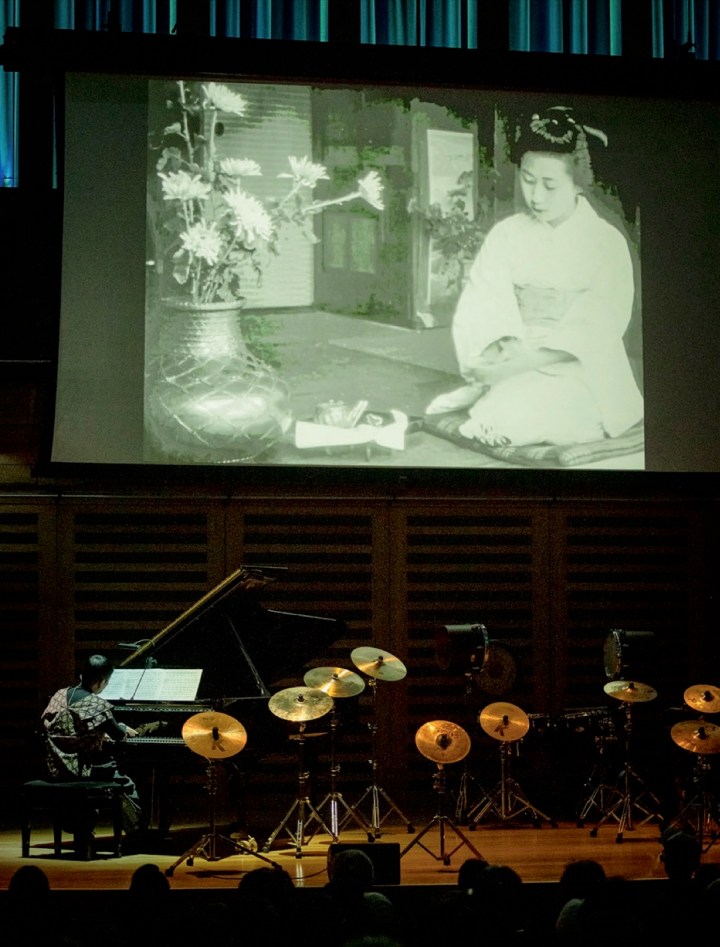
The dark stage is peppered with cymbals that resemble flowers gazing at an artificial sun. A solitary bell is heard but its source is unclear. Midori Takada emerges from an aisle and ascends onto the stage, intermittently striking an upturned metal bowl. She walks through the field of alloy disks, picking between them, emphasising their tonal differences, before stopping at a suspended gong. Various textures are drawn from it. Takada scrapes the surface with brushes, then her thumb, persuading the instrument to sing like a migrating whale. She removes her black cloak, letting it drop to the floor – a deliberate gesture bookending her theatrical entrance.

Tonight’s performance centres around new scores for silent films about Japan. These surviving shorts, which are held at the BFI National Archive, date back to the end of the Meiji era, when Western film makers fixed their collective gaze on the country. Captured by outsiders at the dawn of the 20th century, Japan’s landscapes, buildings, fashions, customs and people are inevitably exoticised. However, the films remain vital records of a nation transitioning into modernity, and their restoration and digitisation was done to coincide with the 2020/21 Tokyo Olympics.

Takada’s live score makes full use of the percussive palette incorporating cymbals, variously pitched toms, marimba, grand piano and prerecorded sounds. The emphasis is always on the melodic potential of the instruments, particularly where the drums are concerned. Two of the toms are turned sideways, positioned at head height, while the remaining drums rest on the floor. Takada darts across them, with each isolated hit conjuring up an unexpected melodious note. Collectively, her rolls are evocative of countless liberated cobblestones flying across city barricades and raining fast onto the street.

As images of the Dotonbori Canal in Osaka flash upon the screen, Takada moves over to the marimba. Her complex repeating patterns instantly remind me of Philip Glass or, more precisely, Christoph Sietzen’s marimba rendering of the Glassworks track “Opening”. Whereas that piece is steeped in a fragile melancholy, Takada’s playing is vibrant, especially when synced to visions of urban life lost to time: people under parasols escaping the rain, street food vendors, a bonsai tree market, children lining up for school, silk factories, a parade celebrating the country’s victory in the 1904–05 Russo-Japanese War.

The most arresting film is The Ainus Of Japan, which documents the cultural rites of an Indigenous group native to Hokkaido and Russia’s far east. We are shown dancing rituals, a drinking ceremony and married women marked by moustache-like facial tattoos. The Ainu were forced to assimilate into Japanese society and this anthropological record is a rare window into their culture.

The films are not showing constantly and when they’re turned off, Takada’s playing is brought to the centre. As she sits behind the piano and jams to prerecorded sounds emanating from the PA, there is a sense she is duetting with ghosts. Throughout the concert, Takada speaks to the audience about “beautiful memories from childhood” like the taste of honey and dates, a coconut tree standing on a desert hilltop or the “sound of red thread being torn”. These brief quizzical phrases contain a quotidian kind of poetry that complements the picturesque visions of Japan from 100 years ago. Like most memories, these images are emotionally vivid but fleeting and prone to distortion.

Ilia Rogatchevski
Originally published by The Wire, December 2023

comment 0

Mutek

Various venues, Montreal, Canada
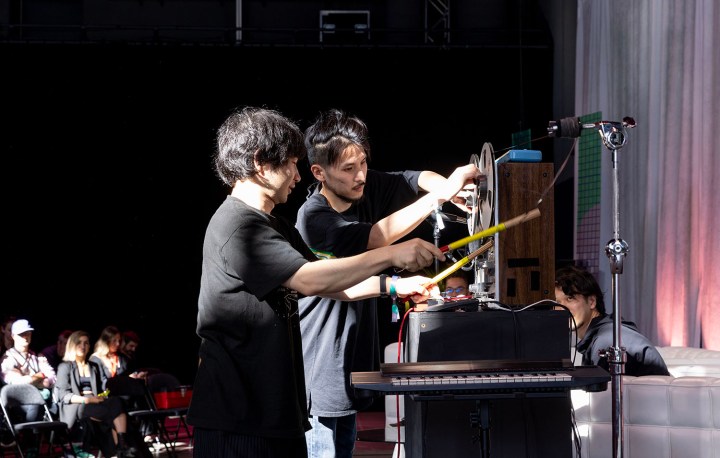
Photo: Open Reel Ensemble at MUTEK Forum by Maryse Boyce

This year is the 24th edition of Montreal based festival Mutek, which investigates how new technologies are applied in the creative industries while also exploring tech’s symbiotic relationship with electronic music. It takes place over six days with around 120 artists performing in various venues. At a conference running parallel to the gigs, more than 70 speakers – AI experts, XR (extended reality) professionals, and climate activists – present keynotes, workshops and panel discussions on the theme of Future Currents.

Grand River aka Aimée Portioli opens the festival at New City Gas, a remodelled gasworks that once powered Montreal’s street lights. Her carefully sculpted pulses glow with intensity, threatening to consume everything in their search for a universal rhythm. Premiering material from his latest album No Highs, Tim Hecker is even less forgiving. The set is dominated by avalanche-like frequencies that kidnap the body and inspire Vincent de Belleval to summon atmospheres of burning furnaces and oceanic emergencies in his synchronised light installation.

Performing at Société Des Arts Technologiques (SAT) is Open Reel Ensemble, a trio from Japan who play reel-to-reel recorders. They scratch the reels, bow exposed tape and hit long loops with drumsticks, weaving a rich tapestry of sounds from seemingly unremarkable sources. Call and response sections are recorded live and seamlessly folded back into the groove. In an artist Q&A, band leader Ei Wada explains how he sees these obsolete machines as “exotic folk instruments from the past” that allow the musician to move through time.

More dance-focused sets, albeit ones utilising inventive projections, come courtesy of acts like Efe Ce Ele, Paraadiso and SUFYVN (with visuals by Kaminska). For those with the stamina to keep going all through the night, the ornate MTELUS concert hall hosts the likes of .VRIL and Eris Drew. Ambient performances, meanwhile, are held at Les 7 Doigts. Erin Gee’s ASMR-influenced work Affect Flow is the most memorable of these. Gee hooks up five volunteers to biosensors which control the sound in various ways. The mood oscillates from overwhelming metallic washes to organ-like tones while Gee mediates the seance with her muted monologue and closemiked objects.

The central city square of Esplanade Tranquille is taken over by free performances throughout the week. Toddlers in ear defenders share the dancefloor with seasoned ravers. Out of the expanded programme, Canadian trio Randy’s Calling stands out the most. They encircle themselves with a daisy chain of countless defective ring modulator pedals and generate irresistible waves of feedback laced with a rhythmic electric crackle.

Another highlight is Alessandro Cortini and Marco Ciceri’s concert at the Théâtre Maisonneuve. Ciceri’s hyperreal visuals of undetermined objects resemble AI hallucinations, with the details elusive and constantly shifting. Cortini’s modular set, meanwhile, imitates obliteration by first harmonising mosquitoes with an aircraft engine and ending the piece with tectonic plates grinding against each other.

One of the main draws is the Satosphère, a domed space on the top floor of SAT housing immersive experiences. Projections of cascading viscous liquid – created by BunBun and Alex Vlair – morph into flowerlike apertures opening to reveal the night sky above. When combined with Nadia Struiwigh’s textural techno and the sweat lodge temperature on the dancefloor, these dreamlike images usher everyone in the room into a communal psychedelic experience.

By contrast France Jobin and Markus Heckmann’s Entanglement makes more cerebral use of the same space. This time we’re parked on beanbags, looking up at the ceiling. Geometric structures, inspired by quantum physics, untangle in front of our eyes, as string-infused drones, loaded with static, hang heavily in the air. I view the same piece on a virtual reality headset before the show. It’s one of the more successful XR experiences at Mutek, because it constructs an alternative abstract world rather than trying to supplement or augment our present one.

At the conference, the discourse around AI and XR is generally idolatry, but cracks of critique are also visible. Chris Salter, who co-produced the climate crisis-themed XR play Animate – also staged at the festival – admits to the limitations of what he calls “body extension” and traces XR’s origins to the Vietnam War (when pilots landed their helicopters in the dark using infrared sensors and headsets). Despite the technology’s dominance in the military and computer games, Salter states that artists are the ones who test its limits, citing Marshall McLuhan’s belief in art as an early warning system that monitors changes in society.

Ilia Rogatchevski
Originally published by The Wire, October 2023

comment 0

Svalbard Soundtracks

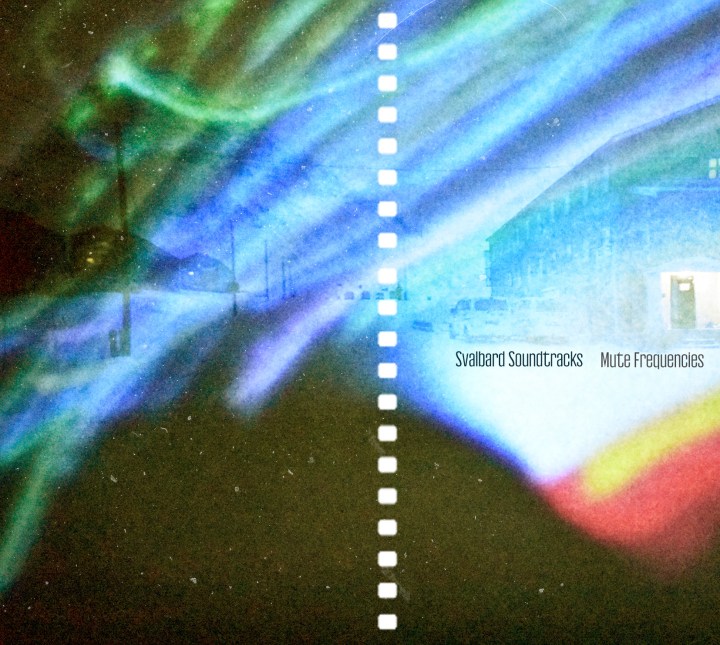
Mute Frequencies, my sound art project with Laura Rogatchevskaia, released its Svalbard Soundtracks album today. It’s something we’ve been working on since 2019 and we’re really happy to see that the project found a home on the Flaming Pines label.

Inspired by three silent documentaries about the Norwegian archipelago of Svalbard, Mute Frequencies have produced an infectious, restless and disturbing journey across time and place in these soundtracks for nostalgic tales of human endeavour, and natural beauty.

From dust speckled black and white footage of seal carcasses, craggy fjords and mining towns to the washed out palette of 1970s Soviet canteens for dusty miners the duo of Ilia Rogatchevski and Laura Rogatchevskaia have crafted a poignant album which aims to explore not just a place, but its representation across particular moments in time.

The three works which comprise the album are named for the silent documentaries they aim to soundtrack: Further North, There Is Only the North Pole (1976, USSR), Spitsbergen (1958, Poland), and A Trip To Svalbard (1930, Norway). As we move back in time over the course of the album from 1976 to 1930 we discover very different versions of Svalbard and its inhabitants, both within each piece, and between them.

There are the triumphant synths of Further North, There Is Only the North Pole with its patriotic Soviet miners of the 1970s. While the nature-focused Spitsbergen (1958) with its spectacular landscapes, curious foxes, auks and intrepid explorers moves rapidly from sparse, metallic tinkling to bursts of drums, plucked bass and shakers within just one short section. The final work which places us amid A Trip To Svalbard from 1930 and its stories of hostile weather, hunting, heroic men and mining detonations builds us a world from percussive strikes, vibrating sheets of metal and stabs of industrial synth tones.

Svalbard Soundtracks is a beguiling album which plays with the conventions of nature documentaries, just as it meditates on the particular resonances of nostalgia.

Listen/download here.
The Quietus review here.

comment 0

Nkisi

Nkisi, Iklectik, London, UK
Photo: Jonathan Crabb

In the concluding chapter of Kick It: A Social History Of The Drum Kit, author Matt Brennan notes that drums have infiltrated music production to the extent that “we are all drummers now”. This is especially true of electronic music where sampled or synthesized beats form the backbone of virtually every dance, hiphop and pop track. “Rather than drummers being replaceable,” he argues, “the art of the drum kit, drummers, and drumming has now been normalised to the point where it is an indispensable part of contemporary music culture.”

Brennan’s assessment comes to mind when listening to Nkisi’s set at Iklectik, the first concert in the Black Industrial/Noise event series. With her bank of synths, drum machines and CDJs, Nkisi positions complex polyrhythms to the centre of our attention. Deep bass drums interchange between the left and right channels, while chemical washes dominate the higher frequencies. The beginning is slow, almost ambient, but the set quickly builds into a panicked dialogue between malfunctioning appliances, laser pitched toms and floor shattering kicks.

In a conversation with the artist and scholar Hannah Catherine Jones before her set, Nkisi discusses the function of rhythm and ritual in her work. She explains that witnessing the ceremonies at Benin’s Ouidah Vodun Festival showed her how music can affect the environment by welcoming spiritual energies into the performance space. In addition, she notes that the construction of cross rhythms – conflicting patterns played simultaneously – are instrumental to her practice, particularly in a live setting.

Nkisi’s fluctuating dynamics between the different rhythmic layers encourage the audience to actively participate. The heaving groove and unexpected accents shift all the bodies in the room to dance, even those who initially parked themselves on the floor. With the temple-like interior bathed in ultramarine light, and infectious beats pulsating from all sides, it’s impossible not to surrender your mind and body.

Jones likens this idea to Sylvia Wynter’s concept of consciousness reversal, which states that drums, and the multitude of grooves expressed through them, bind the self to the collective social experience of dancing and listening. Nkisi also sees her music as a conduit for spiritual technologies that runs counter to the demonisation of voodoo by Hollywood, and helps to keep ancient energies alive by bringing them into a contemporary art-music context.

In the Kongo culture, nkisi are sculptural objects inhabited by spirits. These days, Nkisi says, they are often “imprisoned in museums”, permanently exposed to the public, divorced from their intended ritualistic function. It’s easy to draw a parallel between the spiritual activation of such objects and the fetishisation of gear in electronic music. For Nkisi, however, sonic practice is a sincere form of channelling that allows outside forces to take over. “Noise is connected to the non-representation of nature – ancestors,” she says. “The spirit loves to communicate through electricity.” Her music is also connected to decolonial practices and asks “how to take care of the invisible forces without trying to expose them or continuing the violence” directed towards the occult.

During their talk, Jones muses on the idea that “repetition makes us learn something”. Through repetition, mediated by electricity, Nkisi initiates the audience into ancestral musical practices, teaching us the power that rhythm has over the collective experience and ensures that ancient rituals continue to exist in the present.

Ilia Rogatchevski
Originally published by The Wire, August 2023.

comment 0

Suzanne Ciani

Suzanne Ciani + Li Yilei
Kings Place, London, UK

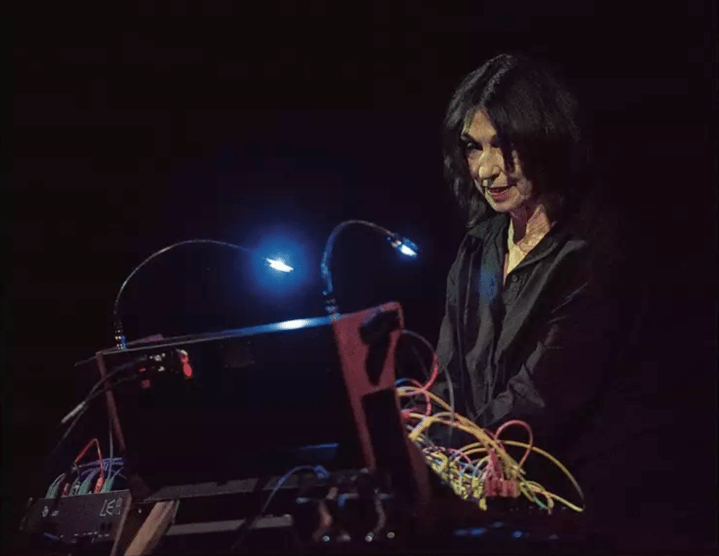
Taking refuge in Kings Place from the sweltering summer heat, I’m met by Li Yilei’s solitary song. The London based artist begins with an avian melody performed on a whistle. The phrase fills the hall, looping and creasing, inviting other sounds to follow. Electric rushes bring to mind soft fabric blowing in the breeze of an open window and the dancing tree leaves beyond. Li takes to her Moog Claravox to duet with the bird calls. The theremin is somewhat harsh at first, but Li later fades in gentle drones and sounds of rain.

Perhaps it’s the disconcerting weather coupled with the incessant hype around AI in the media, but the discordant frequencies emanating from Li’s theremin and the way they swell into broken and distorted voices evokes a sense of loss for me. Li is influenced by Eastern ideologies of emptiness and their music laments the fading resilience of nature. Soon our planet will be nothing more than plastic trash and scorched earth. We’ll be gone, but the lauded AI we are so desperate to perfect will remain, reminding our lifeless desert that it was once thriving and beautiful with a litany of simulated rainforest sounds.

The start of Suzanne Ciani’s performance echoes the closing minutes of Li’s set with crashing waves and electric birdsong that rise out of the silence to challenge my pessimism. Her workstation consists of the Buchla 200e, a few touch screens and a bird-like tactile controller. The composer’s movements are captured by a live visual feed. The projection shows her intimate interaction with the modular synth, going some way to deconstruct the instrument’s monolithic impassibility.

Suddenly, bubbling acid bass and metallic textures catapult us into the cosmos. The tempo increases. It’s pulsating, almost industrial, begging you to move without ever really breaking out into dance beats. There is a moment when the camera loses focus and only the synth’s blinking LEDs remain visible. The impression is that of a ship sighting the lights of a coastal city at night, in dense fog. You’re not sure whether to feel relief or trepidation, because you’re still many miles from shore.

Despite its illuminating projection, Ciani’s quadraphonic set is better experienced with your eyes closed. Subaquatic sounds and crashing waves cascade around the the cavernous concert hall, as if striving to flood it. At one point the sequenced beeps are filtered and transformed into humanoid voices that recall the sampled throat singing in Shpongle’s psytrance epic “Divine Moments Of Truth”. In light of Ciani’s former flirtation with new age, this performance is psychedelic but in a way that doesn’t rely on kitsch or cliche. Instead the composer foregrounds technology to make the listener look inward.

At the end of the show, Ciani invites the audience onstage to say hello to her Buchla. She also expresses admiration for the quadraphonic format, explaining that “electronic sound is meant to move”. The Buchla was designed with this in mind and therefore creates “valid content for the medium”. Ciani’s remarkable career as a commercial composer, concert pianist and electronic music pioneer are documented in the 2017 film A Life In Waves. In it, she talks about being drawn to nature’s spiritual influence and the romanticism of life itself. Perhaps, if we appreciated what Ciani calls the “theatre of the ocean”, with the same conviction that she does, our future wouldn’t be so bleak after all.

Ilia Rogatchevski
Originally published by The Wire, July 2023

comment 0

Museum Of Portable Sound

Museum Of Portable Sound
Portsmouth, UK/Online

“Are you familiar with the story of the first MP3?” asks John Kannenberg, director and chief curator of the Museum of Portable Sound (MOPS). He plays me the 1987 a cappella version of Suzanne Vega’s “Tom’s Diner”. Karlheinz Brandenburg, the mathematician who co-developed the MP3, believed this song to be the purest recording of the human voice and a perfect test case for his compression algorithm. Kannenberg suspects, however, that it was just a pretext for meeting the singer and “evidence of tech bros being icky”. Vega disliked her canonisation as “The Mother of the MP3”, and later recorded “Tom’s Diner” onto a wax cylinder at the Thomas Edison laboratory in New Jersey in a bid to wrestle her song back from the digital world.

The MP3 origin story is one of many that Kannenberg employs to contextualise his collection of sounds, which currently stands at 325 items spread over 30 galleries. The project originated in Kannenberg’s museology background and field recording work, which evolved into a PhD thesis arguing “for the collection, preservation, and exhibition of sounds as objects within museum practice”. MOPS is unlike other museums in that it’s not a physical space, but consists of audio files stored on the curator’s old iPhone 4S. Visiting the museum can be done via Zoom or in person, if you’re able to travel to Portsmouth where Kannenberg is currently based.

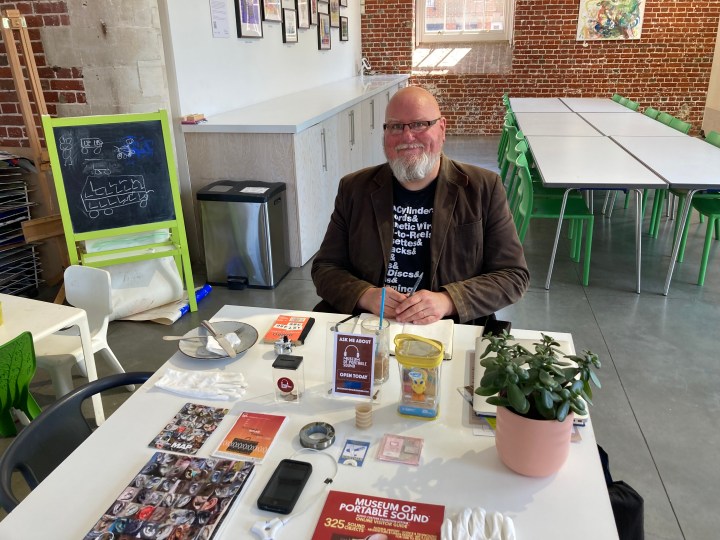
We meet at the Aspex gallery cafe on a quiet Sunday afternoon. Engaging in cloakroom cosplay, Kannenberg offers to check in my bags before handing me a gallery guide. The table is laid out with portable sound objects, white archival gloves, museum map and iPhone. The visit begins with a discussion of the objects: a spool of recording wire, an official Hello Kitty MiniDisc, and a Tweety Bird-shaped MP3 player among other things. This is only a small sample of Kannenberg’s extensive collection of physical media. The sound files are organised into colour coded playlists and follow a taxonomy that mirrors the curatorial categories you may find in an ordinary museum.

“Tom’s Diner”, for example, is listed in the History of Audio Recording gallery, alongside “The First Recording Of A Human Voice”, produced in 1860 by the French inventor Édouard-Léon Scott de Martinville. The first exhibit in the Archaeology gallery is a 1939 BBC broadcast of King Tutankhamun’s trumpets being played for the first time in 3000 years. Remarkably, the originals were used and one trumpet accidentally shattered. For visitors overwhelmed by the volume of sounds on offer, Kannenberg creates guided tours encompassing themed highlights and “city tours” of field recordings.

Kannenberg explains that creating MOPS was the first time he felt “honest as an artist”, combining his own practice and specialism in museology with humour. The roleplay aspect and meticulously designed gallery guide highlight the strange rituals associated with museums. MOPS also challenges established histories of sound. Citing the development of mechanical telephones, Kannenberg notes that the discovery of sound travelling down string has been traditionally attributed to Robert Hooke, but the phenomenon was known independently to various cultures centuries prior to the British physicist’s experiments. While MOPS has its detractors – David Toop once called it a “flea circus” – the project interrogates what museums are with an inventive curatorial approach and presents its artefacts with a sense of fun often absent in sound art.

Ilia Rogatchevski
Originally published by The Wire, July 2023

comment 0

Deep Listening w/ Blanc Sceol

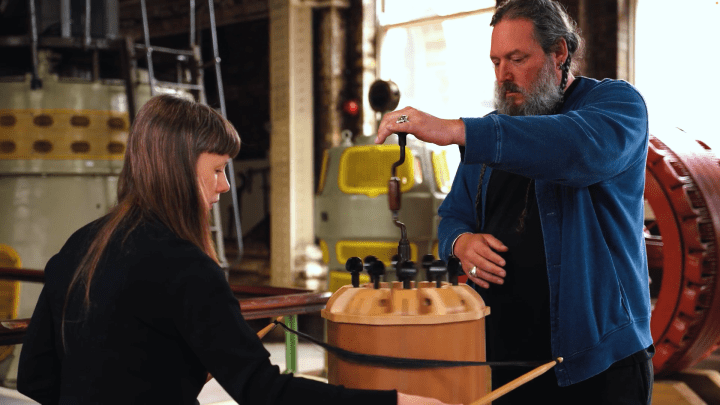
In my latest podcast for audio.com I talked to Blanc Sceol, the London based sound art duo of Stephen Shiell and Hannah White.

Stephen and Hannah work together across disciplines, incorporating field recording, intervention, voice, acoustic ecology and instrument building. They often focus on participatory action and deep listening practices.

Their compositions and performances are anchored in their surroundings and respond to the landscape. We discuss their sound practice, instrument making and ecology work.

Video and lead photo by Hannah Lovell.