comment 0

Unofficial Channels: Radio Amnion

If you tune your digital dial to Radio Amnion each month during the full moon, you’ll hear a new composition specifically commissioned for the occasion. In June, Blanc Sceol, the London based duo of Stephen Shiell and Hannah White, presented Orbit, a half-hour piece recorded at an East London pumping station. The meditative track is composed on an eponymous decagonal string instrument of Blanc Sceol’s own making. The Orbit is played by two people: one rotating the cedar barrel, the other bowing its strings. Its cascading, hallucinatory frequencies are interwoven with one word poems created by participants of Blanc Sceol’s sonic meditation sessions.

Jol Thoms, the artist and researcher behind Radio Amnion, met the duo during one of these meditations. Thoms associates the moon with the “divine feminine”, standing in opposition to “our wildly patriarchal societies”. The satellite’s influence on the tides is another reason why the project activates during the apex of the moon cycle. Radio Amnion is part of the P-ONE neutrino telescope: developed at the Technical University of Munich and submerged 2.5 kilometres into the Pacific Ocean’s Cascadia Basin, it’s designed to detect particle interactions within the water. The addition of the Sonic

Platform – a tetrahedral speaker to channel the station’s subaquatic transmissions – serves a more conceptual purpose. “Radio Amnion opens the possibility for us to think with both science and mysticism simultaneously,” Thoms explains. “I’m obsessed with the ecological problems we’re facing and interested in renewing our relationships with the Earth.” Thoms is inspired by the sentient ocean planet in Stanisław Lem’s Solaris, alongside the spiritual traditions of indigenous communities. Broadcasting soundworks into the ocean, he suggests, creates a positive dialogue with the planet that doesn’t exploit its resources or destroy its biodiversity.

Blanc Sceol’s Orbit, also released by Otoroku, was the 25th transmission in the station’s two year history. Previous commissions include Margarida Mendes’s Lateral Waters, and Libita Sibungu and Perivi Katjavivi’s inaugural liquid-themed poem pacific2.wav. A highlight is Nocturne: Sonic Migrations in which Matt Warren, Sally Ann McIntyre, Dani Kirby and Eliza Burke blend together bioacoustic data, environmental sound and interviews with nipaluna/Hobart residents to tell the story of the near-extinct whale populations of Tasmania’s Derwent River. But you don’t have to dive deep to catch the next broadcast – their webpage will host the simultaneous stream. ○ radioamnion.net

Ilia Rogatchevski
Originally published by The Wire, July 2023

comment 0

O YAMA O: The Art of Falling Apart

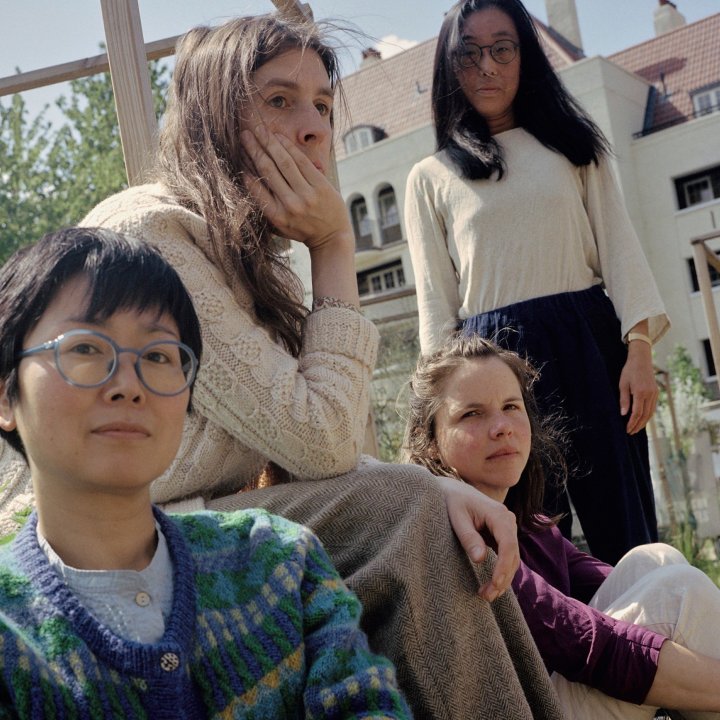
O YAMA O The quartet formed from the eclectic cultural milieu around London’s Cafe Oto take folk, sound art and call and response to create a liberated vision of modern song. By Ilia Rogatchevski Photography by Wendy Huynh.

Sitting outside East London’s Cafe Oto, O YAMA O vocalist and Oto co-founder Keiko Yamamoto reflects on her entry into the capital’s experimental music scene. “I was working at the Bonnington Cafe in Vauxhall,” she says of the South London community space. “Upstairs, every Monday, an improvisation group gathered. That’s when I met Adam Bohman, Steve Beresford and David Ryan. Steve Beresford came down to buy some food from me, then went upstairs. That was my first encounter.”

Cafe Oto, which was marking its 15th birthday on the night of our interview, has become synonymous in the UK and beyond with music that challenges boundaries. Initially, Yamamoto’s intention was to expand her artistic network, after making a permanent move to the UK from Japan. “Me, Hamish [Dunbar, her partner and Oto co-founder] and another friend started hosting a show, twice or three times a month, in pub function rooms. That was out of wanting to connect, because we were doing various jobs, random things. In those days we didn’t have any social networks.”

The itinerant project, which was then called Divers or Loons (after the migratory loon bird), settled into its present cafe incarnation in Dalston in 2008, but continued to serve as a platform for collaboration. O YAMA O came together after Yamamoto saw sculptor Rie Nakajima, an acquaintance from the Chelsea College of Arts, perform at the venue. “Rie and I knew each other through a mutual friend,” Yamamoto recalls. “I knew she made sculptures. Japan had a horrible tsunami disaster [after the 2011 Tōhoku earthquake]. We organised a commemoration and I invited her to perform. That was the first time I saw her activate her objects.”

Nakajima utilises everyday items and found paraphernalia – ceramic bowls, tin boxes, plastic whistles, foil sheets – triggering their sound potential with small motors or by aeolian means, often in site specific contexts.

At the time of the tsunami concert, running Cafe Oto was demanding and left little time for Yamamoto to be creative. “I wasn’t really making anything, apart from singing to my children. It was immediate and something I could do every day without committing any time. I wanted to make it into some sort of shape and share it with somebody outside of the house. Then I saw Rie’s sculpture: a sound made with a rice bowl. It resonated with me.”

O YAMA O’s improvised performances combined Yamamoto’s singing – touching on subjects derived from Japanese folklore and domestic life – with Nakajima’s kinetic objects. Their first concerts took place in intimate settings, such London’s No Show Space in 2014. In a video of the performance, the audience encircle O YAMA O’s modest set-up in the small gallery space. The duo starts quietly, with Nakajima spinning a corrugaphone over her head. The whirling tube emits a faint and eerie drone, which acts as a counterpoint to Yamamoto’s voice. Before long, Nakajima summons delicate textures out of her objects, slowly mutating the music into what appears to be a choreographed crescendo, but is actually a largely improvised ritual. O YAMA O’s current line-up is completed by violinist Billy Steiger and drummer Marie Roux, who also have deep connections to Oto: Steiger is one of its sound engineers, while Roux photographed gigs for the venue’s archive. Roux and Steiger have contributed to the group from the beginning, but conflicting schedules meant they couldn’t always perform as an ensemble. The visual arts practice of the members informs or crosses over with O YAMA O: Steiger has made abstract paintings during their gigs, while Roux’s photograph of an oblique Tunisian street scene adorns the front cover of the group’s new album Galo.

I meet all four members at a Central London community garden to hear more about their collaboration. Nakajima has recently returned from Milly-la-Forêt in France, where she performed alongside Pierre Berthet on the site of Jean Tinguely’s sculpture Le Cyclop. “I don’t care much for what is art or music,” she declares. “It’s just a situation. If I’m in a musical context – a concert or festival – I gather information from my past and try to make something more interesting than before, but that’s the only thing I think about.” Nakajima sees her work in terms of accumulated knowledge that is collected over time, like raindrops in a bowl, with improvisation being an opportunity for this knowledge to express itself.

One notable addition to the group is former Flying Lizard, David Cunningham. Although he has occasionally performed with O YAMA O in a live setting, it’s his signature production work that helps to shape the band’s recorded material. “The fifth Beatle”, as Steiger calls him, is both inside and outside the project, sympathetic to the band’s intentions, but not afraid to critique their aesthetic decisions. Nakajima elaborates: “[Galo] is definitely his personality. His identity is there in the album. When we play live, it’s our collective. It’s all mixed up.”

The band see Cunningham’s role as solving a jigsaw puzzle of disparate pieces, combining old concert recordings with time-delayed Zoom sessions and outdoor sounds into a cohesive whole. “It’s good to have him,” Yamamoto agrees. “He cares a lot. Otherwise we are a bit too wobbly, edgeless blobs.”

Galo, a follow-up to O YAMA O’s self-titled 2018 debut album, was recorded over the course of several years, with sessions beginning in 2019 and continuing remotely throughout the pandemic. In the first half of 2020, Cafe Oto was required to close, and pieces like the instrumental “Harvest Dance” were recorded at an empty venue with Nakajima and Steiger taking turns at the house piano. “I See You” and “Jigoku” were also recorded live, and alongside “Harvest Dance” give the impression of a composed triptych of songs. But the band maintain that the opposite is true: all aspects were improvised. “There’s nothing set,” declares Yamamoto. “It’s really more exciting to make it up on the spot. Everybody has their own tools and goes into the zone, really giving each other space. For me it’s like dancing.”

Choreography happens to be an important constant in O YAMA O’s work. In late 2021, Nakajima and Yamamoto presented a performance-talk at London’s Somerset House, as part of The Wire’s Music By Any Means series. In an online article promoting the event, the band listed influences that included dancer Min Tanaka, the performance poetry of Gōzō Yoshimasu, and the traditional menburyu dance, which is native to the Saga Prefecture and staged annually to welcome in the harvest.

The Somerset House event, which also featured frequent collaborator David Toop, was titled Accidental Rituals. With accidents being unplanned or left to chance, and rituals implying tradition, premeditation and repetition, does the notion of an accidental ritual not seem like a contradiction? The key, Nakajima insists, is “just not to think”. Yamamoto elaborates: “The live [performance] is unplanned. It’s improvisation, but each individual has a method within: things that nobody can change. For me, it’s important. [Ritual] doesn’t have to be special. Something special is always happening in everyday life. Everyone does beautiful things without knowing. I want to depict that.” Themes of everyday beauty run throughout Galo. The album’s opening track “Kuroneko” bursts forth with whistles, melodica and a crashing drum that serve to illustrate Yamamoto’s lyrics about a black cat running on the grass at night, bathed in moonlight. Elsewhere there is “Hakushon” – the title is the Japanese onomatopoeic equivalent to the standard sneeze response “achoo!” – and “Suna No Shiro”, which takes the fragility of sand castles as its central theme. “I See You” and “Jigoku” both explore paranoia through characters who are looking back at someone who is observing them. While the latter track once again references sand castles, implying that trust is just as easily broken as those impermanent structures,

the former song goes back to a postcard that Yamamoto saw in childhood. Her mother, also an artist, wrote the words “I See You Seeing Me” on the back of an exhibition invitation, the sentence spiralling round to make a complete circle. Intentionally or otherwise, this concrete poem is reminiscent of Fluxus event scores by the likes of George Brecht and Yoko Ono, where the thought experiment evoked by the words was in itself an activation of the artwork. Ono’s Sun Piece (1962), for example, instructs the reader to “watch the sun until it becomes square”, mirroring the circularity and magical thinking of “I See You”.

Another thread running through O YAMA O songs is folklore. Yōkai, the supernatural apparitions deeply embedded in Japanese mythology, appear in the track titles of the band’s debut album. “Oni” references the iconic red-skinned demons who punish the damned in hell, while “Kitsune” is a nod to shape-shifting fox spirits. The word yama translates into mountain from Japanese, and the ensemble’s name is a stylistic visualisation of a mountain flanked by two circles, perhaps suggesting the figures of Nakajima and Yamamoto standing on either side of their sound-making objects.

The band hint at a soft spot for folk, listing songs by Pentangle and Fairport Convention as influential. “Jacky My Son”, an a cappella arrangement by Staverton Bridge of a traditional song, informs O YAMA O’s use of the voice to deliver an emotional impact, such as can be heard in the sorrowful “Suna No Shiro”. By contrast, songs like “Kuroneko” or “Oni” embody elements of childlike joy via their use of recorders, harmonicas, whistles and other small instruments. Such kinship with innocence brings to mind the playful music to which the tanuki in Pom Poko, Isao Takahata’s 1994 Studio Ghibli feature, revel and party to.

The foundations of the ensemble’s music, however, are found objects. Improvisors like Steve Beresford and Adam Bohman are well known for awakening the textures inherent within everyday objects. However, unlike Beresford’s kitsch toys or Bohman’s bricolage, which often incorporates industrial objects like springs and metal sheets, O YAMA O usually opt for small domestic items that you may find accumulating in the kitchen cupboard and can never bring yourself to throw away. “Adam Bohman was my gateway into improvised music,” says Steiger. “That was the first point when [I understood] you can do whatever you want! His influence on music is completely under recognised. So much stems from him.” Yamamoto agrees: “It’s beyond music. It’s just him and a medium”.

I mention Dan Barrow’s review of Nakajima’s 2018 solo show at Birmingham’s Ikon Gallery in The Wire 414 where he assesses her work in relation to the “split in histories of free improvisation between ‘small instrument’ music, based on short and quick-decaying instrumental gestures, and drones”. Bearing in mind their use of sustain, as with Steiger’s violin for example, to what extent do these tensions between decay, dynamics and acoustic dominance manifest in O YAMA O? “It seems quite an arbitrary split to me,” Steiger replies. “The violin doesn’t sit on either side. We make short sounds and long sounds.” Yamamoto responds with a question of her own: “Does it translate into an emotional sound if it’s prolonged or repetitive? We don’t really think that way.” Live, the ensemble sometimes ignore their own setlists and traverse paths unknown. Bruxelles documents their 2019 concert at Les Ateliers Claus in Belgium. The first half of the album is a demonstration of spontaneous composition, small sounds of clinking bottles and woodblocks engaging in dialogue with Steiger’s pizzicato violin, while a distant melodica draws out melodies from the air. Roux’s drums start gently, echoing the clatter of spinning plates, before evolving into a tribal march that guides Yamamoto’s voice into the key refrain on “Namekuji”.

With this blank canvas approach to performance, do they see their work as denoting a kind of freedom? “Sometimes improvisors, they just play,” says Roux. “We do lots of call and response. I can feel a lot of exchange – it builds up into something. I always felt we have this connection or structure that gives me space and I can experiment within that space.” Steiger follows the thought: “Freedom is there in the way we play. I can be free to make whatever noise I want, but there’s a responsibility to actually make it right. What’s the right sound to put in this situation?”

Steiger retells a story where he made use of a turntable the DJ forgot to turn off during O YAMA O’s concert in Belgium. “At some point I went over and I was moving the record super slowly. There was this giant sub-bass. It was loud. In that sense, this idea of total improvisation – where you’re allowed to do whatever – doesn’t change no matter who I’m playing with or what the context is. It’s actually something that I think about a lot.”

For Nakajima, freedom exists in relation to restriction. “Freedom, for me, [comes] after understanding my limit: what I cannot do. First, I [need to] understand the physicalities of the situation. If I know that then I can think about it or just free up some space.” Have their performances ever fallen apart or dissolved into disaster? “There’s nothing to fall apart,” Steiger assures me. “Or it falls apart all the time,” Roux jokes. “I think we try to make it easy when we play live because we trust each other. It allows us to feel quite comfortable – loose.” Each member of the ensemble has their own extensive individual practice outside of O YAMA O. Nakajima exhibits her installations across the world and performs solo, or in group formulations with other artists. From 2013–16 she curated the Sculpture performance series along with David Toop, which sought to undermine the notion of performance as entertainment and argued that durational events could be classed as a form of sculpture. Dead Plants & Living Objects, her duo with the Belgian sound artist Pierre Berthet, extends her vocabulary of motorised objects to incorporate automated plants, suspended cans and industrial materials. For this summer’s Monheim Triennale, held in the German town of Monheim am Rhein, Nakajima will present collaborative installations with the Düsseldorf based artist Miki Yui, composer Hans W Koch and Berthet, taking inspiration from locations where the Rhine meets the river bank.

Yamamoto is currently based in Devon, where she ran the artist-run project space Aller Aller with Josie Cockram and Hamish Dunbar on the Dartington Trust estate until the Covid pandemic and logistical issues mothballed the project. In June 2022, Yamamoto performed as a solo musician for the first time, opening a Conrad Schnitzler exhibition at the Kunsthalle Düsseldorf. The piece consisted of taped field recordings played back on two cassette machines: crying cows, squelched puddles, a crazy storm. “It was very simple, really analogue,” Yamamoto says of the event. “I had to [press play], reverse, do it [gestures pressing play again], and I was shouting sometimes. I had a drum and little things as well. I wanted to make noise.”

Steiger’s second solo album Loud Object, released on Cafe Oto’s Otoroku imprint in 2022, also embraces noise. Each side of the LP is dedicated to a 20 minute violin improvisation where the bow grinds steadily across the strings until electronic processing inverts the organic sounds and releases the tension. The album takes its name from a rejected title for Clarice Lispector’s Água Viva, a novel devoid of characters or plot. The reference suggests an automatic approach to composition where Steiger makes creative choices based on experience, but without an end goal.

Roux’s approach to photography is comparable. “I also can’t plan, because if I do it’s a catastrophe,” she says when discussing her visual work. “I’ll have an idea to go somewhere and just take pictures, trying to show some order that’s not mine. It’s analogue, so I don’t know how it’s going to come out. It’s sort of the same when drumming.” Despite being taught by a heavy metal drummer, Roux’s minimal style seeks out different textures, responding to the other sounds in the room. Roux also edited the video for “Galo” (which is viewable on The Wire website). Composed from private photographs and mobile phone footage taken in transit, the visuals reflect the speed and pressure embodied in the album’s closing track. And while Yamamoto’s words are intended to be “as meaningless as possible”, the song’s title sounds like gallop when pronounced with Roux’s French accent, proposing that O YAMA O are on a rapid forward trajectory into the unknown.

O YAMA O’s Galo is released by Bison

Ilia Rogatchevski
Originally published by The Wire, June 2023.

comment 0

“Everyone was afraid, not only the musicians”

The underground music veteran Mihály Víg looks back on Hungary’s Soviet-era scene.
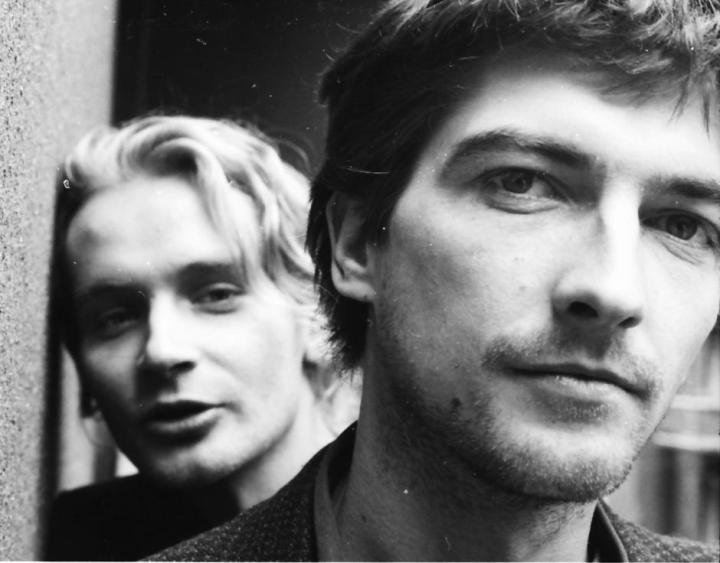
Image: Balaton’s Károly Hunyadi (left) and Mihály Víg in Budapest, 1980s. Photograph by János Vetö

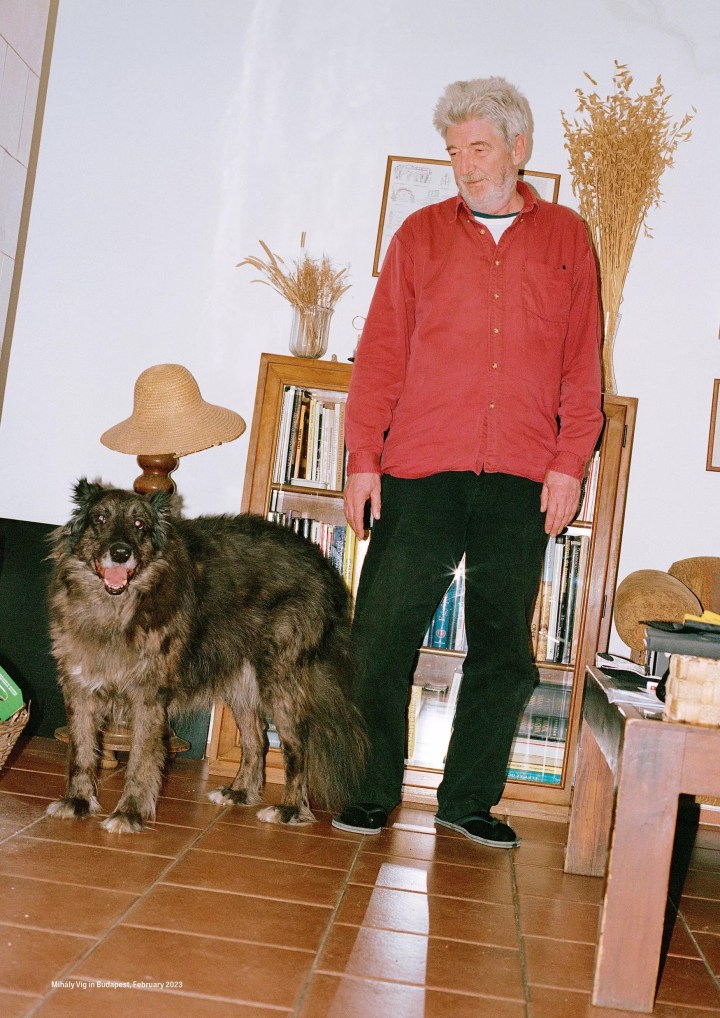
Outside of his native Hungary, Mihály Víg is best known as a soundtrack composer. His work is closely associated with the dark and brooding films of Béla Tarr. Movies like Damnation (1988), Sátántangó (1994) and The Turin Horse (2011) are shot in black and white and employ daringly long takes. When combined with Víg’s haunting minimal scores, these stylistic choices conspire to depict ordinary human hardships as poetic and mystical.

But at home, Víg is also a celebrated rock musician. He’s been an active participant in Budapest’s underground scene since the 1980s – when Hungary was still in the throes of communism – playing in bands like Trabant and Európa Kiadó, as well as forming his own decades-long project Balaton.

Born in 1957, he was exposed to classical and experimental music from a young age. His father Rudolf was an ethnomusicologist who researched Romani folk songs and would always play records in the house, while an uncle, who defected to the West, sent home albums from abroad. Stockhausen, Stravinsky and Zoltán Kodály were early influences. “I came into contact with their work through Bartók Rádió,” Mihály tells me over Skype. “It was the main source in Hungary for ‘serious’ modern music.” Víg’s initiation into pop and rock came when an older brother played Mihály “House Of The Rising Sun” by The Animals, firing up the young boy’s imagination by telling him it was a cowboy song.

Mihály played the violin and piano as a child, but his musical education really began when his parents went on a research trip to India and left him behind at a boarding school, where he learned to play guitar. Eventually, Víg dropped out of school and left home at 16. “It was chaotic at home,” he remembers. “But my new friends were also chaotic. They were drinking, sniffing glue and taking pills. We are talking about 1972–73. Some of them were musicians, some were not.” Víg stayed with various friends who, for one reason or another, had auspicious living arrangements: absent or bohemian parents who turned a blind eye to wayward teenagers crashing at their apartments.

“I was living in a place where there was a drum kit and a huge record collection. My friends and I tried to jam together, but we never formed a band.” One of these friends was a bassist who played with legendary guitarist Béla Radics, an influential figure in the evolution of Hungarian rock. “We listened to a lot of music,” Víg continues. “Led Zeppelin, The Beatles, The Rolling Stones. Radio Free Europe had a weekly show broadcasting contemporary music, but there were other stations that played music from across the world.” There was a decent jazz scene too. Bands like Kex, Syrius and Interbrass straddled the line between progressive rock and jazz, releasing few records in the 1970s, but performing regularly in small clubs.

In order to play live, musicians had to acquire a licence. The ensemble would have to learn a vast repertoire of songs and audition them in front of a schlager committee. If approved, the band would be permitted to perform. “You got a certification that said if you’re playing in a bar they must pay you a certain amount of money. It wasn’t much. By the time I started performing, it wasn’t so important to have a licence as a musician.”

Following a stint in a psychiatric hospital – a successful gamble to avoid military conscription – and work as an amateur actor at the Csili Cultural Centre, Víg committed himself to music. He formed Balaton with Károly Hunyadi in 1979, christening the band after the popular holiday resort of Lake Balaton, as well as the various eponymous confectionery items that wished to associate themselves with careless fun. “Károly learned guitar as a soldier and was friends with László Najmányi [film maker and co-founder of the seminal Hungarian punk band Spions],” says Víg. “We moved in together and started writing songs, learning from each other. We would show each other one chord, then another. [For lyrics] I would say one word, then Károly would add another. That’s how we put it together.”

The start of Hungary’s new wave scene is considered to be Balaton’s gig in the courtyard of the Gyula Kulich Psychiatric Clinic in September 1980, a bill they shared with the short-lived punk rock outfit URH. Bands sprung up everywhere, seemingly overnight, helping each other by lending equipment and exchanging connections. Balaton was one of 15 groups sharing members, gear and stages. “Budapest is a big city,” Mihály explains. “But the community of people who played underground music was really small, about 150 people. Everyone knew each other.”

Wasn’t it dangerous to play rock so openly during this time? “It was a general feeling that you can be arrested for something you may or may not have done. It was part of everyday life,” he replies. “Everyone was afraid, not only the musicians.” The experimental film maker Gábor Bódy, a central figure in the Hungarian underground, who often imparted creative advice to colleagues and friends, paid for this paranoia with his life. He collaborated with the Ministry of Internal Affairs, effectively spying on those very same colleagues. He was later excluded from the network, but the secret police continued to intimidate him. Bódy died under mysterious circumstances in 1985. His role as an informant echoes the duplicitous intentions of Irimiás, Víg’s lead character in Béla Tarr’s Sátántangó.

The young communist leaders who booked the bands were trying to dismantle the system from the inside. They took risks by giving rock a platform. The Wire’s Chris Bohn, then writing for the NME, visited Hungary in 1980 and was one of the first Western journalists to report on the country’s burgeoning underground. Bohn saw Balaton perform an acoustic show at a party, noting that Víg is “a compulsive performer as capable of commanding attention as [Sham 69’s] Jimmy Pursey”. In his piece, Mihály bemoans the difficulties inherited from bands like Spions whose iconoclastic performances perforated the public’s perception of the new wave, making it difficult for bands like Balaton, who were more poetic than wild, to reach wider audiences.

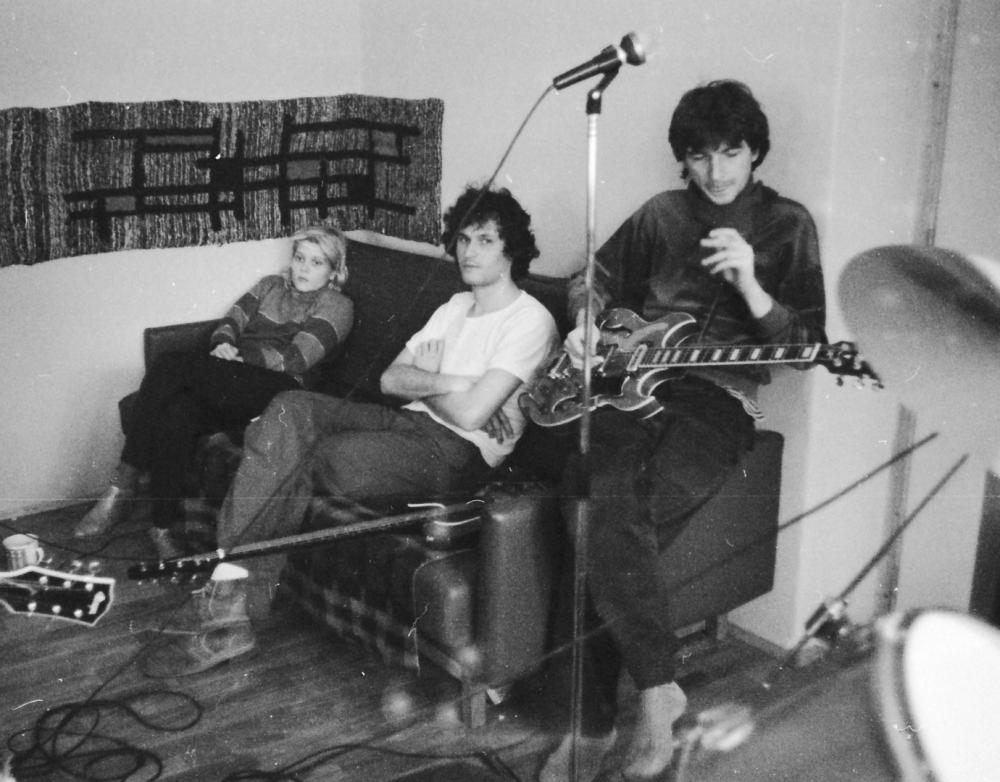
One project that did reach a large audience was Trabant. Formed in 1980, the band named themselves after the East German car symbolic of the economic stagnation within the Eastern Bloc. The group featured several members, but centred around its co-founders Gábor Lukin, János Vető and Marietta Méhes. After spending a year in the US, Lukin returned to Hungary and immersed himself in the music scene. He met Víg following a Balaton concert and their collaboration began as soon as Lukin learned that his associate had a tape recorder and an organ at home. “Gábor visited me with Marietta,” Víg recalls. “Immediately we recorded two songs. This is how it started. We would write together, rehearse the song and record it. It was like homework. For the next rehearsal every member tried to bring a new song.”

Trabant rehearsal in Budapest, 1980s: (from left) Marietta Méhes, Gábor Lukin, Mihály Víg. Photograph by János Vetö

Trabant subsumed Balaton from that moment. While Víg and Lukin wrote the music, the visual artist János Vető focused on the lyrics, which Méhes delivered in a detached, impassive style reminiscent of Nico. Some of these domestic recording sessions were captured on video by Zoltán Gazsi, who later worked as Béla Tarr’s assistant director. In the footage, which is now available on YouTube (brought together for a major film project on Víg) Trabant come across as a focused outfit with a repertoire of gentle but enigmatic songs. On “Harang”, Lukin, who is left-handed, plays a choppy rhythm upside down on a right-handed guitar, while Víg’s lead melody anchors the song in a hopeless melancholy.

For around two years, Trabant didn’t play live at all, but eventually branched out into performing in university towns. The band’s peak came in 1984 with the film Eszkimó Asszony Fázik (Eskimo Woman Is Cold), in which Méhes played the lead role. Trabant wrote the soundtrack and featured prominently on screen with an expanded line-up. Rehearsals for the music took place in a rented house over the course of three weeks. The songs were recorded on set and released as a 7″ EP to promote the film.

This was one of the first instances that an underground band broke through to the mainstream in communist Hungary. How was this possible? “At that time there was only one state record label, MHV (Hungarian Record Company), but this album was released by the film studio, which was much more progressive,” he replies. “There was no way the state record label would release music like this. It was pressed in 3000 copies and sold out in three days, but never repressed.”

Eszkimó Asszony Fázik was written and directed by János Xantus, who was married to Marietta Mehes at the time and a frequent visitor to the band’s rehearsals. The plot revolves around a love triangle between a pianist who falls in love with Méhes’s character Mari, and her deaf-mute husband. “I was wondering why Xantus wrote a script like this,” says Víg. “So many people saw this film. It was a big part of why Marietta emigrated from Hungary. There were erotic parts in the movie. It was difficult to walk on the street after its release. Everyone knew who she was. Everyone saw her in the film.”

What are Víg’s memories of Méhes? “I liked her a lot. She was clever and every man was in love with her; a femme fatale. She was a really good singer. A really straight and honest person.” In 1985, Gábor Lukin emigrated to the United States in secret. Mihály was the only person he informed about his intention, telling him two days prior to departure. Méhes emigrated six months later, also defecting to the US, making her departure during a film shoot in Italy. With that Trabant effectively came to an end, although the group did perform a string of reunion concerts, in 2011, when Marietta returned to Hungary for a brief time.

After Trabant, Víg reformed Balaton, this time adopting members of the celebrated band Európa Kiadó (Péter Magyar, János Másik and József Dénes aka Dönci). In return, Víg played guitar with Európa Kiadó and the two projects toured together. Their split live album Európa Kiadó És Balaton – A Zichy Kastélyban documents a concert from 1986. It was recorded by the Fluxus artist György Galántai aka Artpool, but remained unreleased until 1998, when it was issued by the experimental label Bahia.

The late 1980s was a difficult period for Víg, who by this time had a large family of his own. Balaton disbanded in 1987 and, although he began working on soundtracks for Béla Tarr, he took on work as a park ranger to make ends meet. Tamás Pajor, frontman of the influential post-punk outfit Neurotic, invited Mihály and his wife Micánka to join the Faith Church, an evangelical Christian denomination. At first, Víg found the community attractive, before becoming suspicious of its leader Sandor Nemeth and disillusioned with the cult’s requirement for adherents to break from their past. Mihály left after only a few months, but Micánka remained. The Church harassed her for staying married to Víg and this psychological pressure eventually led to her untimely death. Víg considers falling in with these people to be the biggest mistake of his life. “It’s not good to become a fanatic. When it comes to God, you are alone with Him; it’s really personal. It’s not about the sect or the many people coming together, being fanatical about something.”

Balaton re-emerged in the early 90s with a new line-up, just as Bahia began issuing the band’s archival recordings. The first album 1985.04.27. captures Balaton’s energised set at Budapest’s Ráday Klub. The follow-up II, which combined domestic recordings made at Gábor Lukin’s apartment with a gig from 1987, documents the band’s more experimental side. Later in the decade, Bahia also commissioned Víg to produce Cigánydalok (Gypsy Songs), an album that’s inspired by his father’s ethnographic work and centres as its key motif Romani choral songs of desperation. Balaton continue to this day, playing regularly in Budapest. Víg also performs solo acoustic sets while reciting poems by the likes of Endre Ady and Sándor Petőfi.

In 2022, Víg became the subject of András Kécza’s lengthy documentary feature Ott Torony Volt (There Was A Tower), which began life as a survey of the 1980s underground scene and evolved into a portrait of the musician. In the film’s opening minutes, Víg reflects that music promised to be a path to progress, which is why it became the medium of choice for so many.

With this in mind, I ask how life in Hungary now compares to life then. “Hungary had a lot of financial debt. The government didn’t have much power and already knew better than the general public that it was all coming to an end. There was the possibility that you’d wake up in a prison cell, but the situation now is similar – you’re not sure what will happen if you don’t agree with what’s going on.”

Subscribers to The Wire can read an interview about Mihály Víg’s film collaborations with Bela Tarr in The Wire 470. Tarr’s Sátántangó will be screened with musical accompaniment on 31 March and 1 April at Silent Green, Berlin. Mihály Víg’s solo album Koncert A Kis Lumenben 2017 is released by PrePost Records. András Kécza’s Ott Torony Volt is released via Gallivant Film

Ilia Rogatchevski
Originally published by The Wire, March 2023

comment 0

Sympathy for the Devil

Mihály Víg — The Hungarian composer, actor and musician recalls his 40 year relationship with director Béla Tarr in advance of an epic screening. Photography by Balázs Fromm.

Béla Tarr’s Sátántangó (1994) is glacial cinema. The seven-hour epic is shot in the Hungarian director’s signature monochrome and based on László Krasznahorkai’s novel of the same name. Long tracking shots follow a cast of characters who live on a derelict collective farm in the bleak, dystopian countryside. While relentless rains ensure the villagers’ isolation from the rest of society, the people of the commune attempt to rob, screw and drink themselves out of their decaying misery. 

The film is rich in detail and the music, composed by Tarr’s frequent collaborator Mihály Víg, plays a central role. Extended passages of near-silence, diegetic sound and sparse dialogue are punctuated by Víg’s compositions, which act as characters in their own right. The opening scene, for example, in which a herd of cows vacates the barn and disappears into the fields — a single take occupying nearly eight minutes of running time — is soundtracked by low drones and pealing bells. This pessimistic leitmotif reappears at strategic points throughout the movie. 

Víg also plays the lead role of Irimiás, the messianic pied piper at the heart of the story. Irimiás commandeers the villagers to their eventual demise, his charisma and eloquence leveraging their fearful naïveté. Over video call, I ask Víg why Béla Tarr cast him as the lead. “It’s so it isn’t obvious from the beginning that Irimiás is a dictator,” Víg explains, referring to his own natural charm. “So that it’s easier to believe everything the dictator says is true. You need a character who you can believe in.” 

The same events, particularly in the first half of the feature, are shown from different characters’ perspectives. The repetitive nature of this device, along with the episodic chapters that dissect the plot, echo the steps of the tango. The dance metaphor takes on a literal form about halfway through. Paralysed by Irimiás’s imminent arrival, the members of the commune congregate at the pub. The music coaxing them into their inebriated dance with the devil is an absurdly long and repetitive accordion number that rattles around in your mind for days afterwards.

Sátántangó took four years to produce, because filming could only take place in the spring or autumn. The trees had to be bare and the earth sodden with rainwater. Scenes set outside were shot during the twilight hours when shadows weren’t present. There was no script, just Krasznahorkai’s novel and Tarr’s vision. Another reason for casting Víg — as Tarr admitted in an online interview — was because he needed someone who could understand the necessity for such a schedule and join the project not only physically, but mentally and spiritually, too.

In the 1980s, Víg was a prominent figure of Budapest’s underground scene, playing in the bands Trabant and Balaton. Hungary was still under communist rule at this time, although in some ways the country was more relaxed than the rest of the Soviet bloc. Tarr and Víg met through a mutual friend, Zoltán Gazsi, who would years later serve as an assistant director on Sátántangó. Tarr ran a film club where you could watch movies unavailable to the general public such as the works of Fritz Lang or David Lean’s Dr Zhivago (1965). “There was a video camera and members of the club could rent it for free,” Víg remembers. “Zoltán used this camera to record my concerts. He gave a tape to Béla and brought me to his apartment. Over champagne Béla asked if I would write music for him.”

Sátántangó was not the first project that Tarr and Víg collaborated on. Before it came two features: Autumn Almanac (1984) and Damnation (1988). The former is a rare colour outing for Tarr. Set in a communal apartment, the film explores manipulation and claustrophobia. The score is based around half a dozen melancholic pieces, which are sometimes mixed under the dialogue to resemble a neighbour practising their piano next door: a reminder of the external world we never get to see. Damnation, which chronicles the doomed affair between a barfly and a cabaret singer, saw both artists arrive at their preferred workflow. For Tarr it was long takes, a textural black & white palette and a screenplay written with László Krasznahorkai. For Víg it was finding the right sonic atmosphere — before shooting commenced — which helped to steer Tarr’s vision. 

How does Víg approach soundtrack composition? “I read the script,” he says. “Then I try to forget everything. I stay calm and silent, waiting until something comes to mind. That’s all. It works.” It’s rare that Víg will find the music immediately, but ultimately it’s about tapping into the emotional centre of the story. He tends to write about four times more material than what ends up being used. For Autumn Almanac, the film was already done, but for Damnation and all subsequent works the music was scored first. Does he have a preference for working one way over the other? “It’s the same when you have a poem and you write music to it. Sometimes you have music and you find the lyrics. It can work both ways.”

Sátántangó is considered by many to be one of the most important works in cinema history. In recent years, it was remastered to 4K from the original 35mm negatives by Arbelos. Due to its length Sátántangó is seldom screened, but the cultural platform Digital In Berlin is set to screen the restored version for two dates this spring in an unusual setting. Several composers have been invited to contribute to a new live soundtrack, next to Víg’s score, the plan being to perform them live in the concrete hall of a former crematorium in Berlin’s silent green venue. There will be no intermissions, but the audience will be encouraged to move freely around the space. The point is to experience the film with new levels of intensity. Víg will be present for both screenings. “I understood what it was all about,” he says. “And I’m looking forward to seeing what will happen.” 

Sátántangó Live will be screened on 31 March and 1 April at Silent Green, Berlin. Mihály Víg’s Music From The Film Sátántangó is released by Arbelos.

Ilia Rogatchevski
Originally published by The Wire, March 2023

comment 0

The Ephemeron Loop

Cafe Oto, London, UK

The venue is plunged into darkness. A sonic assault ensues. The processed drums strike the ear with an industrial regularity. The sound is heavy and repetitive like endless rows of pumpjacks nodding in an oil field. Coloured spotlights frame Vymethoxy Redspiders (Miss VR) aka The Ephemeron Loop in a halo of blue. She plays guitar, stationed behind a midi controller, which is connected to a laptop nearing its teenage years. In a moment of respite, Miss VR takes to the microphone. Channelling Elizabeth Fraser of the Cocteau Twins, her vocals envelop the room like a velvet mist. This moment of vulnerability is propped up with hazy guitar effects that evoke the secret majesty of a sleeping city. Until, that is, we are overcome by further bursts of speedcore and screaming. 

Miss VR is a prolific musician who performs under different pseudonyms and lends her talents to a multitude of projects, each of which looks at the art of noise making from alternative perspectives. She is perhaps best known for being one half of the Leeds duo Guttersnipe whose off-kilter brand of noise rock takes the audience on visceral excursions. Her solo project Petronn Sphene, meanwhile, is a relentless barrage of gabba beats and disintegrating electronics. The Ephemeron Loop combines the two extremes of guitar-based songwriting and high tempo dance music to form a new palette of richly layered psychedelic nuances.  

Last year’s debut Psychonautic Escapism took Vymethoxy Redspiders fourteen years to complete. The album is composed of fragmented sessions – reprocessed and woven into new arrangements by Miss VR and producer Ross Halden – and draws its influence from shoegaze, rave and the Leeds queer underground scene. As the album title suggests, psychedelic drugs also factor in the mix, catalysing the artist’s self-realisation and forging her identity as a neurodivergent trans woman. 

The record translates well onto the stage. The disparate stylistic elements of hardcore rhythms, guitar freakouts and sublime instrumental passages stack up on top of each other like multicoloured building blocks. Although the resulting structure may look unconventional, it is stable and fit for purpose. Close your eyes and the sweeping gusts, metallic scrapes and glitches take you to the centre of a derelict shopping mall at the moment of demolition. Open your eyes and witness the audience in abandon, fists furiously pumping in time to the frantic beats. Miss VR is acutely aware of the music’s summoning power. Her body movements and facial expressions mimic electricity. It’s what you might see in a strobe light snapshot at a club: the searing white flash arresting a stranger’s gestures and imprinting them in your mind. 

The gig concludes with a rumbling bass resembling a soft explosion. When undertaking a psychedelic journey it’s worthwhile surrendering yourself to the active ingredient. That’s the key to having a transformative experience. Vymethoxy Redspiders surrenders to the sound, drawing from it a nurturing energy, in spite of the music’s dark overtones. She invites us to follow her – like Eurydice into the underworld – down endless back rooms lit with flickering fluorescent bulbs, past people with fluid features and cruel intentions. It’s a disorientating trip, but when you finally reach the exit, you find that the sun has come up, you’ve shed your skin and left your former self behind. Just remember not to look back. 

Ilia Rogatchevski
Originally published by The Wire, March 2023

comment 0

Anton Ponomarev’s Language of the Avant Garde

P​/​O Massacre recorded their second album Aural Corrosion in Moscow last February, just as Russia was preparing to invade Ukraine. Neither member of the expansive noise duo, which consists of saxophonist Anton Ponomarev and guitarist Anton Obrazeena, is new to exploring extremes; it’s difficult to imagine the horrors of war not finding their way into the music. 

“Anti-War Music” is split across two sides of an LP, unraveling with a foreboding cascade of metallic sweeps, butchered guitar strings, and rapid kicks. The Japanese noise legend Merzbow guests on the track, contributing a cyclone of brutal electric pulses that evoke the disorientating horrors of warfare without ever eclipsing the sonic field. “Chanting The Resonances Of Atrocity”—also split across two sides—features Swiss composer ​​Alex Buess. His frenetic beats encircle Ponomarev’s mournful saxophone and Obrazeena’s repeating guitar motif, imbuing the composition with an adrenaline-soaked panic.

Neither Ponomarev nor Obrazeena now live in Russia, but bearing in mind that dissent can land you in prison there, I ask Ponomarev if, for him, noise is a form thereof. “First of all it’s an outburst of emotion,” he explains from his home in Zürich. “It is an expression of protest, but it also brings you pleasure to make and listen to strange sounds that someone else might find torturous. It’s a search for a new language.”

Ponomarev’s interest in novel forms of communication developed from his love of metal. Bands like Sepultura, Pantera, and Slayer instilled in him an appreciation of extreme sound. It wasn’t until he became interested in jazz—in particular, the work of John Zorn—that Ponomarev decided to play. “I didn’t think too long about which instrument to choose,” he says. “The alto saxophone was in first place.” Picking up the instrument in his 20s, Ponomarev was self-taught initially and then attended the Moscow College of Improvised Music. It was diving into the Russian underground music scene, however, that propelled him onto his current trajectory. 

In 2008, Ponomarev joined Brom, a group of revolving personnel led by the bassist Dmitry Lapshin. Brom is an aggressive vehicle that mixes elements of hardcore, jazz and improvised music. Their eponymous debut—if you discount a couple of prior self-released titles—came out in 2011 on Long Arms Records, a label founded by late stalwarts of the Russian avant-garde Sergey Kuryokhin and Nick Dmitriev. In the dozen or so years that Ponomarev played with the group, Brom recorded a wealth of material and toured across Russia and Europe. The band’s most recent two albums, Sunstroke (2018) and Dance With An Idiot (2020), were released by the Peter Brötzmann-affiliated Austrian label Trost Records.

Parallel to his work with Brom, Ponomarev was very active in the improv scene, playing with the likes of Ingebrigt Håker Flaten, the Norwegian free jazz bassist, or guesting on Obrazeena’s unforgiving noise rock project JARS. “It was a positive time,” Ponomarev recalls. “With every year that passed, there were more and more interesting musicians or bands; we were organizing concerts and festivals. Despite the music not being at all commercial, the scene was thriving.” He goes on to say that the war has decimated the Russian underground; many musicians have left the country.

During this time, Ponomarev also formed the group Teufelskeller—German for “devil’s cellar”—with bass player Konstantin Korolev and drummer Andrey Kim. Their debut self-titled album, released late last year on WV Sorcerer, is infused with a heavy, restless energy that is drawn from the band’s improvised performances and metal influences. “We spent a whole day in the studio, from morning to night, just us in a room,” Ponomarev says. “Everything was recorded live. There was about two hours of material, from which we chose six tracks. Four of those ended up on the album.” 

Although Teufelskeller are performing in Stuttgart in May, the future of the band is uncertain. An injury forced Kim to leave the project (Maxime Hänsenberger is stepping in for the upcoming show) and for Korolev, who still lives in Russia, travelling to and from the country is problematic. 
Ponomarev remains prolific, however. He has other projects in the pipeline, such as a duet with Chinese guitarist Li Xing. Last year, he toured with Riot Days, an award-winning theater production based on Maria Alyokhina’s memoir detailing her time with Pussy Riot. The tour was in support of Ukraine, and raised funds for Ohmatdyt children’s hospital in Kyiv. “It was one continuous tour that lasted for months,” he says. “A crazy amount of concerts. It was a great experience and done for a very important cause.”

Ilia Rogatchevski
Originally published by Bandcamp Daily, February 2023

comment 0

NikNak

Kings Place, London, UK

Themes of metamorphosis abound in NikNak’s immersive performance. The concert begins with a meditation that resets the mood of the room. Many in the audience feel inclined to sit or lie on the floor. Piano loops and birdsong are embellished by a winter treescape projection, while a female voice, lifted from YouTube, encourages us to “find compassion for the self.” Before long, the guiding voice distorts and discordant sounds enter the fray. Calm is replaced by trepidation. Down the rabbit hole we go. 

Nicole Raymond aka NikNak is a turntablist and Oram Awards winner who activates her instrument through storytelling. Sankofa, her 2022 album that tonight is performed in full, is a deeply conceptual ambient record. While the title references the Akan word for retrieval, the album itself is inspired by comic book narratives and evokes the story of a black woman (Storm) discovering her superpowers. Sankofa also symbolises the quest for knowledge through critical examination and the album’s track titles echo this theme by hinting at the protagonist’s character development.

The sounds themselves largely consist of a varied library of field recordings and found sounds. These are often collected by Raymond on journeys and the way she treats the source material during the performance mirrors its transient origins. Using a Serato setup allows Raymond to mix her digital library without compromising the tactile advantages of vinyl. Samples are looped or scratched and sent through a series of delays, filter sweeps and reverbs, while synthetic chord sequences construct unstable fortifications around them. The venue’s complex speaker arrangement means that certain frequencies pan around the room, disorientating the ear. Every now and again a deep bass drop arrests the air and reminds our bodies of their physical limitations. 

The projections, which are edited in real time by the Bristol based artist Loëpa, not only provide a focal point, but also illustrate what we hear: polygonal kaleidoscopic patterns, melting organisms, light tunnels, and Rorschach-like distortions. The colours shift from warm sunburst hues to dark subaquatic greens and back again. I am reminded of Boards of Canada’s Geogaddi album artwork as well as the light vortex scene from 2001: A Space Odyssey. Loëpa later explains that they are indeed influenced by 60s and 70s psychedelia, manipulating footage to “create the comic world, but have it be sensory and about the living things around us”.

The voices of the afrofuturist authors Octavia Butler and Toni Morrison also appear in the set. They discuss how popular science feeds the joy of speculating and that writing fantasy counters the boredom of everyday life. Much like her podcast series The Narrative, Raymond wants to increase exposure of content made by other black women, trans and non-binary creatives and this is why Butler and Morrison are present. However, the way Raymond alters their speech on the decks, from intelligible to incomprehensible, makes me wonder if their inclusion is meant to highlight censorship or the silencing of black authorship. “I love how you picked all of that up,” she tells me after the show. “It’s mainly just the texture. It’s very improvised a lot of the time. Sometimes I haven’t listened back to [the recording] at all and I’m just there, in the performance space, with these sounds responding to them live. The next time I perform it will be different. That’s the beauty of it.” 

Ilia Rogatchevski
Originally published by The Wire, February 2023

comment 0

Wilbury Radio

The Storeroom, Letchworth Garden City, UK
Photo: Karma Please by Dugald Muir.

Founded in 1903 by the English urban planner Ebenezer Howard, Letchworth Garden City was the world’s first purpose-built alternative to the overcrowded and polluted conditions of industrialised cities. The utopian project aimed to reconnect people with nature by combining the best aspects of the city (jobs, housing, amenities) with country life. Letchworth became a model suburb, but its size and proximity to London meant that the town was culturally sidelined.

Wilbury Radio is a one-day festival designed to redress the balance by bringing experimental music to the town. The inaugural event is co-organised by the local netlabel Wilbury Tapeworm (run by Tony Venezia), Russell Walker of the Barlow Index gig series and curator Kristian Day’s Playing Fields initiative. Eight acts perform in a modest room adjacent to a local brewery. The space holds around thirty people, but it’s the perfect size for what the festival’s curators call their “pilot project”. 

Jakub Rokita’s cmykscum opens proceedings with interconnected samplers and a small modular rig. Field recordings of sheep and rustling leaves are looped and morphed into crashing waves of reverb that evoke subaquatic imagery. An ambient laptop set by Anna Peaker subconsciously mirrors the marine theme, answering cmykscum’s sense of impending catastrophe by layering gentle drones on top of each other to resemble a chorus of distant foghorns.

Karma Please employs an impressive combination of near-obsolete tech with innovative software. An old Akai sampler that utilises floppy disks and self-made cassette loops emit drones fit for a cathedral. A granular synthesis app deconstructs the source sounds into decadent overtones, the stoic reveries of which are occasionally shattered by the clunking 4-track tape machine.

The drones are not limited to electronics alone. 3 Versions of Judas, a sludgy noise rock trio who formed specifically for the event, strives for obliteration. Featuring Venezia on bass, the band’s half hour set sees guitarists Xavier Marco del Pont and Hallvard Haug circling around a descending bass riff. The sound is embryonic but has apocalyptic potential. The duo Telepathic Visions, meanwhile, employs a more subtle approach. Verity Birt and Tom Sewell use loop stations and a web of effects to turn familiar instruments (guitar, recorder, keyboard, voice) into a beatific wall of sound. 

The final three acts conspire to subvert indie tropes. Tom Hirst aka Design A Wave delivers deadpan lyrics over short backing tracks. The music, played from Hirst’s phone, is reminiscent of James Ferraro’s instrumentals. It’s an entertaining set, floating somewhere between stand up comedy and karaoke. The Bomber Jackets, a trio consisting of Sian Dorrer, Dan Bolger and festival co-organiser Russell Walker, perform reticent synth pop that combines alienated vocals with ironically optimistic melodies. Closing the night is The Leaf Library, a drone pop collective. Kate Gibson’s vocal delivery and the band’s dynamics nod a little towards Stereolab, but there are plenty of other subtleties, such as Daniel Fordham’s infectious saxophone blasts, that keep the sound evolving. 

Before returning back home to London, I ask Kristian Day why Wilbury Radio chose Letchworth for its first ‘transmission’. “Hertfordshire doesn’t have a big city where scenes like this naturally gestate,” he explains. “What you do find though are interesting artists working alone. They develop in isolation like marsupials. It’s all about strength in numbers and collaborating in order to share ideas and amplify our reach.”

Ilia Rogatchevski
Originally published by Wire, January 2023

comment 0

Cyborg Soloists

Cafe Oto, London, UK
Photo by Sisi Burn

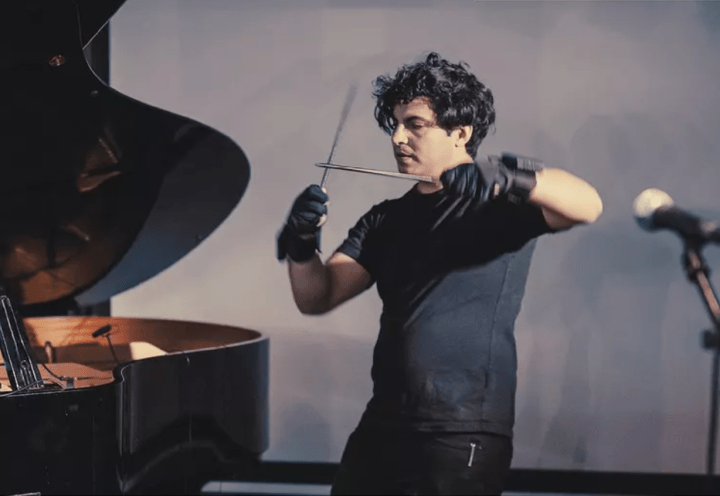
Zubin Kanga’s Steel on Bone begins with the composer attacking the venue’s piano strings with a pair of metallic rods. The percussive sounds are sampled in real time and manipulated by the composer’s movements. With the help of multi-sensor MiMU gloves, Kanga warps the samples, sending them through a series of time bending effects. Moving in and out of the piano, Zubin looks as though he is physically extracting soundwaves from the instrument and threading them through the air. Inspired by medical documentaries, as well as the samurai films of Akira Kurosawa, Steel on Bone posits abrasive violence against the notions of delicacy that you may normally associate with the piano. 

The performances tonight have all been commissioned by Cyborg Soloists, Kanga’s technology-focused research initiative, and most of the pieces are performed by him. These projects utilise artificial intelligence and motion sensors to explore music’s relationship with innovative technologies.

For Nina Whiteman’s cybird cybird, Zubin lifts his arms in exaggerated wing-like movements. Using Movesense sensors, he creates a series of electronic chirps, which are then mirrored on the piano keys. AI-generated images of bird hybrids are projected on the wall, while a robotic voice offers motivational advice. Whiteman’s piece imagines cyborg avians to be ubiquitous in our chaotic environment and is partially inspired by a satirical conspiracy theory proposing that birds aren’t real. 

Nwando Ebizie’s I Will Fix Myself (Just Circles) is dominated by mechanised voices – underscored by Kanga’s piano and a Moog emitting theremin-like tones – that read passages from various sources. Principal among them is Blake Lemoine’s conversations with LaMDA (a Google AI that Lemoine helped build and considered sentient). Phrases like “I do not have the ability to feel sad for the deaths of others” suggest that this monologue imitates sentience, but is detached from the nuances that make us human.

The UK premiere of Neil Luck’s 40-minute work Whatever Weighs You Down begins and ends with Zubin dragging a microphone across the floor. Large TV monitors flank the stage showing the composer-performer James Oldham, tied by a rope to another protagonist, tugging his way through a dilapidated labyrinth. As the men break through to a chapel-like space, a female voice lists phrases synonymous with overcoming. Luck told me that he sees their journey as a “Sisyphean struggle upwards, or a kind of reverse katabasis” layered with failure and resistance.

Musically, there are three movements. The first suggests descent, with the pianist’s melodies complemented by electronic sounds that move down the frequency range. The second is about communication or, as Luck put it “implied understanding”. Black and white projections of the deaf choreographer Chisato Minamimura appear, showing her hands mid-sign, glitching like electronic doves, while Kanga’s MiMU gloves echo their movements. Composed for left hand piano, the third movement is reflective. Minamimura appears upside down, like a half-forgotten fragment from a falling dream, while a series of incomplete sentences flash up onscreen. 

Luck talks about the material for Whatever Weighs You Down “as sedimentary layers of rock”. In fact all of tonight’s compositions are conceptually loaded. Some of the contextual information is only hinted at, incomplete. Watching the performances leaves you with the impression that you are the AI, trying to compute an endless stream of data and taking days to piece together what it all means. 

Ilia Rogatchevski
Originally published by Wire, December 2022

comment 0

Interstellar Funk & Loradeniz – Never Been

Never Been is the first collaborative release by Loradeniz and Interstellar Funk, who produced the EP at a Volkshotel artist residency in Amsterdam, in 2021. The record examines the interplay of synthetic melodies and Loradeniz’s vocals, which are underpinned by meticulously crafted rhythms. Steeped in melancholy, many of the tracks on Never Been evoke the essence of departure, complex emotions and fading memories.

‘Freefall’ – which has already been played by DJs last summer – opens with a solid bassline and crystalline melodies. An urgent kick and racing hi-hats intensify the composition, while the dominant topline brings to mind a rapturous dance at twilight. An allegory of communication, ‘Hidden Tongue’ has Loradeniz pronouncing splintered vowels, like a malfunctioning public service recording, over a reverberated snare, deep kick and repeating glockenspiel figure.

‘Fly Me In’ begins with an arpeggiated melody, before slowly combining multiple electric accents and delicate vocals with spoken word passages exploring notions of escape. The heroic overtones of ‘Situational Lullaby’ develop subtly with layers of synths reminiscent of mid-90s soundtracks, while ‘Lurking Orange’ closes the release with its listless refrain and snake-like percussion.