Bluecoat, Liverpool, UK
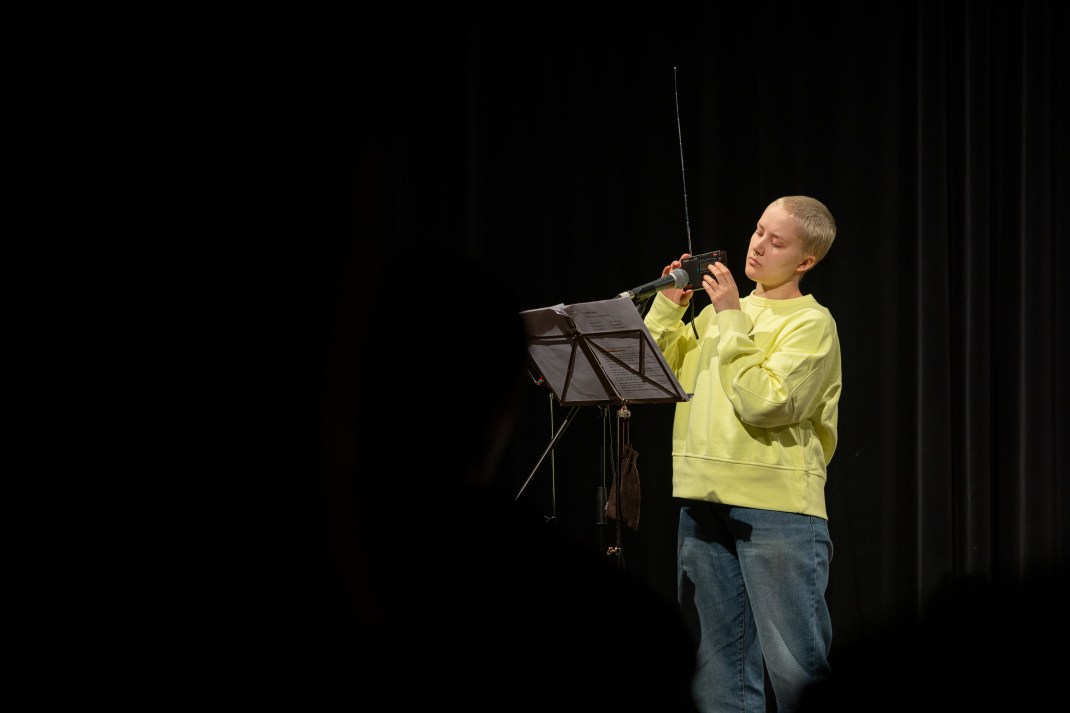
Photo: Lucy Enderby by Benjamin Nuttal
Commissioned by the disability charity We Are Unlimited and the Liverpool Biennial, Roy Claire Potter’s COMMS FAIL is a multifaceted work that foregrounds radio not only as a medium for transmission but as a metaphor for communication breakdown. The hybrid piece is designed to evolve over time but in this iteration it’s a radio play performed in front of an audience and simultaneously broadcast on Resonance FM.
Bluecoat’s utilitarian performance space is a blank slate for Potter’s minimalist staging. Joining Potter are the actors Lucy Enderby and Alex Symington. Standing in a triangular formation, the three figures echo corners of a quad antenna used by amateur radio enthusiasts. As the audience enters, ushers guide attendees to their seats and hand out miniature bells attached to biros, which are later activated in unison to simulate radio interference.
Inclusivity is central to the piece, with a British Sign Language interpreter, televised captions and an audio describer present for the benefit of remote listeners and disabled audience members. Typically cast to the periphery of media – if considered at all – these inclusive elements are deliberately brought to the forefront here. In addition to providing paratextual weight to Potter’s script they are also, to reclaim the social media pejorative, performative in the sense that they underscore how often people with neurodivergence and disabilities are underserved in such contexts.
The actors and audience mill under the red wash of the stage lights while a repeating chord sequence, peppered with trepidatious hi-hats, plays over the speakers. Composed by Carmel Smickersgill, the music is based on prompts given by people with lived experience of autism. The composition later leans into bass frequencies that imitate electromagnetic waves and searing synths that scan across the spectrum: from Red (overstimulation) and Blue (miscommunication), to Purple, where the previous two modes combine and build in anticipation of reciprocal information exchange.
The script underpinning the narrative is fractured, dancing around an obfuscated problem. The “botanical shapes” of solar flares, alluded to in Potter’s opening monologue, precipitate technological collapse. The flares disable “satellites, doorbells, fridge-freezers” and, as the energy of the sun diminishes, humans hear the “final signals” of their failing phones “transmit in the dark”. Ham radio, however, survives and offers an alternative peer to peer transmission network.
The three actors display contrasting motivations. Enderby appears ambivalent about the unfolding changes, while Symington is enthusiastic. Potter’s delivery is typically anxious with overtones of distress lingering between the syllables – phrases repeated; words disassembled.
Certain moments in the text are punctuated by the actors playing transistor radios (extending the aerials, cycling between stations and experimenting with mic proximity) and the ushers holding up plastic sheets illustrated with curvilinear abstractions. While the faint rustling of the latter props mimic sferics bouncing off the Earth’s magnetosphere, the transistor static conveys a sense of emptiness that supersedes the vacated radio bands.
After the cardinal climax of surging percussion and crosstalk, listeners are implored to “make an alliance” to “shape a silence” and embrace “holy moments of perfect clarity”. With McLuhan-like zeal, Potter argues for inventing “the message at the same time as the language”, reducing the distance between people and returning to more corporeal forms of communication. More than moralistic technophobia, COMMS FAIL asks us to reflect on the media we use to communicate and the impact on what is being said.
Ilia Rogatchevski
Originally published by The Wire, June 2026

