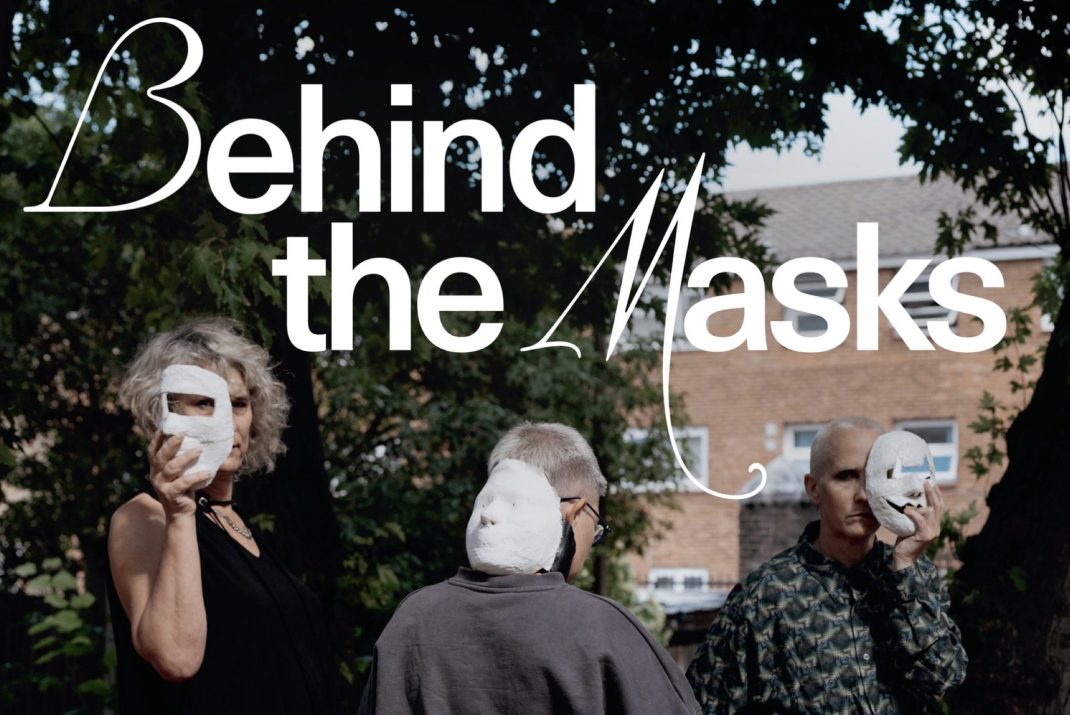
In a new work referencing 9/11, London’s performance art trio mix Burroughsian cut-ups with absurdist clowning to find the truth. Photography by Amy D’Agorne.
Inside the concrete confines of South London performance space Iklectik stand two vertical screens displaying the colossal carnage of the 2001 9/11 attacks in New York. In front of them, on a riser marked 4WTC (a reference to the Southeast Plaza Building of the World Trade Center complex), sits one third of the surrealist trio Tears|Ov. Terces Wale wears an oversized cardboard head. Its grotesque smile is cast downward, beady eyes scanning the room. Evil gabber kicks, elastic drones and sinister toplines escape from a fleet of samplers and black boxes commandeered by accomplices Lori E Allen and Lottie Lou Poulet.
Casting off the mask, Wale paces between the crowd monologuing about “the bully who was bullied by their bully”, thrashing on the floor with a bass guitar and throwing stacks of Monopoly money into the air. While the banal poetics of appropriated material inform the group’s sonic playbook, and the clandestine gifts of the Burroughs-Gysin cut-up process lend themselves to the text, dada underpins their performance. Wearing a suit and a shaved hairstyle, Wale comes across as a metamodern Claude Cahun. “I have an alter ego called Boobies the Clown,” Wale says on a group video call. “In my performances, you’re seeing a different iteration of that character. There are lots of themes that oscillate around the performance. I wanted to reflect on Ol’ Dirty Bastard’s vibes and the French highwire artist [Philippe Petit] who walked between the [WTC’s] Twin Towers [in 1974].”
Tears|Ov launched their latest record A Life On Hold on the 25th anniversary of 9/11. Tracks such as “Probably, I”, with its battery acid beats shuffling along like Dead Cities-era Future Sound Of London, or the synthetic standing bells detuning throughout “Simple Things/Formation For Now”, evoke millennial dread. The group have personal connections to the terrorist attacks, too. “I lived in New York and Terces lived in London,” says Allen, who was working nearby and saw both towers collapse. “I was worried about voyeurising it, about it being passé, but 9/11 made way for Palantir, ICE, the surveillance state in the US. It’s still really relevant. Working with Wrench [Gooding] on the visuals, we had a tête-à-tête about including the jumpers and impact images. I felt we had to honour the terrible beauty of it. I didn’t want to say it outright but wanted the needlessness of it to come through.”
On the day the towers fell, Allen managed to phone Wale to reassure them she was safe. “It helped me commit to Lori in a way that I hadn’t done in other relationships,” Wale admits. “I really could have lost someone I loved. It had a huge extrasensual effect on me. And here we are, still together.”
Reuniting in London in 2002, Wale and Allen cycled through various collaborations before settling on Tears|Ov. There was FØL, a “masturbatory” psych band also featuring Terminal Cheesecake’s Gordon Watson. Then came the shortlived folk project Serious Hardened Swingers, in which, Wale says, they were “noodling with poetry”. Arguably, meeting Tapeworm/ Wormhole label founder Philip Marshall over a decade ago sent Tears|Ov on their current trajectory. “I first met Lori and Terces at a party for Wolfgang Tillmans, at a Berlin bar,” Marshall reveals via email. “I liked their humour a dry sass – and that truly queer otherness, and playful horror, that’s unlike any other.”
Their first tape, 2016’s Tears Of The Material Vulture, is credited to Lori E Allen despite contributions from Wale and the cellist Katie Spafford, who continued collaborating with the band until 2021’s Pluto’s Return. “There was a bit of a drama around that [first] one,” Allen recalls. “I was commissioned to do it. We then played at the Tate Modern [as part of Tillmans’s 2017 South Tank installation] and they wanted it to just be Lori E Allen. We thought it was an art world thing.”
Conceptually, Tears Of The Material Vulture straddles similar themes to what Tears|Ov are currently exploring. Much like the endless labyrinths of Kane Parsons’s Backrooms, the 80 minute running time suggests you’re stuck in an eternal loop. The title plays on the phrase material culture, pointing towards Allen’s former career as an archaeologist and her obsession with examining what she calls “bodiless artefacts” exhumed from the dustiest corners of YouTube. The album’s foundations derive from samples of Madame Chaos, a NYC public access cable TV show that Allen worked on in the mid-90s. Informed by hiphop sample culture, the way the programme took the offal from an oversaturated media hellscape (spiralling edits of cartoons, B movies and commercials soundtracked by clipping breakbeats), foreshadowed the hyperactive visuals of the TikTok-era internet.
By contrast, the group’s debut proper A Hopeless Place (2019) comes over like a lucid dream marinated in mild panic, even as it overflows with non sequiturs from cringeworthy family gameshows. “That album was about unrequited love,” says Allen. “That’s where we started styling ourselves as ‘experimental pathos’. There are some good numbers on there, though.”
Indeed, among the album’s many good numbers, “Trapdoor Ant” and “I Stand On The Cable” are infused with a paranoid energy. In the former, a wet house beat and jerking metal percussion frame Wale’s evocation of a “trapdoor wiped clean with bodily juices” and, in the murky atmosphere of the latter, Spafford’s cello pirouettes around an Alan Watts lecture, recalling the jazz noir of Angelo Badalamenti’s “Silencio”.
Evolving from the Tate performance, the record reveals itself like a time capsule of half-forgotten mementos, or the “Pandora’s box” referenced in the closing title track that spills horrors into the world and leaves hope sealed firmly inside. The follow-up, Pluto’s Return, was a response to the uncertain chaos of the Covid-19 pandemic. Framed through an astrological reading of the dwarf planet’s influence on terrestrial events, it provided, according to Allen, “all the evidence we needed that capitalism doesn’t have a pause button”. The record echoes newer material, too, namely an unreleased Sound UK commission, and “AWOL”, which appears on A Life On Hold. Wale, who works as an addiction therapist in the prison system, elaborates: “I read this book called We’re All Doing Time [by Bo Lozoff of the Prison-Ashram Project], which is about how we’re all doing time in the prisons of our minds. It’s a wonderful role reversal of what it is to be human.”
Although initially inspired by the circular bureaucracy of customer service (see the frenetically edited automated replies on “P/R/o/t/L” or the snide “We’re Sorry”), A Life On Hold surreptitiously mirrors momentous life events: Wale and Allen cementing their love in the wake of 9/11, for example. Poulet, whose credits include engineering live sets for Liars, Throbbing Gristle and 808 State, as well as producing Test Dept’s Disturbance (2019), joined Tears|Ov when mixing A Life On Hold three years ago. “We finished mixing the album at Wysing Arts Centre,” recalls Poulet. “When I drove them back to the station, because I did some vocals [on “Narrow Valley”], they asked me if I wanted to be in the band. I kind of went: I don’t know. I don’t normally do bands!”
Despite misgivings, the collaboration proved fruitful. “Meeting these two,” says Poulet, “reopened me to poetry. I fell in love with the text and it still inspires ideas. The archeology we were talking about earlier makes me want to work for the future.”
For Allen, this approach goes back to childhood, hearing her parents’ voices overlapping with the TV next door and the storybook tapes, recorded by her mother, worn down by continuous playback. On the other hand, Wale’s eyes are fixed on the stars: “I’ve been really getting into Philip K Dick and feel that poetry, especially when you use chaos magick or cut-up processes, comes from aliens or a spiritual entity. It’s a collaborative process with the universe.”
Tears/Ov’s A Life On Hold is released by The Wormhole
Originally published by The Wire, October 2026

